
Personal Horoscope
Brad Pitt Birth Chart
Born Wednesday, December 18, 196306:31:00 (timezone = GMT -6 hours)
96w56, 35n20
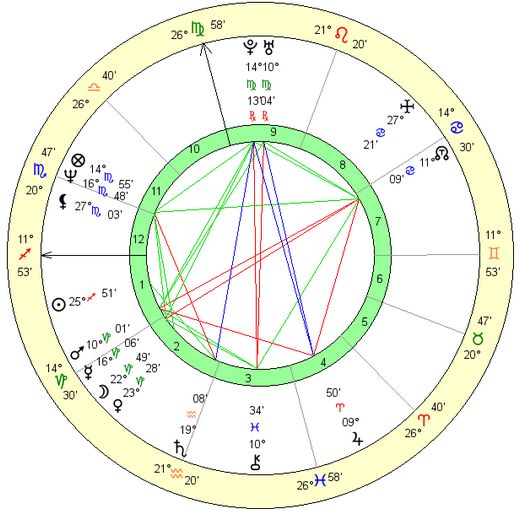
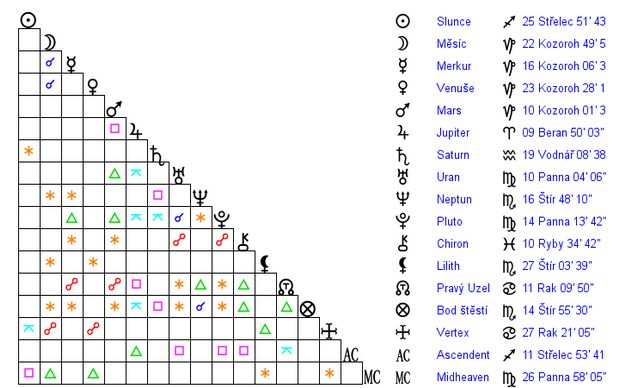
| Planet | Longitude | House | |
| Sun | 25 Sagittarius 51' 43" | 1 | |
| Moon | 22 Capricorn 49' 54" | 2 | |
| Mercury | 16 Capricorn 06' 33" | 2 | |
| Venus | 23 Capricorn 28' 12" | 2 | |
| Mars | 10 Capricorn 01' 36" | 1 | |
| Jupiter | 09 Aries 50' 03" | 4 | |
| Saturn | 19 Aquarius 08' 38" | 2 | |
| Uranus | 10 Virgo 04' 06" R | 9 | |
| Neptune | 16 Scorpio 48' 10" | 11 | |
| Pluto | 14 Virgo 13' 42" R | 9 | |
| Chiron | 10 Pisces 34' 42" | 3 | |
| Lilith | 27 Scorpio 03' 39" | 12 | |
| True Node | 11 Cancer 09' 50" | 7 | |
| Part of Fortune | 14 Scorpio 55' 30" | 11 | |
| Vertex | 27 Cancer 21' 05" | 8 | |
| House | Longitude | ||
| Ascendant | 11 Sagittarius 53' 41" | ||
| House 2 | 14 Capricorn 30' 07" | ||
| House 3 | 21 Aquarius 20' 32" | ||
| House 4 | 26 Pisces 58' 05" | ||
| House 5 | 26 Aries 40' 55" | ||
| House 6 | 20 Taurus 47' 56" | ||
| House 7 | 11 Gemini 53' 41" | ||
| House 8 | 14 Cancer 30' 07" | ||
| House 9 | 21 Leo 20' 32" | ||
| MC (Midheaven) | 26 Virgo 58' 05" | ||
| House 11 | 26 Libra 40' 55" | ||
| House 12 | 20 Scorpio 47' 56" |
| Planet | Aspect | Planet | Orb |
| Sun | Sextile | Saturn | 6.72 |
| Sun | Quincunx | Vertex | 1.49 |
| Sun | Square | Midheaven | 1.11 |
| Moon | Conjunction | Mercury | 6.72 |
| Moon | Conjunction | Venus | 0.64 |
| Moon | Sextile | Neptune | 6.03 |
| Moon | Trine | Midheaven | 4.14 |
| Mercury | Conjunction | Moon | 6.72 |
| Mercury | Sextile | Neptune | 0.69 |
| Mercury | Trine | Pluto | 1.88 |
| Mercury | Sextile | Chiron | 5.53 |
| Mercury | Sextile | Part of Fortune | 1.18 |
| Venus | Conjunction | Moon | 0.64 |
| Venus | Trine | Midheaven | 3.50 |
| Mars | Square | Jupiter | 0.19 |
| Mars | Trine | Uranus | 0.04 |
| Mars | Trine | Pluto | 4.20 |
| Mars | Sextile | Chiron | 0.55 |
| Mars | Opposition | True Node | 1.14 |
| Jupiter | Square | Mars | 0.19 |
| Jupiter | Quincunx | Uranus | 0.23 |
| Jupiter | Quincunx | Pluto | 4.39 |
| Jupiter | Square | True Node | 1.33 |
| Jupiter | Trine | Ascendant | 2.06 |
| Saturn | Sextile | Sun | 6.72 |
| Saturn | Square | Neptune | 2.34 |
| Saturn | Quincunx | Pluto | 4.92 |
| Uranus | Trine | Mars | 0.04 |
| Uranus | Quincunx | Jupiter | 0.23 |
| Uranus | Conjunction | Pluto | 4.16 |
| Uranus | Opposition | Chiron | 0.51 |
| Uranus | Sextile | True Node | 1.10 |
| Uranus | Square | Ascendant | 1.83 |
| Neptune | Sextile | Moon | 6.03 |
| Neptune | Sextile | Mercury | 0.69 |
| Neptune | Square | Saturn | 2.34 |
| Neptune | Sextile | Pluto | 2.57 |
| Neptune | Conjunction | Part of Fortune | 1.88 |
| Pluto | Trine | Mercury | 1.88 |
| Pluto | Trine | Mars | 4.20 |
| Pluto | Quincunx | Jupiter | 4.39 |
| Pluto | Quincunx | Saturn | 4.92 |
| Pluto | Conjunction | Uranus | 4.16 |
| Pluto | Sextile | Neptune | 2.57 |
| Pluto | Opposition | Chiron | 3.65 |
| Pluto | Sextile | Part of Fortune | 0.70 |
| Pluto | Square | Ascendant | 2.33 |
| Chiron | Sextile | Mercury | 5.53 |
| Chiron | Sextile | Mars | 0.55 |
| Chiron | Opposition | Uranus | 0.51 |
| Chiron | Opposition | Pluto | 3.65 |
| Chiron | Trine | True Node | 0.59 |
| Chiron | Square | Ascendant | 1.32 |
| Lilith | Trine | Vertex | 0.29 |
| Lilith | Sextile | Midheaven | 0.09 |
| True Node | Opposition | Mars | 1.14 |
| True Node | Square | Jupiter | 1.33 |
| True Node | Sextile | Uranus | 1.10 |
| True Node | Trine | Chiron | 0.59 |
| True Node | Quincunx | Ascendant | 0.73 |
| Part of Fortune | Sextile | Mercury | 1.18 |
| Part of Fortune | Conjunction | Neptune | 1.88 |
| Part of Fortune | Sextile | Pluto | 0.70 |
| Vertex | Quincunx | Sun | 1.49 |
| Vertex | Trine | Lilith | 0.29 |
| Vertex | Sextile | Midheaven | 0.38 |
| Ascendant | Trine | Jupiter | 2.06 |
| Ascendant | Square | Uranus | 1.83 |
| Ascendant | Square | Pluto | 2.33 |
| Ascendant | Square | Chiron | 1.32 |
| Ascendant | Quincunx | True Node | 0.73 |
| Midheaven | Square | Sun | 1.11 |
| Midheaven | Trine | Moon | 4.14 |
| Midheaven | Trine | Venus | 3.50 |
| Midheaven | Sextile | Lilith | 0.09 |
| Midheaven | Sextile | Vertex | 0.38 |
A Perspective on AstrologyAstrology reveals nothing more than tendencies. A person may rule their stars if they exert their will. If one chooses to drift along the currents of life, then the potentials indicated within this **brad-pitt-birth-chart** will manifest their effects over time. Yet, one key element never shown in a natal chart is the individual's will and how it might evolve. The exercise of free will is left entirely to the individual. Astrology forewarns us, allowing us to better navigate life's currents. What a man sows, he must reap. The karmic law operates in perfect harmony with the planets. The incarnation of the soul into a physical vessel occurs at the opportune moment, when the karmic law and the planetary spheres can work in unison. Remember that the so-called favorable or adverse configurations in a horoscope are not the result of chance or luck, but the harvest of our past actions—the birth chart depicts what we have brought from past incarnations and what we ought to master in this one. What we lack in our present life can be attained in the future by embracing specific spiritual tasks. The stars impel, they do not compel. As Goethe beautifully wrote: *'From every power that binds the world, man frees himself when he gains self-control.'* The AscendantThe Ascendant is the gateway of the soul for fulfilling the being's karmic quest. It governs the physical appearance and personality, showing how we were perceived by others in childhood, how we project ourselves into our environment, our baseline level of vital energy, non-specific immunity, recovery periods, the foundation of our psychophysical constitution, temperament, and the very blueprint of our destiny. The Ascendant of this personality is: SAGITTARIUS The cusp of the first house in Sagittarius endows its bearer with enthusiasm, courage, and optimism; indeed, it is widely considered the "best Ascendant." However, such an individual may lack a sense of responsibility and often struggles to retain what they have acquired. The temperament is choleric, motor-oriented, with a powerful yet short-lived will! This will is highly dependent on the feelings and social conscience of the Sagittarius, reacting instinctively, which often poses a challenge. They love entertainment, preferably grand and dignified (hunting, receptions, etc.). A profound desire for independence and a penchant for traveling to distant lands. A well-aspected Ascendant is highly prophetic, possessing synthetic thought. Excess of optimism. Religious in nature, representing a genuine, inner piety. Philanthropic! Loves animals, particularly horses. A negative trait is unpredictability or being "scatterbrained". An entrepreneur of this sign will precisely delegate tasks until evening, only to change their mind ten times during the day—their subordinates eventually either break down or leave the company. Impulsiveness, exaggeration, rebelliousness, anarchy. Physically, they resemble Gemini—tall and slender, with a longer nose, high forehead, and an open countenance, though with darker, swifter, and more piercing eyes than Gemini (bearing a commanding hint). A peculiar speech pattern—ranging from highly formal to slang, demonstrating absolute adaptability. Planets in the SignsPlanets in the zodiac signs are a crucial component of chart interpretation. The manifestation of each planet in a specific sign exerts a profound and highly characteristic influence on our lives. Sun in Sagittarius Above all, they seek adventure, honoring and championing truth and justice. The sense of justice is exceptionally developed, often causing difficulties in childhood, as they tend to be highly undiplomatic, speaking their convictions directly and without filter. Sagittarius is an intellectual and philosophical sign, fond of travel and exploring new cultures. Establishing an inner sense of security is essential for this Sun, yet it remains a challenging task. The Sun in Sagittarius is generally broad, optimistic, and delights in helping others. Moon in Capricorn This is perhaps its least harmonious placement. Such an individual tends to be highly conservative in their approach to emotions and domestic matters. They struggle to express their feelings spontaneously and often lack even a basic awareness of them. There is a tendency to form relationships for material or emotional security, or for social advancement. They often face difficulties in discovering their spiritual identity, in giving and receiving, and suffer from a blocked sense of safety and security. Subconsciously, they seek wild, untamed nature, to which they paradoxically have a blocked relationship. They can be unreliable, restless, frequently shifting their opinions based on others' views and their own immediate needs. Pragmatic by nature, they keep their home well-ordered. Mercury in Capricorn The individual is practical and their interests are concrete. Typical professions include the pragmatic mechanical engineer, mathematician, or merchant. Social recognition and the attainment of material wealth are often the primary goals of their endeavors. Thinking conforms to strict structures and laws; when coupled with a well-placed Jupiter anywhere in the birth chart, this Mercury is ideal for a judge. The mindset is highly conservative. Breaking free from conventions is a major hurdle. If Mercury in Capricorn is afflicted, the person can be highly conservative to the point of narrow-mindedness (exemplified by the stern, spinster mathematics professor). In such cases, access to information may be restricted. Venus in Capricorn This placement causes the individual to evaluate relationships primarily through the lens of common sense and pragmatism. Bound by ancient traditions, they may appear conservative in love. From an emotional perspective, they often view relationships as a vehicle for achieving social status and security, tending to sideline their own emotions. Venus in Capricorn also possesses a taste for luxury. Mars in Capricorn An excellent placement, especially for technicians and engineers. The individual maintains sober, pragmatic attitudes, prioritizing reality in all areas of life. Though highly sexual, they keep their emotions and passions well under control. Self-control is paramount for Capricorn, and with Mars here, sexuality is under full dominion. This aspect is ideal for a priest, as celibacy poses no great challenge; yet if they decide to become sexually active again after many years, they adapt effortlessly with high vitality. People with this Mars find it difficult to assert themselves; they are cautious and suspicious, reluctant to initiate activities unless convinced of others' interest. This applies to sex as well—unless they feel sufficiently attractive and desired, they rarely make the first move. Women with this Mars are naturally drawn to men with Capricornian energy. Jupiter in Aries This indicates an individual with a significant measure of personal ambition, always striving to rise to the forefront and achieve fame, often at any cost (depending on the nature of the aspects). They delight in showcasing their brilliant abilities, taking great pride in them. Quite self-interested, they also enjoy sports, requiring physical activity to release both physical and mental tension. Saturn in Aquarius In air signs, this planet primarily blocks communication and mental development. However, especially in the case of strong aspects, it fosters mental discipline, granting the strength and motivation to overcome cognitive hurdles. The fundamental issue with Saturn in Aquarius is that the individual often becomes authoritarian in their views, mistaking their subjective opinions for universal truths and imposing them relentlessly on others (depending on the aspects). Since this position affects mental endeavors, it is highly unfavorable for roles like a scientific research director, who might dismiss the validity of others' ideas and rigidly enforce their own unconstructive views at the expense of progress and cooperation. Planets in the Astrological HousesEach house represents a specific area of life. The position of a planet in a house tells us how a person fares or struggles in that area. For an accurate calculation of planets in houses, it is necessary to know the most precise time of birth possible. Sun in the 1st House This position is somewhat unique, as the Ascendant often falls in the same sign, further amplifying the Sun's influence. The individual will realize themselves through the physical body, sports, self-assertion, entrepreneurship, and so forth. The specific manner and energy of this self-realization are shown by the zodiac sign in which the Sun resides and its aspects to other planets. Challenging aspects reinforce an unpleasant egotism and bossiness; the individual becomes too self-absorbed, commanding others while sparing themselves. The Sun in the first house places the interests of the ego and the physical body above all else. Naturally, the self-assertion will differ between Aries—where these traits manifest to an extreme—and Pisces, which always seeks the broader implications of its behavior, though this is not an absolute rule. The Sun in the first house always provides abundant vital energy, fueling a drive for sports and physical activities, along with greater resilience to illness. Moon in the 2nd House Here, the desire for security is anchored in money and material possessions. Paradoxically, however, this placement usually leads to significant fluctuations in assets, wealth, and income, resulting in financial instability. Much depends on the aspects and the zodiac sign of the Moon. An afflicted Moon in Aquarius or Pisces will manifest most volatilely, while a harmonious Moon in Capricorn will be most stable, even though Capricorn is otherwise far from ideal for the Moon. In some instances, the individual completely turns away from materialism, becoming quite puritanical in both thought and lifestyle, thereby finding true life security and their own spiritual identity. This mental path is easier to predict with an afflicted Moon in Capricorn or Virgo than, say, in Sagittarius. Women (such as female superiors) play a significant role in the material affairs of those with this Moon. It also causes major fluctuations in self-esteem and self-definition. The person may oscillate between extremes—from an inflated self-image to feelings of restriction and limitation, often without external cause. Fluctuations may also manifest in health, particularly in the throat area (tonsils, thyroid gland, etc.). People with this Moon, especially women, often feel compelled to radically redecorate or remodel their home within a very short timeframe (often every two or three months). Mercury in the 2nd House The individual focuses heavily on material matters and financial security. This personality is highly adept at generating wealth through intellectual pursuits and investing wisely. They prefer independent work but also thrive in journalism, tourism, or the communications industry. They define themselves against their environment through intellect and communication. While evaluating themselves realistically, their self-worth is somewhat dependent on external feedback. This is an ideal aspect for tax advisors, financiers, financial analysts, and brokers, helping them build healthy self-confidence. They possess excellent potential for continuous growth and education in these fields, leveraging media channels to secure vital information. Venus in the 2nd House This individual will often acquire material wealth through artistic endeavors or partnership relations—paradoxically, this rule primarily applies to men. This does not imply a "marriage of convenience" with a subsequent inheritance, but rather a relationship where the man finds professional fulfillment through his partner, gaining corresponding income. These individuals typically spend their money on social activities or luxury items (especially when in Capricorn). In relationships, they try to dazzle their counterpart with their earnings, assets, or overall financial security. They work best with their own inner space through their partner, who can teach them much about acquiring wealth through their own efforts. Relationships and material abundance form the cornerstone of their self-confidence. Mars in the 1st House An individual with this aspect asserts themselves dynamically through physical strength. A natural-born leader and warrior in the truest sense, they explore their physical vessel through strength and physical capability; such individuals are often found in special forces, paratrooper units, or rescue services. They pursue their goals with immense energy and willpower, and are highly resourceful, willingly dedicating their exceptional physical gifts to the service of others. Generally respected and recognized by their peers, if Mars is challenged, they may attempt to demand respect through sheer force. Even with a harmonious Mars in the first house, they struggle to regulate their energy (e.g., Mars in Aries is virtually uncontrollable) and tend to overexert themselves, unaware of their physical limits. They often view life through the lens of "life is a battle," creating unnecessary relationship conflicts. If Mars is retrograde in the first house, it indicates an individual who in a past life clung excessively to the ego and selfishly pursued their own interests; now, they may manifest as a natural, insidious, and swift aggressor (the nature of the aspects must always be considered). People with Mars in the first house typically possess a muscular, athletic build and a rapid, sometimes comical gait if the planet is afflicted. Jupiter in the 4th House With this constellation, the individual longs for a spacious or luxuriously appointed home. They usually enjoy a happy childhood, and since this Jupiter resides in an angular (cardinal) house, it benignly influences the entire birth chart. These individuals enjoy material abundance in the family and are well-provided for. They favor high-quality possessions, love creating a beautiful home, and their later years are typically serene and blessed. Jupiter rules the vibrational field of Sagittarius and the ninth house; in the fourth house, it sometimes manifests as frequent changes of residence or moving abroad. It is of great significance to them to feel proud of their family or heritage. Sometimes they have ancestors from foreign cultures, especially on the paternal side. A strong, unafflicted Jupiter indicates well-known and popular personalities. These individuals also make successful real estate brokers, builders, industrialists, or mining magnates. Challenging aspects may bring success and wealth, but also a tendency to boast, leading to envy and a lack of popularity. A retrograde Jupiter points to a domineering and tyrannical rule over the family in a past life, bringing trials through which the individual can consciously resolve past errors. Saturn in the 2nd House In this case, material resources are restricted and blocked; the individual strives diligently for a good income, yet inexplicably fails despite working to their utmost limits. They suffer from difficulties in self-definition and organizing their personal space, which they often try to fill with unimportant objects. This person frequently struggles with self-worth, facing obstacles that prevent them from obtaining wealth, housing, proper status, or desired academic titles (in compensation, an excess of academic titles may appear, representing a pathological manifestation of self-definition stemming from an inferiority complex). They harbor a persistent fear of poverty, making them highly thrifty, though this frugality may cause them to miss lucrative financial opportunities. They are also overly cautious. Saturn in the second house is a primary constellation for the development of an inferiority complex (highly important). These individuals always evaluate themselves by societal standards rather than their own, creating a primary trauma (they cannot evaluate themselves naturally and feel guilt if they try). They only feel worthy when they meet rules associated with the second house (such as obtaining an academic title). Persistent anxiety over financial loss or poverty primarily breeds this inferiority complex, which secondary manifests as poverty or a feeling of having no control over finances. Difficulties with their home are common—often cluttered, poorly ventilated, or plagued by unclear ownership rights. People with this Saturn are frequently oppressed and bullied. Administering the homeopathic remedy *Psorinum* in quantum potency is highly effective for understanding and integrating the energies of this planet in the second house. Uranus in the 9th House Blocks, compensations, or projections in the realms of religion, higher philosophy, spiritual evolution, synthetic thinking, the development of spiritual faculties, relationship growth, higher magic, and hermetism. These individuals often hold unconventional, even radical religious views (depending on the aspects), drawn to Eastern philosophies and new spiritual movements. In their quest for unusual spiritual experiences, they may travel to remote lands. They are typically hermetic researchers, archaeologists, occult scholars, and outstanding publishers of spiritual and occult literature. When blocked, these matters are repressed, but these blocks are not absolute, allowing them to at least recognize the existence of the spiritual realm and begin their quest. In compensation, they may mimic gurus or spiritual leaders, espousing unusual religious or philosophical views unsupported by higher realization, synthesizing opinions through study and fantasy. In projection, they criticize others who feign spiritual knowledge, as they feel a deep connection to these matters and see them mirrored in their environment. Uranus in the ninth house (when well-placed) yields innovative and progressive views on spiritual knowledge and higher philosophy. Neptune in the 11th House These are usually people with grand but idealistic ambitions that are highly vague and unspecific. They appear shy in public and among friends. We must distinguish between two forms of Neptune: the blocked/afflicted and the harmonious. If Neptune is harmonious, the individual gracefully liberates themselves from societal rules and laws without breaking them, shattering taboos and releasing themselves from the rigid structures of Saturn. In this self-liberating process, they employ intuition and inspiration, expanding their consciousness. However, if Neptune is blocked or afflicted, they fear breaking free from Saturnian structures; they fail or refuse to see their friends clearly, and any favoritism they receive proves detrimental. They may display an anxious urge to comply with any rule or regulation, even if nonsensical. Generally, they face difficulties in group settings, as Neptune obscures and blurs these dynamics, leading to vague social anxieties. They seek group attention and wish to be the centerpiece, which rarely succeeds due to their inability to express themselves concretely. They may also persistently seek influential connections, and the unfulfillment of these desires brings suffering under the Neptunian principle. These challenges can be resolved through the hermetic signatures of Aquarius and the sign hosting Neptune. Pluto in the 9th House This constellation is highly favorable for philosophical, mystical, and magical insight and abilities. However, it creates an obstacle: a powerful expectation of acquiring these faculties. Pluto strives to possess them, which paradoxically blocks them, as a fundamental spiritual law dictates that the highest mysteries (and the ninth house is the domain of high teachings) can only come to us when we fully relinquish all expectations. To attain these gifts, the individual must encounter intense, high-pressure situations that introduce them to the principles required to reach them. Since Pluto in the ninth house signifies the positive role of a spiritual guide—a guru—one form of this pressure can be a guru who, through strict guidance, drives the seeker toward their true destination. If Pluto is harmonious and powerful, the seeker usually meets the right guide or may become one themselves. Under challenging aspects, however, they often encounter false gurus or play the role of a spiritual leader themselves, finding relative "success" because those around them cannot easily detect their manipulation. In all cases, those with Pluto in the ninth house are hindered by the pressure of intense expectations regarding their spiritual growth. The greatest spiritual guides, gurus, and avatars never reveal future predictions to anyone, as this could block their path entirely and lead them in a less suitable direction. Perhaps the finest book explaining these principles is the beautifully written, ancient Tibetan story *Milarepa* as retold by the Tomášes. I highly recommend this work to anyone who takes spiritual knowledge seriously. The ninth house governs publishing; thus, these individuals may engage in publishing occult, magical, astrological, or spiritual literature. A distinct chapter of Pluto in the ninth house is relationship evolution. In its unintegrated state, Pluto blocks relationship growth. In practice, the individual forms relationships easily and enjoys anchoring them, but over time, the relationship stalls without any concrete reason. They begin to feel dissatisfied and seek to end it, repeating the pattern in the next relationship. They often coerce their partner through Plutonian means (manipulation and pressure) into activities meant to develop the relationship, but (if Pluto is afflicted) the partner usually rejects these methods. Mutual manipulation and power struggles ensue. A typical way they try to develop the relationship is by presenting spiritual literature to their partner. A severely afflicted Pluto virtually prevents meaningful relationship evolution, even if the person has no trouble initiating connections. All ninth-house principles must be honestly integrated to improve this dynamic. Individuals with this Pluto should avoid hasty and often inaccurate judgments, most frequently expressed in matters of faith. Aspects of the PlanetsAn aspect is the geometric position of one planet relative to another. Based on their angular relationship, we can determine how these planetary forces interact, dividing them into three categories: harmonious, challenging (disharmonious), and conjunctions. To discover how each aspect manifests in a person's life, consult the interpretation below. Sun in Harmonious Aspect to Saturn Endows the individual with the capacity for diligent and responsible work; such people are generally highly reliable, though they may suffer from reduced self-confidence and a tendency to place unnecessary limitations upon themselves. Moon in Conjunction with Mercury This conjunction amplifies the flow of harmonious aspects, particularly poetic sensibility and deep empathy for others. Emotional complexities are resolved with a clear mind and precise analysis. There is a strong need for close contact with family. A minor shadow side of this conjunction is a penchant for gossip. Highly intelligent. Moon in Conjunction with Venus An individual with this conjunction possesses a natural charm that frequently opens doors that others could only unlock through years of experience. They love luxury and the finer pleasures of life. Highly diplomatic, they direct their talents toward fostering harmonious relationships in their environment. Moon in Harmonious Aspect to Neptune Harmonious aspects awaken deep compassion, friendliness, and a romantic outlook on life. Though they may not be models of orderliness, they are exceptionally hospitable and open-hearted. These aspects blend sensitivity and receptivity, allowing access to the higher vibrational planes and channeling artistic inspiration (Fire – painting, inner vision; Air – music; Earth – sculpture, graphics; Water – poetry and writing, when supported by a strong Mercury). Mercury in Harmonious Aspect to Neptune Harmonious aspects bless the native with a rich imagination and refined artistic taste, though they may lack an eye for mundane details. They are drawn to photography, esotericism, and fashion. However, their trusting nature can sometimes lead to disillusionment. Often, the native possesses unique spiritual gifts. This aspect represents the union of high intuition and inspiration with intellect, speech, and communication. It is the signature of poets (especially when allied with the Moon). Practical thinking may be lacking, and material stability is often left unresolved. Communication is unique—lacking exactness or rigid definitions. Mercury in Harmonious Aspect to Pluto Harmonious aspects grant the individual powerful willpower and decisive, clear views. Their intellectual domain is exceptionally broad, spanning from magic and psychology to mathematics and physics. They require an active exchange of ideas and experiences. The influence is similar to the conjunction, though gentler, with a greater emphasis on the power of persuasion. Mars in Challenging Aspect to Jupiter Challenging aspects often trigger ruthless and extreme reactions. Such an individual is relentlessly driven in their actions, often blind to how their behavior impacts those closest to them. This configuration usually splits into two evolutionary paths: one striving for wealth, status, and power, and the other dedicating itself to idealistic or radical movements. In either case, it stirs a powerful thirst for travel and adventure. Mars in Harmonious Aspect to Uranus Instills a fiercely individualistic streak and a passion for unconventional interests. Two paths may unfold: either the native channelizes their energy into activist groups or radical movements, or they apply their brilliance to cutting-edge research, engineering, architecture, and similar pioneering fields. Outstanding for elite sports requiring explosive, rapid bursts of energy. Avant-garde technology. Mars in Harmonious Aspect to Pluto In esoteric astrology, Mars is the lower octave of Pluto, and Pluto the higher octave of Mars. This aspect creates a powerful synergy of physical and psychic power, as well as occult potential. Pluto intensifies the Martian drive, making the native incredibly industrious and thorough in all endeavors. They are remarkably stubborn; once a goal is set, they cannot be easily deterred. This aspect is characteristic of great military commanders, gifting them with genius strategic abilities. These individuals seek masterly control over others and themselves. It is a unique aspect that carries the individual to the ultimate realization of their goals, regardless of the obstacles in their path. Jupiter in Harmonious Aspect to Ascendant The individual is highly social, optimistic, enthusiastic, liberal, and tolerant. They have a zest for life, love entertainment, and possess an insatiable thirst for knowledge across a vast array of subjects. Others are naturally drawn to them, finding comfort and joy in their presence. Saturn in Challenging Aspect to Neptune This configuration is challenging to master, blocking the imagination and introducing confusion and vagueness into practical affairs. The native can be dogmatic or reactionary in their beliefs. While similar to the conjunction, it is gentler and manifests primarily in the physical realm—affecting the body's neurohumoral balance. Specifically, it can lead to insufficient pituitary hormone production and impaired communication between the pituitary and hypothalamus, disrupting the feedback loops of the endocrine system. Uranus in Conjunction with Pluto A rare aspect that accompanies profound, epochal shifts in human history. The conjunction creates exceptionally powerful, original personalities (especially when aspecting sensitive points in the chart). They possess brilliant, revolutionary ideas that can captivate the masses. This conjunction produces either an absolute genius or utter madness! Aspects of Uranus with other outer planets are complex and often slow to manifest, but Pluto acts as the catalyst, grounding these high-vibration energies into physical reality. Uranus in Challenging Aspect to Ascendant The native is constantly active and easily bored. For stimulation, they may rely on others to keep them engaged, inspired, or occupied. They possess a fierce desire for personal freedom, wishing to do exactly what they want, precisely when they want to do it. They often juggle multiple projects simultaneously and love surrounding themselves with eccentric individuals. Relationships can prove challenging, as they resist being tied down. Their rebellious and impulsive nature can occasionally court trouble. They must learn the art of patience and slowing down. Neptune in Harmonious Aspect to Pluto These harmonious aspects span generations (the sextile lasted from 1945 to 1995), fostering a collective leaning toward peace and, when combined with other elements, driving major transformative and peace-seeking movements on a global scale. ConclusionThis natal chart was calculated under the assumption that the input data—such as time, place of birth, and correct timezone, including any potential daylight saving time adjustments—are accurate. Even a one-hour discrepancy in birth time can result in inaccurate house placements or an incorrect Ascendant. By no means is this astrological analysis exhaustive. It is evident that every human being is a far more complex entity than a single page can ever capture. To generate your own Natal Chart online completely free of charge, please visit Free Natal Chart Source Zbyněk Slába www.oranzovestranky.cz |
