
Personal Horoscope
Jodie Foster Birth Chart
Born Monday, November 19, 196208:14:00 (time zone = GMT -8 hours)
118w15, 34n03
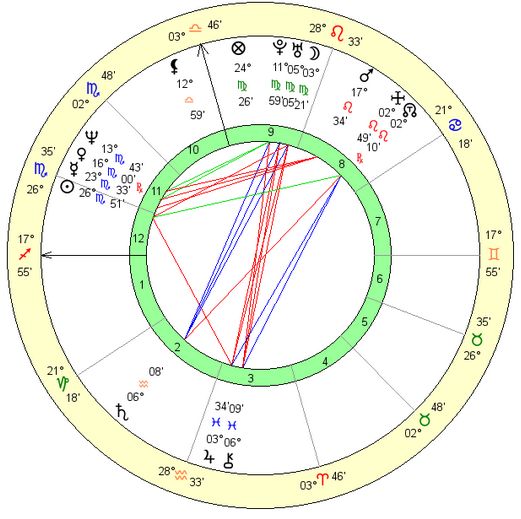
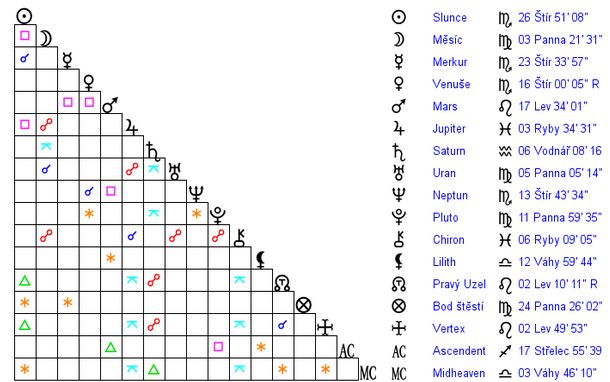
| Planet | Longitude | House | |
| Sun | 26 Scorpio 51' 08" | 12 | |
| Moon | 03 Virgo 21' 31" | 9 | |
| Mercury | 23 Scorpio 33' 57" | 11 | |
| Venus | 16 Scorpio 00' 05" R | 11 | |
| Mars | 17 Leo 34' 01" | 8 | |
| Jupiter | 03 Pisces 34' 31" | 3 | |
| Saturn | 06 Aquarius 08' 16" | 2 | |
| Uranus | 05 Virgo 05' 14" | 9 | |
| Neptune | 13 Scorpio 43' 34" | 11 | |
| Pluto | 11 Virgo 59' 35" | 9 | |
| Chiron | 06 Pisces 09' 05" | 3 | |
| Lilith | 12 Libra 59' 44" | 10 | |
| True Node | 02 Leo 10' 11" R | 8 | |
| Part of Fortune | 24 Virgo 26' 02" | 9 | |
| Vertex | 02 Leo 49' 53" | 8 | |
| House | Longitude | ||
| Ascendant | 17 Sagittarius 55' 39" | ||
| House 2 | 21 Capricorn 18' 18" | ||
| House 3 | 28 Aquarius 33' 36" | ||
| House 4 | 03 Aries 46' 10" | ||
| House 5 | 02 Taurus 48' 21" | ||
| House 6 | 26 Taurus 35' 19" | ||
| House 7 | 17 Gemini 55' 39" | ||
| House 8 | 21 Cancer 18' 18" | ||
| House 9 | 28 Leo 33' 36" | ||
| MC (Midheaven) | 03 Libra 46' 10" | ||
| House 11 | 02 Scorpio 48' 21" | ||
| House 12 | 26 Scorpio 35' 19" |
| Planet | Aspect | Planet | Orb |
| Sun | Square | Moon | 6.51 |
| Sun | Conjunction | Mercury | 3.29 |
| Sun | Square | Jupiter | 6.72 |
| Sun | Sextile | Midheaven | 6.92 |
| Moon | Square | Sun | 6.51 |
| Moon | Opposition | Jupiter | 0.22 |
| Moon | Quincunx | Saturn | 2.78 |
| Moon | Conjunction | Uranus | 1.73 |
| Moon | Opposition | Chiron | 2.79 |
| Mercury | Conjunction | Sun | 3.29 |
| Mercury | Square | Mars | 6.00 |
| Mercury | Sextile | Part of Fortune | 0.87 |
| Venus | Square | Mars | 1.57 |
| Venus | Conjunction | Neptune | 2.28 |
| Venus | Sextile | Pluto | 4.01 |
| Mars | Square | Mercury | 6.00 |
| Mars | Square | Venus | 1.57 |
| Mars | Square | Neptune | 3.84 |
| Mars | Trine | Ascendant | 0.36 |
| Jupiter | Square | Sun | 6.72 |
| Jupiter | Opposition | Moon | 0.22 |
| Jupiter | Opposition | Uranus | 1.51 |
| Jupiter | Conjunction | Chiron | 2.58 |
| Jupiter | Quincunx | True Node | 1.41 |
| Jupiter | Quincunx | Vertex | 0.74 |
| Jupiter | Quincunx | Midheaven | 0.19 |
| Saturn | Quincunx | Moon | 2.78 |
| Saturn | Quincunx | Uranus | 1.05 |
| Saturn | Quincunx | Pluto | 5.86 |
| Saturn | Trine | Midheaven | 2.37 |
| Uranus | Conjunction | Moon | 1.73 |
| Uranus | Opposition | Jupiter | 1.51 |
| Uranus | Quincunx | Saturn | 1.05 |
| Uranus | Opposition | Chiron | 1.06 |
| Neptune | Conjunction | Venus | 2.28 |
| Neptune | Square | Mars | 3.84 |
| Neptune | Sextile | Pluto | 1.73 |
| Pluto | Sextile | Venus | 4.01 |
| Pluto | Quincunx | Saturn | 5.86 |
| Pluto | Sextile | Neptune | 1.73 |
| Pluto | Opposition | Chiron | 5.84 |
| Pluto | Square | Ascendant | 5.93 |
| Chiron | Opposition | Moon | 2.79 |
| Chiron | Conjunction | Jupiter | 2.58 |
| Chiron | Opposition | Uranus | 1.06 |
| Chiron | Opposition | Pluto | 5.84 |
| Chiron | Quincunx | Midheaven | 2.38 |
| True Node | Quincunx | Jupiter | 1.41 |
| True Node | Conjunction | Vertex | 0.66 |
| True Node | Sextile | Midheaven | 1.60 |
| Part of Fortune | Sextile | Mercury | 0.87 |
| Vertex | Quincunx | Jupiter | 0.74 |
| Vertex | Conjunction | True Node | 0.66 |
| Vertex | Sextile | Midheaven | 0.94 |
| Ascendant | Trine | Mars | 0.36 |
| Ascendant | Square | Pluto | 5.93 |
| Midheaven | Sextile | Sun | 6.92 |
| Midheaven | Quincunx | Jupiter | 0.19 |
| Midheaven | Trine | Saturn | 2.37 |
| Midheaven | Quincunx | Chiron | 2.38 |
| Midheaven | Sextile | True Node | 1.60 |
| Midheaven | Sextile | Vertex | 0.94 |
A Perspective on AstrologyWhen exploring a celestial blueprint such as the jodie-foster-birth-chart, we must remember that astrology reveals nothing more than tendencies. A human being can master their stars if they exert their will. If one chooses to drift aimlessly with the current of life, then the tendencies outlined in the birth chart will eventually manifest their influence. There is one profound mystery that a natal chart can never fully display: the individual’s free will and how it may evolve. The application of free will is left entirely to the seeker. Astrology serves as a forewarning, allowing us to navigate life's currents with greater wisdom. What a soul sows, it must reap. The karmic law operates in perfect harmony with the planets. The incarnation of a soul into a physical vessel occurs at the exact auspicious moment when the karmic law and the cosmos align in perfect unison. Remember that the so-called auspicious or challenging configurations in a horoscope are not products of chance or luck; they are the harvest of our past deeds. The chart mirrors what we have carried over from previous incarnations and what we are meant to master in this life. What we lack in our present existence can be acquired in the future by consciously embracing our destiny's tasks. The stars impel, but they do not compel. As Goethe once beautifully wrote: *From every power that binds the world, a man frees himself when he gains self-control.* The AscendantThe Ascendant is the gateway through which the soul enters to fulfill its karmic mission. It defines a person's physical appearance and personality, while also showing how others perceived us in childhood, how we assert ourselves in our environment, our baseline level of available energy, our non-specific immunity, and our rate of physical recovery. It forms the very foundation of our psycho-physical constitution, temperament, and destiny. The Ascendant of this personality is: SAGITTARIUS The cusp of the first house in Sagittarius endows its native with enthusiasm, courage, and optimism; it is generally considered the "best Ascendant." However, such an individual may not always be highly responsible and can struggle to retain what they have acquired. Their temperament is choleric and physically driven; their will is immensely strong but short-lived! This will is deeply dependent on the emotions and social awareness of the Sagittarius, leading to instinctive reactions, which often pose a challenge. They love entertainment, preferably that which is lively yet dignified (such as hunting, receptions, etc.). A powerful urge for independence and a penchant for traveling to distant lands are characteristic. A well-placed Ascendant here is highly prophetic and possesses synthetic thinking. There is, however, a tendency toward excessive optimism. They are deeply religious, possessing a genuine, inner devotion. They are philanthropic! They love animals, particularly horses. Their most negative trait is unpredictability and a certain "flightiness." As business owners, they might meticulously assign tasks for the entire day, only to change their mind ten times before evening, leaving subordinates either on the verge of a breakdown or ready to resign. Impulsiveness, exaggeration, rebelliousness, and anarchy are also common. Physically, they resemble Gemini—tall and slender, with a longer nose, higher forehead, open facial features, and darker eyes. Their gaze is swifter and more piercing than that of Gemini, carrying a hint of command. A unique feature is their speech—ranging effortlessly from formal language to colloquial slang, showing absolute adaptability. Planets in SignsThe placement of planets in the zodiac signs is a crucial component of astrological interpretation. The manifestation of each planet in a specific sign exerts a profound and highly characteristic influence on our lives. Sun in Scorpio This placement manifests primarily as powerful and deep emotions, driven by the subconscious, monumental energy of Pluto, the ruling planet of this sign. Scorpios possess a remarkable gift for observation and can effortlessly distinguish the essential from the trivial. They are often deeply compassionate and may possess healing abilities. Infidelity or rejection is devastating to them. They do not easily forgive and can fall into depressions that, like all Scorpio emotions, are profound and intense. Scorpios must learn to receive and trust; they often struggle with these fundamental lessons and occasionally fall prey to deception. A lesser-known characteristic of those with the Sun in Scorpio is their frequently exceptional driving skills. Moon in Virgo Such an individual is usually rather shy, detesting unrefined or crude behavior. They cherish order (especially at home) and sometimes tend to over-analyze and evaluate their feelings. This naturally breeds conflict, as emotions are spontaneous expressions of the soul, and any attempt to rationalize or control them rarely ends well. The lesson of this Moon is to learn to accept and feel without judgment. People with this placement choose their friends with care and are capable of serving others selflessly. The Moon in Virgo is, in many ways, an archetype of the pure Virgin Mary. Mercury in Scorpio This position is highly investigative; outstanding powers of observation and a sharp, intuitive judgment make this native an excellent detective or psychologist. They always carry their mental endeavors to completion, and in debates, they can be uncomfortably sharp, even devastating. They instinctively find their opponent's weakest point and target it relentlessly. This placement of Mercury is exceptional for research and scholarly work, showing an aptitude for nuclear and quantum physics. Such individuals are drawn to everything hidden and mystical, yet they must be careful not to fall into blind devotion toward any religious dogma, which would hinder their personal growth. Their thinking is both analytical and synthetic. An afflicted Mercury in Scorpio can indicate a master deceiver, sometimes of international proportions. Any afflicted element in Scorpio carries danger, and Mercury is certainly no exception. Venus in Scorpio This placement bestows a powerful sexual magnetism that operates primarily on a subconscious level—meaning this individual attracts others effortlessly, even without being conventionally attractive physically. This Venus is associated with the archetype of the mysterious, seductive woman who wields immense influence over her surroundings. A person with Venus in Scorpio loves passionately, yet they may encounter bewildering relationship obstacles, as their partner may prove volatile or unreliable. Rejection can trigger deep bitterness and jealousy. Nonetheless, they strive to understand their partner and can be remarkably self-sacrificing. They do, however, thrive on emotional intensity and dramatic displays. Mars in Leo This placement manifests as a penchant for drama, theatricality, and showmanship. The personality is highly dramatic and dislikes any opposition to their plans, which they deem flawless (depending also on the nature of Mars's aspects to other planets). The way this individual takes action is fascinating—at times highly creative, pragmatic, and captivating, while at other times completely impractical, with actions that seem to have neither rhyme nor reason. Mars in Leo possesses a powerful sexual magnetism and allure. A man with this placement will seek to dazzle women with his generosity, lavish gifts (often gold), and grand theatrical gestures, though he can carry these displays to extremes. He is deeply honorable and expects the same from others, which inevitably leads to disappointment. Women with Mars in Leo seek a partner who embodies these noble qualities and take great pride in them. Although they use their counterpart for social prestige, they also demand submission. Indeed, submission is expected from the partner by both genders here; if both partners have Mars in Leo, an almost unresolvable clash of wills arises—even though this constellation is highly attracted to itself energetically. Jupiter in Pisces In water signs, this planet demands emotional depth; the native yearns for love and emotional fulfillment. They possess a deep romantic sensibility, though they can fall prey to self-pity, self-sacrifice, and sentimentality. They manifest their desire to help others through noble intentions and prayers, making this an ideal aspect for spiritual seekers, priests, and healers. The shadow side of this placement includes illusions, idle daydreaming, non-constructive fantasies, excessive religious dogmatism, and a potential susceptibility to addictive substances (depending heavily on Jupiter's aspects). They cherish music, leaning toward classical or liturgical genres. Saturn in Aquarius In air signs, this planet tends to restrict communication and intellectual development. However, especially when strongly aspected, it fosters mental discipline and grants the native the strength and motivation to overcome intellectual hurdles. The primary challenge of Saturn in Aquarius is that the individual can become highly authoritarian in their views, often mistaking subjective opinions for universal truths and attempting to impose them on others relentlessly (depending on the aspects). Since this position heavily influences mental activities, it is highly unfavorable for roles such as scientific directors, as they may dismiss the validity of others' ideas and rigidly push their own often non-constructive stances, hindering collective progress and cooperation. Planets in Astrological HousesEach house represents a specific area of life. The position of a planet within a house reveals how one fares in that particular domain. For an accurate calculation of planets in houses, the exact time of birth is crucial. Sun in the 12th House This is probably the most complex solar placement to interpret in a personal horoscope. This is primarily the vibrational field of Pisces and Neptune; regardless of the sign on the house cusp, the Sun here is always colored by this mystical energy. Anyone with the Sun in this position tends to be introspective, sensitive, and requires private, inner space to process the reality of the outer world. They are naturally drawn to esotericism, psychology, and mysticism. They are usually highly intuitive, and it depends entirely on the sign and the aspects of the Sun how conscious they are of this intuition and whether they can apply it practically. Individuals with this placement possess a vivid, active imagination, often retreating into its realms to find peace and harmony. They cherish fairy tales and ancient legends. The twelfth house is the house of institutions, such as schools and hospitals; thus, especially with children having this placement, it is crucial to respond sensitively to school issues, as unresolved problems could easily lead to a transition from school to a hospital environment. The greatest challenge of the twelfth house is any negative aspect—affecting any planet residing within or even the ruler of the cusp sign. If the Sun is afflicted, there is always a risk of seeking escape from reality in ways detrimental to health, such as through psychotropic substances or alcohol. In the case of any affliction to the Sun in the twelfth house, it is vital to assess how well the individual has mastered the principles of the tenth and eleventh houses—namely, accepting societal laws and rules, and subsequently liberating themselves from them while maintaining respect for them, knowing they are not universally binding. If this principle is unmastered, severe difficulties, particularly of a psychological nature, are highly probable. The Sun in the twelfth house often generates a form of 'spiritual addiction.' Individuals may style themselves as false gurus, chase every spiritual technique that catches their eye, or fall prey to cults. This is most prominent when Pisces or Neptune is afflicted in the twelfth house. For instance, a square between the Sun in Pisces in the twelfth house and Neptune or Uranus in the tenth house almost certainly yields a highly troubled individual who will fight fiercely against all established rules while intensely seeking escape from the harshness of the world, potentially ending up destitute on the streets. While this is an extreme comparison, such a state is entirely possible under these aspects. Another principle that can manifest when the twelfth-house Sun is afflicted is the urge to 'force help' upon others. Such a person feels a compulsive need to save others, yet lacks the actual capacity to do so, subconsciously seeking to make others dependent on them. This can drain others energetically, and the karmic rebound on their own mental and physical health is massive. Consequently, a secondary craving for help from others arises, which is rarely fulfilled or effective, locking them in a vicious cycle. Conversely, a harmonious Sun here offers magnificent opportunities for ultimate enlightenment and redemption, though this naturally hinges on mastering the aforementioned tenth and eleventh house dynamics. The path of mysticism lies open, and through proper practices, the seeker can expand their consciousness to attune to higher, cosmic forces that otherwise remain dormant in everyday life. If successful, their awareness gently opens to these sublime energies, unlocking mystical gifts and deeper insights. This process is intensely individual. The sign in which the Sun resides can suggest which spiritual path is most suitable, but the final choice remains an exercise of free will. Perhaps the most famous book illustrating a young, initially confused seeker’s path to enlightenment is the ancient Tibetan spiritual classic, *Milarepa* (highly recommended in the translation by the Tomášes). This profound dynamic of the tenth, eleventh, and twelfth houses weaves throughout the story, and though we live in a very different cultural and spiritual setting, this work offers profound wisdom. Moon in the 9th House This placement brings a deep fascination with foreign cultures, stemming directly from the soul's desires. This frequently leads to romantic partnerships with foreigners and living abroad. The individual may turn to higher education or spiritual studies to navigate life's crises, seeking a broader perspective. This Moon creates an excellent foundation for studying high white magic and profound hermetic teachings (Kabbalah, mysticism, etc.). It also bestows publishing talents that promote the spiritual and mental growth of others through educational and literary work. The development of partnership and marital relations is paramount here—a Moon blocked by Saturn hinders relationship growth, and the sign of Capricorn presents similar challenges. It acts favorably on the cultivation of original, pioneering ideas. It connects the native to higher energies, offering transcendental knowledge—a gift from higher spheres, a channel of pure information. Depending on the zodiac sign where this ninth-house Moon resides, it nurtures and refines synthetic thinking (Sagittarius being ideal). Generally, this Moon signifies higher education, and its energetic signature points toward the humanities rather than pragmatic, hard sciences. The Moon in the eighth house supports the individual's interest in foreign spiritual traditions, and depending on the sign and aspects, these may range from exotic paths to classic spiritual doctrines. Mercury in the 11th House These are friendly individuals for whom forging connections is a source of mental stimulation and an opportunity to communicate within a sphere where they feel secure. They excel at weaving shared ideas together, multiplying and expanding their intellect through friends and associates. They are often active in groups united by a specific purpose, such as local politics or athletic goals (especially with Mercury in Aries). Within collective settings, they acquire vital information for their personal growth and place their intellectual gifts at the service of the community. They develop their communication skills in a very direct manner—mostly verbally, but also through writing, depending on the circumstances. They tend to be well-liked within their social circles. Venus in the 11th House These individuals delight in moving through high society, finding great satisfaction there. They build extensive networks of acquaintances and know how to utilize them, though they are equally generous in returning favors. They accept patronage as a matter of course, yet they remain genuinely appreciative of it. A challenge arises with challenging aspects: the individual may strive to break into elite social circles but find themselves rejected, appearing somewhat ridiculous. Venus in the eleventh house facilitates the integration of this house's core principle—realizing that societal laws and conventions are not universally binding—a realization that often unfolds primarily through a romantic partner. The partner can also greatly assist in their emancipation, liberation, the breaking of taboos, and the restructuring of leisure time. The foundation of their self-confidence lies in receiving patronage, liberating themselves from taboos, rules, and laws, and utilizing their leisure time in a deeply satisfying manner. Mars in the 8th House The relationships established in the seventh house are consolidated here in a Martian fashion. Consequently, especially under challenging aspects, these individuals may hold onto their partner through force or sheer dominance, refusing to let them go. Their decision-making is steered by powerful, deep-seated emotions. They are drawn to magic, occultism, and mysticism, often seeking a high volume of sexual encounters (depending on the zodiac sign hosting Mars). For them, sexuality is always a vital form of self-expression. If Mars resides in earth signs, they often engage in finance or economics. Mars in the eighth house bestows evocative magical abilities, which can be further amplified by a strong aspect to Mercury (such as a conjunction). Medical professionals with this placement frequently specialize in emergency medicine, traumatology, surgery, or first response services. This planet in the eighth house typically portends Martian modes of death—swift, unexpected, or violent, almost always resulting from the destruction or failure of the organ corresponding to the zodiac sign of Mars. If retrograding, it indicates the misuse of magical powers in a past incarnation, requiring the native to process destructive aggression in this life (particularly challenging under adverse aspects). It may also point to a homicide committed in a past life, bringing an acute risk of violent death due to karmic rebound. In all matters of violence, a vital spiritual law applies: the greater the emotional charge invested in a violent act, the more severe its karmic repercussions. A cold, calculated crime does not carry nearly the same karmic weight as an act committed during an emotional explosion. Conversely, this rule also holds true for positive deeds: if you help someone driven by intense compassion, your positive karmic merit is vastly magnified. Jupiter in the 3rd House This Jupiter amplifies the matters of the first house, such as self-assertion, the baseline level of available energy, and non-specific immunity, especially when harmoniously aspected. The native possesses outstanding communication and media skills, enjoys excellent relationships with siblings, and encounters highly favorable conditions for study, where success is virtually guaranteed. Harmonious aspects between Jupiter and the Moon, or Jupiter yield writing talents and a gift for journalism. These individuals generally love travel and are in their element when taking frequent short-distance trips. An afflicted Jupiter manifests through several troublesome issues, notably intellectual snobbery. The individual constantly emphasizes their intellect and loves to show off; however, they may lack natural intelligence, attempting to compensate by acquiring academic titles. Once earned, they insist on their prominent display and can indulge in endless, circular debates. A retrograde Jupiter can cause minor speech impediments, indicating the exploitation or neglect of siblings in past lives. In this incarnation, it introduces challenges in sibling relationships to help the soul understand and resolve these past errors. Saturn in the 2nd House In this placement, material resources are restricted and blocked; despite working tirelessly, the individual inexplicably struggles to earn a good living. They experience difficulties establishing boundaries with their surroundings and defining their external space, which they often try to fill with trivial objects. They frequently battle low self-worth and face obstacles in securing money, housing, social status, or desired academic degrees (in compensation, an excess of academic credentials may point to a pathological attempt to define boundaries due to an inferiority complex). Haunting fears of financial ruin make them extremely thrifty, yet this hoarding behavior can cause them to miss lucrative opportunities. They are also prone to excessive caution. Saturn in the second house is the primary astrological signature for a deep-seated inferiority complex. These individuals constantly measure their worth by societal standards rather than their own, creating a fundamental trauma (they struggle to value themselves naturally and feel guilt if they try). They only feel worthy when meeting rigid societal rules linked to the second house (such as securing a degree). Persistent anxiety over poverty and loss of control over resources breeds this inferiority complex, which can manifest externally as actual poverty or a chaotic financial life. Difficulties with their living spaces are common—homes may be cluttered, poorly ventilated, or plagued by property disputes. Those with this Saturn are often vulnerable to oppression or bullying. To mitigate these Saturnian challenges, the quantum administration of the homeopathic remedy *Psorinum* is highly effective in helping the native process and master these second-house energies. Uranus in the 9th House This placement indicates blocks, compensation, or projection in the realms of religion, higher philosophy, spiritual evolution, synthetic thinking, the awakening of spiritual gifts, relationship growth, and high magic or hermeticism. These individuals often hold highly unconventional, sometimes radical spiritual views (depending on aspects), drawn to Eastern philosophies and alternative movements. In their quest for extraordinary spiritual experiences, they may embark on long journeys to distant lands. Many are hermetic researchers, archeologists, occult scholars, or exceptional publishers of spiritual and esoteric literature. Under a block, these higher pursuits are suppressed, yet even when the Uranian energy is unintegrated, the block is rarely absolute; the individual remains conscious of the spiritual realm and is compelled to seek it. In compensation, they may act as pseudo-gurus or spiritual guides, promoting eccentric religious or philosophical concepts that lack genuine transcendental insight, constructed instead through study and imagination. In projection, they criticize others who claim spiritual mastery, reflecting their own unfulfilled inner calling. When well-placed, Uranus in the ninth house offers revolutionary, progressive perspectives on spiritual wisdom and higher philosophy. Neptune in the 11th House This placement typically indicates individuals with grand, idealistic, yet vague and ill-defined ambitions. They often project a shy aura to both the public and their close friends. We must distinguish between the afflicted (or blocked) and the harmonious expressions of Neptune. When harmonious, the individual can elegantly liberate themselves from rigid societal norms and laws without breaking them, shattering taboos and dissolving the binding structures of Saturn. Through intuition and cosmic inspiration, they achieve genuine expansions of consciousness. If blocked or afflicted, however, they harbor a deep fear of leaving Saturnian structures. They fail to see their friends clearly (or refuse to see them), and any patronage they receive proves detrimental. They might exhibit a rigid, anxious obedience to rules and regulations, even nonsensical ones. Generally, they struggle in group dynamics, as Neptune dissolves boundaries and clouds perceptions, leading to vague social anxieties. They yearn for group validation and wish to be at the center of their circle, yet they fail to achieve this due to an inability to assert themselves clearly. They may also constantly chase influential connections and patronage, with the failure of these desires bringing them profound Neptunian disillusionment. These challenges can be alleviated through the hermetic signatures of Aquarius and the sign hosting Neptune. Pluto in the 9th House This configuration is highly auspicious for philosophical, mystical, and magical wisdom and abilities, yet it introduces a challenging, paradoxical dynamic: an intense expectation of acquiring these spiritual gifts. Pluto desperately craves this power, thereby blocking it, for a fundamental spiritual law dictates that the highest truths (and the ninth house is the domain of sacred sciences) can only reach a person when they completely surrender all expectation. To attain these gifts, the soul must undergo high-pressure situations that introduce them to the principles required for mastery. Since Pluto in the ninth house signifies the role of a spiritual guide or guru, this pressure often manifests through a teacher who, through rigorous demands, steers the native toward their true calling. If Pluto is harmonious and powerful, they will encounter a true guide or may eventually become one themselves. Under adverse aspects, however, they are prone to meeting charlatans, or they may play the role of a false guru themselves, often quite "successfully" as others fail to detect their manipulation. In all cases, those with Pluto in the ninth house are hindered by the sheer weight of expecting spiritual progress. The greatest spiritual guides, gurus, and avatars never predict the future, as doing so could completely block the initiate's path, steering them in less suitable directions. The finest book illustrating these dynamics is the beautifully written, ancient Tibetan tale *Milarepa* by the Tomášes. This work is highly recommended for anyone taking their spiritual journey seriously. Because the ninth house rules publishing, these individuals may also channel their energy into producing occult, magical, astrological, or spiritual literature. Another critical facet of Pluto in the ninth house is relationship development, which unintegrated Plutonian energy tends to block. In practice, the native easily initiates and solidifies a relationship, but over time, a mysterious stagnation sets in without any obvious cause. They grow restless and seek to end it, only to repeat the exact cycle in the next partnership. They often use Plutonian tactics (manipulation and pressure) to force their partner to grow or change, which an unyielding partner will reject. This leads to mutual manipulation and power struggles. A classic manifestation of this placement is the native constantly pushing spiritual or philosophical books on their partner. A heavily afflicted Pluto makes it virtually impossible to sustain a meaningful, evolving relationship despite an easy start. One must honestly integrate all ninth-house principles to overcome this pattern. Furthermore, those with this placement must guard against hasty and often inaccurate judgments, particularly regarding matters of faith and dogma. Planetary AspectsAn aspect is the geometric relationship between two celestial bodies. Depending on the angle they form, we can determine how these planets interact, categorizing aspects into three main groups: harmonious, challenging, and conjunctions. How each aspect manifests in a person's life is detailed in the analysis below. Sun in Challenging Aspect to Moon Creates inner friction, particularly in relationships with close family members (parents and children), and conflicts between professional public service and personal interests. It brings obstacles in life, especially during youth. Sun in Conjunction with Mercury Individuals with this aspect are highly subjective and creative; they excel at expressing their views and often possess artistic talents. While this is an excellent aspect for performing artists, it can limit logical reasoning and attention to detail, making the mind intensely subjective. If the Moon is waxing, this subjectivity is heightened; conversely, a waning Moon brings greater objectivity to intellectual processes. Arrogance and bias can also accompany this placement. In any case, it indicates an intellectual being. We must always analyze the specific type of conjunction: a rare 'cazimi' configuration grants extraordinary, genius-like gifts, whereas a 'combust' planet often breeds arrogance and bluntness (the ultimate expression always depending heavily on the specific zodiac sign). Sun in Challenging Aspect to Jupiter Fosters an excessive idealism that can lead to supporting questionable movements or organizations. An individual with this aspect is often willing to make grand sacrifices. They are overly optimistic, possess a passion for travel, and fiercely avoid commitments. Moon in Challenging Aspect to Jupiter Challenging aspects trigger an insatiable inflation of emotional needs, craving constant care and comfort. An introverted individual may seek refuge in an intense religious or spiritual life. Their dependence on external conditions is profound, making it vital for them to discover an authentic, self-generated purpose in life. Moon in Conjunction with Uranus This conjunction (affecting women particularly strongly) instills a powerful craving for emotional and domestic freedom, making it very difficult to find common ground with family and partners. The native requires constant change. Though appearing emotionally open at first glance, they release tension through sudden emotional outbursts, leading a restless life. They suffer from a sense of alienation from society (an alienation complex). Emotions are fused with eccentricity and originality, bringing sharp mood swings, fragmented feelings, and a rejection of traditional family values. Mercury in Challenging Aspect to Mars Challenging aspects stimulate mental acuity but also provoke a contentious nature and foster impatience. The individual may struggle with interpersonal relationships, yet they possess a strong, commanding leadership quality. Many great reformers possessed this very aspect. The mind is swift, pragmatic, and accurate, but there is a persistent drive to force their truths upon others, often accompanied by a streak of arrogance. Venus in Challenging Aspect to Mars Bestows extreme sensitivity but demands constant social, physical, and sexual stimulation. Highly energetic and popular in social groups, their self-assurance can sometimes verge on pure egotism. Though quick-tempered, they do not hold grudges. They cherish harmony and are quick to reconcile. They are easily offended, with an unstable emotional landscape where open friendship can instantly turn into hostility. Highly impulsive, they place impossible demands on partners, falling in and out of love with headspinning speed. This aspect highly activates sexuality and raw magnetism. In a female chart, it can carry a warning of physical violation. Venus in Conjunction with Neptune Heightens emotional sensitivity, romanticism, and a tendency to idealize the partner, which can pave the way for deep disappointments and illusions. Their fantasies often eclipse reality. However, within a healthy relationship, they are fiercely loyal and self-sacrificing. They love fashion, art, and photography. In a harmonious conjunction: for a woman, sexual arousal is intimately linked with the transcendent, mysticism, and magic. In a man's chart, this aspect reveals the qualities of his anima (inner woman) and the nature of the women who will enter his life. In creative individuals, it signals divine inspiration, exquisite taste, and immense creativity. In an afflicted conjunction (for instance, if Venus is in Taurus in the second house), it can manifest as a pathological greed for possessions. Note this general rule: if a horoscope features a single powerful aspect between fixed signs, it will exert the strongest, most fateful influence, serving as a benchmark for all other aspects. If Neptune is in a fixed sign squaring Venus in another fixed sign, it typically denotes a pathological obsession with material manipulation, which is exceptionally difficult to resolve, especially when placed in angular houses. It brings an unhealthy dependence on sensory stimuli, an enormous craving for physical touch (such as a need for prolonged embraces, etc.). Coupled with a diurnal Venus in Libra, it fosters an obsessive pursuit of aesthetic perfection. Venus in Harmonious Aspect to Pluto Grants the capacity to experience relationships with immense gravity and depth. They demand the same absolute intensity from their partner, which can trigger conflicts if these expectations are unmet. A trine between Venus and Pluto especially bestows a talent for media and publishing. The individual often possesses influential contacts that pave the way to success. This aspect powerfully activates sexuality and magnetic allure. In a woman's chart, it indicates an incredibly intense, visceral experience of pleasure and sexuality, whereas in challenging aspects, these heights are only reached through high-stakes, crisis-driven situations. Generally, it fosters a very realistic, raw expression of sexuality, stripped of conventional taboos or false modesty. Such a woman yearns to know her partner's absolute truth and every secret. Her sexual magnetism is mesmerizing, completely independent of conventional physical beauty. Naturally, this peaks with a Venus-Pluto conjunction in Scorpio, though other signs exhibit similar depth. Trines and sextiles share this profound meaning, though their outward manifestation is slightly gentler. Mars in Challenging Aspect to Neptune This is generally excellent for mysticism, enhancing imagination and fantasy, which the native often prioritizes over dry reality. These aspects are common among revolutionaries and the hyper-materialists of modern society. They severely inhibit a practical approach to life. Under a Mars-Neptune opposition, kleptomania can manifest. It represents a feverish drive to assert oneself through impossible ideals and elusive fantasies (tilting at windmills)—completely chaotic endeavors. Medically, the individual becomes their own enemy, triggering autoimmune reactions. This often begins subtly with allergies. Conditions associated include anemia, claudication (intermittent limping), phantom pains, bruising, snoring, influenza, myasthenia gravis, pernicious anemia (Biermer's disease), gangrene, immune fluctuations, and blood group incompatibility. Mars in Harmonious Aspect to Ascendant Fosters independence, courage, determination, and assertiveness. They care little for the opinions of others, surrounding themselves with active, energetic friends. They possess strong integrity and loyalty, fiercely defending their beliefs and ideals. This aspect physically fortifies the body, boosting vitality and granting superior regenerative powers. Jupiter in Challenging Aspect to Uranus Challenging aspects yield an unquenchable thirst for the mysteries of life, a desire for multifaceted experiences, and absolute independence. The native is highly original, with knowledge spanning vast domains, though they can fall into dogmatic thinking. It brings a hunger for power, a sense of self-importance requiring others to show them deference, and sudden legal or bureaucratic conflicts. Medically, it points to nerve issues in the thighs, buttocks, and hips, injuries to these areas or the coccyx, and the risk of sudden, benign tumors. Neptune in Harmonious Aspect to Pluto These harmonious aspects span generations; both planets remained in a supportive sextile from 1945 to 1995. This influence inspires peace-oriented ideologies and, when coupled with other aspects, fuels major transformative, peace-building movements on a global scale. ConclusionThis natal chart has been constructed on the assumption that the provided birth details—including time, location, and time zone (with adjustments for daylight saving time where applicable)—are accurate. Even a single hour's discrepancy in birth time can result in inaccurate house placements or an incorrect Ascendant. By no means is this astrological analysis exhaustive. Every human being is a far more complex and multi-dimensional soul than can ever be captured on a single page. To generate your own personal birth chart online completely free of charge, please visit Free Natal Chart Source Zbyněk Slába www.oranzovestranky.cz |
