
Personal Horoscope
Marilyn Monroe Birth Chart
Born Tuesday, June 01, 192609:30:00 (timezone = GMT -8 hours)
118w15, 34n03
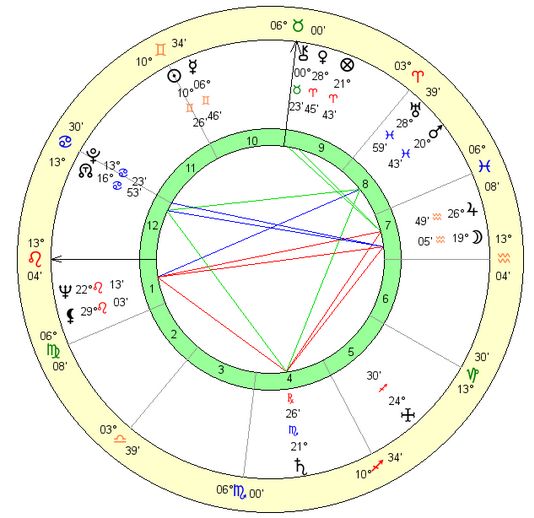
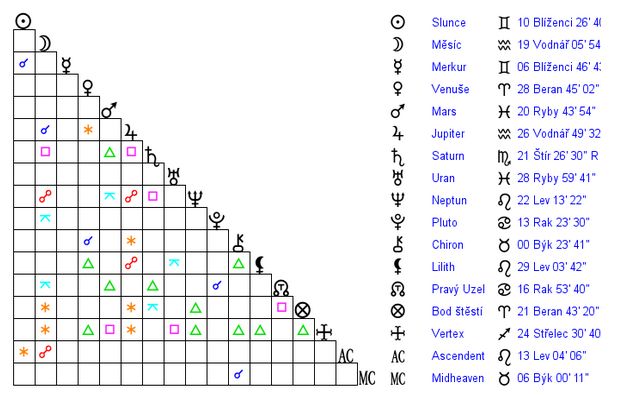
| Planet | Longitude | House | |
| Sun | 10 Gemini 26' 40" | 10 | |
| Moon | 19 Aquarius 05' 54" | 7 | |
| Mercury | 06 Gemini 46' 43" | 10 | |
| Venus | 28 Aries 45' 02" | 9 | |
| Mars | 20 Pisces 43' 54" | 8 | |
| Jupiter | 26 Aquarius 49' 32" | 7 | |
| Saturn | 21 Scorpio 26' 30" R | 4 | |
| Uranus | 28 Pisces 59' 41" | 8 | |
| Neptune | 22 Leo 13' 22" | 1 | |
| Pluto | 13 Cancer 23' 30" | 11 | |
| Chiron | 00 Taurus 23' 41" | 9 | |
| Lilith | 29 Leo 03' 42" | 1 | |
| True Node | 16 Cancer 53' 40" | 12 | |
| Part of Fortune | 21 Aries 43' 20" | 9 | |
| Vertex | 24 Sagittarius 30' 40" | 5 | |
| House | Longitude | ||
| Ascendant | 13 Leo 04' 06" | ||
| House 2 | 06 Virgo 08' 01" | ||
| House 3 | 03 Libra 39' 42" | ||
| House 4 | 06 Scorpio 00' 11" | ||
| House 5 | 10 Sagittarius 34' 55" | ||
| House 6 | 13 Capricorn 30' 17" | ||
| House 7 | 13 Aquarius 04' 06" | ||
| House 8 | 06 Pisces 08' 01" | ||
| House 9 | 03 Aries 39' 42" | ||
| MC (Midheaven) | 06 Taurus 00' 11" | ||
| House 11 | 10 Gemini 34' 55" | ||
| House 12 | 13 Cancer 30' 17" |
| Planet | Aspect | Planet | Orb |
| Sun | Conjunction | Mercury | 3.67 |
| Sun | Sextile | Ascendant | 2.62 |
| Moon | Conjunction | Jupiter | 7.73 |
| Moon | Square | Saturn | 2.34 |
| Moon | Opposition | Neptune | 3.12 |
| Moon | Quincunx | Pluto | 5.71 |
| Moon | Quincunx | True Node | 2.20 |
| Moon | Opposition | Ascendant | 6.03 |
| Mercury | Conjunction | Sun | 3.67 |
| Venus | Sextile | Jupiter | 1.92 |
| Venus | Conjunction | Chiron | 1.64 |
| Venus | Trine | Lilith | 0.31 |
| Mars | Trine | Saturn | 0.71 |
| Mars | Quincunx | Neptune | 1.49 |
| Jupiter | Conjunction | Moon | 7.73 |
| Jupiter | Sextile | Venus | 1.92 |
| Jupiter | Square | Saturn | 5.38 |
| Jupiter | Opposition | Neptune | 4.60 |
| Jupiter | Sextile | Chiron | 3.57 |
| Jupiter | Opposition | Lilith | 2.24 |
| Jupiter | Sextile | Vertex | 2.31 |
| Saturn | Square | Moon | 2.34 |
| Saturn | Trine | Mars | 0.71 |
| Saturn | Square | Jupiter | 5.38 |
| Saturn | Square | Neptune | 0.78 |
| Saturn | Quincunx | Part of Fortune | 0.28 |
| Uranus | Quincunx | Lilith | 0.07 |
| Neptune | Opposition | Moon | 3.12 |
| Neptune | Quincunx | Mars | 1.49 |
| Neptune | Opposition | Jupiter | 4.60 |
| Neptune | Square | Saturn | 0.78 |
| Neptune | Trine | Part of Fortune | 0.50 |
| Neptune | Trine | Vertex | 2.29 |
| Pluto | Quincunx | Moon | 5.71 |
| Chiron | Conjunction | Venus | 1.64 |
| Chiron | Sextile | Jupiter | 3.57 |
| Chiron | Trine | Lilith | 1.33 |
| Chiron | Conjunction | Midheaven | 5.61 |
| Lilith | Trine | Venus | 0.31 |
| Lilith | Opposition | Jupiter | 2.24 |
| Lilith | Quincunx | Uranus | 0.07 |
| Lilith | Trine | Chiron | 1.33 |
| True Node | Quincunx | Moon | 2.20 |
| Part of Fortune | Quincunx | Saturn | 0.28 |
| Part of Fortune | Trine | Neptune | 0.50 |
| Vertex | Sextile | Jupiter | 2.31 |
| Vertex | Trine | Neptune | 2.29 |
| Ascendant | Sextile | Sun | 2.62 |
| Ascendant | Opposition | Moon | 6.03 |
| Midheaven | Conjunction | Chiron | 5.61 |
An Astrological PerspectiveAstrology reveals nothing more than mere tendencies. A person can master their stars, should they choose to exert their will. If one decides to simply drift upon the currents of life, then the potentials written in the natal chart will, at their appointed hour, manifest their influence. By examining the marilyn-monroe-birth-chart, we see a profound tapestry of destiny, yet one key element remains forever hidden within any natal horoscope: the free will of the individual and how it may evolve. The exercise of this free will is left entirely to the seeker. Astrology serves as our divine forewarning, enabling us to navigate the tides of existence with greater wisdom. What a man sows, he must inevitably reap. The law of Karma operates in perfect harmony with the celestial spheres. The incarnation of a soul into the physical vessel occurs at the exact auspicious moment when karmic law and the planetary alignments can move in unison. Remember that the so-called auspicious or malevolent configurations in a chart are not the product of mere chance or luck, but are the harvest of our past deeds—the birth chart mirrors what we have brought forth from prior incarnations and what we are destined to master in this one. What we lack in our present life can be forged in the future by embracing our spiritual tasks. The stars impel, but they do not compel. As Goethe wisely wrote: "From every power that binds the world, man frees himself through self-control." The AscendantThe Ascendant is the gateway of the soul, through which the being enters to fulfill its karmic destiny. It governs the physical appearance and personality, revealing how we were perceived by others in childhood, how we assert ourselves within our environment, our baseline of available energy, our non-specific immunity, our rate of recovery, the foundation of our psycho-physical constitution, temperament, and the very blueprint of our fate. The Ascendant of this personality is: LEO A flair for the dramatic, a tendency to boast (and indeed, to exaggerate)—these are the hallmark traits of Leo on the Ascendant. The temperament is choleric, the will exceptionally strong and instinctual, unlike Gemini, where it is intellectualized. There is a deep capacity for affectation. Yet, unlike Aries, Leo can champion causes not only for themselves but for others. While they love to perform and be the center of attention, they do so with consideration for their audience; they are deeply social. Their demeanor is open, warm-hearted, and intensely loyal. Indeed, after Capricorn, this is perhaps the most loyal and generous Ascendant in the entire zodiac. Their great weakness, however, is a vulnerability to flattery—a trait easily exploited! They are entertaining and love to celebrate. An afflicted Ascendant in Leo can manifest as an extremely despotic, nitpicking individual, reacting disproportionately when things displease them. This is the specific, rigid pedantry of a challenged Leo. While Virgo expresses discontent through fretting and complaining, Leo does so despotically. If one resists them, the outcome is fraught, for the royal pride of Leo feels wounded and reacts with undue severity. This Ascendant bestows, above all, broad shoulders—often disproportionately so. The physical vessel is typically of an athletic build with strong bones (granting resilience against physical trauma). A majestic, though not necessarily precise, gait is evident—it is a deeply human, somehow admirable stride. :-) A key distinguishing feature is often very light eyebrows. Planets in the SignsPlanets in the signs constitute a vital pillar of astrological interpretation. The expression of each celestial body within a specific sign exerts a profound and highly characteristic influence upon our lives. Sun in Gemini These are, first and foremost, individuals guided by intellect and common sense, who require constant mental stimulation. They delight in acquiring and disseminating knowledge, though at times they may do so without plunging into the absolute depths of a subject—though this is not a universal rule. The Sun in Gemini thrives on connection and the exchange of ideas; they love to travel and explore. The ideal calling for them is that of a teacher. The divine mission of such a Sun is to connect humanity and serve as a conduit for information. Moon in Aquarius This placement bestows, above all, emotional independence. This key concept naturally introduces challenges in relationships, as such individuals feel stifled if they perceive themselves bound by their emotions or family ties. They harbor a distaste for heavy responsibilities and obligations, and their domestic life is often unstable, unconventional, and unique. The Moon in Aquarius is highly typical of those who champion feminist ideals. Mercury in Gemini Here, Mercury is in its domicile—its finest placement. The paramount drive for this individual is the acquisition and transmission of knowledge (the archetype of the teacher). The mind is exceptionally clear, logical, and thirsts for intellectual stimulation; they revel in verbal fencing. Their thinking is highly adaptable, showing great academic aptitude, a talent for synthesis, mathematics, and general versatility. They possess excellent rhetoric and a pleasing voice, though they may change their opinions with striking rapidity. They endure constant nervous tension and require physical movement to dissolve this restlessness. Excellent merchants often possess Mercury in Gemini, while an afflicted Mercury can produce deft pickpockets (quick and nimble fingers). An inharmonious Mercury becomes superficial, scattered, unfocused, and lacking in perseverance. Venus in Aries This placement brings a powerful need for affection and attention. While capable of loving passionately, this individual can be highly sensitive, quick to take offense, and argumentative. They are adept at asserting their own desires. Men with Venus in Aries are drawn to courageous, independent women who can stand on their own. In partnerships, this manifests as competitiveness, enthusiasm, and a certain egocentrism. If Venus is the "Evening Star" (positioned behind the Sun counter-clockwise in the chart), it points to intense emotions; their spontaneity is immediate, yet highly mutable. Actions and events are weighed through the scales of aesthetics and ethics. The Evening Star suggests a certain wisdom and maturity in emotional matters, or that the emotional life may be bound by tradition or spiritual values. Mars in Pisces This is one of the most challenging placements for Mars in the natal chart. While this constellation endows individuals with rich intuition and imagination—allowing them to conceive ingenious and often correct ways to solve problems—their profound lack of practicality makes it highly difficult for them to implement these solutions and bring them to fruition. A classic representation of this Mars would be the elderly humanities professor who, under certain alignments, cannot even manage to boil water for tea. :-) A person with Mars in Pisces frequently acts with consideration for others, and compassion plays a massive role in their deeds. They crave unusual sensory experiences and may never quite know what appeals to them most in intimacy. In the sexual realm, they long for transcendent, extrasensory experiences; the nature of their aspects dictates what means they might employ to heighten their amorous adventures. Under discordant aspects, the use of mind-altering substances is not uncommon. For instance, Mars in Pisces square Neptune is a highly perilous aspect that may tempt the individual to "accelerate" spiritual development or seek timeless experiences through psychotropic means—a path fraught with danger, as a negative trait of this Mars is a weakened will, making addictions hard to break. For Mars in Pisces, sex is primarily an escape from mundane routine, preferred over mere physical release. They are aroused by mysterious or clandestine relationships, meaning they do not always represent the archetype of marital fidelity, though their innate compassion often prevents them from carrying out infidelity. A similar equivalent of this behavior is found with Venus in Pisces or in the Twelfth House, particularly in women. A person with this Mars is always highly sensitive, especially on a psychological level. A woman with this placement often seeks a partner embodying Pisces traits—mysterious, a dreamer, a poet. Under discordant alignments, she may feel drawn to partners who abuse psychotropic substances. Both genders with Mars in Pisces long for romance and frequently escape into worlds of dreams and fantasy. Artistic talent is a very common grace of this placement. Jupiter in Aquarius In air signs, the individual emphasizes personal growth through analytical thinking and intellect. They possess a great capacity for self-analysis and introspection, observing and dissecting their own impulses. They delight in contributing to collective ideologies and analyzing societal evolution. In Aquarius, the focal point of their activity is the creation and dissemination of new intellectual paradigms. They thrive in communication and working with collective groups. Saturn in Scorpio In water signs, this planet presents its greatest challenges by blocking the flow of emotion, leading to inexplicable emotional barriers. The individual is constantly confronted by their own feelings, forced to cultivate emotional self-discipline. Scorpio is an intensely emotional sign, and Saturn filters and constricts these currents. The person may struggle to navigate their own feelings, appearing stiff or artificial to others. They are also prone to taking offense and jealousy. The greatest pitfall of this aspect is the absence of personal conviction, leading them to adopt the views of others, particularly authority figures. Their primary task is to learn to trust their own feelings and forge independent perspectives, free from the opinions of others. Planets in the Astrological HousesEach house represents a specific realm of existence. The placement of a planet within a house reveals how one fares in that particular area. To calculate these positions accurately, the exact time of birth is paramount. Sun in the 10th House The key themes for this solar placement are career, self-assertion, and public recognition. The individual yearns for social prestige, status, and honor, and is willing to exert maximum effort to attain them. If the path to these achievements is blocked, their sense of identity suffers, necessitating either a method to dissolve the block or a suitable substitute, such as charitable work. Regardless, they will strive for a position of significance. Even children with the Sun in the Tenth House contemplate their future careers, assuming success as a given—often saying, "One day I will build a house, for I shall earn the means to do so." Those with a harmoniously aspected Sun in the Tenth House rarely face career obstacles. However, the sign and aspects of this Sun are of immense importance. The Tenth House represents the core of "liberation"—the ultimate goal of all mystical teachings—which is the absolute and unconditional acceptance of societal norms and laws. When a soul can internalize these laws, it realizes they are not universally binding, leading to liberation from their influence in the Eleventh House and the integration of higher, universal laws. This liberation is not anarchy, but understanding and non-judgment. However, if the Sun is in Aquarius or afflicted by Uranus, it blocks the acceptance of societal rules, leading to anarchic tendencies, rebellion, and recurring conflicts with authority. Consequently, the individual cannot grasp the liberating principles of the Eleventh House, blocking their ultimate enlightenment in the Twelfth. Above all, they block humility! This anarchic urge can degenerate into a desperate search for enlightenment through alcohol or drugs, with Neptune and Pisces playing a heavy role. Significant conflict also arises if the Fourth House is heavily populated, creating a painful tug-of-war between career and family. Generally, a person with the Sun in the Tenth House is well-regarded and capable of appreciating others, though this remains dependent on aspects and signs (e.g., an afflicted Sun in Leo will demand recognition at all costs, turning a leader into a tyrant for their subordinates). Moon in the 7th House This individual longs with all their soul for intimate emotional connections, often adopting a maternal role within them. They attract people who seek security and safety. However, these expectations are rarely met, as the Moon in the Seventh House causes emotional fluctuations aligned with lunar phases. The nature of their relationships depends heavily on the sign of the Moon. They perceive their environment intuitively and emotionally. The quality of their social circle and public reputation may fluctuate. The Moon here signifies the marriage partner and their core traits. It is crucial to determine whether the Chart Ruler (the planet ruling the Ascendant) or the Moon is stronger. If the Chart Ruler is stronger, the individual dominates the relationship; otherwise, they tend to be subordinate, yielding to their partner out of a deep soul-need, which can block spontaneous connection. This can also affect business partnerships and friendships, as well as open adversaries, who manifest according to the Moon’s sign. For example, a Moon in Scorpio attracts hidden but potent enemies, making surprise a key element. The Seventh House is responsible for discovering sexual and spiritual identity. The Moon's aspects and sign heavily influence these processes. A strong Moon attracts numerous high-quality relationships. Generally, an individual with the Moon in the Seventh House may struggle with absolute fidelity, as they appear unstable and constantly seek new connections. Mercury in the 10th House An individual with this placement seeks a career that provides mental stimulation and allows them to express their ideas and communication skills. They prioritize intellectual satisfaction over financial gain. They excel in education, journalism, tourism, and administrative roles, pragmatically utilizing the information they gather. In higher aspects, this produces university professors, architects, or executives. Under harmonious aspects, they make excellent judges, while discordant aspects may render them susceptible to external influence or corruption. Venus in the 9th House These individuals are deeply drawn to foreign cultures, often leading to relationships with foreigners or living abroad. They cultivate diverse friendships, placing great value on philosophy and faith. Their spiritual beliefs are of a higher order—they reject dogma, preferring personal exploration, often aided by a spiritually aligned partner. For these individuals, a woman may often serve as a spiritual teacher. This placement fosters the study of hermetic sciences and high magic, with insights arriving most easily through partnerships. The partner significantly influences their philosophical outlook, higher education, and synthetic thinking. Self-confidence is forged through deepening philosophical views, faith, harmonious relationships that support hermetic abilities, and long journeys to foreign lands. Mars in the 8th House Relationships formed in the Seventh House are bound here in a Martian manner. Under discordant aspects, the individual may hold onto partners through force or control. Decisions are guided by deep, intense emotions. They harbor a keen interest in magic, occultism, and mysticism, often maintaining a highly active sex life (depending on the sign of Mars). Sexuality is always a form of self-expression. In earth signs, they often engage in finance or industry. Mars in the Eighth House grants evocative magical abilities, amplified by conjunctions with Mercury. Doctors with this placement often specialize in emergency medicine, trauma, surgery, or rescue services. This position signifies typical Martian deaths—sudden, unexpected, or violent, usually due to the failure of an organ corresponding to the sign of Mars. If retrograded, it points to the misuse of magical powers in a past life, requiring the individual to process destructive aggression in this incarnation. It can also indicate a past-life murder, carrying a karmic risk of violent death. In all acts of violence, a key rule applies: the greater the emotional energy invested in a violent act, the more severe its karmic consequences. A cold-blooded act does not carry the same chaotic emotional karma as a crime of passion. Naturally, this applies to positive deeds: helping others out of profound compassion multiplies your positive karmic merit significantly. Jupiter in the 7th House This individual is outwardly friendly to all and takes the lead in relationships. Generous by nature, they surround themselves with influential people. They carry themselves with confidence but struggle with the conflict between surrendering to a partner and maintaining their freedom. They seek an ideal partner, which can cause friction. Usually, relationships are fortunate, friendships are reliable, and they are supported by others due to their charm. In a day chart, the partner is loyal, extroverted, caring, and practical. A typical profession is a mediator. If afflicted, however, this placement leads to immoral behavior, infidelity, untrustworthy companions, and legal troubles due to taking the law into one’s own hands. A retrograde Jupiter indicates past-life infidelity or betrayal of friends, with current relationship struggles serving as a means to resolve these ancient negative patterns. Saturn in the 4th House Here, the discovery of emotions, security, and the ability to accept and be accepted is restricted. Even with understanding parents, a child with this placement may take on burdens that are not theirs, feeling oppressed in the home. They long for domestic peace, but physical obstacles repeatedly intervene. As adults, they carry guilt for family matters beyond their control. This trauma means they can only explore their emotions if they conform to societal rules—a process beginning in infancy and extending through adolescence. They react according to traditional values, which may be misunderstood by others. A heavily afflicted Saturn here often leads to endogenous depression. The individual cannot spontaneously express feelings because they are barely aware of them. They live with a constant sense of peril, fearing the loss of security, and may appear cold or detached, often rejecting natural healing. If afflicted, their endeavors often fail despite their efforts, confining them to a narrow family circle and fostering pathological social avoidance. It can manifest as cramped living conditions, poverty, Spartan upbringing, miserliness, and loneliness. A harmonious Saturn brings a strict but fair upbringing that builds character without psychological damage, leading to prudence, caution, and beneficial stays abroad. It is a classic signature of a mining engineer. Furthermore, this placement signifies hereditary diseases, the severity of which corresponds to Saturn’s affliction. Uranus in the 8th House All transpersonal planets in the Eighth House must be interpreted with caution, and Uranus is no exception. The Eighth House governs death, magic, transformation, sexuality, and shared resources. An unintegrated Uranus here manifests as blockage, compensation, or projection. In blockage, sexuality is repressed, and its transformative nature is ignored, leading to frigid indifference—a state highly distressing to spiritually minded individuals. In compensation, it manifests as a restless desire for sexual novelty, bordering on promiscuity, and a ceaseless search for "the one." In projection, the individual criticizes the promiscuity of others. Generally, these people seek unconventional ways to acquire wealth; under negative aspects, they may turn to fraud. Under positive aspects, they possess a genius for investing others' money, often ignoring conventional methods. Their search for answers regarding reincarnation and the cycle of life is highly unorthodox. They may practice Eastern spiritual techniques or form new cults, traveling to distant lands to study tantra and energy work. In partnerships, Uranus in the Eighth House makes commitment extremely difficult; the individual must learn to detach and release relationships to overcome Saturnian blocks. Only then can they utilize Uranus for tantric transformation. As a signifier of death, Uranus brings sudden, unexpected, and painless transitions. The affected organ depends on the sign: Aries points to strokes; Taurus to neck injuries, suffocation, or falls; Gemini to falling objects, asphyxiation, or neurological events; Cancer to drowning or stomach failure; Leo to sudden cardiac arrest or arrhythmia; Virgo to bowel or lung failure; Libra to kidney failure, falls, or suicide; Scorpio to reproductive failure, drowning, animal attacks, or infection; Sagittarius to liver or lung failure, or falls; Capricorn to leukemia or bone diseases; Aquarius to lung disease, arrhythmia, or alcoholism; Pisces to drug overdose, pneumonia, or hypothermia. Neptune in the 1st House Individuals with this placement perceive higher spiritual vibrations through their physical bodies. Their self-assertion is subtle, almost imperceptible; if noticed, they face resistance that halts their progress. This Neptune is ideal for self-discovery, as bodily awareness can lead to spiritual salvation. They utilize Neptunian avenues—such as spiritual practices, mysticism, or even alcohol and substances—for self-exploration. While an afflicted Neptune in Pisces is more prone to addiction than a harmonious Neptune in Aries, the planet in the First House is less problematic than in the Twelfth, as substances are used for body awareness rather than escapism. However, they must avoid intoxicants, as they suffer far greater physical damage from them than others. They radiate subtle energies and perceive atypical reactions from their environment. They should not try to conform to physical ideals. If unintegrated, they assert themselves through illusion and naivety, with a high risk of autoimmune disorders in youth. Neptune weakens the body part corresponding to its sign (e.g., in Taurus, it weakens the throat, causing chronic infections; removing tonsils is perilous here, as the vulnerability may shift to the heart or lungs). They are highly sensitive, often drawn to art or fashion, but can be unreliable. They suffer from vague anxieties, which intensify if Neptune is conjunct the Ascendant. When unintegrated, they demand too much of themselves, leading to suffering—a classic Neptunian theme. A retrograde Neptune conjunct the Ascendant often indicates a difficult birth, such as a prolonged labor or inhaling amniotic fluid. Pluto in the 11th House This aspect exerts powerful pressure to liberate oneself from Saturnian constraints. To break free from societal rules, the individual requires intense, crisis-driven situations, the severity of which depends on Pluto's aspects. An unintegrated Pluto blocks Eleventh House principles. The individual is not only thrust into crises but also manipulates and pressures others. If harmonious, they enjoy the protection of powerful, Plutonian yet fair friends. This protection is highly effective; in the chart of a statesman, it shields both the leader and the nation. If afflicted and placed higher than the luminaries, it brings ruin through friends, typically via fraud or corruption—methods that often remain legally untouchable. (Pluto in the Eleventh House of a nation or corporation can trigger the collapse of massive financial institutions). Generally, this placement grants a talent for economic manipulation. The root of their fixation lies in manipulating others to gain friendship, protection, or to shatter societal taboos. If highly afflicted, they may seek to overturn established rules at any cost, seeking personal power within groups. They often resolve personal crises by immersing themselves in political causes. Planetary AspectsAn aspect is the geometric relationship between two planets. Depending on the angle they form, we can discern their mutual influence, categorized into harmonious, inharmonious, and conjunctions. The interpretation below reveals how these aspects manifest in life. Sun conjunct Mercury Individuals with this aspect are highly subjective and creative, expressing their views with artistic flair—an excellent signature for performing artists, though it can limit objective logic and attention to detail. Thinking is intensely subjective. If the Moon is waxing, this subjectivity increases; a waning Moon brings greater objectivity. Arrogance and bias can accompany this placement, though the individual is always highly intellectual. The nature of the conjunction is key: cazimi (in the heart of the Sun) is rare and bestows exceptional gifts, whereas a combust Mercury (*combustus*) often produces arrogance and brashness, depending on the sign. Sun in harmonious aspect to the Ascendant An individual with this aspect is friendly, energetic, self-assured, and sincere, enjoying good health and inner vitality. Moon conjunct Jupiter This conjunction manifests in two distinct ways: in the first, the individual is a generous, warm-hearted, and hospitable host. In the second, they are demanding, requiring immense care, love, a large family, and luxury, with a passion for long-distance travel. Introverts often lead a life of spiritual devotion and contemplation. They may pursue goals selfishly and enjoy studying or living abroad. Moon in inharmonious aspect to Saturn Inharmonious aspects make it nearly impossible for the individual to express their feelings, leading them to hide behind a protective mask. They require a stable home as a sanctuary, yet they artificially burden their domestic life with excessive duties. They are prone to depression. Moon in inharmonious aspect to Neptune This brings a yearning for something transcending the self, often leading to esoteric interests and religion. The individual is deeply self-sacrificing and frequently exploited. They are drawn to exotic arts but may struggle with domestic order. This aspect combines extreme sensitivity with the ability to perceive higher vibrations and artistic inspiration, but it is also a foundational signature for psychological disorders (such as schizophrenia or psychotic states). Schizophrenia, a state of divided consciousness, is essentially a natural state rather than a disease—a reaction of the social environment to the individual's reality, and their subsequent reaction to that environment. When the individual accepts that they perceive multiple dimensions, clinical symptoms fade. It can also manifest as somnambulism, addiction, chaos, and emotional unreliability. There is a compulsive need to dramatize feelings, alongside a tendency toward confusion, delusion, and unrealistic desires. They possess a deep love for art and fashion. Moon in inharmonious aspect to the Ascendant The individual experiences highly volatile emotions and nervous strain, requiring regular periods of quiet to soothe their nerves. They must master their emotional reactions and avoid becoming overly entangled in the lives of others. Venus in harmonious aspect to Jupiter This bestows a gentle demeanor, warmth, and social adaptability. The individual is hospitable, generous, and fond of fashion, with this aspect proving highly beneficial in legal disputes. Mars in harmonious aspect to Saturn These aspects are intriguing as they restrict imagination—a trait considered beneficial for hazardous professions, though one might argue how much constructive imagination could aid in a crisis. These individuals can work tirelessly, showing caution, thoroughness, and initiative, free from the fear of scarcity. Jupiter in inharmonious aspect to Saturn Inharmonious aspects present conflicting choices, leaving the individual in constant hesitation regarding major changes, risks, or opportunities. If a wise compromise is struck, the results can be highly rewarding. Jupiter in inharmonious aspect to Neptune This placement creates a restless soul and a nomadic urge, making it difficult to settle down or find a clear purpose. While willing to sacrifice for an ideal, they must guard against naivety. They may lack a standard legal consciousness, struggling to integrate higher values into worldly laws. At best, they fanatically attempt to force universal laws into the earthly legal system, unaware of its inherent imperfections. At worst, they exploit higher laws to bypass worldly ones—much like Stalin and Hitler, who masterfully manipulated higher laws through astrologers and occultists for personal gain. This same signature in a national chart can provoke conflicts to distract from entirely different domestic crises. Saturn in inharmonious aspect to Neptune This is a challenging aspect that restricts imagination, bringing confusion and ambiguity to practical affairs. The individual may harbor reactionary beliefs. It manifests primarily in the physical realm, disrupting the neurohumoral balance—specifically, the production of pituitary hormones and communication between the pituitary gland and the hypothalamus, throwing the entire endocrine feedback system into disarray. ConclusionThis natal chart was calculated under the assumption that all input data—time, place of birth, and time zone, including daylight saving adjustments—are correct. Even a minor discrepancy in the birth hour will result in inaccurate house placements or an incorrect Ascendant. By no means is this astrological analysis exhaustive. Every human being is a far more intricate and complex soul than can ever be captured on a single page. To create your own personal Natal Chart online and completely free of charge, please visit: Free Natal Chart Source Zbyněk Slába www.oranzovestranky.cz |
