
Personal Horoscope
Monica Bellucci Birth Chart
Born Wednesday, September 30, 196414:30:00 (Time Zone = GMT +1 hour)
12e14, 43n27
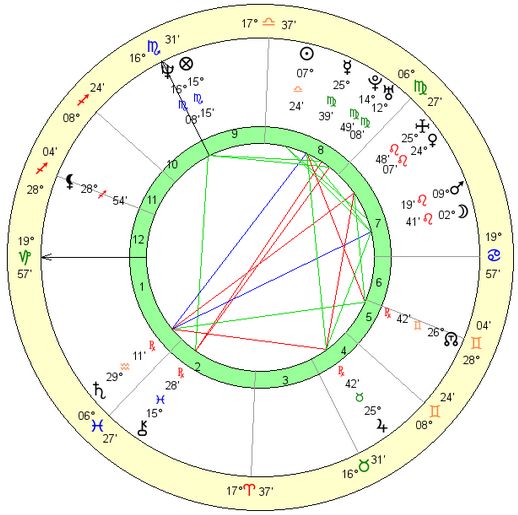
| Planet | Longitude | House | |
| Sun | 07 Libra 24' 27" | 8 | |
| Moon | 02 Leo 41' 42" | 7 | |
| Mercury | 25 Virgo 39' 22" | 8 | |
| Venus | 24 Leo 07' 15" | 7 | |
| Mars | 09 Leo 19' 31" | 7 | |
| Jupiter | 25 Taurus 42' 52" R | 4 | |
| Saturn | 29 Aquarius 11' 58" R | 1 | |
| Uranus | 12 Virgo 08' 24" | 8 | |
| Neptune | 16 Scorpio 08' 31" | 9 | |
| Pluto | 14 Virgo 49' 00" | 8 | |
| Chiron | 15 Pisces 28' 32" R | 2 | |
| Lilith | 28 Sagittarius 54' 51" | 12 | |
| True Node | 26 Gemini 42' 36" R | 5 | |
| Part of Fortune | 15 Scorpio 15' 06" | 9 | |
| Vertex | 25 Leo 48' 41" | 7 | |
| House | Longitude | ||
| Ascendant | 19 Capricorn 57' 51" | ||
| House 2 | 06 Pisces 27' 09" | ||
| House 3 | 17 Aries 37' 57" | ||
| House 4 | 16 Taurus 31' 23" | ||
| House 5 | 08 Gemini 24' 39" | ||
| House 6 | 28 Gemini 04' 14" | ||
| House 7 | 19 Cancer 57' 51" | ||
| House 8 | 06 Virgo 27' 09" | ||
| House 9 | 17 Libra 37' 57" | ||
| MC (Midheaven) | 16 Scorpio 31' 23" | ||
| House 11 | 08 Sagittarius 24' 39" | ||
| House 12 | 28 Sagittarius 04' 14" |
| Planet | Aspect | Planet | Orb |
| Sun | Sextile | Moon | 4.71 |
| Sun | Sextile | Mars | 1.92 |
| Moon | Sextile | Sun | 4.71 |
| Moon | Sextile | Mercury | 7.04 |
| Moon | Conjunction | Mars | 6.63 |
| Moon | Sextile | Jupiter | 6.98 |
| Moon | Quincunx | Saturn | 3.50 |
| Mercury | Sextile | Moon | 7.04 |
| Mercury | Trine | Jupiter | 0.06 |
| Mercury | Quincunx | Saturn | 3.54 |
| Mercury | Square | True Node | 1.05 |
| Mercury | Trine | Ascendant | 5.69 |
| Venus | Square | Jupiter | 1.59 |
| Venus | Opposition | Saturn | 5.08 |
| Venus | Sextile | True Node | 2.59 |
| Venus | Conjunction | Vertex | 1.69 |
| Venus | Quincunx | Ascendant | 4.16 |
| Mars | Sextile | Sun | 1.92 |
| Mars | Conjunction | Moon | 6.63 |
| Jupiter | Sextile | Moon | 6.98 |
| Jupiter | Trine | Mercury | 0.06 |
| Jupiter | Square | Venus | 1.59 |
| Jupiter | Square | Saturn | 3.49 |
| Jupiter | Square | Vertex | 0.10 |
| Jupiter | Trine | Ascendant | 5.75 |
| Saturn | Quincunx | Moon | 3.50 |
| Saturn | Quincunx | Mercury | 3.54 |
| Saturn | Opposition | Venus | 5.08 |
| Saturn | Square | Jupiter | 3.49 |
| Saturn | Sextile | Lilith | 0.29 |
| Saturn | Trine | True Node | 2.49 |
| Uranus | Sextile | Neptune | 4.00 |
| Uranus | Conjunction | Pluto | 2.68 |
| Uranus | Opposition | Chiron | 3.34 |
| Uranus | Sextile | Midheaven | 4.38 |
| Neptune | Sextile | Uranus | 4.00 |
| Neptune | Sextile | Pluto | 1.33 |
| Neptune | Trine | Chiron | 0.67 |
| Neptune | Conjunction | Part of Fortune | 0.89 |
| Neptune | Sextile | Ascendant | 3.82 |
| Neptune | Conjunction | Midheaven | 0.38 |
| Pluto | Conjunction | Uranus | 2.68 |
| Pluto | Sextile | Neptune | 1.33 |
| Pluto | Opposition | Chiron | 0.66 |
| Pluto | Sextile | Part of Fortune | 0.43 |
| Pluto | Trine | Ascendant | 5.15 |
| Pluto | Sextile | Midheaven | 1.71 |
| Chiron | Opposition | Uranus | 3.34 |
| Chiron | Trine | Neptune | 0.67 |
| Chiron | Opposition | Pluto | 0.66 |
| Chiron | Trine | Part of Fortune | 0.22 |
| Chiron | Sextile | Ascendant | 4.49 |
| Chiron | Trine | Midheaven | 1.05 |
| Lilith | Sextile | Saturn | 0.29 |
| Lilith | Opposition | True Node | 2.20 |
| True Node | Square | Mercury | 1.05 |
| True Node | Sextile | Venus | 2.59 |
| True Node | Trine | Saturn | 2.49 |
| True Node | Opposition | Lilith | 2.20 |
| True Node | Sextile | Vertex | 0.90 |
| Part of Fortune | Conjunction | Neptune | 0.89 |
| Part of Fortune | Sextile | Pluto | 0.43 |
| Part of Fortune | Trine | Chiron | 0.22 |
| Part of Fortune | Conjunction | Midheaven | 1.27 |
| Vertex | Conjunction | Venus | 1.69 |
| Vertex | Square | Jupiter | 0.10 |
| Vertex | Sextile | True Node | 0.90 |
| Ascendant | Trine | Mercury | 5.69 |
| Ascendant | Quincunx | Venus | 4.16 |
| Ascendant | Trine | Jupiter | 5.75 |
| Ascendant | Sextile | Neptune | 3.82 |
| Ascendant | Trine | Pluto | 5.15 |
| Ascendant | Sextile | Chiron | 4.49 |
| Ascendant | Sextile | Midheaven | 3.44 |
| Midheaven | Sextile | Uranus | 4.38 |
| Midheaven | Conjunction | Neptune | 0.38 |
| Midheaven | Sextile | Pluto | 1.71 |
| Midheaven | Trine | Chiron | 1.05 |
| Midheaven | Conjunction | Part of Fortune | 1.27 |
| Midheaven | Sextile | Ascendant | 3.44 |
A Perspective on AstrologyAstrology reveals nothing more than cosmic tendencies. A soul can master their stars if they manifest their true will. If a person chooses to drift with the current of life, then the tendencies indicated in the natal chart will eventually manifest their effects. Looking at the monica-bellucci-birth-chart, we see a blueprint of potential, but one crucial element never appears in a native chart: the individual's free will and how it may evolve. The exercise of free will is left entirely to the seeker. Astrology offers us a sacred forewarning, allowing us to navigate life's currents with greater wisdom. What we sow, we must reap. The karmic law operates in perfect harmony with the planets. The birth of a soul into a physical vessel occurs at the exact auspicious moment when karmic law and planetary configurations align. Remember that the so-called favorable or adverse configurations in a horoscope are not the result of chance or mere luck, but are the harvest of our past actions—the birth chart reflects what we have brought from past incarnations and what we must master in this one. What we lack in our present life can be earned in the future by embracing our spiritual tasks. The stars impel, they do not compel. As Goethe wisely said: "From every power that holds the world in chains, the soul frees itself by gaining self-control." The AscendantThe Ascendant is the gateway of the soul, through which the being fulfills its karmic purpose. It expresses the physical appearance and personality, revealing how we were perceived by others in childhood, how we project ourselves into our environment, our baseline level of vital energy, non-specific immunity, recovery time, the foundation of our psycho-physical constitution, temperament, and the very blueprint of our destiny. The personality's Ascendant is: CAPRICORN It manifests as a reserved nature and a dry sense of humor (individuals with this Ascendant often favor dark humor), as well as practicality and thoroughness. At first glance, these individuals usually appear serious, radiating an aura of stability. A person with this Ascendant possesses a persistent, concrete, and powerful will. They are exceedingly cautious, with a melancholic temperament. It is very difficult to anger them, but when provoked, their wrath is formidable. They can be vain and immensely industrious. If they are not recognized, unlike a Leo who might laugh it off, they will feel deeply offended. Their ambition is boundless but highly concealed, simmering beneath an exterior of "holiness" that they themselves might not even consciously realize. They are serious, steadfast, and deeply protective of their inner privacy; exposing their hidden personal life will provoke a fierce reaction. Yet, they are highly responsible, grave, possess a fine sense of dignity, and are经历 fiercely loyal—never to be bribed. An afflicted Ascendant can be sullen, depressive, blocked, and disdainful. Capricorn disdains clearly and explicitly. This Ascendant often points to a past incarnation in noble lineages (blue blood) (similar to Capricorn, Leo, and Sagittarius). Capricorn bestows unmistakable physical traits: a compact, often less-proportioned body, a prominent chin, a narrow chest, a longer neck, and weaker knees, which may result in an uncertain gait. Their handwriting is precise and orderly, as if printed. Planets in the SignsPlanets in the signs constitute a vital component of horoscope interpretation. The expression of each planet in a specific zodiac sign exerts a profound and highly characteristic influence on our lives. Sun in Libra Libras possess a highly developed sense of harmony; they are acutely sensitive to imbalance and are willing to do whatever it takes to restore equilibrium. However, because they often carry this trait to extremes, it can result in a characteristic and highly frustrating indecisiveness, which sometimes drives those around them either to fits of laughter or utter despair. They dislike crude or aggressive behavior, cherish pleasant surroundings and a cozy home, and feel truly fulfilled when in balanced relationships with others. Their conduct is often pleasant and diplomatic, though a potential drawback is their frequent dependence on the opinions, support, and approval of others. Moon in Leo The individual is open, communicative, loves to present themselves as an extroverted soul, and frequently craves the admiration of their peers. Emotionally they can be somewhat reserved, yet they are deeply genuine, opening up instantly to sincere flattery. To them, life is a grand theatrical stage; they love interacting with their environment and enjoy being the center of attention within the family. Women with this placement dislike subordinate roles, while men admire strong, ambitious women whom they tend to idealize and revere, which can sometimes lead to inner conflict. Mercury in Virgo Mercury is in its second-best placement here (known as the nocturnal Mercury), making it ideal for detail-oriented work, precision, and responsibility. Though meticulous, they may struggle to submit their work on time because, in their eyes, it is never truly finished or perfect. They are analytical and often pedantic, with little patience for unfounded ideals. This placement lacks a synthetic mode of thinking but excels in fine mechanics, watchmaking, or engineering; they possess excellent judgment and a superb factual memory, though they may lack abstract logic. They are highly reliable. If afflicted, they can become nitpickers, focusing excessively on details while losing sight of the bigger picture. Lacking holistic thinking, they can be overly critical and analytical, which may make them less popular in group settings. This is the classic position of the bureaucrat who values mental order above all else. Mercury in Virgo weakens the intestines, making sedentary work less advisable. However, because they are natural scholars, this often creates a conflict. Emotional distress may manifest physically as "emotional diarrhea." Venus in Leo This placement bestows a rich, multifaceted personality and a love for social pageantry. They approach relationships with a sense of drama, expecting much from their partner and often radiating a unique brand of self-centeredness that, paradoxically, others find highly magnetic. They adore luxurious social events. However, difficulties can arise in relationships because individuals with Venus in Leo often overlook or fail to respect the feelings of their partner. Mars in Leo This Mars manifests as a penchant for acting and self-dramatization. The personality can express itself dramatically and intensely dislikes opposition to its plans, which it deems flawless (depending also on the aspects Mars forms with other planets). The nature of their actions is intriguing—at times they can be creative, concrete, and deeply captivating, while at other times they can be highly impractical, with actions that seem to have neither rhyme nor reason. Mars in Leo radiates a powerful sexual magnetism and allure. A man with this placement will seek to dazzle women with his generosity, lavish gifts (often of gold), and theatrical gestures, though he can easily push his expressions to extremes. He is highly honorable and expects the same in return, which naturally can lead to disappointment. Women with Mars in Leo seek men who embody these grand qualities and take great pride in them. Although they may use their partner for social prestige, they still demand submission. Indeed, both genders expect submission from their partner in a relationship; if both partners share Mars in Leo, it can create an almost gridlocked situation, even though they are otherwise strongly drawn to each other energetically. Jupiter in Taurus An individual with Jupiter in an earth sign always strives to expand their personality through practical endeavors, with material gain often being their primary objective. They appreciate luxurious surroundings, enjoy working with animals, and generally find solace and vitality in nature. Saturn in Aquarius In air signs, this planet primarily constricts communication and intellectual expansion. However, especially through strong aspects, it fosters mental discipline and provides the individual with the strength and motivation to overcome intellectual obstacles. The fundamental issue with Saturn in Aquarius is that the person can become highly authoritarian in their views, often treating their subjective opinions as absolute truths and trying to impose them on others relentlessly (depending on the aspects). Because this placement heavily influences intellectual pursuits, it is highly unfavorable for roles such as a scientific leader, as they may refuse to recognize the validity of others' ideas, dogmatically pushing their own—often unconstructive—views to the detriment of collective progress and cooperation. Planets in the Astrological HousesEach house represents a specific area of life. The placement of a planet in a house reveals how well or how poorly one fares in that domain. To calculate the planets in the houses accurately, the exact time of birth is indispensable. Sun in the 8th House Regarding the significance of the eighth house, this placement is fascinating in many respects. When well-aspected, the eighth house often brings a flow of material wealth without personal effort (such as windfalls, inheritances, etc.). However, a danger arises: individuals with the Sun in the eighth house always seek self-transformation, typically choosing one of two paths: they either dedicate themselves to helping others through alternative means, discovering themselves in the process, or they focus on accumulating wealth and consolidating personal power. If, for instance, they also have a negative aspect to Pluto, they may attempt to amplify their power by manipulating others through occult methods, or by making their clients dependent on them. While anyone can imagine the karmic consequences, it is essential to thoroughly analyze any affliction to the Sun in the eighth house to determine the potential outcomes. A person with this Sun is deeply drawn to the subconscious and seeks ways to work with it. They observe the cycles of life and death in themselves and others, study historical epochs of human development, and often enjoy working in the media if it provides answers to their unvoiced existential questions. They view death as a transitional evolutionary stage rather than a definitive, immutable end. They often encounter death within their family from an early age, or experience sudden, dramatic shifts in life (which are further amplified by any aspects from Pluto—rendering them deep and irreversible—or Uranus, which brings a chain of sudden changes whose ultimate impact may not always be catastrophic). Also crucial is the subconscious expression of their sexuality—if the Sun is well-placed, they use their sexual energy creatively for self-transformation; if afflicted, they may abuse it with destructive results. This placement is excellent for determining whether a soul possesses tantric capabilities. Finally, the Sun in the eighth house unconsciously seeks a financially secure partner—a subconscious drive. It also points to the qualities we value in others (for example, the Sun in Cancer seeks a stable partner who can provide for the family and whose emotional nature is steady). Moon in the 7th House This individual longs with all their soul for deep emotional connections, often assuming a maternal role within them. They attract people into their lives who are themselves searching for safety and security. However, these expectations are rarely met, as the Moon in the seventh house causes emotional fluctuations tied to the lunar cycles (waxing and waning). The primary mode of contact for such an individual depends directly on the zodiac sign in which the Moon resides. People with this placement perceive their environment intuitively and through their emotions. The quality of their social circle can be highly mutable, as can the validation they receive from others. The Moon here signifies the marriage partner and their core traits. It is vital to determine whether the chart ruler (the planet governing the Ascendant sign), the Moon, or other planets in the seventh house hold more power. If the chart ruler is stronger, the native will dominate the relationship; otherwise (the more common scenario), they may find themselves subservient or "under the thumb" of their partner. In this case, it is a submission that stems from a deep soul need, which can ultimately be frustrating as it may block spontaneous interactions with the world. This block can extend to business partners, friends, and even open enemies, who then manifest according to the zodiac sign of the Moon. For example, a Moon in Scorpio will attract hidden enemies whose influence is covert but powerful due to the element of surprise. The seventh house is responsible for discovering one's sexual and spiritual identity, as well as original ideas. The Moon, through its sign and aspects, heavily influences these processes for better or worse. A strong Moon attracts a greater number of high-quality relationships. Generally, an individual with the Moon in the seventh house is rarely the epitome of a faithful partner, as they can be somewhat unstable and constantly seek a wide variety of connections and relationships. Mercury in the 8th House The intellect is heavily colored by emotional impulses. By the very nature of the eighth house, a person with this Mercury tends to conceal their thoughts from others. They possess a vivid interest in the mysteries of life, transformation, and death. Drawn to psychology, they explore the higher aspects of sexuality, study the occult, and are fascinated by the evolution of the human mind and behavior from primordial times to the present. They possess exceptional powers of observation and analysis, which they rarely show openly, using them shrewdly in business and financial dealings. They acquire knowledge by exploring hidden realms and the occult, and excel at explaining the underlying connections in these fields, making them highly capable tarot readers or diviners. Since the eighth house also governs the partner's finances, an individual with this Mercury (especially if afflicted) may be inclined to choose a partner based on material status. They anchor their relationships primarily through intellectual rapport and communication (depending also on the sign on the cusp of the eighth house). Venus in the 7th House This individual is typically highly popular, diplomatic, attractive, and charming. To their detriment, however, they often require constant validation of their worth from others. In romantic partnerships, they may harbor unrealistic expectations in the emotional realm. They forge relationships easily and naturally due to their charm and popularity; unlike in the fifth house, however, they place great emphasis on stability and depth. Their initial contact is always captivating, as they instinctively seek the finest qualities in others. Through their partner, these individuals learn to interact with the world, achieve self-actualization, gain friends, and discover original concepts. The foundation of their self-esteem rests upon positive feedback from others, harmonious romantic or platonic relationships, a balanced environment, and ease of social interaction. Mars in the 7th House This Mars primarily represents the manner of initial contact and points to the archetype of the marriage partner. A woman with this placement will seek a powerful, energetic partner who mirrors her own unfulfilled desires (a classic seventh-house projection). Similarly, a man will likely choose a strong woman to whom he will submit, becoming "henpecked." While the term may sound amusing, the reality is less so, as individuals with Mars in the seventh house genuinely defer to their partners in almost everything, asserting themselves through them. If Mars is afflicted, they may attract partners with aggressive or even brutal behavior. Much depends on the zodiac sign in which Mars resides: Aries will be more physically intense, whereas Mars in Pisces may experience more psychological or emotional torment. The initial contact for someone with Mars in the seventh house is usually rapid and spontaneous, with a heavy emphasis on physical attraction. Emotional bonds are formed and severed with equal impulsiveness. A vast amount of energy is channeled into discovering their own erotic expression, and they often possess highly original ideas in the sexual realm. They can be excellent team players, bringing original ideals to collaborative efforts; however, if Mars is afflicted, or if they face significant opposition, they can easily find themselves in difficult situations, as they struggle to handle open confrontation. They often make enemies due to their blunt honesty and lack of hypocrisy. If Mars is afflicted or unaspected, there is a serious risk of losing lawsuits; in such cases, it is highly advisable to avoid all legal battles entirely! A retrograde Mars indicates unresolved relationship dynamics from past lives, and its energies are quite challenging to integrate (as the energies of the seventh house operate on a subtler, more spiritual plane). Jupiter in the 4th House With this configuration, the individual deeply craves a spacious, grand, or luxuriously appointed home. They usually enjoy a blissful childhood, and because this Jupiter resides in an angular house, its benevolent influence radiates throughout the entire birth chart. These individuals often experience material abundance within the family and are well-provided for. They have a taste for quality, delight in creating a beautiful home, and their twilight years are typically peaceful, prosperous, and happy. Jupiter rules the vibrational frequency of Sagittarius and thus the ninth house; in the fourth house, it can manifest as frequent changes of residence or even relocating abroad. It is of paramount importance to them to feel proud of their lineage or a highly developed family heritage. They may have ancestors from foreign cultures, particularly on the paternal side. A strong, unafflicted Jupiter here signifies prominent and popular figures. Such individuals also make successful real estate brokers, builders, industrialists, or mining magnates. Adverse aspects may bring success and wealth, but also a tendency to boast, provoking envy and reducing popularity. A retrograde Jupiter points to a past-life tendency toward authoritarianism or domestic tyranny, bringing challenges that help the soul recognize and heal these past transgressions. Saturn in the 1st House This is one of the more challenging placements of Saturn, as the first house governs the level of vital energy, non-specific immunity, resistance to disease, physical regeneration, and self-assertion. Saturn's lessons must always be integrated, and the first house is no exception; thus, this planet will restrict and delay all these areas. Any "infraction" against spiritual laws is "punished" by a drop in vital energy, almost invariably leading to illness or physical ailments. When assessing health vulnerabilities in a specific area, we must always consider three factors: the sign in which Saturn resides, the house with Capricorn on its cusp, and any planets located within Capricorn. In principle, the organ ruled by the sign of Saturn is weakened, as is the organ ruled by any afflicted planets in Capricorn, while the root cause of the illness lies in the life area represented by the house with Capricorn on its cusp. For example: if Saturn is in the first house in Virgo, the cusp of the fifth house is in Capricorn, containing an unaspected, retrograde Mercury, alongside the Sun and Mars squaring Pluto in the second house, this individual—due to improper conduct in the realms of sex, creativity, and children—will suffer from weakened digestion (intestines, digestion) and motor nerve issues (Mercury). This configuration points to someone who manipulates their partner through their sexuality (Pluto) or misuses their vital sexual energy, perhaps avoiding parenthood (fifth house), etc. Through manipulation of the partner, they attempt to expand their own personal space (Pluto in the second house) and exert dominance in the relationship. This behavior inevitably manifests as a physical ailment (Mercury—motor nerves). As a rule, with Saturn in the first house, especially near the Ascendant, we must always examine the position of Pluto. If Pluto is afflicted, the risk of health issues is substantially higher. It is vital to uncover the spiritual cause behind the illness; through conscious awareness, the healing process can begin. However, individuals often struggle to admit Pluto's influence, making recovery more complex. Appropriate hermetic remedies must be employed to gradually transform one's mindset and approach to life. Crucially, regarding the law of cause and effect, the native must never be told exactly which path to take; they must determine their own evolution through personal contemplation. Only then can they fully integrate Saturn's energy. The first house governs self-assertion. The primary trauma thus lies in how one asserts oneself, manifesting as a feeling that they may only project themselves through socially accepted, "proper" channels. Any attempt to assert themselves in their own unique way (as indicated by the Sun) results in a crisis of self-confidence, guilt, and remorse. If Saturn is in the first house and the Sun is in a fire sign (Aries, Leo, Sagittarius), it almost always leads to aggression and self-destructive behavior. These individuals possess immense energy that is blocked by Saturn, causing it to build up, while finding a healthy outlet remains exceedingly difficult. As stated, Saturn's energies must first be mastered before their positive potential can unfold. People with Saturn in the first house tend to let others limit and direct them, easily yielding to authority. Lacking such guidance, they can slip into a lack of principles or disorder. They often struggle with low self-esteem. If poorly aspected, they can feel crushed by obstacles and fail to progress. If harmoniously aspected or strong, they systematically tackle problems, overcoming them through sheer perseverance. However, they must always cultivate self-discipline to continue their spiritual evolution. Uranus in the 8th House All transpersonal planets in the eighth house must be analyzed with great care, and Uranus is no exception. The eighth house is the significator of death, magic, the occult, transformation, sexuality, spiritual heritage, deep bonding, and psychological insight; if unintegrated, Uranus here manifests as a block, compensation, or projection. As a block, it restricts sexuality, particularly its higher spiritual aspect, where the individual fails to grasp its transformative purpose, leading to frigidity or a lack of interest in sex as a tool for personal evolution. This is highly challenging for spiritually advanced individuals; those with a more earthly nature experience fewer issues. As compensation, it manifests as a craving for constant sexual novelty, potentially leading to promiscuity and an endless search for "the one." In projection, the individual often harshly criticizes the promiscuous behavior of others. Generally, people with this placement seek unconventional ways to acquire wealth, and under negative aspects, they may even resort to deceit. With positive aspects, they possess an excellent talent for managing other people's money and making wise, if highly unorthodox, investments. Their search for answers regarding the cycle of life and reincarnation can be pioneering and highly unusual. They are often drawn to Eastern spiritual practices, tantra, or the creation of new movements, leading them to travel to distant lands in search of esoteric wisdom. Uranus in the eighth house can be highly disruptive in relationships, making them difficult to anchor. The individual must first learn the art of detachment, releasing relationships gracefully to overcome Saturnian blocks. Only when they master this challenging phase can they harness Uranus's energy for profound transformation and tantric practices. As a significator of death, Uranus brings a sudden, unexpected, and usually painless transition. The sign it occupies indicates the vulnerable organ or body part: in Aries, it points to strokes or cranial events; in Taurus, suffocation, a broken neck, or falls; in Gemini, injuries from falling objects, neurological events, or asphyxiation; in Cancer, drowning, stomach failure, or choking; in Leo, heart failure, cardiac arrest, or arrhythmia; in Virgo, bowel failure, entrapment, or pulmonary collapse; in Libra, kidney failure, falls, or self-harm; in Scorpio, reproductive organ failure, drowning, animal attacks, infections, or execution; in Sagittarius, liver or lung failure, or falls from heights; in Capricorn, leukemia, blood, bone, or skin disorders; in Aquarius, lung disease, infection, cardiac arrhythmia, or the effects of alcoholism; in Pisces, drug overdose, pneumonia, or fatal exposure to cold. Neptune in the 9th House This is one of Neptune's more auspicious placements, bestowing a natural affinity for mystical teachings, hermeticism, spiritual evolution, and the pursuit of higher philosophy. Caution is required in youth when Neptune's energy is unrefined, or if it is afflicted or retrograde. In such cases, the individual can easily fall prey to dogmatic religious cults and rigid belief systems. Because Neptune resides here in the vibrational domain of Sagittarius and Jupiter, one must exercise caution in legal matters, which can become protracted and inconclusive. It is wise to find a trustworthy legal advisor and rely on them despite any personal doubts. Neptune in the ninth house also reflects the spiritual qualities of the partner, who may be unusual, have difficulty expressing themselves, or possess unique speech patterns. Individuals with this placement have a talent for publishing works on higher philosophy, magic, astrology, hermeticism, and the high arts. If afflicted, they still possess these gifts but may access them through alternative, sometimes risky techniques, such as holotropic breathwork or mind-altering substances. Such practices should always be undertaken under the guidance of an experienced guide. Spiritually, Neptune in the ninth house creates an insatiable thirst for divine knowledge, higher philosophy, and deep magic; unmet expectations can lead to disillusionment and suffering. These challenges can be mitigated using the hermetic signatures of Jupiter and the sign in which Neptune resides. Pluto in the 8th House In this position, Pluto fosters a highly unique way of securing relationships. A connection is initiated in the seventh house, and in the eighth—a fixed house—it is cemented so that it may expand in the ninth. Pluto in the eighth house operates on a deep, subconscious level, striving to anchor and secure the relationship at all costs through Plutonian means: manipulation, pressure, or even psychological control, though this mechanism is practically invisible. In daily life, the partner of such an individual is virtually unable to end the relationship, even if it has become entirely unfulfilling. The forms of pressure used are incredibly subtle, diplomatic, and hidden; the partner cannot perceive them directly, only recognizing them through the reflections of their social circle. Even a harmonious Pluto can cause a partner to feel an urge to flee due to the unspoken control, yet they remain unable to articulate their reasons. An afflicted Pluto, however, exerts such intense psychological pressure that departure becomes nearly impossible. (This aspect is significantly intensified by Pluto in Scorpio, whereas Pluto in Libra radiates such a charming, sweet diplomacy that there is never any cause for suspicion, yet the outcome remains identical). In both cases, partners may repeatedly separate and reunite, creating those "eternal relationships" typical of Pluto's influence. The partner is subconsciously convinced they will never find anyone better, even as the constant pressure repels them. They struggle to leave, while the native with Pluto in the eighth house cannot comprehend why, believing they are doing everything to please their partner (a highly sophisticated form of Plutonian control). This configuration also governs the crystallization of one's sexual identity, particularly the aspects that can be harnessed for personal transformation. Unless Pluto is severely afflicted, the individual has an open path to all techniques that utilize sexual energy for spiritual alchemy (such as Tantric Yoga). Here, it is useful to explain the principle of cultivating sexual energy: ordinary sexual intercourse takes place entirely within the first and second chakras. (This is highly evident in "lower" forms of art evoked in these energy centers; circus performers, for instance, require frequent sexual activity to keep their first two chakras highly active). During climax, the sexual energy discharges in the pelvic region. This occurs primarily because attention is focused solely on these two centers. To elevate this energy to the higher chakras, one must direct consciousness upward during intimacy. By focusing on the fourth chakra, the sexual energy naturally follows attention, traveling up the spinal channel through the third chakra, thereby activating the Hara center. Sex thus ceases to be merely a physical and emotional union, dramatically amplifying the qualities of the heart chakra. In practice, Tantric exercises are designed to activate all chakras; by focusing on the space above the crown chakra, the sexual energy eventually flows effortlessly through the entire spine, awakening each energetic center. The root of these fixations lies in relationship bonding, sexual alchemy, and the anchoring of one's unique sexual identity and original ideas. Afflictions can create a subconscious dread of death and the transformative power of sex, often manifesting psychologically as intense phobias or aversion to classic symbols of transformation and sexuality: spiders, bees, wasps, scorpions, frogs, and snakes. Aspects of the PlanetsAn aspect is the geometric relationship between two planets. Depending on the angle they form, we can discern how they influence each other, dividing them into three categories: harmonious, challenging (disharmonious), and conjunctions. How these aspects manifest in your life is detailed below. Sun in Harmonious Aspect with Moon Contributes to balance, relaxation, and inner peace, significantly increasing the chances of finding success and fulfillment in life. Relationships with the opposite sex are generally balanced and harmonious. Sun in Harmonious Aspect with Mars Bestows the ability and desire to set goals and achieve them. Assertiveness, drive, competitiveness, impatience, and quick reflexes are all classic expressions of this aspect. Moon in Harmonious Aspect with Mercury Harmonious aspects grant a superb memory, a poetic soul, and a deep capacity for empathy. Typical professions where this aspect shines include teaching, journalism, and psychology. These individuals are also deeply interested in their ancestry, roots, and environmental issues. This often indicates high intelligence, where the soul speaks freely to the mind. Moon in Conjunction with Mars Instills courage, a love for adventure, and a penchant for unconventional solutions. In the domestic sphere, they know exactly what they want, and it is difficult to convince them that others also deserve their own space. They dislike subordination, loving travel, entrepreneurship, and pioneering research. Moon in Harmonious Aspect with Jupiter The individual is exceptionally open, optimistic, and generous. Thanks to these qualities, they are often highly successful, radiating their positive energy to those around them. They are natural idealists who cherish a welcoming home, and they tend to excel in legal matters and academic studies. Mercury in Harmonious Aspect with Jupiter Harmonious aspects bring a joyful optimism, a philosophical mind, kindness, and openness. However, the individual may pursue their intellectual passions regardless of the material consequences. They adore travel and cannot remain in one place for long. Mercury in Harmonious Aspect with Ascendant With this aspect, the individual possesses a wide array of interests and a love for travel. They are naturally curious and thrive in social environments where they can exchange ideas. They savor mental connections and find great joy in debating new concepts. Venus in Challenging Aspect with Jupiter This primarily causes high emotional demands. The individual may struggle to maintain friendships due to their intense interests, such as religious pursuits, extreme idealism, or long stays abroad. They often have artistic ambitions but may lack the necessary talent. This can indicate a confrontational nature, self-centeredness, and high demands in relationships, alongside a penchant for luxury and excessive spending. Venus in Challenging Aspect with Saturn Brings a sense of responsibility and restraint to most emotional and social endeavors. They are deeply loyal, conventional, and steadfast, requiring a secure relationship to feel self-assured. They harbor a hidden dread of rejection, and their self-esteem in relationships is often fragile. Hesitancy and inhibitions, frequently stemming from parental upbringing or authority figures, can create a fear of loss—both emotionally and materially. They often subordinate their feelings to practical considerations, with a marriage of convenience being a common manifestation. They may also harbor subconscious fears of unemployment and poverty. An older, reliable friend brings them a sense of security. They are meticulous and responsible with shared resources. Jupiter in Challenging Aspect with Saturn Challenging aspects present the individual with conflicting choices, causing them to constantly hesitate—whether to make major changes, take risks, or decline good opportunities. If a wise compromise is found, the results are often highly rewarding. Jupiter in Harmonious Aspect with Ascendant The individual is highly social, positive, enthusiastic, liberal, and tolerant. They love entertainment and enjoy gathering knowledge on a vast array of topics. Others are naturally drawn to them simply because they feel good in their presence. Uranus in Harmonious Aspect with Neptune Instills a yearning for a purposeful life, though these energies are subtle and require the support of other planets to fully manifest. They also greatly enhance the imagination. Uranus in Conjunction with Pluto This is a rare aspect that always accompanies major turning points in human history. The conjunction produces powerful, highly original personalities (especially when touching sensitive points in the chart), yielding brilliant ideas that can inspire large crowds. It tends to create either an absolute genius or someone entirely unstable! While Uranus's aspects with other outer planets can be elusive, Pluto acts as a catalyst, grounding these energies into physical reality. Neptune in Harmonious Aspect with Pluto These harmonious aspects endure for generations; both planets remained in a sextile from 1945 to 1995. It is believed to foster peaceful mindsets and, when combined with other aspects, supports global peacekeeping and transformative movements. Neptune in Harmonious Aspect with Ascendant The native is deeply empathetic and compassionate. It is highly probable they developed strong intuitive and psychic gifts in a past incarnation, which can rise to the surface in this lifetime. They are immensely creative and highly sensitive to the needs of others. Pluto in Harmonious Aspect with Ascendant Tends to be somewhat serious, possessing an immense degree of personal magnetism. They have a searching, inquisitive mind and strive for diplomacy in their relationships. They have natural leadership abilities that can be cultivated, provided they dedicate effort to their development. At times, they can be highly emotional as powerful inner energies surge. However, they are entirely comfortable with intensity. Philosophy and the reform of societal issues appeal to them deeply. ConclusionThis natal horoscope was calculated under the assumption that the birth data provided—such as time, location, and time zone (including daylight saving corrections)—is entirely accurate. Even a one-hour discrepancy can result in inaccurate house placements or an incorrect Ascendant. By no means is this astrological analysis exhaustive. Every human being is a far more complex and multifaceted entity than can be captured on a single page. To generate your own personal Natal Horoscope online for free, please visit Free Natal Horoscope Source Zbyněk Slába www.oranzovestranky.cz |
