
Personal Horoscope
Uma Thurman Birth Chart
Born Wednesday, April 29, 197013:51:00 (Time Zone = GMT -4 hours)
71w04, 42n21
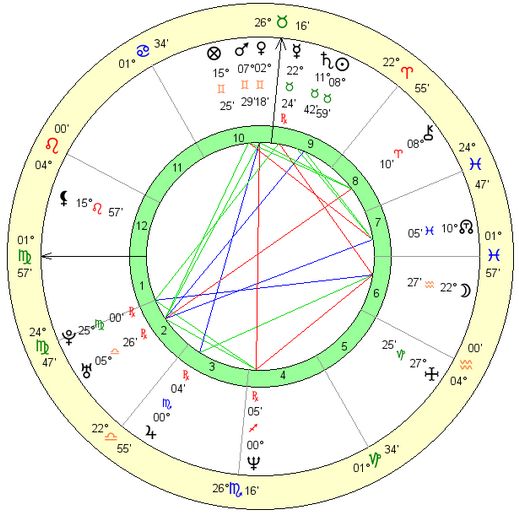
| Planet | Longitude | House | |
| Sun | 08 Taurus 59' 19" | 9 | |
| Moon | 22 Aquarius 27' 49" | 6 | |
| Mercury | 22 Taurus 24' 45" R | 9 | |
| Venus | 02 Gemini 18' 10" | 10 | |
| Mars | 07 Gemini 29' 36" | 10 | |
| Jupiter | 00 Scorpio 04' 02" R | 3 | |
| Saturn | 11 Taurus 42' 40" | 9 | |
| Uranus | 05 Libra 26' 28" R | 2 | |
| Neptune | 00 Sagittarius 05' 00" R | 4 | |
| Pluto | 25 Virgo 00' 57" R | 2 | |
| Chiron | 08 Aries 10' 51" | 8 | |
| Lilith | 15 Leo 57' 42" | 12 | |
| True Node | 10 Pisces 05' 47" | 7 | |
| Part of Fortune | 15 Gemini 25' 38" | 10 | |
| Vertex | 27 Capricorn 25' 16" | 5 | |
| House | Longitude | ||
| Ascendant | 01 Virgo 57' 08" | ||
| House 2 | 24 Virgo 47' 08" | ||
| House 3 | 22 Libra 55' 52" | ||
| House 4 | 26 Scorpio 16' 10" | ||
| House 5 | 01 Capricorn 34' 14" | ||
| House 6 | 04 Aquarius 00' 35" | ||
| House 7 | 01 Pisces 57' 08" | ||
| House 8 | 24 Pisces 47' 08" | ||
| House 9 | 22 Aries 55' 52" | ||
| MC (Midheaven) | 26 Taurus 16' 10" | ||
| House 11 | 01 Cancer 34' 14" | ||
| House 12 | 04 Leo 00' 35" |
| Planet | Aspect | Planet | Orb |
| Sun | Conjunction | Saturn | 2.72 |
| Sun | Quincunx | Uranus | 3.55 |
| Sun | Sextile | True Node | 1.11 |
| Sun | Trine | Ascendant | 7.04 |
| Moon | Square | Mercury | 0.05 |
| Moon | Trine | Jupiter | 7.60 |
| Moon | Square | Neptune | 7.62 |
| Moon | Quincunx | Pluto | 2.55 |
| Moon | Square | Midheaven | 3.81 |
| Mercury | Square | Moon | 0.05 |
| Mercury | Trine | Pluto | 2.60 |
| Mercury | Conjunction | Midheaven | 3.86 |
| Venus | Conjunction | Mars | 5.19 |
| Venus | Quincunx | Jupiter | 2.24 |
| Venus | Trine | Uranus | 3.14 |
| Venus | Opposition | Neptune | 2.22 |
| Venus | Sextile | Chiron | 5.88 |
| Venus | Square | Ascendant | 0.35 |
| Mars | Conjunction | Venus | 5.19 |
| Mars | Trine | Uranus | 2.05 |
| Mars | Sextile | Chiron | 0.69 |
| Mars | Square | True Node | 2.60 |
| Mars | Square | Ascendant | 5.54 |
| Jupiter | Trine | Moon | 7.60 |
| Jupiter | Quincunx | Venus | 2.24 |
| Jupiter | Square | Vertex | 2.65 |
| Jupiter | Sextile | Ascendant | 1.89 |
| Jupiter | Quincunx | Midheaven | 3.80 |
| Saturn | Conjunction | Sun | 2.72 |
| Saturn | Sextile | True Node | 1.61 |
| Uranus | Quincunx | Sun | 3.55 |
| Uranus | Trine | Venus | 3.14 |
| Uranus | Trine | Mars | 2.05 |
| Uranus | Sextile | Neptune | 5.36 |
| Uranus | Opposition | Chiron | 2.74 |
| Neptune | Square | Moon | 7.62 |
| Neptune | Opposition | Venus | 2.22 |
| Neptune | Sextile | Uranus | 5.36 |
| Neptune | Sextile | Pluto | 5.07 |
| Neptune | Sextile | Vertex | 2.66 |
| Neptune | Square | Ascendant | 1.87 |
| Neptune | Opposition | Midheaven | 3.81 |
| Pluto | Quincunx | Moon | 2.55 |
| Pluto | Trine | Mercury | 2.60 |
| Pluto | Sextile | Neptune | 5.07 |
| Pluto | Trine | Vertex | 2.41 |
| Pluto | Trine | Midheaven | 1.25 |
| Chiron | Sextile | Venus | 5.88 |
| Chiron | Sextile | Mars | 0.69 |
| Chiron | Opposition | Uranus | 2.74 |
| Lilith | Sextile | Part of Fortune | 0.53 |
| True Node | Sextile | Sun | 1.11 |
| True Node | Square | Mars | 2.60 |
| True Node | Sextile | Saturn | 1.61 |
| Part of Fortune | Sextile | Lilith | 0.53 |
| Vertex | Square | Jupiter | 2.65 |
| Vertex | Sextile | Neptune | 2.66 |
| Vertex | Trine | Pluto | 2.41 |
| Vertex | Trine | Midheaven | 1.15 |
| Ascendant | Trine | Sun | 7.04 |
| Ascendant | Square | Venus | 0.35 |
| Ascendant | Square | Mars | 5.54 |
| Ascendant | Sextile | Jupiter | 1.89 |
| Ascendant | Square | Neptune | 1.87 |
| Ascendant | Square | Midheaven | 5.68 |
| Midheaven | Square | Moon | 3.81 |
| Midheaven | Conjunction | Mercury | 3.86 |
| Midheaven | Quincunx | Jupiter | 3.80 |
| Midheaven | Opposition | Neptune | 3.81 |
| Midheaven | Trine | Pluto | 1.25 |
| Midheaven | Trine | Vertex | 1.15 |
| Midheaven | Square | Ascendant | 5.68 |
A Perspective on AstrologyAstrology reveals nothing more than celestial tendencies. A soul may master their stars through the conscious assertion of divine will. Should one choose to drift aimlessly along the currents of life, the patterns woven into the birth chart will eventually manifest their destiny. Yet, there is one profound mystery that a natal chart cannot map: the individual’s free will and their capacity for spiritual evolution. The exercise of this sovereign will rests entirely with the individual. Astrology serves as a sacred forewarning, granting us the wisdom to navigate life's shifting tides. What a soul sows, it must inevitably reap. The karmic law operates in perfect resonance with the planets. The incarnation of a soul into a physical vessel occurs at the exact cosmic alignment where karmic destiny and planetary forces harmonize. Indeed, in examining a celestial blueprint like the uma-thurman-birth-chart, we witness how these cosmic currents intertwine. Remember that the so-called favorable or adverse configurations within a horoscope are not products of chance or luck, but rather the fruits of our past deeds—the natal chart mirrors what we have carried over from previous incarnations and what we are destined to master in this lifetime. What we lack in our present existence can be cultivated in the future by consciously embracing our spiritual tasks. The stars impel, but they do not compel. As Goethe wisely wrote: *From every power that binds this world, a man frees himself when he gains self-control.* AscendantThe Ascendant is the gateway through which the soul enters to fulfill its karmic mission. It governs the physical appearance and outward personality, revealing how we were perceived by others in childhood, how we project ourselves onto the world, and our baseline of vital energy. It indicates our non-specific immunity, recovery rates, the foundation of our psychophysical constitution, temperament, and the very blueprint of our earthly destiny. The Ascendant of this personality is: VIRGO The core qualities of an individual with this Ascendant are meticulousness, consistency, and a highly analytical, logical mind. Such a person often projects an aura of refined perfection. The temperament is melancholic, yet often accompanied by a delicate will guided by apprehension and shyness (the "timid deer" syndrome). Psychically sensitive and unstable, even under favorable planetary influences, they cannot tolerate any form of pressure. Their greatest virtue is absolute precision (befitting a watchmaker or technician). They often struggle to perceive situations holistically, focusing instead on intricate details, unable to process everything all at once. An afflicted Ascendant breeds extreme sensitivity to details, overbearing pedantry, and the qualities of a brilliant detective or analyst—though they can be quite challenging to live with! Intimate life may present hurdles, as they often demand clinical purity from their partner and lack sexual spontaneity. The Bach flower remedy Crab Apple acts as a wonderful balm for this state. They endlessly dissect, criticize, and analyze problems, spending weeks on a single issue. Physically, they are often tall and slender, sometimes possessing a somewhat uncoordinated or gangly gait, giving a slightly awkward, lanky impression. Those of small or medium stature, however, often possess significant physical strength. Their handwriting often has an antique, historical, and artistic quality, showing an extraordinary appreciation for detail. Planets in the SignsPlanets in the signs form an essential foundation of astrological interpretation. The expression of each celestial body within a specific zodiac sign exerts a profound and highly characteristic influence upon our lives. Sun in Taurus Highly grounded individuals who seek stability and material security. They are resistant to changing their habits, preferring tangible resources and the practical side of existence. They tend to preserve everything—the favorable and unfavorable alike—clinging deeply to the past and their ancestral roots. Often highly creative and sensual, they may sometimes lack aggressive ambition. They are fiercely loyal, partly due to their aversion to altering their relational dynamics. Stubbornness is a common trait, and their pragmatic approach to life may make them skeptical of alternative healing modalities. Moon in Aquarius Characterized above all by emotional independence. This core trait naturally creates challenges in relationships, as these individuals feel suffocated when bound too tightly by emotions or family obligations. Resenting rigid responsibilities and duties, their domestic life is often unconventional and unpredictable. The Moon in Aquarius is frequently found in the charts of independent reformers and feminists. Mercury in Taurus Bestows a deliberate, methodical, and slow-paced intellect, capable of focusing intensely on practical problems. Though at a disadvantage in rapid verbal debates, they possess sound judgment because their thinking is not swayed by fleeting impulses. They view abstract speculation as a waste of time, preferring conservative thought patterns. Often diplomatic, a harmonious Mercury in Taurus is ideal for diplomatic service, as well as any profession requiring meticulousness and reliability. Venus in Gemini Creates a tendency to constantly analyze feelings, which can intellectually detach the individual from them. They can speak eloquently about their emotions, yet often struggle to truly feel them. In intense emotional situations, they may appear remarkably aloof. They are capable of initiating and ending relationships without deep inner turmoil, and they rarely embody the traditional archetype of absolute fidelity. Mars in Gemini Grants a sharp, agile mind that resolves practical problems through pure logic. However, they tend to scatter their energies by taking on too many tasks at once, which can delay or prevent success. A man with this placement typically woos a partner through endless conversation, unconsciously highlighting his intellect, wit, and cleverness. If the partner's Venus is also in Gemini or another Air sign, these intellectual advances are often highly successful. However, if her Venus is in an Earth sign, she may perceive him as a mere talker or even a fool. While the mental agility of this Mars is an asset, a notable disadvantage is a somewhat lower sexual energy and physical magnetism, which applies to both men and women. Jupiter in Scorpio In water signs, this placement demands emotional depth; the individual yearns for profound love and emotional fulfillment. Blessed with a sense of romance, they can also fall prey to self-pity, self-sacrifice, and sentimentality. Their desire to heal and help others is often expressed through therapeutic practices. A potential pitfall is a tendency toward unrestrained sexual expression. They are courageous, strong-willed, resourceful, and naturally drawn to the esoteric mysteries. Saturn in Taurus In earth signs, Saturn creates blockages and challenges in the physical and material realms. Unexplained difficulties arise regarding deadlines and schedules, yet the responsibility ultimately rests upon the individual. Highly pragmatic, they value firm, uncompromising stances, keeping their feet planted firmly on the ground rather than drifting into fantasy. This Saturn reinforces conservative views and stubbornness. Under challenging aspects, it can obstruct finances, yet it intensifies the desire for material security, often leading to frustration due to a perceived lack of abundance. Planets in the Astrological HousesEach house represents a specific arena of life. The placement of a planet within a house reveals how one fares in that particular domain. For a precise calculation of these planetary houses, an accurate birth time is absolutely essential. Sun in the 9th House This placement confers many fascinating inclinations. Foremost is a strong affinity for foreign lands, manifested through long journeys of discovery, study abroad, marriage to a foreigner, or living permanently overseas. It fosters a love for higher education, a deep (yet highly personal and non-dogmatic) faith, a lifelong thirst for knowledge, hermetic abilities, an interest in esoteric religions, and a natural aptitude for white magic. The Sun in the ninth house also favors publishing endeavors. The evolution of relationships is critical here; since the ninth house governs the expansion of established bonds, the sign and aspects of the Sun must always be considered. Harmonious aspects (such as a trine to Saturn) foster stability and healthy long-term growth, whereas a Pisces Sun squaring Neptune and conjunct Uranus almost inevitably leads to the dissolution of relationships through anarchy, illusion, and a groundless desire for freedom, coupled with a rejection of the structure necessary for any relationship to endure. A well-placed Sun in the ninth house expands ideas, opens consciousness to higher energies, and brings spiritual realization. These individuals possess synthesis-oriented thinking (as opposed to the analytical nature of the third house), allowing them to form balanced worldviews. They are the quintessential inquisitive intellectuals. Moon in the 6th House This is a somewhat challenging placement for the Moon, as the sixth house governs daily service and labor. The individual may find themselves in subordinate or menial roles despite possessing high qualifications, which can cause internal distress. Strong, harmonious aspects can mitigate this. They often perform thankless tasks within the family unit as well, and their innate willingness to serve can lead to exploitation by others. Their productivity is highly dependent on the emotional fluctuations triggered by this lunar placement. They find deep emotional satisfaction in charitable works and helping others. In their work, they are diligent. Challenging aspects to the Moon attract unreliable or difficult co-workers, and vice versa. These individuals share a profound emotional bond with animals; work as an animal caretaker, for example, is deeply fulfilling to their soul. It is vital for intelligent, gifted children with this placement to care for a pet from an early age, as this fulfills their emotional needs and tempers the later urge to accept subordinate employment. A child with this Moon has a vital emotional need to express their feelings directly; suppressing these expressions is highly damaging. The worst phrase they can hear is "your emotions are a burden to others," which leads to severe psychological blockages and physical illness. The Moon in the sixth house can indicate fluctuating health linked to lunar cycles. The zodiac sign indicates the specific physical vulnerability—such as skin or gum inflammation in Capricorn, or stomach issues in Cancer. Diets aligned with lunar cycles are highly beneficial, facilitating a profound purification of both body and soul. Mercury in the 9th House This individual possesses outstanding scholarly talents, yearning for self-improvement and wisdom, which often leads to academic advancement. Their interests lie in philosophy, religion, law, and foreign cultures. A challenging aspect of this placement is a persistent, often justified, feeling of being intellectually marginalized throughout life. They excel in studying high hermetic arts (Kabbalah, Tarot, Hermeticism), enjoying an open channel to esoteric information. Relationships are nurtured through the exchange of ideas, which simultaneously refines their own intellect. They constantly analyze their ideals; whether they sustain faith in them depends on Mercury's aspects. Since the ninth house rules synthetic thought and Mercury rules analytical thought, friction between these two cognitive styles often manifests physically as allergies. Venus in the 10th House This placement of Venus bestows a polished and diplomatic demeanor in professional matters, a quality that greatly aids career advancement. They collaborate beautifully with others, though they may subordinate their personal life to professional duties (such as attending social events for career leverage). Typical professions include the arts or real estate. They frequently work alongside women, often in female-dominated or mixed environments. Through a partner, they learn to integrate and accept societal rules and laws, which is vital for their development; without accepting these rules, they will not feel validated by society. This places higher demands on the partner, as many individuals integrate these rules with great reluctance, especially if Uranus aspects their tenth house. The partner should ideally teach them the art of non-judgment, a practice closely linked to acceptance. Self-esteem is built on professional success, harmonious relations with colleagues, a balanced work-life dynamic, and the successful integration of societal structures. Mars in the 10th House This placement of Mars is always somewhat tense, as the individual is fiercely ambitious, striving for preeminence. It is a classic signature of leadership, but if afflicted, it manifests as a significant obstacle: driven by aggression and a refusal to compromise, the individual adopts roles and standards that do not truly align with their spiritual evolution (pretending to be something they are not) to maintain their status at all costs. If they hold onto power, they are resented by their peers; if they lose it, they turn that resentment inward. They may literally "walk over bodies" to achieve their goals, showing little regard for others. Even a harmoniously aspected Mars in the tenth house tends to jump to hasty conclusions. Typical vocations include military doctors, surgeons, engineers, and metalworkers. A retrograde Mars suggests past-life rebellions against authority and involvement in corruption. For a healer or physician, it points to accepting bribes for healing in a past incarnation—a grave karmic transgression. Consequently, they face arduous working conditions in this lifetime. In the chart of a statesman or politician, a retrograde Mars points to past-life corruption; karmically, nothing could be worse for such a person than to continue accepting bribes in this life. Jupiter in the 3rd House This Jupiter amplifies the matters of the first house, such as self-assertion, vital energy, and non-specific immunity, especially when harmoniously aspected. The individual possesses exceptional communication and media skills, enjoys supportive siblings, and experiences favorable academic conditions where success is almost guaranteed. Harmonious aspects between Jupiter and the Moon or Mercury bestow literary talent and a gift for journalism. They love to travel and feel most alive when taking short, frequent trips. An afflicted Jupiter manifests as intellectual snobbery—an ostentatious display of intellect. Such individuals may lack natural brilliance, compensating by collecting academic degrees. Once obtained, they insist on their formal display and revel in endless, circular debates. A retrograde Jupiter can cause minor speech impediments, reflecting past-life exploitation or neglect of siblings. In this incarnation, relations with siblings present challenges designed to help them resolve and heal these past karmic errors. Saturn in the 9th House The individual is deeply influenced by the religious conventions and moral standards of their upbringing. This imprint is virtually unyielding; conscious effort can only modify its form, not its core essence. The more one rebels against this influence, the harder it is to transcend. Long-distance travel is often blocked; business trips prove more fruitful than journeys of self-discovery. Travel carries inherent risks; for instance, Saturn in Scorpio can expose the individual to dangerous situations or threats. They are drawn to higher philosophy and law, but an afflicted Saturn blocks these pathways, breeding frustration. In its compensatory form (in electric signs), it drives an obsessive pursuit of esoteric knowledge, foreign religions, and philosophy, which naturally creates further blocks. The primary trauma lies in relationship growth. They initiate and solidify bonds well, but struggle to sustain them, leading to mysterious breakups unless they adhere to societal norms. Until Saturn's energy is integrated, they cannot develop relationships in accordance with their soul's intuitive desires. Saturn in the ninth house is common in the charts of scientists studying the interaction of matter and radiation, advanced occultists, and serves as an ideal aspect for understanding divine essence, materialization, and altering the structure of matter. Uranus in the 2nd House Creates blockages or overcompensations in self-boundary, self-assertion, finances, and the definition of personal space (both inner and outer). For example, under strong compensation, an individual might build an imposing, unusual fence around their home, filling their living space with chaotic belongings. Conversely, a blockage results in an impersonal, empty, and sterile home. A third reaction is projection, where they blame external circumstances for their financial woes, refusing to see that the issue lies within. They defend their self-worth at all costs, seeking to define themselves through material possessions. Yet, Uranus acts as a "conduit" for money; they are rarely thrifty and struggle to acquire lasting assets. Income is erratic; financial windfalls typically come from sudden lottery wins, original discoveries, or inventions. They often hold eccentric views on money. If Uranus is powerfully and harmoniously aspected, however, they can amass significant wealth through scientific breakthroughs or original ideas. Neptune in the 4th House In childhood, the domestic environment was likely confusing or obscure—something was "not quite right." Often, there is a hereditary link to alcoholism, warning the individual to exercise extreme caution with intoxicants. They are prone to romanticizing the ideal home, yet they prefer comfortable chaos over domestic organization. The primary Saturnian trauma is dissolved through an unconventional upbringing, a pattern they may repeat with their own children. An afflicted Neptune causes crises of identity and belonging, blocking access to ancestral roots and triggering anxiety neuroses. They are more susceptible to hereditary psychological conditions, such as schizophrenia, psychoses, or obsessive-compulsive tendencies. In this context, schizophrenia is a state of divided consciousness—a natural state of awareness that is not inherently a disease but a reaction to the social environment. (The individual rarely grasps their own state). It is an almost inevitable threshold in spiritual evolution; when the soul accepts its multi-faceted perception, clinical symptoms fade. This aspect can manifest as sleepwalking, substance abuse, and emotional volatility, alongside a dramatic need to express feelings (akin to hysteria). It breeds confusion, chaos, unrealistic desires, and a deep love for art and fashion. Pluto in the 2nd House Pluto resides here within the vibrational field of Venus. In a harmonious position, the individual amasses wealth through plutonic means, though financial operations may put them in high-pressure situations; their fixations are deeply rooted in capital. (An afflicted Pluto in a Venusian field forms the energetic basis of unbridled capitalism). Financial acquisition is always laden with intense expectations. A harmonious Pluto is an exceptional signature for a stockbroker (greatly amplified by a Scorpio Ascendant), while an afflicted placement grants similar brilliant instincts but carries the risk of catastrophic financial ruin following a streak of success. (A harmonious Pluto coupled with an afflicted Scorpio Ascendant can yield a similar outcome). If the Scorpio vibration is linked to the eighth house, financial collapse can lead to self-harm or other violent ends. Aspects of the PlanetsAn aspect represents the geometric relationship between planets. By examining the angles they form, we can discern how these celestial forces interact. Aspects are divided into three groups: harmonious, challenging, and conjunctions. The interpretations below reveal how these celestial alignments manifest in life. Sun conjunct Saturn Bestows profound self-discipline. The individual often clings to established routines, lacking the desire or courage for change. Though they encounter various hardships, they possess the spiritual resilience to overcome them, growing stronger through learned experience. Sun in harmonious aspect to Ascendant Grants a friendly, energetic, self-assured, and sincere disposition. This aspect supports robust health and inner vitality. Moon in challenging aspect to Mercury Challenging aspects can impair memory. While empathy is strong, the individual may misinterpret the feelings of others. It breeds emotional struggles and a tendency toward gossip. Although highly intelligent, they may use their intellect to weave highly convincing and natural-sounding falsehoods, often falling prey to self-deception and believing their own fabrications. Moon in harmonious aspect to Jupiter Indicates an exceptionally open, optimistic, and generous nature. These qualities bring success, and their positive aura naturally uplifts others. An idealist who cherishes a beautiful home, they are often successful in academics and legal matters. Moon in challenging aspect to Neptune Awakens a yearning for something beyond the mundane self, driving the individual toward esoteric paths and mysticism. Highly self-sacrificing, they are prone to exploitation. They are drawn to exotic arts, though they neglect domestic order. This alignment blends sensitivity and receptivity, allowing them to tap into higher vibrations and artistic inspiration. However, it is also a primary signature for psychological vulnerabilities (schizophrenia, psychoses). Here, schizophrenia is viewed as a split consciousness—a natural state of awareness that is not inherently a disease but a reaction to the social environment. (The individual rarely grasps their own state). It is an almost inevitable threshold in spiritual evolution; when the soul accepts its multi-faceted perception, clinical symptoms fade. This aspect can manifest as sleepwalking, substance abuse, and emotional volatility, alongside a dramatic need to express feelings (akin to hysteria). It breeds confusion, chaos, unrealistic desires, and a deep love for art and fashion. Mercury in harmonious aspect to Pluto Bestows an iron will and clear, incisive convictions. Their intellectual scope is vast, ranging from occultism and psychology to mathematics and physics. They require an active exchange of ideas and experiences. The influence is similar to the conjunction, though milder, with a stronger urge to persuade others. Venus conjunct Mars Infuses the individual with deep sensitivity, though they crave constant social, physical, and sexual stimulation. Possessing immense energy, they are highly popular, though their self-assurance can border on selfishness. They are quick-tempered but quick to forgive, yearning for harmony and reconciliation. This alignment highly charges their sexual magnetism. For a woman, caution is advised regarding potential male aggression or crossing of boundaries. Venus in harmonious aspect to Uranus Demands constant excitement and spontaneity from friends and partners. Emotionally independent, they avoid restrictive commitments. They form relationships impulsively, though these bonds are rarely long-lasting. This aspect grants immense sex appeal and a sudden, magnetic attraction. Physically, with a daytime Venus (ruling the 7th House and Libra), it can manifest as fetishism, voyeurism, frotteurism, certain forms of homosexuality, vitiligo, or unexplained renal colic (spasms without kidney stones). It can also cause ureteral spasms and sudden spinal issues or herniated discs in the lumbar region. With a nighttime Venus (Taurus, 2nd House), it may manifest as dysphagia (throat spasms), difficult menopausal transitions, a floating kidney, or misaligned cervical vertebrae. Venus in challenging aspect to Neptune Fosters an intense, romantic idealism that complicates life and leads to convoluted situations. They often prefer fantasy over reality, and esoteric pursuits can drain the energy needed for real-world relationships. They must cultivate detachment and emotional resilience. It can also breed laziness. For instance, Venus in Taurus in the second house indicates an obsessive desire for material possessions. Note the cardinal rule of astrology: if a chart contains a single powerful aspect within fixed signs, it exerts the strongest, most karmic influence, serving as the benchmark for all other aspects. When Neptune in a fixed sign squares Venus in a fixed sign (especially in angular houses), it points to an obsessive manipulation of physical matter that is highly difficult to resolve. It manifests as a deep dependency on sensory stimulation and an immense need for physical affection (such as prolonged embraces). A daytime Venus in Libra breeds an obsessive pursuit of aesthetic perfection. Venus in challenging aspect to Ascendant The individual constantly seeks external validation, struggling with self-doubt. They naturally attract circumstances that require little effort on their part. While they possess a charming, warm, and highly agreeable personality, they can sometimes be insincere, take things for granted, or succumb to laziness. Mars in harmonious aspect to Uranus Confers fierce individualism and eccentric interests. This energy typically flows in one of two directions: either involvement in radical, anti-establishment groups, or a dedication to cutting-edge research in engineering, architecture, or technology. It is an outstanding signature for high-performance sports requiring short, explosive bursts of energy. Mars in challenging aspect to Ascendant The individual tends to be assertive, highly independent, and competitive, finding it difficult to collaborate. They may project an arrogant or egoistic aura. An internal conflict rages between their personal desires and the need for harmonious relationships, occasionally leading to impulsive behavior and sudden outbursts of anger. Jupiter in harmonious aspect to Ascendant Grants an exceptionally social, optimistic, enthusiastic, and tolerant disposition. They love entertainment and enjoy gathering knowledge across a vast array of subjects. Others are naturally drawn to their warm and comforting presence. Uranus in harmonious aspect to Neptune Inspires a yearning for a purposeful life, though the influence is subtle and requires the support of other planets to fully manifest. It also enhances the creative imagination. Neptune in harmonious aspect to Pluto These harmonious aspects are generational; the sextile between these two planets lasted from 1945 to 1995, fostering peaceful global mindsets and, when supported by other alignments, driving major transformative and peace-seeking movements worldwide. Neptune in challenging aspect to Ascendant The individual is often selfless in relationships, sometimes to their own detriment. They must learn to set healthy boundaries and avoid codependent dynamics where they play the victim or martyr. They must remain strong, refusing to let others exploit their gentle, compassionate nature. Self-doubt can lead them to trust untrustworthy individuals. In this lifetime, their soul’s task is to stand strong, cultivate self-reliance, and prevent others from taking advantage of their kindness. ConclusionThis natal chart was calculated based on the assumption that the provided birth details—including time, location, and time zone (with adjustments for daylight saving time)—are accurate. Even an hour's discrepancy in birth time will yield inaccurate house placements or an incorrect Ascendant. By no means is this astrological analysis exhaustive. Every human being is a far more complex and multifaceted entity than can be captured on a single page. To generate your own personalized natal chart online completely free of charge, please visit Free Natal Chart Source Zbyněk Slába www.oranzovestranky.cz |
