
david gahan birth chart
Personal Horoscope
Born Wednesday, May 09, 196205:00:00 (Time Zone = GMT +1 hour)
00e05, 51n38
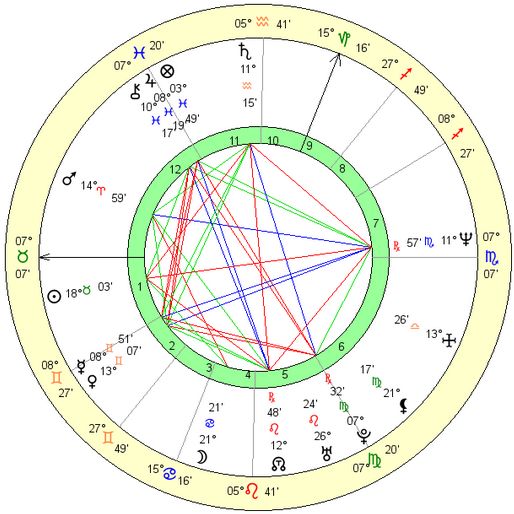
| Planet | Celestial Longitude | House | |
| Sun | 18 Taurus 03' 31" | 1 | |
| Moon | 21 Cancer 21' 17" | 4 | |
| Mercury | 08 Gemini 51' 56" | 2 | |
| Venus | 13 Gemini 07' 33" | 2 | |
| Mars | 14 Aries 59' 37" | 12 | |
| Jupiter | 08 Pisces 19' 10" | 12 | |
| Saturn | 11 Aquarius 15' 55" | 11 | |
| Uranus | 26 Leo 24' 15" | 5 | |
| Neptune | 11 Scorpio 57' 36" R | 7 | |
| Pluto | 07 Virgo 32' 50" R | 6 | |
| Chiron | 10 Pisces 17' 08" | 12 | |
| Lilith | 21 Virgo 17' 19" | 6 | |
| True Node | 12 Leo 48' 38" R | 5 | |
| Part of Fortune | 03 Pisces 49' 57" | 11 | |
| Vertex | 13 Libra 26' 03" | 6 | |
| House | Celestial Longitude | ||
| Ascendant | 07 Taurus 07' 43" | ||
| House 2 | 08 Gemini 27' 08" | ||
| House 3 | 27 Gemini 49' 49" | ||
| House 4 | 15 Cancer 16' 25" | ||
| House 5 | 05 Leo 41' 25" | ||
| House 6 | 07 Virgo 20' 30" | ||
| House 7 | 07 Scorpio 07' 43" | ||
| House 8 | 08 Sagittarius 27' 08" | ||
| House 9 | 27 Sagittarius 49' 49" | ||
| MC (Midheaven) | 15 Capricorn 16' 25" | ||
| House 11 | 05 Aquarius 41' 25" | ||
| House 12 | 07 Pisces 20' 30" |
| Planet | Aspect | Planet | Orb |
| Sun | Sextile | Moon | 3.30 |
| Sun | Square | Saturn | 6.79 |
| Sun | Opposition | Neptune | 6.10 |
| Sun | Sextile | Chiron | 7.77 |
| Sun | Trine | Midheaven | 2.79 |
| Moon | Sextile | Sun | 3.30 |
| Moon | Square | Mars | 6.36 |
| Moon | Sextile | Lilith | 0.07 |
| Moon | Opposition | Midheaven | 6.08 |
| Mercury | Conjunction | Venus | 4.26 |
| Mercury | Square | Jupiter | 0.55 |
| Mercury | Trine | Saturn | 2.40 |
| Mercury | Quincunx | Neptune | 3.09 |
| Mercury | Square | Pluto | 1.32 |
| Mercury | Square | Chiron | 1.42 |
| Venus | Conjunction | Mercury | 4.26 |
| Venus | Sextile | Mars | 1.87 |
| Venus | Square | Jupiter | 4.81 |
| Venus | Trine | Saturn | 1.86 |
| Venus | Quincunx | Neptune | 1.17 |
| Venus | Square | Pluto | 5.58 |
| Venus | Square | Chiron | 2.84 |
| Venus | Sextile | True Node | 0.32 |
| Venus | Trine | Vertex | 0.31 |
| Venus | Quincunx | Midheaven | 2.15 |
| Mars | Square | Moon | 6.36 |
| Mars | Sextile | Venus | 1.87 |
| Mars | Sextile | Saturn | 3.73 |
| Mars | Quincunx | Neptune | 3.03 |
| Mars | Trine | True Node | 2.18 |
| Mars | Opposition | Vertex | 1.56 |
| Mars | Square | Midheaven | 0.28 |
| Jupiter | Square | Mercury | 0.55 |
| Jupiter | Square | Venus | 4.81 |
| Jupiter | Trine | Neptune | 3.64 |
| Jupiter | Opposition | Pluto | 0.77 |
| Jupiter | Conjunction | Chiron | 1.97 |
| Jupiter | Sextile | Ascendant | 1.19 |
| Saturn | Square | Sun | 6.79 |
| Saturn | Trine | Mercury | 2.40 |
| Saturn | Trine | Venus | 1.86 |
| Saturn | Sextile | Mars | 3.73 |
| Saturn | Square | Neptune | 0.69 |
| Saturn | Quincunx | Pluto | 3.72 |
| Saturn | Opposition | True Node | 1.55 |
| Saturn | Trine | Vertex | 2.17 |
| Saturn | Square | Ascendant | 4.14 |
| Neptune | Opposition | Sun | 6.10 |
| Neptune | Quincunx | Mercury | 3.09 |
| Neptune | Quincunx | Venus | 1.17 |
| Neptune | Quincunx | Mars | 3.03 |
| Neptune | Trine | Jupiter | 3.64 |
| Neptune | Square | Saturn | 0.69 |
| Neptune | Sextile | Pluto | 4.41 |
| Neptune | Trine | Chiron | 1.67 |
| Neptune | Square | True Node | 0.85 |
| Neptune | Opposition | Ascendant | 4.83 |
| Neptune | Sextile | Midheaven | 3.31 |
| Pluto | Square | Mercury | 1.32 |
| Pluto | Square | Venus | 5.58 |
| Pluto | Opposition | Jupiter | 0.77 |
| Pluto | Quincunx | Saturn | 3.72 |
| Pluto | Sextile | Neptune | 4.41 |
| Pluto | Opposition | Chiron | 2.74 |
| Pluto | Trine | Ascendant | 0.42 |
| Chiron | Sextile | Sun | 7.77 |
| Chiron | Square | Mercury | 1.42 |
| Chiron | Square | Venus | 2.84 |
| Chiron | Conjunction | Jupiter | 1.97 |
| Chiron | Trine | Neptune | 1.67 |
| Chiron | Opposition | Pluto | 2.74 |
| Chiron | Quincunx | True Node | 2.52 |
| Chiron | Sextile | Ascendant | 3.16 |
| Chiron | Sextile | Midheaven | 4.99 |
| Lilith | Sextile | Moon | 0.07 |
| True Node | Sextile | Venus | 0.32 |
| True Node | Trine | Mars | 2.18 |
| True Node | Opposition | Saturn | 1.55 |
| True Node | Square | Neptune | 0.85 |
| True Node | Quincunx | Chiron | 2.52 |
| True Node | Sextile | Vertex | 0.62 |
| True Node | Quincunx | Midheaven | 2.46 |
| Vertex | Trine | Venus | 0.31 |
| Vertex | Opposition | Mars | 1.56 |
| Vertex | Trine | Saturn | 2.17 |
| Vertex | Sextile | True Node | 0.62 |
| Vertex | Square | Midheaven | 1.84 |
| Ascendant | Sextile | Jupiter | 1.19 |
| Ascendant | Square | Saturn | 4.14 |
| Ascendant | Opposition | Neptune | 4.83 |
| Ascendant | Trine | Pluto | 0.42 |
| Ascendant | Sextile | Chiron | 3.16 |
| Midheaven | Trine | Sun | 2.79 |
| Midheaven | Opposition | Moon | 6.08 |
| Midheaven | Quincunx | Venus | 2.15 |
| Midheaven | Square | Mars | 0.28 |
| Midheaven | Sextile | Neptune | 3.31 |
| Midheaven | Sextile | Chiron | 4.99 |
| Midheaven | Quincunx | True Node | 2.46 |
| Midheaven | Square | Vertex | 1.84 |
An Astrological PerspectiveAstrology reveals nothing more than tendencies. Man can master his stars if he exerts his will. If one chooses to drift along the currents of life, the tendencies indicated in the natal chart will eventually manifest their effects at some point. One thing a natal horoscope does not show is the individual's will and how it might evolve. The exercise of free will is left entirely to the individual. Astrology forewarns us, allowing us to better navigate the situations we encounter in life. What a man sows, he must reap. The karmic law works in harmony with the planets. The birth of a soul into a physical body occurs at the opportune moment when both karmic law and the planets can operate in perfect alignment. Remember that the so-called good or evil configurations in a horoscope are not the result of chance or luck, but are the harvest of our past actions—the chart displays what we have brought from past lives and what we must master in this one. What we lack in our current life can be acquired in the future by taking up specific spiritual tasks. The stars impel, they do not compel. As Goethe wisely said: "From every power that binds the world, man frees himself when he gains self-control." The AscendantThe Ascendant is the gateway of the soul, serving to fulfill the being's karmic mission. It expresses the physical appearance and personality, revealing how we were perceived by others in childhood, how we assert ourselves in our environment, our baseline level of available energy, our non-specific immunity, recovery periods, the foundation of our psychofyzical constitution, temperament, and the blueprint of our destiny. The Ascendant of the personality is: TAURUS This placement manifests as a more reserved nature, stability, as well as stubbornness and exquisite taste. Phlegmatic in temperament, the will is resilient and enduring, with deliberate and slow decision-making. The demeanor is dignified and diplomatic; it is highly difficult to provoke them to anger—their reaction time is long, but when they finally "charge," it is truly a sight to behold! :-) They adore aesthetic, pleasant, and harmonious environments. If aspected by Mercury, they make excellent storytellers, joke-tellers, and caricaturists; they sometimes lean toward gardening and construction (embodying solidity, reliability, and precision). In an inharmonious placement, they can be intensely stubborn, obstinate, and require a long time to realize that clinging to a rigid ritual is futile. Strong materialism and attachment to earthly possessions are common. They demand perfect physical and material security; in a challenging aspect, this can become their primary life pursuit. Physically, it often presents as a sturdy, robust body, a short and strong neck, a broad nose, curly hair, and often dark eyes and hair. The gait is heavy and grounded. Their dancing is often precise, with flawless variations. A dimple in the chin or cheek (sometimes shared with Libra) is common. A joyous expression while dancing also reliably betrays a Taurus Ascendant. Planets in the SignsPlanets in the signs are a crucial element of chart interpretation. The manifestation of each planet in a specific zodiac sign exerts a profound and highly characteristic influence on our lives. Sun in Taurus Highly conservative individuals who require stability and material security. They dislike changing their habits and prefer material means and the practical side of things. They tend to preserve everything—the good and the less good—and cling too heavily to the past and their roots. Often, these individuals are creative and sensual, yet they usually lack healthy ambition. They are intensely loyal, partly because they dislike changing their relationships. They often suffer from stubbornness, and their pragmatic approach to life rarely takes alternative healing methods or other unconventional ideas into account. Moon in Cancer These individuals are deeply sensitive, possessing a wealth of inner affection, but they need and demand a great deal of reciprocal love to feel happy and emotionally secure. Interestingly, a person with this Moon placement requires guidance—a stable oversight by another person that allows them to live in peace, relax, and find their spiritual identity. This is a maternal archetype with a profound appreciation for the safety and warmth of home; men with this placement are also nurturing and often seek deep relationships with motherly women. If their own mother was intensely maternal, it can lead to difficulties in forming romantic relationships due to an emotional fixation on her. Mercury in Gemini Here, Mercury is in its essential dignity. The most critical activity for this individual is acquiring and transmitting knowledge (the archetype of the teacher). Thinking is clear, logical, and demands intellectual stimulation. They love verbal sparring. The mind of such a person is highly flexible; they possess a natural aptitude for study, combinatorics, and mathematics. Highly versatile, they exhibit excellent rhetoric and a pleasant voice, though they may change their opinions very rapidly. They suffer from constant nervous tension and need active movement to disperse this energy. Mercury in Gemini is found in excellent merchants; when afflicted, however, it is the mark of skilled pickpockets (quick, nimble fingers). An inharmonious Mercury is superficial, scattered, unfocused, and lacks endurance. Venus in Gemini This placement creates difficulties through its tendency to constantly analyze feelings, which effectively distances the individual from experiencing them. They can speak of their emotions eloquently but are often unable to truly feel them. In emotional situations, they can appear detached. They are capable of forming and ending relationships without significant inner involvement and do not typically represent the archetype of romantic fidelity. Mars in Aries This infuses the native with fieriness, energy, and assertiveness. It is a classic constellation for a warrior, military leader, or top-tier executive—though caution is advised, as this role often lacks the necessary tact and diplomacy. A personality with Mars in Aries deals with opponents mercilessly and without considering the consequences. Such individuals tend to be unobservant of details, which complicates practical matters. They may not be ideal partners, as women in particular find inattentive men hard to tolerate. Their energy is immense and difficult to contain, leading to a constant urge to discharge it. Although Aries is a cardinal sign, Mars here drives a ceaseless quest for the new. Characteristic traits include combativeness, competitiveness, aggressiveness, rivalry, and a direct expression of thoughts and opinions. Interestingly, in women's charts (if Mars is not in the first house), they will subconsciously seek a partner who embodies these traits—someone with a sense of adventure, who may often belong to rescue or armed forces. A typical trait of a man with Mars in Aries is a constant desire to banish boredom; in relationships, this manifests after some time as a craving for new adventure and excitement, which can lead to infidelity. Jupiter in Pisces In water signs, such an individual primarily seeks emotion, yearning for love and emotional fulfillment. Blessed with a sense of romance, they can also succumb to self-pity, self-sacrifice, and sentimentality. They channel their desire to help others through good intentions and prayer; this is an ideal aspect for spiritual seekers, priests, and mystics. The drawbacks are illusions, idle daydreaming, unconstructive fantasies, excessive religious devotion, and a potential susceptibility to addictive substances (depending also on Jupiter's aspects to other planets). They love music, leaning toward classical or liturgical genres. Saturn in Aquarius In air signs, this planet primarily blocks communication and mental development. However, it supports (especially in the case of strong aspects) mental discipline, granting the strength and motivation to overcome intellectual hurdles. The core issue of Saturn in Aquarius is that the individual often becomes authoritarian in their opinions, viewing their subjective beliefs as absolute truths and trying to force them upon others relentlessly (depending on the nature of the aspects). Since this placement chiefly affects mental faculties, it is highly unfavorable for roles like scientific research directors, who may reject the validity of others' ideas and push their own unconstructive views at the expense of progress and collaboration. Planets in the Astrological HousesEach house represents a specific area of life. The placement of a planet in a house reveals how one fares in that particular domain. For an accurate calculation of planets in the houses, the most precise birth time possible is required. Sun in the 1st House This placement is unique as the Ascendant often lies in the same sign, further amplifying the Sun's influence. The individual will seek self-actualization through the physical body, sports, self-assertion, or entrepreneurship. The exact manner and energy of this drive are shown by the zodiac sign the Sun occupies and its aspects. Challenging aspects reinforce an unpleasant selfishness and imperiousness. Such a person becomes vain and loves to command others while sparing themselves. The Sun in the first house places the interests of the ego and the physical body above all else. The difference in self-assertion is naturally vast between Aries (where these traits manifest *ad absurdum*) and Pisces (which always seeks the broader aspects of behavior, though this is not absolute). The Sun in the first house always bestows abundant vitality, driving a great deal of energy into sports and physical activities, as well as a higher resistance to illness. Moon in the 4th House Evaluating this lunar placement responsibly is quite complex. In an age that rarely favors traditional values, the fourth house plays a fundamental role. Unlike the egoistic drive of the Sun, the Moon represents the needs of the soul—here, the soul's yearning for a harmonious domestic environment and emotional security. A well-aspected Moon can create a home saturated with peace and comfort. Challenging aspects have a similar yearning, but the individual's efforts to establish a serene environment may fail. The person's upbringing and parental attitudes in childhood have a massive influence. Unfortunately, most children with a challenged Moon naturally grow up in less-than-tranquil homes, as the fourth house also speaks of our origins. An individual with the Moon in the fourth house may experience highly fluctuating success in all activities. Destined events can be similarly unexpected and volatile. One day they give and receive effortlessly; a week later, everything changes (depending on aspects and sign). If not heavily afflicted, the Moon here eases the key processes of the fourth house: discovering feelings, finding spiritual authenticity, and the capacity to accept and be accepted. Afflictions, however, lead to blockages in natural physical expression, such as movement, dance, or even comfort with one's own nudity—creating intimacy blocks due to shame. Finally, the fourth house rules real estate; the Moon's placement indicates fluctuations in property matters. This individual always maintains a deep, personal emotional connection to ancestral property and their own heritage. Mercury in the 2nd House The individual heavily focuses their attention on material matters and securing financial stability. Usually, this personality is skilled at earning money through intellectual pursuits and investing it wisely. They prefer independent work but also enjoy careers in journalism, tourism, or the communication industry. Through intellect and communication, they define themselves within their environment. They generally evaluate themselves realistically, though their self-worth is somewhat dependent on external feedback. This is an ideal aspect for tax advisors, financiers, financial analysts, and brokers. Through these professions, the individual builds healthy self-confidence, possessing an excellent capacity for continuous growth and gathering necessary information through media channels. Venus in the 2nd House This individual often derives their material means from artistic pursuits or romantic relationships—paradoxically, this especially applies to men. This is not a "marriage of convenience" followed by an inheritance, but a relationship where the man actualizes his career through his partner, earning a corresponding income. These individuals often spend money on social activities or luxury items (especially in Capricorn). They may try to form connections by dazzling their partner with their income, assets, or overall material security. They work best with their inner space through a partner, who can teach them much about earning material wealth through their own labor. Self-esteem is heavily anchored in romantic partnerships and material abundance. Mars in the 12th House This is arguably the most challenging placement for Mars (as it is for most planets), because the twelfth house rules isolation, mental suffering, confinement, state institutions, and hospitalization, alongside spiritual culmination and enlightenment. The aspects of Mars are therefore crucial. With harmonious aspects, the native has mystical inclinations in which they succeed, working patiently for a good cause without needing recognition. If the aspects are challenging, the negative vibration of Neptune manifests, leading to alcoholism (of the water type), a tendency toward psychotropic substances, schizophrenia, and psychotic states (manic depression, etc.). Secret enemies may harm them (e.g., an official arbitrarily denying a crucial application). If Mars is retrograde, it indicates the abuse of magical and mystical powers in a past life, complicating these practices today and often bringing a lonely, melancholy life, confinement, or long-term hospitalization. The specific signs clarify these impacts: Mars in Aries faces direct violence, whereas in Pisces it manifests as alcoholism or addiction. Every person with Mars in the twelfth house needs a purpose for their spiritual activities; without it (especially with difficult aspects), they resort to plotting, self-loathing, and resentment. Accumulated negative emotions can erupt as mental health struggles. Illnesses arising in the twelfth house are difficult to treat with allopathic medicine but respond well to alternative and esoteric therapies, such as homeopathy. Martial illnesses are generally easier to treat than plutonian ones. It is vital to remember that twelfth-house challenges serve spiritual growth and karmic cleansing, prompting the soul to recognize past-life transgressions, an area where alternative medicine is highly supportive. Jupiter in the 12th House Harmoniously, this manifests as an interest in mysticism (further supported by Cancer and Pisces), astrology, religion, and yoga. Within a harmonious Capricorn and Aquarius field, this Jupiter offers great promise for completing the process of redemption (the ultimate principle of the twelfth house). Generally, individuals with this placement have an open path to self-discovery through meditation, connecting to higher informational fields, and perceiving deeper connections. Through these methods, they can grow and expand. This constellation grants a profound understanding of higher cosmic law, amplified by harmonious aspects to Neptune or Pisces. Challenging aspects in the twelfth house are always problematic, and Jupiter is no exception. Such individuals feel dissatisfied with reality, escaping into fantasy, religion, and mysticism. As grand idealists, they may suffer from psychological tension. A retrograde Jupiter indicates a karmic debt and suggests that in a past life, the soul did not fully utilize its opportunities for spiritual evolution toward redemption. Now, the opportunity returns under more difficult conditions. This is a mentally heavy aspect leading to isolation and suffering, but through specific esoteric signatures, the energies of a retrograde Jupiter can be integrated to accelerate positive spiritual evolution. Saturn in the 11th House While Saturn in the tenth house is in its best possible position, in the eleventh house it represents one of the most difficult placements. This is because the individual carries primary trauma regarding liberation from societal rules and laws, which they integrated through the saturnian field in the tenth house. The presence of Saturn in the Uranian field (eleventh house) makes actual liberation from these rules virtually impossible in this lifetime, even with a harmonious Saturn or a strong Uranus. In this incarnation, the native’s sole task regarding saturnian energy is to comprehend the law of liberation, with the understanding that they can only fully apply it in the next life. They are often highly solitary and shy, though a strong Saturn may drive them to join groups with a single, concrete, often political goal. Their friends are typically saturnian—serious, less entertaining, and often facing financial difficulties. Saturn in the eleventh house carries a specific danger: if it is elevated above the luminaries (positioned above the Sun and Moon), it threatens ruin through the betrayal of close relatives, whether material or psychological (due to unexpected fraud by family or close associates). The danger is proportional to Saturn’s affliction. If strong and harmonious, it grants powerful protectors from high social strata. If afflicted, it brings equally powerful and troublesome adversaries whose negative influence is difficult to eliminate. Uranus in the 5th House Compensations, blockages, and projections in the realms of sex, creativity, playfulness, children, and also entrepreneurship, sports, entertainment, teamwork, and individual independence. When blocked, all these matters are hindered or stalled; in women, this can lead to secondary infertility, intimacy issues, or parenting struggles. In compensation, the individual strives desperately to excel in art, sex, or business, though most of these ventures end in failure unless Uranus is highly harmonious or its energies are already integrated. They love extreme sports, but with challenging aspects, they must be highly cautious of injuries caused by reckless behavior and the desire to outshine others. In projection, they envy others' entrepreneurial or intimate successes and criticize them for it. Uranus in the fifth house almost always causes an unconventional approach to sex; if severely challenged, it can lead to various aberrations or homosexuality motivated by a desire to 'try something different' rather than a true desire for same-sex partnership (which belongs more to the seventh house). The individual must accept and embrace their deviations, as rejecting them reinforces saturnian blockages. These individuals have unconventional artistic talents, enjoying reformative techniques that push creative boundaries. Their children are equally unconventional, original, and independent. Neptune in the 7th House This placement primarily creates relationship difficulties, as these individuals act too idealistically, holding unrealistic expectations and naively choosing partners with traits opposite to what they truly need. They focus heavily on outward appearance, ignoring crucial character traits and reality. Especially when Neptune is unintegrated or afflicted, the individual harbors vague anxieties about social contact, appearing antisocial. They always idealize their partner, and if Neptune is retrograde, the partner often brings embarrassment (being unreliable, antisocial, idealistic, or prone to addictions). For a person of high social standing, this can harm their career and social standing. An unintegrated Neptune can block the discovery of one's sexual and spiritual identity, as well as original ideas. While not a typical signature for sexual deviances, it can play a role in their emergence, particularly in early life. If Neptune in the seventh house is harmonious and integrated, the native is a highly spiritual being with a unique chance of finding their spiritual guide—their guru. By its nature, Neptune makes a person demand more in relationships and push their ideals at all costs, leading to suffering from unmet expectations. These issues can be addressed through the esoteric signatures of the diurnal Venus and the sign containing Neptune. Pluto in the 6th House In a harmonious aspect, this is an excellent position for detectives, deep psychologists, and anyone requiring extraordinary investigative skills in their profession. It marks healers and magnetopaths who work exceptionally well with pendulums, possess telepathic or telekinetic abilities, and excel at diagnosis. The root of fixations here lies in excessive health anxiety and dark fears of disease. Pluto, especially when afflicted, can cause troublesome, chronic illnesses that are hard to diagnose and treat with conventional medicine (diagnoses are often inaccurate, and treatments misplaced; alternative therapies should always complement care). Individuals with Pluto in the sixth house (even when harmoniously aspected) often cleanse their bodies through radical means, such as drastic diets or sexual abstinence, though these methods rarely benefit them and can worsen their condition. This aspect causes intense emotional expression, which these individuals may cleverly use to manipulate others (especially in the workplace, where they face pressure from superiors and exert pressure on subordinates or colleagues). Being plutonian, these processes are incredibly difficult to expose. Even with a harmonious Pluto, the native often discovers their healing abilities under duress and through manipulation. If afflicted, access to sixth-house principles comes almost exclusively through pressure, such as workplace harassment or, more commonly, severe illness (malignancies). The affected organ can be deduced from the zodiac sign occupied by Pluto, the sign on the cusp of the sixth house, and the sign of the sixth house ruler (if stronger than Pluto). Finally, emotional overload can vent through sudden, unexpected events (outbursts, illness, etc.). Planetary AspectsAn aspect is the geometric relationship between two planets. Based on the angle they form, we can determine their mutual influence, categorizing aspects into three groups: harmonious, inharmonious, and conjunctions. The manifestation of each aspect in a person's life is detailed below. Sun Harmonious with Moon Contributes to balance, relaxation, and inner peace, significantly increasing the chances of finding success and contentment in life. Relationships with the opposite sex are generally balanced and harmonious. Sun Inharmonious with Saturn Creates two groups of people: one resigns under the weight of frequent hardships, while the other is stimulated by them to achieve higher and finer performance. Self-confidence may be lowered, but it is earned through honest labor. Sun Inharmonious with Neptune Causes people to be overly compassionate and self-sacrificing, exposing them to the danger of exploitation and fraud. These individuals must be exceptionally cautious with drugs, alcohol, and tobacco, as they have a strong tendency to resolve their issues or escape their visions through addictive substances. It increases craving (with any planet); in the case of the Sun, this is a pathological craving for fame, power, and authority, enormous sexual desire, confusion, and chaos—typical of false gurus and prophets who pretend to be something they are not, false inspiration, and illnesses (increased sensitivity). Moon Inharmonious with Mars With inharmonious aspects, the individual often suffers from emotional tension, acting rashly and ruthlessly. They thrive in domestic disputes and navigate them with ease. Imperious and unyielding, they enjoy a nomadic lifestyle, often finding it difficult to settle down. Mercury Conjunct Venus This conjunction bestows oratorical skill and social grace, as well as persuasiveness and poise. Their views are balanced, though their thinking can be so rational that they rarely express their emotions openly. Mercury Inharmonious with Jupiter Inharmonious aspects bring extremist thinking. The individual teeters on the edge of doubt and belief, struggling to align theory with practice. Restless and prone to moving abroad, they may also engage in unsuccessful legal disputes. Mercury Harmonious with Saturn Harmonious aspects grant the individual poise and a practical approach to the problems of daily life. It also brings conservatism and a penchant for routine. Thinking is clear, direct, and systematic. Excellent aptitude for study. Mercury Inharmonious with Pluto Inharmonious aspects dominate the individual's mind with dogmatic opinions and instincts, resulting in deep-seated prejudice. Studies are sporadic but highly intense, often followed by exhaustion. In their search for truth, they are utterly convinced of their own path, ignoring practical considerations. Intelligence is used to manipulate others—seen in spies, secret agents, intelligence officers, or participants in classified research. They use all information destructively! (Crucial point). This principle operates mostly unconsciously. (For instance, at the moment the atomic bomb was dropped on Hiroshima, Mercury was in a sharp square to Pluto). Venus Harmonious with Mars The individual is attentive to their partner, practical toward others, and warm-hearted. They usually have many friends and spend their leisure time meaningfully. Endowed with abundant creative energy, they approach most tasks with ease. It activates sexuality and sexual charisma. Venus Inharmonious with Jupiter Primarily causes intense emotional demandingness. Due to their specific interests—such as religious activities, idealism, or long stays abroad—they struggle to maintain friendships. They often possess artistic ambitions but lack the necessary talent. A conflict-prone type, they are often selfish and demanding in relationships, with a love for luxury items on which they spend heavily. Venus Harmonious with Saturn Grants responsible and reserved behavior in most emotional and social activities. Highly loyal, conventional, and stable, they need a secure relationship to build self-assurance and trust. They harbor a hidden fear of rejection, and their self-esteem in relationships is often low. An older, reliable friend brings them security. They are meticulous and responsible with entrusted funds. Venus Inharmonious with Pluto Manifests in a highly characteristic way: they are capable of loving and hating with all their heart, deeply and intensely. They keep their true passions under wraps and usually possess a vivid imagination. They crave dominance over others, which typically plays out in business or the relentless pursuit of material wealth. It activates sexuality and sexual charisma. There is a risk of male violence (blackmail, coercion, etc.). Inharmonious aspects create a similar magnetism to harmonious ones, but accompanied by intense, even paranoid jealousy! Women, in particular, can fabricate jealousy to the point where they drive their partner to actual infidelity, even if there was originally no cause. In a man's horoscope, Venus always indicates the qualities of his lover—pointing to mesmerizing women with powerful sexual magnetism who can dominate their partner quietly, invisibly, yet highly effectively! Mars Harmonious with Saturn Harmonious aspects are intriguing as they significantly limit the imagination, which is generally deemed beneficial for dangerous professions. However, the question remains to what extent constructive imagination might help in a critical situation. Individuals with these aspects can work tirelessly; they are cautious, thorough, enterprising, and free from the fear of lack. Jupiter Harmonious with Neptune Harmonious aspects bestow a compassionate yet restless soul, the ideals of a reformer, artistic inclinations, and religious visions. These visions, however, can be suppressed by stronger aspects of other planets. The trine and sextile are excellent aspects for lawyers and judges; legislative bodies should ideally be established under these harmonious influences. As with the conjunction, harmonious aspects can be a soul-memory of a high state of being in the distant past (e.g., angelic origin). This is a residual trace of the energies the soul possessed during the creation of the cosmos. Rarely, it may also recall an incarnation in which an archangel took form in the human vessel. Jupiter Inharmonious with Pluto Inharmonious aspects primarily cause stubbornness and combativeness. The individual yearns for self-knowledge, loves to travel, holds revolutionary attitudes, and is often active in religious spheres. These aspects create a fundamental conflict between the inner and outer self, leading to inner turmoil. In the best-case scenario, they assert themselves by fighting against plutonian mysteries; in the worst, they destroy societal rules. (If a harmonious aspect between Jupiter and Pluto exists in a nation's chart, a highly developed legal system exists, balanced with law enforcement. If inharmonious, there are fundamental contradictions between legal means and repressive forces! The transit of Pluto over France's natal Jupiter triggered the revolution). Jupiter Harmonious with Ascendant The individual is highly social, positive, enthusiastic, liberal, and tolerant. They love entertainment and are eager to gather knowledge across a wide range of topics. Others are naturally drawn to them simply because they feel good in their presence. Saturn Inharmonious with Neptune These are more difficult to master, blocking imagination and assertiveness, and bringing confusion and ambiguity to practical matters. The being tends to be reactionary in their views and beliefs. These aspects have similar manifestations to the conjunction but are weaker, showing up chiefly in the physical realm: specifically in the body's neurohumoral balance. This involves insufficient production of pituitary hormones and poor communication between the pituitary gland and the hypothalamus, disrupting the entire endocrine system due to weakened feedback on actual hormone levels. Saturn Inharmonious with Ascendant The individual is more serious and tends to be withdrawn, perhaps due to a lack of confidence, feelings of inadequacy, or self-doubt. They prefer relationships with older, more mature people. Highly professional, they can be overly critical of themselves and their efforts. Neptune Harmonious with Pluto These harmonious aspects last for a very long time; both planets were in a sextile from 1945 to 1995. It is believed to foster peaceful mindsets and, combined with other aspects, reinforce global peacemaking and transformative efforts. Neptune Inharmonious with Ascendant Under this aspect, the individual is selfless in relationships, perhaps too much so, at their own expense. They must learn not to spare others and avoid relationships where they play the victim or martyr. They must remain strong, refusing to let anyone exploit them just because they are kind and gentle. A lack of self-confidence may lead them to trust someone unworthy. In this lifetime, they must learn to stand on their own feet, cultivate self-assurance, and prevent others from taking advantage of them. Pluto Harmonious with Ascendant They tend to be somewhat serious, carrying a great deal of personal magnetism. Blessed with an inquisitive mind, they strive to be diplomatic in their relationships and dealings with others. They possess leadership qualities that can be nurtured, provided they put effort into developing them. At times, they can be highly emotional as powerful forces battle within them. Intensity is something this person is entirely comfortable with. Philosophy and reforming societal ills strongly appeal to them. ConclusionThis natal chart was calculated under the assumption that the birth data provided—such as time, place, and the correct time zone, including any daylight saving time adjustments—is accurate. Even a one-hour discrepancy in birth time can result in inaccurate house placements or an incorrect Ascendant. By no means is this astrological analysis exhaustive. It is clear that every human being is a far more complex entity than can be captured on a single page. To generate your own Natal Chart online and entirely free of charge, please proceed to: Free Natal Chart Source Zbyněk Slába www.oranzovestranky.cz |
