
Personal Horoscope
Elvis Presley
Born Tuesday, January 08, 193504:35:00 (time zone = GMT -6 hours)
88w42, 34n15
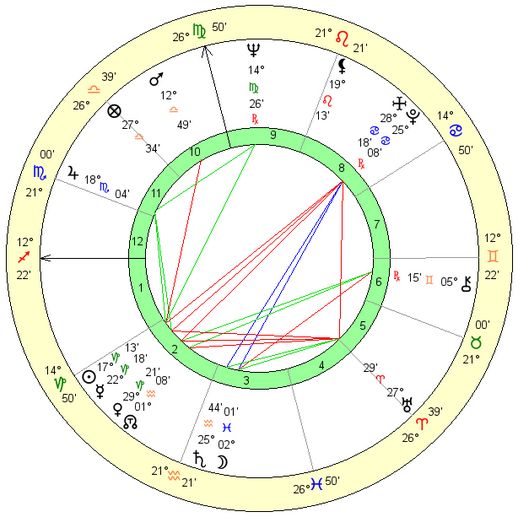
| Planet | Longitude | House | |
| Sun | 17 Capricorn 13' 56" | 2 | |
| Moon | 02 Pisces 01' 27" | 3 | |
| Mercury | 22 Capricorn 18' 25" | 2 | |
| Venus | 29 Capricorn 21' 54" | 2 | |
| Mars | 12 Libra 49' 51" | 10 | |
| Jupiter | 18 Scorpio 04' 09" | 11 | |
| Saturn | 25 Aquarius 44' 34" | 3 | |
| Uranus | 27 Aries 29' 57" | 5 | |
| Neptune | 14 Virgo 26' 58" R | 9 | |
| Pluto | 25 Cancer 08' 03" R | 8 | |
| Chiron | 05 Gemini 15' 46" R | 6 | |
| Lilith | 19 Leo 13' 46" | 8 | |
| True Node | 01 Aquarius 08' 06" | 2 | |
| Part of Fortune | 27 Libra 34' 52" | 11 | |
| Vertex | 28 Cancer 18' 49" | 8 | |
| House | Longitude | ||
| Ascendant | 12 Sagittarius 22' 24" | ||
| House 2 | 14 Capricorn 50' 38" | ||
| House 3 | 21 Aquarius 21' 59" | ||
| House 4 | 26 Pisces 50' 30" | ||
| House 5 | 26 Aries 39' 53" | ||
| House 6 | 21 Taurus 00' 25" | ||
| House 7 | 12 Gemini 22' 24" | ||
| House 8 | 14 Cancer 50' 38" | ||
| House 9 | 21 Leo 21' 59" | ||
| MC (Midheaven) | 26 Virgo 50' 30" | ||
| House 11 | 26 Libra 39' 53" | ||
| House 12 | 21 Scorpio 00' 25" |
| Planet | Aspect | Planet | Orb |
| Sun | Conjunction | Mercury | 5.07 |
| Sun | Square | Mars | 4.40 |
| Sun | Sextile | Jupiter | 0.84 |
| Sun | Trine | Neptune | 2.78 |
| Sun | Opposition | Pluto | 7.90 |
| Sun | Quincunx | Lilith | 2.00 |
| Moon | Conjunction | Saturn | 6.28 |
| Moon | Sextile | Uranus | 4.53 |
| Moon | Quincunx | Pluto | 6.89 |
| Moon | Square | Chiron | 3.24 |
| Moon | Quincunx | Midheaven | 5.18 |
| Mercury | Conjunction | Sun | 5.07 |
| Mercury | Sextile | Jupiter | 4.24 |
| Mercury | Square | Uranus | 5.19 |
| Mercury | Opposition | Pluto | 2.83 |
| Mercury | Trine | Midheaven | 4.53 |
| Venus | Square | Uranus | 1.87 |
| Venus | Opposition | Pluto | 4.23 |
| Venus | Trine | Chiron | 5.90 |
| Venus | Conjunction | True Node | 1.77 |
| Venus | Square | Part of Fortune | 1.78 |
| Venus | Opposition | Vertex | 1.05 |
| Venus | Trine | Midheaven | 2.52 |
| Mars | Square | Sun | 4.40 |
| Mars | Sextile | Ascendant | 0.46 |
| Jupiter | Sextile | Sun | 0.84 |
| Jupiter | Sextile | Mercury | 4.24 |
| Jupiter | Sextile | Neptune | 3.62 |
| Jupiter | Square | Lilith | 1.16 |
| Saturn | Conjunction | Moon | 6.28 |
| Saturn | Sextile | Uranus | 1.76 |
| Saturn | Quincunx | Pluto | 0.61 |
| Saturn | Trine | Part of Fortune | 1.84 |
| Saturn | Quincunx | Vertex | 2.57 |
| Saturn | Quincunx | Midheaven | 1.10 |
| Uranus | Sextile | Moon | 4.53 |
| Uranus | Square | Mercury | 5.19 |
| Uranus | Square | Venus | 1.87 |
| Uranus | Sextile | Saturn | 1.76 |
| Uranus | Square | Pluto | 2.37 |
| Uranus | Opposition | Part of Fortune | 0.08 |
| Uranus | Square | Vertex | 0.81 |
| Uranus | Quincunx | Midheaven | 0.66 |
| Neptune | Trine | Sun | 2.78 |
| Neptune | Sextile | Jupiter | 3.62 |
| Neptune | Square | Ascendant | 2.08 |
| Pluto | Opposition | Sun | 7.90 |
| Pluto | Quincunx | Moon | 6.89 |
| Pluto | Opposition | Mercury | 2.83 |
| Pluto | Opposition | Venus | 4.23 |
| Pluto | Quincunx | Saturn | 0.61 |
| Pluto | Square | Uranus | 2.37 |
| Pluto | Sextile | Midheaven | 1.71 |
| Chiron | Square | Moon | 3.24 |
| Chiron | Trine | Venus | 5.90 |
| Lilith | Quincunx | Sun | 2.00 |
| Lilith | Square | Jupiter | 1.16 |
| True Node | Conjunction | Venus | 1.77 |
| True Node | Opposition | Vertex | 2.82 |
| Part of Fortune | Square | Venus | 1.78 |
| Part of Fortune | Trine | Saturn | 1.84 |
| Part of Fortune | Opposition | Uranus | 0.08 |
| Part of Fortune | Square | Vertex | 0.73 |
| Vertex | Opposition | Venus | 1.05 |
| Vertex | Quincunx | Saturn | 2.57 |
| Vertex | Square | Uranus | 0.81 |
| Vertex | Opposition | True Node | 2.82 |
| Vertex | Square | Part of Fortune | 0.73 |
| Vertex | Sextile | Midheaven | 1.47 |
| Ascendant | Sextile | Mars | 0.46 |
| Ascendant | Square | Neptune | 2.08 |
| Midheaven | Quincunx | Moon | 5.18 |
| Midheaven | Trine | Mercury | 4.53 |
| Midheaven | Trine | Venus | 2.52 |
| Midheaven | Quincunx | Saturn | 1.10 |
| Midheaven | Quincunx | Uranus | 0.66 |
| Midheaven | Sextile | Pluto | 1.71 |
| Midheaven | Sextile | Vertex | 1.47 |
Astrological Insights: The elvis presley birth chartExploring the elvis-presley-birth-chart reminds us that astrology reveals nothing more than tendencies. A person can master their stars if they exert their will. If one chooses to drift along the current of life, then the tendencies outlined in the birth chart will manifest their effects at certain points in their existence. One key element that does not appear in a natal chart is the individual's will and how it may evolve. The exercise of free will is left entirely to the person. Astrology forewarns us, allowing us to better navigate life's cosmic currents. What a man sows, he must reap. The karmic law works in perfect harmony with the movements of the planets. The incarnation of the soul into a physical vessel takes place at the exact opportune moment when the karmic law and the planets can align in complete synchronicity. Remember that the so-called good or evil configurations in a horoscope are not the result of chance or luck, but the consequence of our past actions—the chart reveals what we have brought from past lives and what we must master in this one. What we lack in the present life can be acquired in the future by consciously taking up our spiritual tasks. The stars incline, but they do not compel. As Goethe beautifully put it: "From every power that binds the world, the man who gains self-mastery sets himself free." AscendantThe Ascendant is the gateway of the soul for fulfilling the being's karmic mission. It expresses a person's physical appearance and personality, and also indicates how others perceived us in childhood, how we assert ourselves in our environment, our baseline of available energy, non-specific immunity, recovery time, the foundation of our psychophysical constitution, temperament, and the bedrock of our destiny. The Ascendant of the personality is: SAGITTARIUS The cusp of the first house in Sagittarius endows its "owner" with enthusiasm, courage, and optimism; it is generally considered the "best Ascendant." However, such a person is usually not very responsible and struggles to maintain what they have acquired. The temperament is choleric, motor-oriented, with a very strong but short-lived will! Yet, the will is highly dependent on emotions and Sagittarius's social consciousness, leading to instinctive reactions, which often pose a challenge. They love entertainment, preferably loud and dignified (hunting, receptions, etc.). A strong desire for independence and a tendency to travel to far-off lands. A well-aspected ASC is highly prophetic, possessing synthetic thinking. Excess optimism. They are religious, reflecting a genuine, inner piety. They are philanthropic! They love animals, especially horses. A negative trait is particularly being "scatterbrained" or unpredictable. A business owner might assign tasks precisely until evening, only to change their mind ten times during the day, eventually causing their subordinates to either break down or leave the company :-) Impulsiveness, exaggeration, rebelliousness, anarchy. Physically, they resemble Gemini—tall and slender, with a longer nose, higher forehead, a more open face, and darker eyes. A quicker, sharper gaze than Gemini (with a hint of command). A peculiar trait in speech—shifting from standard language to jargon, showing absolute adaptability. Planets in the SignsPlanets in the signs are a very important part of interpreting a horoscope. The manifestation of each planet in a specific sign has a significant and highly characteristic influence on our lives. Sun in Capricorn Such a person is usually materially oriented, pragmatic, conservative, and practical. One of the great challenges of this Sun is a rich and intense emotional life, of which the individual is often completely unaware, usually suppressing and sidelining the needs of their soul. Capricorn essentially knows no ease and approaches everything with immense dedication; they tend to be pessimistic and love pleasant, luxurious things. They struggle with spontaneity and openness, but these are precisely the qualities they should consciously strive for throughout their life. The primary criterion by which the Sun in Capricorn evaluates others is wealth and material possessions. While this is not universally true, it is essentially the case. Moon in Pisces These individuals are highly sensitive and often perceive the real world as too harsh and ruthless, a trait particularly prominent in childhood. They tend to construct illusions about the world and then fall into depression upon realizing that reality is different. Compassionate and hospitable, they are friendly but must learn to defend themselves more effectively against external influences, as they have a natural tendency to absorb other people's problems. They often harbor unattainable desires, which can disrupt their family and partnership relations. This Moon position is particularly challenging for men, as they may subconsciously struggle to reconcile with the abundance of feminine energy and expression at their disposal. Oversensitive and vulnerable, they possess a vivid imagination, tend to be subjective and sentimental, and often incline toward mysticism. They should be cautious with toxic substances and alcohol. Possible issues with the feet (prone to flat feet and corns). Mercury in Capricorn The individual is practical and their interests are concrete. Typical professions include the pragmatic mechanical engineer, mathematician, or merchant. Social recognition and the attainment of material prosperity are usually the primary goals of their endeavors. Thinking is subject to strict structures and laws; combined with a well-placed Jupiter anywhere in the chart, this Mercury is ideal for a judge. The thought process is highly conservative. Breaking free from conventions is a challenge for such a person. If Mercury in Capricorn is afflicted, the individual can be highly conservative, even narrow-minded (a classic example being a strict, spinster mathematics professor). In such cases, access to information may be restricted. Venus in Capricorn Brings a tendency to evaluate relationships primarily through common sense and pragmatism. Bound by ancient traditions, they may appear conservative in relationships. Emotionally, they often view relationships as a means to achieve a certain social status and security. They tend to sideline their own feelings. Venus in Capricorn has a penchant for luxury items. Mars in Libra Causes a frequent scattering of energy, which is expended primarily on maintaining harmonious relationships and peace among others. The individual tends to conciliate warring parties, thereby losing sight of the actual state of affairs. They are capable of devising contradictory solutions, a trait that has a dual impact: on one hand, it can lead to valuable experience and the ability to diplomatically resolve conflicts and find strategic solutions; on the other hand, it often leads to indecisiveness with ambiguous outcomes. Perhaps the greatest challenge for Mars in Libra is indecisiveness, especially when sudden, rapid action is required. Consequently, they often realize the correct course of action only after the moment has passed. Typically, their initial reaction is to do nothing and ponder what would be most appropriate. The correct solution is often reached only when the need for action is no longer relevant. This issue is most prominent when the person has a certain amount of time to make a decision. In the face of immediate danger, however, survival instincts usually function correctly, though this again depends on the nature of the aspects. Mars in Libra is not overtly passionate; its expressions are rather traditional, yet it does not shy away from new experiences. They seek to dazzle their partner primarily through communication, prioritizing romantic experiences, and they react very negatively to any disharmony in the intimate sphere. Scorpios usually have the most trouble with this Mars, as their emotional expectations are often unrealistic, making reality difficult to accept. Jupiter in Scorpio In water signs, such a person primarily demands emotion, longing for love and emotional fulfillment. They have a sense of romance but are also prone to excessive self-pity, self-sacrifice, and sentimentality. The desire to help others is often channeled through healing. Their drawback can be sexual wildness and lack of restraint. They are courageous, strong-willed, and resourceful. They enjoy exploring esotericism. Saturn in Aquarius In air signs, this planet blocks communication and spiritual/mental development. However, it supports (especially in the case of strong aspects) mental discipline and provides the individual with the strength and motivation to overcome mental obstacles. The fundamental issue with Saturn in Aquarius is that the person often becomes authoritarian in their views, usually considering their subjective opinions to be universal truths and trying to impose them on others relentlessly (depending also on the nature of the aspects). Since this placement primarily affects mental activities, it is not at all favorable for a lead scientist, for instance, as they will refuse to recognize the validity of others' views and push their own, often non-constructive positions at the expense of general progress and cooperation. Planets in the HousesEach astrological house represents a specific area of life. The position of a planet in a house tells us how an individual fares or struggles in that area. For an accurate calculation of the planets in the houses, it is necessary to know the birth time as precisely as possible. Sun in the 2nd House The individual will place great emphasis on material security and finance, and will also have a significant need for personal inner space. Depending on the aspects of the Sun to other planets, one can infer the degree to which the personality will either feel threatened in their personal integrity and attempt to secure it at all costs, or, conversely, work properly with space—both their own inner space and outer space (e.g., an architect). An afflicted Sun in the second house can have similar effects to Saturn in the same position, creating conditions for an inferiority complex; the person then feels financially threatened and cannot enjoy life. This is linked to insecurity, loss of self-confidence (which is difficult to rebuild), and profound uncertainties with far-reaching impacts. People with this Sun prefer to manage their own finances and dislike interference in their financial and property dealings. If the Sun or the second house (its ruler) is afflicted, issues with land registries or administrative authorities may arise. Moon in the 3rd House This is an excellent aspect particularly for teachers (especially of young children), provided the Moon is harmoniously or strongly placed. The soul of such a person yearns to communicate with others and share their knowledge. If Mercury is also well-placed in the horoscope, their communication skills are naturally enhanced. Besides teaching, this is excellent for trainers, journalists, speakers, or even preachers, though the latter require additional "spiritual" aspects (ninth house). Unless the Moon in the third house is poorly aspected, the individual can express themselves with sensitivity and imagination. They are highly curious, and this curiosity drives their thinking. However, if the Moon is blocked by a negative aspect, unpleasant illnesses (e.g., Alzheimer's) may occur in later years, as this placement can induce mental laziness. This naturally depends heavily on the sign and the aspecting planet. A typical configuration might be the Moon in Pisces opposing Neptune in the ninth house, which can block faith and erode trust in one's ability to take control of one's life. The person lets themselves be guided by others, abdicating responsibility for themselves, which can result in the aforementioned illness. If the root cause of its origin is not fully uncovered, it is practically impossible to cure. The Moon in the third house has a significant influence on the intellect. A higher angular velocity of this planet (over thirteen degrees per day) indicates a higher intellect and quick thinking, and vice-versa. The Moon generally signifies motor skills, and its influence in this area is further emphasized in the third house. An excellently aspected Moon in the third house imparts acrobatic, dancing, and other talents, whereas any negative aspect will manifest very noticeably in the individual's motor skills. A similar influence is exerted on intelligence, memory, and perception. Finally, we must mention business trips of various distances, which the person usually does not decide on themselves but are simply mandated. The character and length of these trips naturally vary. Mercury in the 2nd House The person focuses much of their attention on material matters and securing material affairs. Typically, this is a personality capable of earning money through intellectual activities and investing it wisely. They enjoy independent work but also like working in journalism, tourism, or the communication industry. Through their intellect and communication, they define themselves in relation to their environment. They will generally evaluate themselves realistically, but their opinions will also depend on the views of those around them. This is an ideal aspect for tax advisors, financiers, financial analysts, and brokers. Through these professions, the individual gains healthy self-esteem. They have excellent predispositions for continuous growth and education in these fields and can secure suitable information for their work through information media. Venus in the 2nd House This person will often acquire material wealth through artistic endeavors or from partnerships—paradoxically, this rule particularly applies to men. This does not refer to a "marriage of convenience" with a subsequent inheritance or a rich dowry, but rather to a relationship where the man realizes himself professionally through his partner, deriving corresponding income from this activity. These individuals usually spend their money on social activities or luxury items (especially in the sign of Capricorn). Such a person will try to establish relationships by attempting to dazzle their counterpart with their income, assets, or material security in general. They can work best with their own inner space through a partner, and their partner can also teach them a great deal about acquiring material means through their own work and effort. The foundation of their self-confidence lies primarily in partnerships and sufficient material resources. Mars in the 10th House This position of Mars is always somewhat tense, as the individual is highly ambitious and strives for preeminence among others. This is a typical aspect for a manager or executive, but if the planet is afflicted in any way, its owner faces a major problem: due to their aggressiveness and aversion to compromise, such an individual adopts rules and standards that do not align with their development (pretending to be something they are not) and consequently tries to maintain their acquired position at all costs. If they manage to hold onto the position, they are hated by those around them; if they fail to keep it, they hate themselves. This person goes after their goals literally "over dead bodies" without regard for anyone. Even a harmoniously placed Mars in the tenth house tends to jump to hasty conclusions upon which they then act. Typical professions include military doctors, surgeons, mechanical engineers, metalsmiths, and blacksmiths. Retrograde Mars points to rebellions against superiors in a past life and corruption scandals. In the case of a doctor or healer, it suggests accepting bribes in connection with healing in a past life—a serious offense with a heavier karmic toll. Both doctors and healers then face difficult working conditions in this life for karmic reasons. In the horoscope of a statesman or politician, retrograde Mars speaks of corruption, also in past lives, and from a karmic standpoint, such a person can do nothing worse than continue to accept bribes. Jupiter in the 11th House Such a person usually establishes contacts very well and easily, surrounding themselves with a multitude of acquaintances, but rarely true friends (unless they have a strongly occupied seventh house, for instance). They grow and expand through the collective. They often have grand ambitions and successfully utilize their contacts to achieve them. This position of Jupiter grants powerful protectors and patronage, and also indicates favorable conditions for joint marital business. In a harmonious aspect with the Sun, Moon, or Venus, it provides excellent dispositions for diplomats and members of parliament, especially if the Sun is above the horizon (day birth). Generally, a harmoniously placed Jupiter in the eleventh house is suitable for careers in banking, with a focus on leasing agreements and mortgages. It also plays a highly important role in the previously mentioned principle of liberating oneself from societal rules, integrated by the being during its evolution. If the vibrational field of Capricorn (tenth house, Saturn, Capricorn) is well-aspected, Jupiter allows the process of liberation to be carried out harmoniously; otherwise, there is a risk of anarchy and rebellion against rules and laws, which naturally manifests as societal resistance to the individual. Disharmonious aspects of Jupiter in the eleventh house manifest as false, unearned patronage with often unpredictable consequences; if adversely aspected by the Sun, Moon, or Venus, it points to MPs or diplomats who lack the basic qualifications and skills for this work, resulting in a range of problems with often fatal consequences. People with an afflicted Jupiter in the eleventh house are usually arrogant, which further complicates their situation. Retrograde Jupiter indicates an inability to achieve a certain social status in a past life, suggesting they remained in lower social classes and failed to utilize all the opportunities available to them. Now they encounter relationship difficulties with their surroundings, offering them the chance to understand and resolve past mistakes. A secondary inferiority complex arises here (while Saturn in the second house is "responsible" for the primary one). Saturn in the 3rd House These individuals usually think in a straightforward manner, and if they are to resolve a problem, they need to thoroughly understand it first. They handle practical problems well, especially in the case of harmonious aspects of Saturn. However, they struggle to develop their imagination and are generally distrustful. This position of Saturn blocks primary contact, even though the seventh house is otherwise responsible for it. Thus, these people distrust society, appearing shy and withdrawn, which tends to make a negative impression upon first contact in a group. Saturn in the third house always restricts and blocks communication and growth, affecting studies, information gathering, siblings, and short journeys. The primary trauma usually manifests in the realm of learning and intellect, blocking the process of acquiring, processing, and outputting information unless the person proceeds in accordance with the generally accepted laws and rules of society. Speech impediments, dyslexia, dysgraphia, dysorthographia, and dysphasia may occur. There may also be a lack of connection between the speed of thought and the speed of communication. The primary trauma must always be resolved by understanding the problems it brings. These are twofold and depend on the sign in which Saturn is placed. If it is in a magnetic sign, it manifests as inhibitions: short-term memory is poor, communication is slow, vocabulary tends to be limited, facial expressions and gestures are somewhat restricted, the person struggles to express themselves through movement and dance, finds it difficult to learn foreign languages, has clumsy handwriting, etc. In electric signs, a "compensation" occurs: there is an excess of knowledge that is constantly replenished (the typical aspect of the over-diligent "nerd" from school movies). Gestures will be pronounced and distinct. Handwriting is often sweeping and the paper is frequently torn through :-) A third and less common way this manifests is through projection. For example, Saturn in Gemini manifests as criticizing others for their mistakes, thereby projecting one's own, which are then likewise pointed out by the other person. From a health perspective, this can involve problems (atrophy) of the motor nerves, paralysis, aphonia, and other limitations arising from the respective sign. Bronchopneumonia, rheumatic diseases of the small joints or hands are also possible. Problems occur with neighbors, short journeys, and siblings—where everything grates, siblings are favored, journeys fail, etc. Uranus in the 5th House Compensations, blockages, and projections in the areas of sex, creativity, playfulness, and children, as well as in business, sports, entertainment, teamwork, and the process of gaining independence. Under blockage, all these matters are hindered or locked; in women, this can lead to secondary infertility, problems in intimate relationships, relationships with children, etc. In compensation, the person strives at all costs to excel in art, sex, or business, with most of these activities ending in failure unless Uranus is highly harmonious or its energies have already been integrated. These people also enjoy extreme sports, but in the case of disharmonious configurations, they should be very cautious due to injuries caused by rash actions and the desire to outshine others. In projection, the individual envies others' business or intimate success and criticizes them for it. Uranus in the fifth house practically always causes an unconventional approach to sex, and if extremely afflicted, it can lead to various aberrations or potentially homosexuality, though the latter is more motivated by a desire to "try something different." It is not a direct desire for a same-sex partnership (for which the seventh house would be responsible). However, the individual must come to terms with and accept their deviations; rejecting them is impossible and would only strengthen Saturnian blockages. These people tend to have unconventional artistic talents, enjoying the use of new, reformist techniques in art to push the boundaries of what has already been expressed. Their children are likewise unconventional, original, and independent. Neptune in the 9th House This is one of Neptune's better placements, providing abilities and talents for mystical teachings and hermetism, and granting significant potential for spiritual development and the pursuit of higher philosophy. Caution is needed especially in youth when Neptune's energies are unintegrated, or if it is in any way disharmonious or retrograde. In such cases, the person falls prey to various religious movements, rituals, and dogmas! Since Neptune stands here in the vibrational field of Sagittarius and Jupiter, one must always be careful in legal disputes, which can be protracted and without a clear outcome. In this case, it is wise to choose a suitable lawyer and trust them despite any personal doubts. Neptune in the ninth house also points to the spiritual qualities of the partner. This is related to the development of the relationship (ninth house), and the partner may be unusual in some way, struggle to express themselves, or have other non-specific speech impediments. People with this Neptune have a talent for publishing in the fields of higher philosophy, magic, astrology, hermetism, and higher art. If Neptune is afflicted, the individual still possesses these abilities but accesses them through substitute techniques—such as holotropic breathwork or the use of addictive substances. However, they must always practice these techniques under the guidance of an experienced person! In terms of its operational principle, Neptune in the ninth house manifests as a desire for ever-more spiritual knowledge, higher philosophy, relationship development, and the study of higher magic; unfulfilled expectations lead to suffering. These problems can be resolved through the hermetic signatures of Jupiter and the sign in which Neptune is placed. Pluto in the 8th House In this position of Pluto, a very unusual method of cementing relationships occurs. A relationship is initiated in the seventh house and subsequently cemented in the eighth (fixed) house, so that it can develop in the ninth. Pluto in the eighth house manifests as a deeply subconscious drive to anchor and secure the relationship at all costs, logically employing Plutonian means—namely manipulation, pressure, and even psychological terror, though this mechanism is virtually undetectable. In practical life, this means that the partner of such a person is virtually unable to end the relationship, even if it no longer suits them at all. The forms of pressure used are highly sophisticated, diplomatic, and hidden; the partner is unable to detect them and can only register them through their surroundings, which mirror certain things back to them. Even a harmonious Pluto causes the partner to often attempt to flee the relationship because they are bothered by the hidden manipulation, yet they are unable to define their reasons. An afflicted Pluto, however, creates such forms of pressure that leaving the relationship is practically impossible. (This aspect is significantly amplified, for example, by Pluto in Scorpio. Conversely, Pluto in Libra radiates such incredibly sweet and pleasant diplomacy that there is likewise no reason to suspect anything is amiss, yet the result is the same). In both cases, partners may frequently break up and get back together, creating the "never-ending relationships" typical of Pluto's influence. The partner is persuaded at a deep subconscious level that they will never find such an excellent counterpart again, yet the simultaneous pressure repels them. They constantly try to leave, while their partner with Pluto in the eighth house has no understanding of why this is happening, despite doing everything to please them (one of the ingenious forms of Plutonian pressure). This constellation is also responsible for fixing the discovered sexual identity, specifically the part of it that can be utilized for the personal transformation of the being. Unless Pluto in the eighth is drastically afflicted, the individual has an open path to all techniques leading to transformation through the cultivation of sexual energy (e.g., Tantric Yoga). Here it is important to explain the principle of cultivating sexual energy: classic sexual intercourse takes place exclusively in the area of the first and second chakras. (This is interesting, for instance, in "lower" forms of art evoked in these two chakras. E.g., circus performers need good and frequent sexual intercourse to maintain active first and second chakras for quality performance). At climax, sexual energy discharges in the area of the second chakra, the pelvis, in both sexes. This happens primarily because people focus their attention during intercourse mainly on these two chakras. To direct sexual energy into the higher chakras, one must focus consciousness upon them during the act itself. Thus, if we concentrate on the fourth chakra, sexual energy logically follows our attention and travels up the spinal canal to the fourth chakra via the third, simultaneously activating the energy center (Hara). Sex then ceases to be exclusively a matter of the first and second chakras—a mere physical and emotional union of man and woman—and the qualities of the fourth chakra are significantly strengthened. In practice, however, Tantric exercises are performed to activate all chakras; the individual focuses on the area above the cranial fontanelle, and once this process is fixed in the subconscious, the sexual energy gradually begins to ascend the spinal canal through all the chakras, activating them. In the case of Pluto in the eighth house, the root of fixations lies primarily in cementing the relationship, sexual transformation, and anchoring one's own sexual identity and original ideas. Disharmonious aspects can cause a subconscious dread of death and the transformative possibilities of sex, which on the psychological level often manifests as fear or even uncontrollable aversion and phobias of typical sexual and transformative symbols: spiders, bees, wasps, scorpions, frogs, and snakes. Planetary AspectsAn aspect is the position of one planet relative to another, and based on the angle they form, we can determine their mutual influence. We categorize aspects into three groups: harmonious, disharmonious, and conjunctions. How each aspect manifests in a person's life can be explored in the interpretation below. Sun conjunct Mercury People with this aspect are subjective and creative, capable of expressing their opinions and often expressing themselves artistically. This is an excellent aspect for performing artists on stage, but it limits logical thinking and an eye for detail. Thinking is highly subjective. If the Moon is waxing, the subjectivity of thought increases, and vice versa—with a waning Moon, objectivity in thought processes grows. This aspect is also associated with arrogance and prejudice. In any case, it indicates an intellectual being. However, we must always assess the type of conjunction. *In cazimi* (in the heart of the Sun) is very rare and endows the person with truly exceptional qualities, whereas "combust" (under the beams) will often make the person arrogant and abrasive (the character of the resulting manifestation always depends heavily on the specific sign). Sun in disharmonious aspect with Mars Brings a tendency toward hard work, risk-taking, and also increases physical resilience. Impulsiveness, easy excitability, and selfishness may also occur. Sun in harmonious aspect with Jupiter Creates a confident and optimistic personality. The "owner" of such a horoscope loves to travel and craves adventure. They also enjoy studying and eagerly embrace new experiences. Sun in harmonious aspect with Neptune Often endows a person with sentimentality, a good relationship with people, and a pleasant demeanor. The individual is inclined toward charitable activities, possesses a fine and creative imagination, and often loves art and a comfortable lifestyle. Great imagination, intuition, appreciation for harmony, and a spiritual path. However, all activities lack order and structure (the person seems to "flow through" the structure of life). Sun in disharmonious aspect with Pluto Gives people a tendency toward emotional outbursts, stubbornness, decisiveness, and also meddling in the lives of others, trying to convince them of the need to change their behavior or demeanor. A person with this aspect may encounter death or other profound changes in their immediate environment more frequently. A tendency to influence other people through powerful manipulation on a subconscious level! Self-destruction, rejection of the father model through rebellion and resistance. (Unlike the conjunction, this is not an existential rejection, but a visible resistance to the father). At first glance, the person is kind, but inside they harbor destructive mechanisms directed at their surroundings. However, they are unaware of these mechanisms. Somatic manifestations of negative Sun-Pluto aspects: so-called nervous heart (cardiac neurosis—e.g., palpitations due to stage fright, etc.), spasms in the pancreatic area, and in the case of a hard square, pathological changes in the pancreas or even cancer. Moon conjunct Saturn The conjunction grants the person stability and sincere behavior, even in tense situations. However, they do not trust their feelings much and project a cold impression. They tend to have emotional problems and usually seek older partners. They express their feelings with difficulty, but are constant in them. Moon in harmonious aspect with Uranus Harmonious aspects (affecting women in particular) bring a need for significant emotional independence and a strong position of one's own within the family environment. They dislike submitting to others and often live unconventionally. A feeling of isolation from society (isolation complex). Turbulent emotions. Mercury in harmonious aspect with Jupiter Harmonious aspects bestow optimism, philosophical talent, kindness, and openness. However, the person likes to satisfy their mental interests despite potential material consequences. They love to travel and cannot stay in one place for long. Mercury in disharmonious aspect with Uranus Disharmonious aspects often bring extreme views and a strong need for independence. They impose their opinions, which are often detached from reality, on others with arrogance and an unwillingness to compromise. In their thinking, they are often ahead of their time and incline toward groups whose opinions may even be generally accepted in the future. Inquisitive intelligence, creative thinking, unusual ways of thought, a need for intellectual clashes, but creative activity is often destructive; rebelliousness, anarchy. Health manifestations: with a diurnal Mercury (third house, Gemini)—autism, commotio cerebri (concussion), brain contusion, nervous breakdown, hyperfunction of the thyroid and parathyroid glands (morbid voracity, calcium metabolism, and bone structure). Whooping cough, sneezing, croup, all fistulas (the body seeks any outlet for inflammation to the surface). Periodontitis. With a nocturnal Mercury (sixth house and Virgo)—diaphragmatic hernia, traveler's diarrhea, intestinal fistula, balbuties (stuttering). High risk of perforation of the appendix and all abdominal organs. Mercury in disharmonious aspect with Pluto Disharmonious aspects influence a person's thinking so that they are excessively ruled by their opinions and instincts, resulting in prejudice. Studies are sporadic but highly intense, often followed by exhaustion. When searching for the truth, they are convinced of their own opinion and direction, showing little regard for practical considerations. Intelligence is used to manipulate others, e.g., spies, secret agents, intelligence officers, or participants in classified research. All information is used destructively! (Highly important). This principle usually manifests unconsciously in the individual. (For example, at the moment the atomic bomb was dropped on Hiroshima, Mercury was in a sharp square to Pluto). Venus in disharmonious aspect with Uranus This aspect greatly complicates any relationship, as it is literally perceived as a loss of personal integrity. The person is highly unstable and volatile in their feelings, often cycling through many relationships. Unconventional, confrontational, eccentric, and original in art, their financial side also experiences fluctuations, more frequently downward than upward. Feelings are used entirely outside the framework of social systems, emotional utopias, and an adventurous, unstable love life. Health manifestations: with a diurnal Venus (seventh house and Libra)—fetishism, voyeurism, frotteurism (addiction to a loved one's towel ), some forms of homosexuality, vitiligo (white patches on the skin), renal colic (kidney pain) not caused by nephrolithiasis (stones and sand)—renal spasm without cause. Spasm of the ureter, sudden fractures in the lumbar spine and discs (herniations). With a nocturnal Venus (Taurus, second house)—dysphagia (spasm of the pharynx), menopausal transitions, wandering (hypermobile) kidney, displacement of cervical vertebrae. In a sharp square, injuries to the cervical spine, ruptures of sclerotic cervical vessels. Venus in disharmonious aspect with Pluto Manifests in a very typical way—the person is capable of loving and hating with all their heart, deeply and intensely. They keep their true passions under wraps and usually possess an excellent imagination. They also desire dominance over others, which usually manifests in business or simply in the pursuit of material possessions. It activates sexuality and sexual charisma. Risk of violent acts by a male (blackmail, pressure, etc.). Disharmonious aspects create a similar charisma to harmonious ones, but alongside it comes highly intense, even paranoid jealousy! A woman, in particular, can often manufacture jealousy in such a way that she subsequently provides a reason for her partner's actual infidelity, even if there was originally no cause. In a man's horoscope, Venus always indicates the qualities of his mistress, pointing to spellbinding women with strong sexual charisma who can control their partner completely—subtly, invisibly, yet highly effectively! Mars in harmonious aspect with the Ascendant Tends to be independent, courageous, determined, and assertive. They care little about what others think of them. They tend to have active, energetic friends. They are individuals of strong integrity and loyalty, defending their beliefs and ideals. This aspect benefits the physical body, increasing vitality and granting better-than-average regenerative powers. Jupiter in harmonious aspect with Neptune Harmonious aspects give a person a compassionate but restless soul, the ideals of a reformer, artistic inclinations, and religious visions. These visions, however, may be suppressed by stronger aspects of other planets. The trine and sextile are excellent aspects for lawyers and judges. Supreme legislative bodies should ideally be established under these harmonious aspects. Similar to the conjunction, harmonious aspects can be a memory of a high state of being in the distant past (e.g., angelic origin). It is a trace of the energies the individual possessed during the creation of the cosmos. Rarely, it can also be a memory of an incarnation in which an archangel incarnated into the human being. Saturn in harmonious aspect with Uranus Is highly favorable, as it gives the person solid practical skills combined with originality and an inventive spirit. All this makes it possible to positively develop the potential of all innate qualities. Uranus in disharmonious aspect with Pluto This aspect always accompanies profound turning points in human history. It creates strong, original personalities (especially if placed on sensitive points). Brilliant ideas that captivate a wide circle of people. It produces either a truly exceptional personality or a completely insane one! On a psychological level, it also causes tension and triggers a desire for change. The aspects of Uranus to other planets are diverse and difficult to manifest, but Pluto acts as a trigger for these aspects, allowing them to manifest in real life. Ostracization from society due to asserting one's differences, criminality of a genius caliber, and the use of genius in magic but in a dark direction. Korsakoff's syndrome (chronic alcoholism combined with neurological disease). Anus praeter (colostomy), gallbladder colic without cholelithiasis (purely psychogenic), sebaceous gland abscesses, amok. Neptune in disharmonious aspect with the Ascendant Under this aspect, a person tends to be selfless in relationships, perhaps too much so, at their own expense. They should learn not to spare others and avoid relationships where they play the role of victim or martyr. They should remain strong and not allow anyone to take advantage of them just because they are a kind and gentle person. They may suffer from a lack of self-confidence, which can cause them to trust someone unworthy of their trust. In this life, the individual should stand on their own two feet, cultivate self-confidence, and not allow others to exploit them. ConclusionThis natal horoscope was compiled under the assumption that the input data—such as time, place of birth, and the correct time zone, taking into account possible daylight saving time—is correct. Even a one-hour difference in birth time will result in an inaccurate calculation of the planets' positions in the houses or an incorrect Ascendant. By no means is this astrological analysis exhaustive. It is clear that every human being is a far more complex entity than can be captured on this page. To create your own free online Natal Horoscope, please visit Free Natal Horoscope Source Zbyněk Slába www.oranzovestranky.cz |
