
Personal Horoscope
Jim Morrison
Born Wednesday, December 08, 194311:55:00 (Time Zone = GMT -4 hours)
80w33, 28n04
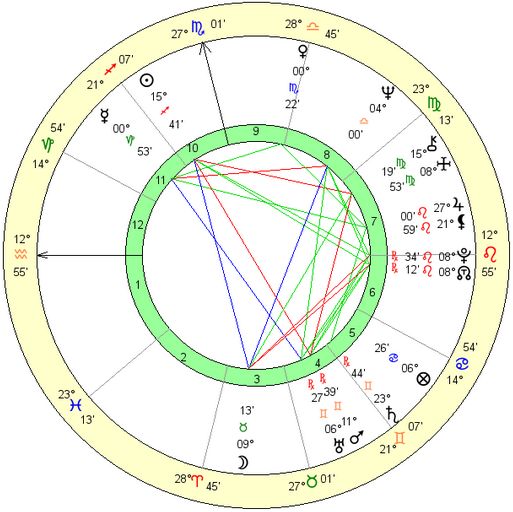
| Planet | Longitude | House | |
| Sun | 15 Sagittarius 41' 33" | 10 | |
| Moon | 09 Taurus 13' 11" | 3 | |
| Mercury | 00 Capricorn 53' 01" | 11 | |
| Venus | 00 Scorpio 22' 57" | 9 | |
| Mars | 11 Gemini 39' 42" R | 4 | |
| Jupiter | 27 Leo 00' 58" | 7 | |
| Saturn | 23 Gemini 44' 44" R | 5 | |
| Uranus | 06 Gemini 27' 28" R | 4 | |
| Neptune | 04 Libra 00' 50" | 8 | |
| Pluto | 08 Leo 34' 31" R | 6 | |
| Chiron | 15 Virgo 19' 16" | 7 | |
| Lilith | 21 Leo 59' 37" | 7 | |
| True Node | 08 Leo 12' 34" R | 6 | |
| Part of Fortune | 06 Cancer 26' 43" | 5 | |
| Vertex | 08 Virgo 53' 06" | 7 | |
| House | Longitude | ||
| Ascendant | 12 Aquarius 55' 05" | ||
| House 2 | 23 Pisces 13' 04" | ||
| House 3 | 28 Aries 45' 12" | ||
| House 4 | 27 Taurus 01' 23" | ||
| House 5 | 21 Gemini 07' 24" | ||
| House 6 | 14 Cancer 54' 13" | ||
| House 7 | 12 Leo 55' 05" | ||
| House 8 | 23 Virgo 13' 04" | ||
| House 9 | 28 Libra 45' 12" | ||
| MC (Midheaven) | 27 Scorpio 01' 23" | ||
| House 11 | 21 Sagittarius 07' 24" | ||
| House 12 | 14 Capricorn 54' 13" |
| Planet | Aspect | Planet | Orb |
| Sun | Quincunx | Moon | 6.47 |
| Sun | Opposition | Mars | 4.03 |
| Sun | Trine | Pluto | 7.12 |
| Sun | Square | Chiron | 0.37 |
| Sun | Sextile | Ascendant | 2.77 |
| Moon | Quincunx | Sun | 6.47 |
| Moon | Quincunx | Neptune | 5.21 |
| Moon | Square | Pluto | 0.64 |
| Moon | Trine | Chiron | 6.10 |
| Moon | Square | True Node | 1.01 |
| Moon | Trine | Vertex | 0.33 |
| Moon | Square | Ascendant | 3.70 |
| Mercury | Sextile | Venus | 0.50 |
| Mercury | Trine | Jupiter | 3.87 |
| Mercury | Quincunx | Uranus | 5.57 |
| Mercury | Square | Neptune | 3.13 |
| Venus | Sextile | Mercury | 0.50 |
| Venus | Sextile | Jupiter | 3.37 |
| Mars | Opposition | Sun | 4.03 |
| Mars | Conjunction | Uranus | 5.20 |
| Mars | Sextile | Pluto | 3.09 |
| Mars | Square | Chiron | 3.66 |
| Mars | Square | Vertex | 2.78 |
| Mars | Trine | Ascendant | 1.26 |
| Jupiter | Trine | Mercury | 3.87 |
| Jupiter | Sextile | Venus | 3.37 |
| Jupiter | Sextile | Saturn | 3.27 |
| Jupiter | Square | Midheaven | 0.01 |
| Saturn | Sextile | Jupiter | 3.27 |
| Saturn | Sextile | Lilith | 1.75 |
| Saturn | Quincunx | Midheaven | 3.28 |
| Uranus | Quincunx | Mercury | 5.57 |
| Uranus | Conjunction | Mars | 5.20 |
| Uranus | Trine | Neptune | 2.44 |
| Uranus | Sextile | Pluto | 2.12 |
| Uranus | Sextile | True Node | 1.75 |
| Uranus | Square | Vertex | 2.43 |
| Neptune | Quincunx | Moon | 5.21 |
| Neptune | Square | Mercury | 3.13 |
| Neptune | Trine | Uranus | 2.44 |
| Neptune | Sextile | Pluto | 4.56 |
| Pluto | Trine | Sun | 7.12 |
| Pluto | Square | Moon | 0.64 |
| Pluto | Sextile | Mars | 3.09 |
| Pluto | Sextile | Uranus | 2.12 |
| Pluto | Sextile | Neptune | 4.56 |
| Pluto | Conjunction | True Node | 0.37 |
| Pluto | Opposition | Ascendant | 4.34 |
| Chiron | Square | Sun | 0.37 |
| Chiron | Trine | Moon | 6.10 |
| Chiron | Square | Mars | 3.66 |
| Chiron | Quincunx | Ascendant | 2.40 |
| Lilith | Sextile | Saturn | 1.75 |
| True Node | Square | Moon | 1.01 |
| True Node | Sextile | Uranus | 1.75 |
| True Node | Conjunction | Pluto | 0.37 |
| Vertex | Trine | Moon | 0.33 |
| Vertex | Square | Mars | 2.78 |
| Vertex | Square | Uranus | 2.43 |
| Ascendant | Sextile | Sun | 2.77 |
| Ascendant | Square | Moon | 3.70 |
| Ascendant | Trine | Mars | 1.26 |
| Ascendant | Opposition | Pluto | 4.34 |
| Ascendant | Quincunx | Chiron | 2.40 |
| Midheaven | Square | Jupiter | 0.01 |
| Midheaven | Quincunx | Saturn | 3.28 |
A Perspective on AstrologyWhen exploring the nuances of the jim-morrison-birth-chart, we must remember that astrology outlines tendencies rather than absolute destinies. Man can rule his stars if he chooses to exert his spiritual will. If one decides to drift along with the current of life, the energetic tendencies indicated in the birth chart will eventually manifest their effects. There is, however, one crucial element never shown in a Natal Chart: the individual's free will and how it may evolve. The application of free will is left entirely to the seeker. Astrology warns us in advance, allowing us to better navigate the currents of life. What a man sows, he must reap. The Law of Karma operates in perfect harmony with the planets. The incarnation of a soul into a physical body occurs at the precise, opportune moment when karmic law and planetary alignments can work in unison. Remember that the so-called beneficial or malevolent configurations in a horoscope are not the result of chance or luck, but are the harvest of our past actions—the chart displays what we have brought from past lives and what we must master in this incarnation. What we lack in our present existence can be acquired in the future by taking up our spiritual tasks. The stars impel, but they do not compel. As Goethe beautifully put it: "From every power that binds the world, man frees himself when he gains self-control." The AscendantThe Ascendant is the gateway of the soul for fulfilling the being's karmic mission. It expresses a person's physical appearance and personality, revealing how we were perceived by others in childhood, how we assert ourselves in our environment, our baseline level of vital energy, our non-specific immunity, our recovery and convalescence periods, the foundation of our psychophysical constitution, temperament, and the bedrock of our destiny. The Ascendant of this personality is: AQUARIUS People with this Ascendant are often highly original, even eccentric; it is within this group that we easily find advocates of various alternative dietary paths and unconventional lifestyles. These individuals also draw attention to themselves through unconventional attire or a love for extreme sports. Their temperament is sanguine, and their will is remarkably steady, firm, even stubborn, occasionally bordering on obsessive-compulsive traits. A major strength is their capacity for reform and fresh, innovative ideas. They resolve most situations in non-standard ways, using novel approaches and concepts that often cause apprehension or resentment in others. This is a deeply humanistic Ascendant that makes no distinctions between people, treating everyone equally. It is untroubled by enemies. It cannot tolerate interference in its personal affairs, politely yet firmly rejecting assistance. It is often exceedingly stubborn! It delights in exploring the new and unusual. An afflicted Ascendant manifests as genuine anarchy, particularly when damaged by Mars or outer planets. Its principle is to tear down the old and imperfect, but it may fail to preserve the necessary structure, "walking over bodies" and thereby destroying even the positive aspects of change, leading to poor outcomes. There can be a tendency toward weight gain and comfort, which is highly dangerous, though these people are usually handsome and attractive. A distinction must be made between allure and physical beauty—there is a difference. Scorpio is alluring, while Aquarius is beautiful. They possess the ability to speak loftily and use refined vocabulary, which is often quite noticeable. Planets in the SignsPlanets in the zodiac signs are a vital component of horoscope interpretation. The manifestation of each planet in a specific sign exerts a profound and highly characteristic influence on our lives. Sun in Sagittarius They seek adventure above all, honoring and professing truth and justice. The sense of justice is particularly highly developed, which can cause the most trouble during childhood, as they are often highly undiplomatic, voicing their convictions bluntly and without filter. Sagittarius is an intellectual and philosophical sign, loving travel and exploring new cultures. Building an inner sense of security is essential for this Sun, yet it remains a highly challenging task. The Sun in Sagittarius is typically broad-minded, optimistic, and eager to help others. Moon in Taurus The individual loves the practical aspects of life, especially fine food and drink, as well as a comfortable and luxuriously furnished home. This Moon is the epitome of the maternal archetype—even in men; it is fertile and characterized by strong sexuality. Women with this placement are often excellent mothers, though they may display an excess of maternal emotion that can stifle others. This manifests in a similar way in men. A person with the Moon in Taurus requires a peaceful and secure home and is usually an excellent, responsible parent. However, much always depends on the nature of the Moon's aspects to other planets. Mercury in Capricorn The individual is practical and their interests are concrete. Typical professions include the pragmatic mechanical engineer, mathematician, or merchant. Social recognition and the attainment of material wealth are usually the primary goals. Thinking conforms to strict structures and laws; combined with a well-placed Jupiter anywhere in the chart, such a Mercury is ideal for a judge. The way of thinking is highly conservative. Breaking free from convention is a challenge for this person. If Mercury in Capricorn is afflicted, the individual can be highly conservative to the point of narrow-mindedness (exemplified by the stern, old-maid mathematics professor). Access to information in such cases may be restricted. Venus in Scorpio Always bestows a powerful sexual magnetism that operates primarily on a subconscious level—meaning this being attracts others without necessarily being physically conventional-looking. This Venus is associated with the archetype of the mysterious, seductive woman who wields significant influence over her surroundings. A person with Venus in Scorpio is capable of passionate love, but often encounters inexplicable relationship obstacles, as their partner may be unstable or unreliable. Rejection can trigger bitterness and jealousy. Nonetheless, this individual strives to understand the other and is deeply self-sacrificing, though they may indulge in emotional outbursts and dramatic scenes. Mars in Gemini Bestows a sharp mind through which practical problems are resolved in a rational manner. However, the individual tends to take on multiple tasks simultaneously, and because they are prone to distraction, results are either delayed or fail to manifest entirely. A characteristic trait of a man with this Mars is his method of wooing: he attempts to win a woman over through constant talking, subconsciously emphasizing his intelligence, wit, and cleverness. If the woman also has Venus in Gemini or another air sign, these efforts are often crowned with success. However, if her Venus is in an earth sign, she will perceive him as a mere talker or even a fool. The mental agility of this Mars is an asset; its rather weak sexual energy and magnetism, however, are a notable disadvantage. This applies to both men and women. Jupiter in Leo This indicates an individual with a high degree of personal ambition who will always strive to come to the forefront and achieve fame, often at any cost (depending on the nature of the aspects). They love to display their brilliant talents and take great pride in them. In this sign, ambition is often stretched to the point of absurdity (depending on the aspects). The individual has a chance of significant windfalls and often desires a larger family; this aspect bestows quite substantial fertility, especially to women. Saturn in Gemini In air signs, this planet primarily blocks communication and intellectual development. However, it fosters (especially in the case of strong aspects) mental discipline, providing the individual with the strength and motivation to overcome intellectual hurdles. With Saturn in this sign, one relies heavily on hard facts. Their communication may seem ineffective, and others often overlook them because their rhetoric lacks the necessary power to convince and captivate. Subconsciously, they strive for success in communication and feel frustrated when they fail. Planets in the Astrological HousesEach house represents a specific area of life. The placement of a planet in a house reveals how one fares in that particular domain. To calculate the exact placement of planets in the houses, the most precise birth time possible is required. Sun in the 10th House The key words for this Sun placement are career, self-assertion, and social self-expression. The individual longs for social prestige, status, and recognition, and is willing to exert maximum effort for these values. If the path to achieving these elements is blocked or closed, the path to establishing one's own social identity is likewise obstructed, making it absolutely necessary to find either a suitable way to dissolve this block or a fitting alternative (such as charitable work, etc.). Nonetheless, such a person will always strive to attain a social standing that ensures a sense of significance. Even children with the Sun in the tenth house ponder their future careers and refuse to envision any obstacles in building them. A common phrase might be: "I will build a house one day because I will earn enough for it." People with a harmoniously placed Sun in the tenth house face no difficulties with employment and career. However, the sign in which this Sun resides and its aspects are of immense importance. The tenth house represents the core of a vital principle: "liberation"—the ultimate goal of all mystical teachings. This involves the absolute and unconditional acceptance of established societal norms, rules, and laws. If the soul is able to internalize these rules and laws, it subsequently realizes they are not universally binding, leading to liberation from their influence in the eleventh house and the adoption of higher, universal principles. This liberation does not mean anarchy, but rather understanding and non-judgment. However, if the Sun is in Aquarius, or negatively aspected by Uranus, it practically blocks the acceptance of these societal rules; the person becomes anarchistic, rebels against these rules, and consequently falls into perpetual trouble (clashes with the law, etc.). Logically, they cannot comprehend or receive the liberating principle of universal laws in the eleventh house, thereby blocking their ultimate enlightenment in the twelfth house. Most importantly, they block their own humility! This anarchic drive can degenerate into an obsessive quest for enlightenment at any cost, leading to the abuse of alcohol and drugs. The planet Neptune and the sign of Pisces play the largest role in this negative pattern. Significant problems also arise if the fourth house is heavily occupied—such an individual will struggle internally between career and family, facing domestic grievances over their work, and so forth. A person with the Sun in the tenth house is generally well-regarded by others and knows how to appreciate others, though this remains highly dependent on aspects and the sign involved. (For instance, an afflicted Sun in Leo will seek to dominate at all costs, and woe to anyone who fails to acknowledge their "majesty." Such a manager becomes a living hell for subordinates.) Moon in the 3rd House This is an excellent aspect, particularly for teachers (especially of young children), provided the Moon is harmoniously or strongly aspected. The soul of such a person longs to communicate with others and share knowledge. If Mercury is also well-placed in the chart, their communicative abilities are naturally enhanced further. Besides teachers, this is excellent for trainers, journalists, public speakers, and even preachers—though the latter require additional "spiritual" aspects (ninth house). Unless the Moon in the third house is poorly aspected, the individual can express themselves with sensitivity and imagination. They are highly curious, and this curiosity drives their intellect. However, if the Moon is blocked by negative aspects, it can lead to neurological or cognitive issues in later years (such as Alzheimer's), as this placement can induce mental lethargy. This depends heavily on the sign and the aspecting planet. A typical configuration might be the Moon in Pisces opposing Neptune in the ninth house, which can block faith and erode trust in one's ability to take control of one's own life. The person lets themselves be guided by others, abdicating personal responsibility, which may manifest as the aforementioned ailment. If the root cause of its origin is not uncovered, healing it is virtually impossible. The Moon in the third house has a profound impact on the intellect. A higher angular velocity of this planet (above thirteen degrees per day) points to a higher intellect and quick wit, and vice versa. The Moon generally rules motor skills, and in the third house, its influence in this area is further amplified. A beautifully placed Moon in the third house bestows exceptional acrobatic, dancing, or other kinetic talents, whereas any negative aspect will impact the individual's motor skills quite significantly. It has a similar effect on intelligence, memory, and perception. Lastly, we find business trips over various distances, which the individual usually does not choose but is simply directed to take. The nature and length of these journeys vary. Mercury in the 11th House These are friendly people for whom seeking out contacts is a source of mental stimulation and an opportunity to communicate in areas where they feel secure. They can unite collective ideas, and through acquaintances and friends, multiply their own thoughts, thereby expanding their intellect. They are often involved in groups with a specific goal, such as local politics or athletic pursuits (Mercury in Aries), etc. Within a group setting, they gather vital information for their further evolution and put their own mental impulses at the service of the collective. Such an individual develops communication skills in a fairly direct manner—usually verbal, but also through writing, depending on circumstances. They are generally popular within their social circles. Venus in the 9th House These individuals are drawn primarily to foreign cultures, which frequently leads to relationships with foreigners and life abroad. People with this Venus tend to have a wide array of friends across diverse social strata and circles, placing significant emphasis on philosophy and faith, and their artistic inclinations often carry religious and philosophical undertones. Their faith, however, is of a higher order—they do not allow dogmas to be imposed upon them, preferring personal exploration and discovery, aided significantly by a partnership with a spiritually kindred soul. A woman may often act as their spiritual teacher. Given the significance of the ninth house, there are tendencies toward studying hermetic sciences and high magic, but information flows to them most easily through their romantic relationships. Generally, the partner exerts a major influence on their comprehension of the higher aspects of faith and philosophical outlooks, as well as on relationship expansion, higher education, and the development of synthetic thinking. Often, these individuals can expand publishing endeavors through their partner. The foundation of their self-confidence will rest primarily on deepening their philosophical views, cultivating faith, maintaining a harmonious relationship that supports the development of higher hermetic abilities and insights, embarking on long and successful journeys abroad, and understanding foreign cultures. It also relies on the development of synthetic thinking and spiritual realization. Mars in the 4th House This position of Mars indicates an individual who, in most cases, will have a strict, forceful—essentially Spartan—upbringing. If the planet is also afflicted and in a fire sign, frequent physical punishment in childhood may not be uncommon. From the parents' perspective, the child "deserves" this style of upbringing due to their attitude toward them, as they themselves often favor force and conflict when resolving domestic issues. Through this mechanism, the individual processes karma from a past life where they were likely a despotic parent. Retrograde Mars is a clear indicator of unmastered parenting roles in a past incarnation, significantly intensifying the negative pattern of a harsh, even tyrannical upbringing. True liberation occurs if this person can rise above the issues with their parents, understand their mechanics, and raise their own children with sensitivity. Sadly, this is not very common, as most people subconsciously apply the behavioral patterns they experienced to their own offspring. The primary conflict in the domestic sphere arises from the following principle: the individual attempts to maintain rigid control over all family matters and cannot brook opposition (this is especially pronounced during retrogradation and with tense aspects). This inevitably clashes with other family members, and if they face a strong personality, the conflict is virtually constant. People with this Mars always channel a great deal of energy into the home, whether through the aforementioned conflicts or by tackling practical issues. The fourth house is also responsible for discovering one's psychological identity, ancestral roots, and inner emotions. These processes almost always unfold through Martial means—that is, through conflict and struggle. The individual thus discovers their emotions and identity through self-awareness in conflict situations, which is naturally highly demanding for those around them. Mars in the fourth house also significantly impacts genetic predispositions and can indicate a variety of inherited conditions—such as acute, urgent, febrile, and inflammatory states, as well as a susceptibility to injuries and burns. An afflicted Mars on the cusp of the fourth house can be a major health concern! The sign in which Mars is placed is also crucial—Aquarius can cause acute nerve or tendon inflammation, Leo sudden heart ailments (arrhythmias, heart attack), Aries severe migraines, and in connection with Jupiter, even brain tumors, etc. Jupiter in the 7th House This person is outwardly very friendly to everyone and likes to take the initiative in relationships. They are generous and seek to surround themselves with people from whom they might benefit in the future. They usually present themselves with confidence in society, but often struggle with the conflicting feelings of wanting to surrender to a partner while longing for freedom. They yearn for an ideal partner, which can cause issues. However, relationships are generally happy, friendships are good and reliable, and this person is supported by their environment due to their personal charm and charisma. They are a welcome guest at social gatherings. In a daytime birth, the partner of such a person is typically loyal, extroverted, social, caring, devoted, and practical. A typical profession for this Jupiter placement is a mediator in the legal system. However, if Jupiter is afflicted (inharmonious), relationships may involve immoral behavior, infidelity (even on the partner's part), choosing poor friends, and potential legal troubles (a tendency to take the law into one's own hands, a lack of legal awareness). Literally lawbreaking impulses can occur, making these aspects particularly unacceptable for a judge. Retrograde Jupiter indicates infidelity in a past life and a poor relationship with friends (whom they may have betrayed). Through their current challenges, the individual has the opportunity to process these energies and comprehend their ancient negative behavioral patterns. Saturn in the 5th House These individuals lack confidence in their creative abilities, but if Saturn is harmonious and the person is sufficiently patient and determined, they can successfully develop their artistic talents. Their relationship with children tends to be formal and distant, lacking playfulness or spontaneity. They also approach social relationships formally (e.g., family relationships maintained out of "duty," etc.). The primary trauma occurs in the area of the natural expression of sexual desire (highly critical). The individual can only express their sexual needs in ways that do not conflict with the established rules of society, which is particularly stressful and unpleasant. In women, this problem manifests as secondary infertility, and in men, as prostate issues (hypertrophy). It also leads to secondary male impotence (based on performance anxiety, striving, and failure). When harmonious, Saturn provides excellent predispositions for Tantra. It also manifests unpleasantly for entrepreneurs, as it blocks independent action; the primary trauma stems from an inability to act independently. When afflicted, the person constantly tries to prove how good they are in business, repeatedly going bankrupt. In the case of harmonious aspects, however, the entrepreneur can be highly focused and powerful. Saturn in the fifth house, by blocking spontaneity, joy, and sexuality, can also cause various energy-deprivation diseases when afflicted. Experience shows that the organ ruled by the sign in which a planet stands in negative aspect to Saturn in the fifth house tends to be weakened. Uranus in the 4th House Blocks, compensations, or projections in the areas of family, home, basic childhood habits, upbringing, etc. In the case of a block, the individual often relocates suddenly and unexpectedly due to objective factors—such as a change in property ownership. These individuals typically have well-equipped, highly technical (almost clinical) homes. Toward their own children, they exhibit the same extreme parenting style they experienced in childhood—sudden praise without cause, balanced by equally sudden and severe punishment. The fourth house rules the discovery of feelings and emotions, and due to Uranus, these feelings often emerge suddenly and unexpectedly (in compensation); under a block, the person is unable to discover their true feelings and emotions until they process Uranian energies. In projection, their environment mirrors back the exact feelings and emotions they themselves cannot access. People with this Uranus are often too independent to form a harmonious, functional family, resisting domestic ties and all duties and obligations that come with supporting a household. The fourth house is also the house of hereditary illnesses; a negatively aspected Uranus can cause chromosomal aberrations, phenylketonuria, strokes, etc. The fundamental task for an individual with Uranus in the fourth house is to find a natural sense of security and neutralize the adverse effects of their upbringing. Neptune in the 8th House These individuals usually suffer from unrealistic expectations in sex and possess an overly vivid imagination in intimate matters. This naturally causes issues and unfulfilled desires in real-world sexual relationships. The individual is drawn to hidden matters, the process of death and rebirth, magic, and the occult. However, they often experience confusion in these areas. This is an excellent aspect for magic, sex magic, and Tantra. Through sexual activities and excellent visualization, altered states of consciousness can be achieved. In professional life, this person often has great ideas and inspiration, but because they often lack the necessary practical knowledge, they fail to realize them, leading to frustration. Neptune in the eighth house always provides an inharmonious connection to Pluto's vibrational field, which can give rise to various non-inflammatory venereal diseases (Mars rules inflammation). Even a harmonious Neptune can cause these conditions. However, if this planet is afflicted or retrograde, there is a risk of the most serious diseases (e.g., AIDS). This is also frequently caused by an overly promiscuous approach to sex. By its very nature, Neptune in the eighth house causes the individual to crave more and more in the realms of sex, sexual transformation, magic, and the occult. They often try to anchor a partnership at all costs, but these expectations remain exaggerated and unfulfilled, resulting in suffering. Resolving the issues caused by this Neptune is somewhat more difficult, requiring the use of Pluto's hermetic signatures and the sign in which Neptune resides. Pluto in the 6th House In harmonious aspect, this is an excellent placement for detectives, deep psychologists, and anyone who needs to utilize extraordinary abilities in their profession. These include healers and magnetopaths who work exceptionally well with pendulums, possess telepathic and telekinetic abilities, and make outstanding diagnosticians. The root of fixations here lies primarily in an obsessive concern with health and dark anxieties regarding disease. Pluto, especially when afflicted, can cause unpleasant and hard-to-treat chronic illnesses that defy reliable diagnosis and treatment by classical medicine (diagnoses are often inaccurate, and treatment is misdirected and ineffective; supplementing treatment with alternative methods is always advisable). People with Pluto in the sixth house (even with harmonious aspects) often cleanse their bodies through radical means, whether drastic diets, sexual abstinence, etc. However, these methods usually bring no positive benefit and can worsen their situation. This aspect causes a highly intense expression of feelings and emotions, which these individuals can skillfully exploit to manipulate others (especially in the workplace, where they face pressure from superiors and in turn exert pressure on their subordinates or coworkers). Because these are Plutonian processes, they are highly difficult to uncover and prove. Even with a harmonious Pluto in the sixth house, the individual discovers their healing abilities under pressure and through manipulation. If Pluto is afflicted, access to most principles of the sixth house is gained strictly through coercive means, resulting either in oppression at work or, more frequently, a serious and often dangerous illness (malignancies). The afflicted or endangered organ can be deduced from the astrological sign in which Pluto resides, the sign on the cusp of the sixth house, and the sign of the ruler of the sixth house cusp—if the ruler is stronger than Pluto. Finally, there is the possibility of emotional overload, which then vents itself through sudden, unexpected action (an outburst, illness, etc.). Planetary AspectsAn aspect is the position of one planet relative to another. Based on the angle they form, we can determine their mutual influence and classify aspects into three groups: harmonious, inharmonious, and conjunctions. How each aspect manifests in a person's life is detailed in the interpretation below. Sun inharmonious with Mars Brings a tendency toward hard work, risk-taking, and increased physical resilience. Impulsiveness, excitability, and selfishness may also occur. Sun harmonious with Pluto Brings decisiveness and a persuasive demeanor. However, they are also stubborn and prone to secretiveness. A tendency to influence others through highly effective manipulation on a subconscious level! Excellent regenerative abilities, a sense of omnipotence, and an incredibly strong will. The individual practically attains whatever they desire, often at any cost. Sun harmonious with Ascendant A person with this aspect is friendly, energetic, self-confident, and sincere. The aspect promotes good health and inner well-being. Moon inharmonious with Pluto Inharmonious aspects evoke deep feelings in a person, which often complicate relationships with loved ones. Occasionally, they find themselves in situations that have a broader impact on their private life, leading them to make significant changes. They are interested in psychology, the occult, alternative lifestyles, and new ways of living. These aspects carry a similar meaning to the conjunction, but with less intensity. In women, the square manifests more in the physical body (spasmodic symptoms) and, crucially, as a categorical rejection of the maternal model—meaning this woman rejects her maternal role and is only capable of learning it under some form of pressure, such as through her child (a serious illness, separation, etc.). This is a highly challenging and complicated aspect! It also causes a poor relationship with one's physical body, amounting to a rejection of the physical self. Moon inharmonious with Ascendant The individual experiences highly volatile emotions and suffers from nervous tension. They must carve out regular, quiet time to soothe their nerves. They need to control their emotional reactions toward others, as they can become overly involved in other people's lives. Mercury harmonious with Venus Harmonious aspects bring balance, an appealing demeanor, and wisdom into life. The individual possesses ideal traits for teaching others and for communication in general. They are pleasant and sensitive in relationships. Mercury harmonious with Jupiter Harmonious aspects bestow optimism, philosophical talent, kindness, and openness. However, the individual enjoys satisfying their intellectual interests even at the expense of material consequences. They love to travel and cannot stay in one place for long. Mercury inharmonious with Neptune Inharmonious aspects significantly complicate practical life. An eccentric artist or spiritual seeker occasionally possesses this aspect. They change their views frequently and unexpectedly. When in trouble, they do not hesitate to employ lies or self-deception, as well as deceiving others. They do not express themselves very concretely and are prone to daydreaming. They require creative people for their development. They escape into fantasy very often and do not possess a strong short-term memory. They are aware of their unique abilities but cannot always utilize them, and depending on other aspects, there is a risk of their misuse. Mental confusion, chaos, a complete lack of order—leaving those around them in despair (e.g., they are incapable of setting an exact meeting time). Morbid intellectual ambition, intellectual competitiveness, and a desire to be the smartest. Venus harmonious with Jupiter Bestows a gentle demeanor and warmth. The personality adapts well to social trends and demands, and has a fondness for fashion. This aspect also imparts hospitality and generosity. It is of excellent help in legal disputes. Mars conjunction Uranus Bestows independence, individualism, and—as is typical of Uranus aspects—inventiveness, and a desire to discover and introduce new things and perspectives. Routine would crush such a person. It is beneficial when they can feel responsible for their own actions, and they prefer to handle everything themselves—they are not naturally team players. The conjunction specifically is highly risky, as both planets are impulsive. If both planets in conjunction are afflicted, they belong to the chronically accident-prone. Fractures, dislocations, luxations, contusions. A love of action, a craving for extreme experiences, and hyperactivity. Mars harmonious with Pluto Generally, Mars is the lower octave of Pluto, and Pluto is the higher octave of Mars. This results in a mutual amplification of both physical and mental strength, occult abilities, etc. These aspects increase Mars's strength, making the person hardworking and highly thorough in all endeavors. However, they are also stubborn, and once they choose a goal, they cannot be easily deterred from achieving it. Harmonious aspects are typical of military leaders, providing talents for brilliant strategic operations. These individuals aim to control both others and themselves. This is the only aspect that drives a person to the final realization of their goals despite all possible obstacles. Mars harmonious with Ascendant Tends to be independent, courageous, determined, and assertive. They care little about what others think of them. They tend to have active, energetic friends. They are individuals of strong integrity and loyalty who will defend their beliefs and ideals. This aspect benefits the physical body, enhancing vitality and providing better-than-average regenerative powers. Jupiter harmonious with Saturn Harmonious aspects are exceptionally favorable, and this holds true for the entire chart—they strengthen, provide a solid foundation, stability, and balance, allowing the individual to develop fully. Uranus harmonious with Neptune Gives the individual a desire for a meaningful life, though these influences are weak and require the "assistance" of other planets to manifest. They also stimulate the imagination. Uranus harmonious with Pluto Causes the individual to feel an inner obligation to change the course of things in their life and surroundings. Depending on the nature of the aspect, the soul often achieves significant personal transformation, which can also be experienced through external events. Harmonious aspects create strong, original personalities (especially when on sensitive points). Brilliant ideas that can inspire a wide circle of people. The conjunction manifests similarly but even more intensely. Aspects of Uranus with other outer planets are diverse and usually difficult to manifest, but Pluto acts as a trigger, allowing these aspects to show up in real life. Neptune harmonious with Pluto Harmonious aspects endure for a very long time; both planets were in sextile from 1945 to 1995, suggesting an influence toward peaceful mindsets and, in combination with other aspects, reinforcing other peacemaking and transformative actions on a global scale. Pluto inharmonious with Ascendant Tends to be intolerant of other people, their opinions, and beliefs. Others may perceive them as a threat to their functioning, or even to their survival. Others attempt to test and try them, and they do the same in return. They need to learn to cooperate more with others. They love intense relationships—the more intense, the better. They also tend to hide feelings even from those closest to them, who likely wish they would open up more. ConclusionThis natal chart was calculated on the assumption that the input data—such as time, place of birth, and correct time zone, including any daylight saving time adjustments—are correct. Even a one-hour difference in birth time will calculate inaccurate house placements or an incorrect Ascendant. By no means is this astrological analysis complete. It is evident that every human being is a far more complex entity than can be captured on this page. To create your own Natal Chart online completely free of charge, proceed to Free Natal Chart Source Zbyněk Slába www.oranzovestranky.cz |
