
Personal Natal Chart
Justin Timberlake Birth Chart
Born Saturday, January 31, 198118:30:00 (Time Zone = GMT -6 hours)
89w58, 35n07
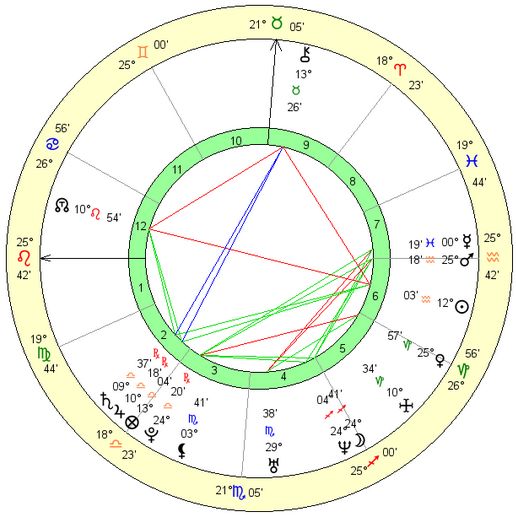
| Planet | Longitude | House | |
| Sun | 12 Aquarius 03' 52" | 6 | |
| Moon | 24 Sagittarius 41' 45" | 4 | |
| Mercury | 00 Pisces 19' 43" | 7 | |
| Venus | 25 Capricorn 57' 05" | 5 | |
| Mars | 25 Aquarius 18' 30" | 6 | |
| Jupiter | 10 Libra 18' 22" R | 2 | |
| Saturn | 09 Libra 37' 32" R | 2 | |
| Uranus | 29 Scorpio 38' 60" | 4 | |
| Neptune | 24 Sagittarius 04' 02" | 4 | |
| Pluto | 24 Libra 20' 13" R | 3 | |
| Chiron | 13 Taurus 26' 52" | 9 | |
| Lilith | 03 Scorpio 41' 32" | 3 | |
| True Node | 10 Leo 54' 40" | 12 | |
| Part of Fortune | 13 Libra 04' 56" | 2 | |
| Vertex | 10 Capricorn 34' 21" | 5 | |
| House | Longitude | ||
| Ascendant | 25 Leo 42' 49" | ||
| House 2 | 19 Virgo 44' 39" | ||
| House 3 | 18 Libra 23' 32" | ||
| House 4 | 21 Scorpio 05' 51" | ||
| House 5 | 25 Sagittarius 00' 12" | ||
| House 6 | 26 Capricorn 56' 13" | ||
| House 7 | 25 Aquarius 42' 49" | ||
| House 8 | 19 Pisces 44' 39" | ||
| House 9 | 18 Aries 23' 32" | ||
| MC (Midheaven) | 21 Taurus 05' 51" | ||
| House 11 | 25 Gemini 00' 12" | ||
| House 12 | 26 Cancer 56' 13" |
| Planet | Aspect | Planet | Orb |
| Sun | Trine | Jupiter | 1.76 |
| Sun | Trine | Saturn | 2.44 |
| Sun | Square | Chiron | 1.38 |
| Sun | Opposition | True Node | 1.15 |
| Sun | Trine | Part of Fortune | 1.02 |
| Moon | Sextile | Mercury | 5.63 |
| Moon | Sextile | Mars | 0.61 |
| Moon | Conjunction | Neptune | 0.63 |
| Moon | Sextile | Pluto | 0.36 |
| Moon | Trine | Ascendant | 1.02 |
| Moon | Quincunx | Midheaven | 3.60 |
| Mercury | Sextile | Moon | 5.63 |
| Mercury | Conjunction | Mars | 5.02 |
| Mercury | Square | Uranus | 0.68 |
| Mercury | Trine | Pluto | 5.99 |
| Mercury | Opposition | Ascendant | 4.61 |
| Venus | Sextile | Uranus | 3.70 |
| Venus | Square | Pluto | 1.61 |
| Venus | Quincunx | Ascendant | 0.24 |
| Venus | Trine | Midheaven | 4.85 |
| Mars | Sextile | Moon | 0.61 |
| Mars | Conjunction | Mercury | 5.02 |
| Mars | Square | Uranus | 4.34 |
| Mars | Sextile | Neptune | 1.24 |
| Mars | Trine | Pluto | 0.97 |
| Mars | Opposition | Ascendant | 0.41 |
| Mars | Square | Midheaven | 4.21 |
| Jupiter | Trine | Sun | 1.76 |
| Jupiter | Conjunction | Saturn | 0.68 |
| Jupiter | Quincunx | Chiron | 3.14 |
| Jupiter | Sextile | True Node | 0.60 |
| Jupiter | Square | Vertex | 0.27 |
| Saturn | Trine | Sun | 2.44 |
| Saturn | Conjunction | Jupiter | 0.68 |
| Saturn | Quincunx | Chiron | 3.82 |
| Saturn | Sextile | True Node | 1.29 |
| Saturn | Square | Vertex | 0.95 |
| Uranus | Square | Mercury | 0.68 |
| Uranus | Sextile | Venus | 3.70 |
| Uranus | Square | Mars | 4.34 |
| Uranus | Square | Ascendant | 3.94 |
| Neptune | Conjunction | Moon | 0.63 |
| Neptune | Sextile | Mars | 1.24 |
| Neptune | Sextile | Pluto | 0.27 |
| Neptune | Trine | Ascendant | 1.65 |
| Neptune | Quincunx | Midheaven | 2.97 |
| Pluto | Sextile | Moon | 0.36 |
| Pluto | Trine | Mercury | 5.99 |
| Pluto | Square | Venus | 1.61 |
| Pluto | Trine | Mars | 0.97 |
| Pluto | Sextile | Neptune | 0.27 |
| Pluto | Sextile | Ascendant | 1.38 |
| Pluto | Quincunx | Midheaven | 3.24 |
| Chiron | Square | Sun | 1.38 |
| Chiron | Quincunx | Jupiter | 3.14 |
| Chiron | Quincunx | Saturn | 3.82 |
| Chiron | Square | True Node | 2.54 |
| Chiron | Quincunx | Part of Fortune | 0.37 |
| Chiron | Trine | Vertex | 2.88 |
| True Node | Opposition | Sun | 1.15 |
| True Node | Sextile | Jupiter | 0.60 |
| True Node | Sextile | Saturn | 1.29 |
| True Node | Square | Chiron | 2.54 |
| True Node | Quincunx | Vertex | 0.34 |
| Part of Fortune | Trine | Sun | 1.02 |
| Part of Fortune | Quincunx | Chiron | 0.37 |
| Vertex | Square | Jupiter | 0.27 |
| Vertex | Square | Saturn | 0.95 |
| Vertex | Trine | Chiron | 2.88 |
| Vertex | Quincunx | True Node | 0.34 |
| Ascendant | Trine | Moon | 1.02 |
| Ascendant | Opposition | Mercury | 4.61 |
| Ascendant | Quincunx | Venus | 0.24 |
| Ascendant | Opposition | Mars | 0.41 |
| Ascendant | Square | Uranus | 3.94 |
| Ascendant | Trine | Neptune | 1.65 |
| Ascendant | Sextile | Pluto | 1.38 |
| Ascendant | Square | Midheaven | 4.62 |
| Midheaven | Quincunx | Moon | 3.60 |
| Midheaven | Trine | Venus | 4.85 |
| Midheaven | Square | Mars | 4.21 |
| Midheaven | Quincunx | Neptune | 2.97 |
| Midheaven | Quincunx | Pluto | 3.24 |
| Midheaven | Square | Ascendant | 4.62 |
A Perspective on AstrologyAstrology reveals nothing more than tendencies. Man can master his stars if he exerts his will. If one chooses to drift with the tide of life, the tendencies outlined in the birth chart will, at some point, manifest their effects. There is one crucial element that the Natal Chart does not show: the individual's will and how it may evolve. The application of free will is left entirely to the individual. Astrology forewarns us, allowing us to navigate life's situations with greater wisdom. What a man sows, he must reap. The karmic law operates in perfect harmony with the planets. The incarnation of the soul into a physical vessel occurs at the opportune moment when karmic law and planetary configurations align. Remember that so-called beneficial or malevolent configurations in a horoscope are not the result of chance or luck, but rather the harvest of our past deeds—the birth chart illustrates what we have brought from past incarnations and what we must master in this one. What we lack in our current existence can be attained in the future by embracing our cosmic tasks. The stars impel, but they do not compel. As Goethe wisely said: *From every power that holds the world in chains, man frees himself when he attains self-control.* The AscendantThe Ascendant is the soul's gateway for fulfilling its karmic quest. It governs the physical appearance and personality of an individual, reflecting how we were perceived by others in childhood, how we assert ourselves in our environment, our baseline of available energy, our non-specific immunity, our rate of recovery, the foundation of our psychophysical constitution, temperament, and the fundamental blueprint of our destiny. The Ascendant of this personality is: LEO Boastfulness and dramatic inclinations (as well as a tendency to exaggerate) are key traits of Leo rising. The temperament is choleric, and the will is highly potent and instinctual—unlike Gemini, where it is calculated. There is a strong sense of affectation. Unlike Aries, Leo can champion causes not only for themselves but also for others. Though fond of the spotlight, they do so with consideration for those around them, possessing a highly social nature. They are open, warm-hearted, and loyal. Indeed, Leo rising is among the most loyal (second only to Capricorn) and the most generous of the entire zodiac. A profound vulnerability, however, is their susceptibility to flattery, which can easily be exploited! They are entertaining and love to celebrate. An afflicted Ascendant can manifest as extreme, despotic meticulousness—an disproportionate reaction when things do not suit them. This is a specific pedantry characteristic of a challenged Leo. While Virgo rising tends to complain, Leo reacts imperiously. If we resist, the consequences can be harsh, as the Leo majesty feels wounded and reacts excessively. This Ascendant typically bestows broad shoulders—disproportionately so. The physique is often athletic with strong bones (providing resilience against physical injury). There is a majestic, though not perfectly precise, gait—highly human and, in its own way, admirable. A key signature is often very light eyebrows. Planets in the SignsPlanets in the signs constitute a vital component of astrological interpretation. The expression of a planet within a specific sign exerts a profound and highly characteristic influence upon our lives. Sun in Aquarius This is often a highly complex placement. To fully comprehend its manifestations, we must analyze Uranus and Saturn, the diametrically opposed co-rulers of Aquarius. These individuals strive for originality and place immense value on their independence. Yet, under the influence of Saturn, they can often be overly conservative and authoritative. They frequently struggle to process their emotions, analyzing them with unnecessary rigidity or tension. Externally, they project self-assurance, but they often harbor a rather low opinion of their own intellectual abilities or creative talents. The Sun in Aquarius can also manifest as radical views and eccentricity. These individuals undeniably possess an innate affinity for progress and science. Moon in Sagittarius An individual with this Moon placement detests anything that might restrict their expression and behavior. They are certainly not the conventional ideal partner, as they cherish freedom and tend to resist binding commitments. They demand and require maximum personal space. By selecting independent and daring partners, they often inadvertently increase the likelihood of relationship instability. They are open, communicative, and their thirst for adventure is legendary. They take great delight in discovering foreign cultures, frequently traveling to distant lands to satisfy this longing. Optimism is their natural state. Mercury in Pisces This placement bestows poetic abilities and intuitive thinking. The thoughts of such an individual possess a certain higher dimension; this Mercury is by no means exact and is ill-suited for mathematicians or mechanical engineers, nor is it ideal for rigorous scientific studies. Paradoxically, however, it is highly favorable for physicists. It provides a rich, active imagination but can also create confusion and misunderstandings in the native's immediate environment. Mercury in Pisces is one of the most challenging placements for this planet, especially in our modern, technological era. Its greatest virtue, however, is that it powerfully bridges waking consciousness with intuition. An individual with this Mercury can express themselves in an almost intoxicating manner. One need only recall the legendary Czech actor Rudolf Hrušínský to immediately grasp the spellbinding style and essence that Mercury in Pisces can project. In its challenged expression, it breeds chaotic thinking, unreliable judgment, an inability to process raw facts, and a poor memory. Venus in Capricorn This placement inclines the individual to evaluate relationships primarily through the lens of pragmatism and common sense. They are often bound by tradition and may appear rather conservative in romance. Emotionally, they may view relationships as a vehicle to attain social standing and security, tending to relegate their own feelings to the background. Venus in Capricorn also harbors a refined appreciation for luxury and quality possessions. Mars in Aquarius This native loves to apply radical solutions to both current and long-standing problems. The issue lies in the fact that while their theoretical proposals seem logical, in practice they often lead to chaos and confusion. An individual with this Mars is frequently an impractical idealist, though much depends on the aspects Mars makes to other planets. This placement introduces highly intriguing elements to sexuality, as they are inventive, modern, and eager to experiment with new concepts. In love, they are open and unconventional, though their raw sexual energy may not be exceptionally high. A unique trait is that they seek erotic relationships out of curiosity and a desire for novel experiences rather than a longing for deep merging with a partner. Men with this placement especially enjoy intellectual engagement, attempting to dazzle their partners with clever remarks, quick wit, and ingenuity. They present themselves as highly intellectual, hoping to captivate and impress their counterpart. Mars in Aquarius is rarely a beacon of absolute fidelity, even if at first glance they project a rather strict, aloof image. They love to experiment and are easily led astray by the promise of fresh, unconventional experiences. Women with this Mars are drawn to partners who embody Aquarian qualities. Jupiter in Libra In air signs, the individual emphasizes personal development through analytical thinking and intellect. They possess a great gift for self-analysis and introspection, closely examining their own motivations. They enjoy participating in collective ideas and evaluating societal evolution. Jupiter in Libra seeks to use knowledge and wisdom to establish harmony and foster peace; interestingly, however, these goals are more frequently realized in personal relationships rather than on a global scale. They possess a deep love for the arts and a desire to be creatively involved. Saturn in Libra In air signs, this planet tends to restrict communication and intellectual development. However, especially when strongly aspected, it fosters mental discipline and grants the native the strength and motivation to overcome intellectual hurdles. In Libra, Saturn emphasizes quality, stable, and committed partnerships in a positive sense. This is certainly not someone who thrives on a casual or promiscuous lifestyle. Within relationships, they demand harmony and mental alignment. If afflicted, this desperate urge to achieve harmony at all costs can become incredibly exhausting for their partner. Planets in the Astrological HousesEach house represents a specific area of life. The position of a planet within a house indicates how well or poorly one fares in that domain. To calculate the houses accurately, the exact time of birth is paramount. Sun in the 6th House This is a somewhat restrictive placement for the Sun, as the sixth house is, among other things, the house of subordinate service and everyday labor. The individual often works exceptionally hard, exhausting themselves without achieving significant career advancement. True fulfillment can be found in serving others and caring for animals. A strongly placed Sun here almost always manifests as a house full of pets, ranging from rabbits and cats to farm animals. The spontaneous expression of emotions can become problematic with this Sun. While the sixth house refines emotions, it also compels the individual toward duty and service. This contradictory principle manifests in childhood; if parents force a child with this placement to suppress or rigidly regulate their emotions, the foundation for psychological distress in later life is laid. Instead, parents should teach such a child to express their feelings directly and healthily. Establishing proper hygiene habits—from daily personal care to dressing—is also vital from an early age. Moon in the 4th House Evaluating this position of the Moon responsibly is no simple task. In an era that often disregards traditional values, the fourth house plays a pivotal role. Unlike the egoistic desire of the Sun, the Moon represents the needs of the soul, and here it manifests as a profound longing for a harmonious home environment and emotional security. A well-aspected Moon can create a household that radiates peace and serenity. Afflicted aspects produce a similar longing, but the native's efforts to cultivate such an environment may be thwarted. The individual's upbringing and their parents' behavior during childhood naturally exert an immense influence here. Unfortunately, most children with a challenged Moon are born into family environments that are far from peaceful, as the fourth house also describes our origins. A person with the Moon in the fourth house may experience highly fluctuating success in all their endeavors. The interventions of fate can be equally erratic and unpredictable; one day the native can give and receive effortlessly, and a week later everything has changed (depending on aspects and sign). Unless heavily afflicted, the Moon in the fourth house facilitates the essential process of this house: discovering feelings and emotions, finding one's spiritual nature and identity, and the capacity to accept and be accepted. Under poor aspects, however, difficulties arise with natural expression on the physical plane. This manifests as issues with natural movement, dancing, and discomfort with one's own nudity—resulting in self-consciousness that blocks intimacy. Lastly, the fourth house rules real estate, and the Moon's placement indicates potential fluctuations in material property. The native will always harbor a deep emotional connection to ancestral property and their own heritage, as well as a profound bond with their ancestral roots. Mercury in the 7th House These individuals yearn for mental kinship with their partners. They gladly share their hobbies, interests, and opinions with a close circle of friends and their significant other. While they show empathy and compassion for others' struggles, their primary motivation is often sheer curiosity! An individual with Mercury in the seventh house tends to analyze relationships intellectually (depending on the zodiac sign) and has an intense need for communication with their partner. Whether they choose verbal or written forms depends on the sign, aspects, and current circumstances (such as long distance). This need to communicate can border on the compulsive; they require constant reassurance that their partner is thinking of them and is ready to converse at any moment. They are highly receptive to information regarding human dynamics and develop their intellect precisely through relational dialogue. They make excellent psychologists, provided other aspects and a healthy dose of intuition are present—attributes a truly skilled psychologist cannot do without. Venus in the 5th House This placement bestows great social activity and popularity, which these individuals are willing to work hard to maintain. Sex becomes a form of creative self-expression, as do their artistic talents and creativity. They easily forge delightful friendships with children. Caution is advised with afflicted aspects of Venus, where there may be a risk of boundary issues with minors. They form romantic relationships easily, and the longevity and depth of their feelings depend on the aspects and sign. They find joy and happiness in the spontaneous expression of their sexuality. An afflicted Venus may lead to a search for illicit or unconventional sexual encounters. Through their partner, they can positively develop their emotions and sexuality, successfully gaining independence and entrepreneurial skills. The foundation of their self-esteem will rest on their ability to cultivate their emotions, their children, creativity, spontaneous sexual expression, and business acumen. Mars in the 6th House Its influence is felt predominantly in work relations, subordinate service, healing, physical health, and the expression of feelings. This individual will constantly strive to outdo the competition at work, which often leads to conflict with colleagues. If Mars is afflicted, these disputes can become highly unpleasant, as the native employs typical Martian tactics—force and pressure—to assert themselves. On the positive side, they possess an incredible work ethic, speed, reliability, and integrity. They can work exceptionally hard, and their colleagues often share similar traits. This is a classic configuration for an excellent administrator, especially if there is room for promotion. Their emotions and feelings are often expressed in connection with their work environment, meaning among colleagues, and these reactions are usually swift, sudden, and spontaneous. It is often said that before others even realize what triggered an emotional outburst from a colleague with Mars in the sixth house, the native has already forgotten why they reacted that way! Aries is a classic sign reflecting this principle, whereas Scorpio will express emotions covertly—no less intensely, but turned inward, effectively suppressing them, which can take a toll on their health. This is especially true under afflicted aspects where emotions are misjudged. Mars in this house signifies rapid, acute illnesses manifesting in the area ruled by the zodiac sign: Pisces affects the lymphatic system, Taurus the tonsils, Scorpio the reproductive organs, etc. Illnesses can also arise due to carelessness, restlessness, or overwork. Mars in the sixth house naturally bestows healing abilities closely tied to the native's interest in maintaining health. The application of these skills depends on the zodiac sign. Pisces will be compassionate, intuitive, and work with energy; Scorpio provides deep insight and works with subtle signatures (homeopathy, automatic drawing, Aura-Soma); fire signs favor massage, Libra works with Tai Chi, etc. A retrograde Mars in this house points to past-life work issues (conflicts with colleagues, harsh working conditions) and, if heavily afflicted, the potential misuse of healing powers in previous incarnations. Jupiter in the 2nd House This placement is not entirely simple to evaluate, as much depends on the zodiac sign. For instance, if in Capricorn, the native may strive for material abundance yet display miserliness. Conversely, they can also squander money with excessive generosity and extravagance. Jupiter in Pisces, on the other hand, tends to disregard money due to idealistic views or higher values, which may sometimes be mere illusions. Generally, this planet in the second house 'safeguards' the physical form, finances, generosity, further growth, and material security (achieved through one's own labor). It is a classic configuration for a patron of the arts, especially highlighted when Jupiter is in Sagittarius. This individual often invests significant sums into their spiritual and psychological development. Self-worth and confidence are built through higher education, and they often gravitate toward the law. Under afflicted aspects, philanthropy is used primarily to boost personal popularity, and there is a risk of squandering wealth through risky ventures driven by a lust for luxury. A heavily afflicted Jupiter is a typical aspect of a gambler. A retrograde Jupiter indicates the mismanagement of financial resources in past lives; the individual must now learn to handle them, often under more challenging conditions, to truly appreciate the value of material assets. Saturn in the 2nd House In this case, material resources are restricted and blocked. The individual often works tirelessly to earn a good living, yet inexplicably fails to thrive. They suffer from difficulties in establishing boundaries with their surroundings and managing their personal space, which they often try to fill with unimportant objects. This person frequently struggles with self-worth and encounters obstacles that prevent them from obtaining money, housing, a suitable position, or a desired academic title. (In compensation, they may accumulate an excess of academic titles—a pathological manifestation of self-assertion stemming from an inferiority complex). They harbor a persistent fear of financial lack, making them highly frugal. However, this frugality can cause them to miss prime financial opportunities. They are also overly cautious. Saturn in the second house is the primary configuration for the development of an inferiority complex (highly important). These individuals always evaluate themselves by societal standards rather than their own, creating a primary trauma (they cannot value themselves naturally and suffer from guilt if they try). They can only feel good about themselves when they fulfill rules associated with the second house (e.g., earning a specific degree). Constant worry over losing money or fear of poverty leads directly to this inferiority complex. This can manifest secondarily as poverty or a feeling of having no control over one's finances. This placement often brings housing issues—apartments that are cluttered, poorly ventilated, or plagued by disputed ownership. People with this Saturn are often oppressed or bullied. A highly effective remedy for this placement is the administration of the homeopathic remedy Psorinum in quantum concentration, which helps comprehend and process the energies of Saturn in the second house. Uranus in the 4th House Blockages, compensation, or projection in the realms of family, home, childhood habits, and upbringing. In the event of a blockage, the native often relocates suddenly and unexpectedly due to external circumstances, such as a change in landlord. These individuals usually possess a highly advanced, technical (almost office-like) household. Toward their own children, they may employ the same extreme parenting styles they experienced in childhood—sudden praise without cause followed by equally sudden, severe punishments. The fourth house is responsible for discovering feelings and emotions, which, under Uranus, often surface abruptly and unexpectedly (as compensation). If blocked, the individual cannot access their true feelings until they process Uranian energies. In projection, their environment mirrors exactly the emotions they cannot find within themselves. People with this Uranus are often too independent to sustain a harmonious, functional family, resisting domestic ties and the responsibilities of maintaining a household. The fourth house also rules hereditary diseases; a negatively aspected Uranus can cause chromosomal aberrations, phenylketonuria, strokes, etc. The fundamental task for someone with Uranus in the fourth house is to find security in a natural way and to neutralize the adverse effects of their upbringing. Neptune in the 4th House During childhood, the family dynamic was often confusing, vague, or 'something was not quite right.' Hereditary alcoholism is common in such families, and the native must exercise extreme caution with alcohol. These individuals love to indulge in beautiful fantasies of a harmonious home, but they always prefer a comfortable chaos and disorder over any domestic organization. The primary trauma rooted in Saturn is dissolved by the Neptunian principle through an unconventional upbringing, which the native then replicates with their own children. If afflicted, Neptune causes issues with spiritual identity—both in finding and establishing it. It also blocks access to one's ancestral roots, giving rise to anxiety neuroses. Generally, an individual with an afflicted Neptune in the fourth house is more susceptible to hereditary schizophrenia, psychotic states, and obsessive neuroses. These mental health struggles always stem from hereditary factors in this case. People with Neptune in the fourth house possess a deep affinity for nature, natural remedies, and healing. However, they lack boundaries in these relationships; they must consciously build these limits and realize that the 'golden mean' is the best path. Here, Neptune resides in the vibrational field of the Moon. Due to this Neptunian resonance, the soul may yearn for an ever-greater family sanctuary and perfect harmony, and when these longings remain unfulfilled, suffering ensues. To heal the issues caused by this Neptune, we can employ the hermetic signatures of the Moon and the sign in which Neptune is placed. Pluto in the 3rd House In a harmonious position, this bestows an extraordinary, magical power of the spoken word; everything uttered carries immense weight. Energy is transmitted primarily through sound (aligning with the third house principle), making this an exceptional placement for singers. Verbal expression is highly persuasive. These individuals know how to exert successful pressure on their surroundings when they need to convince, though in a magnetic sign, this pressure is instead directed from the environment onto them. Their way of thinking is profoundly deep and inscrutable. It is an ideal configuration for those in media and advertising. Their verbal output is potent and often flawless, as they meticulously monitor the quality of their expression and constantly work to refine it. These individuals are rarely satisfied with conventional education, often pursuing alternative paths. The root of their fixations lies in communication, its refinement, and a quest for perfection. Under afflicted aspects, the magical power of the word is abused to manipulate others, creating illusions and disinformation for purposes indicated by the house cusp in Scorpio. These individuals may lie deliberately and opportunistically, often entirely unaware of this destructive tendency, which their peers may also fail to detect. There may be negative sibling influences, troubles during short journeys or business trips (particularly of a legal nature, such as a stolen passport or cash), and forgetfulness due to distractibility. Generally, individuals with Pluto in the third house excel at leveraging their knowledge (for example, in IT) and are highly skilled at selling their expertise, sometimes leaving those in their presence feeling inferior. Planetary AspectsAn aspect is the geometric relationship between planets. Based on the angle they form, we can determine their mutual influence and categorize them into three groups: harmonious, unharmonious, and conjunctions. How each aspect manifests in a person's life is detailed below. Sun harmonious with Jupiter Instills a self-assured and optimistic personality. The native of such a chart loves to travel and seeks adventure, possessing a passion for study and a desire to embrace new experiences. Sun harmonious with Saturn Bestows the capacity for diligent and responsible work. These individuals are highly reliable, though they often suffer from low self-esteem and a tendency to restrict themselves unnecessarily. Moon harmonious with Mercury Harmonious aspects grant an excellent memory, a poetic soul, and a deep empathy for others. This aspect is highly beneficial for teachers, journalists, and psychologists. These individuals also harbor a keen interest in their heritage, roots, and environmental issues. High intelligence is often indicated (the soul speaks freely to the spirit). Moon harmonious with Mars Harmonious aspects provide the capacity for constructive and practical action. Domestic challenges are resolved with ease and a genuine willingness to compromise. They are emotionally open and express their feelings with sincerity. They make excellent hosts. Moon conjunct Neptune This conjunction brings a deep yearning to seek something greater than the ego, often drawing the native toward esoteric realms and religion. The individual is highly self-sacrificing and frequently taken advantage of. They are drawn to exotic arts. However, they are rarely orderly in the home. This conjunction represents a fusion of receptivity and sensitivity, the ability to perceive higher vibrational planes, and artistic inspiration (Fire – painting, inner vision; Air – music; Earth – sculpture, printmaking; Water – poetry, writing when coupled with a strong Mercury). An afflicted conjunction is a primary signature for mental illness (schizophrenia, psychotic disorders). Schizophrenia is a state of split consciousness; in truth, it is a natural state—not a disease in itself, but a reaction of the individual's social environment to their reality, and the individual's subsequent reaction to that environment (the native themselves rarely understands it). Schizophrenia is practically an essential threshold for spiritual evolution. Once the individual realizes they perceive multiple dimensions, clinical symptoms fade as the soul understands its state. Somnambulism, alcoholism, substance abuse, absolute chaos, and an inability to rely on one's own emotions may occur. There can be a pathological need to display emotions (resembling hysteria). Moon harmonious with Pluto Harmonious aspects bring a highly intense emotional life and profound experiences. The native strives to transform their immediate environment for the better and will speak openly and clearly, even at the cost of dispute. These aspects yield highly authentic emotional experiences and powerful expression. Feelings are potent and direct, yet never theatrical. This individual may use their emotions to influence others! A highly harmonious relationship with the mother is common for both genders. Moon harmonious with Ascendant This individual requires people around them to maintain emotional well-being. They are empathetic and attentive to the needs of others, openly sharing their emotions with those around them. They love life and humanity, being fundamentally caring, warm, sensitive, and understanding. Mercury conjunct Mars This conjunction sharpens the intellect dramatically, rendering the native witty, even sarcastic. They love verbal sparring and wordplay. Extremely impatient, they are capable of working to the point of utter exhaustion. Thinking is rapid, practical, and precise. Mercury unharmonious with Uranus Unharmonious aspects often breed extreme opinions and a fierce need for independence. They may impose their views—which are frequently detached from reality—upon others with arrogance and a refusal to compromise. Their mind is often ahead of its time, gravitating toward movements whose ideas may only be widely accepted in the future. They possess a curious intellect, creative and unconventional thinking, and a need for intellectual conflict; however, their creative endeavors can be destructive, leading to rebellion and anarchy. Health manifestations: with a diurnal Mercury (third house, Gemini) – autism, concussion, cerebral contusion, nervous breakdown, hyperthyroidism (pathological appetite, calcium metabolism, and bone structure issues). Croup, sneezing, whooping cough, and fistulas (as the body seeks any outlet to bring inflammation to the surface). Periodontitis. With a nocturnal Mercury (sixth house and Virgo) – diaphragmatic hernia, traveler's diarrhea, intestinal fistula, and stuttering. There is a high risk of appendicitis and perforation of abdominal organs. Mercury harmonious with Pluto Harmonious aspects bestow a formidable will and clear convictions. The sphere of interests is vast—ranging from magic and psychology to mathematics and physics. There is a need for an active exchange of thoughts and experiences. These aspects function similarly to the conjunction, though less intensely, with a greater emphasis on persuasion. Mercury unharmonious with Ascendant This individual possesses boundless energy and struggles to sit still. They seek the company of intellectual peers and thrive on mental challenges, rarely hesitating to initiate debates or challenge others' ideas. At times, they may struggle to express their thoughts clearly, or simply speak excessively. Venus harmonious with Uranus This placement causes the individual to demand constant change and initiative from their friends. Emotionally independent, they rarely seek binding commitments. Relationships are formed spontaneously but are often short-lived. Harmonious aspects bestow sex appeal and sudden magnetism, particularly in women. Health manifestations: with a diurnal Venus (seventh house, Libra) – fetishism, voyeurism, frotteurism (attachment to a loved one's belongings), certain forms of homosexuality, vitiligo, and renal colic independent of kidney stones (spasms without clear cause). Spasms of the ureter, sudden fractures or herniations in the lumbar spine. With a nocturnal Venus (Taurus, second house) – dysphagia (esophageal spasm), menopausal transitions, floating kidney, and displacement of cervical vertebrae. Venus unharmonious with Pluto This manifests in a characteristic manner—the native is capable of loving and hating with absolute intensity. They conceal their deepest passions and possess a vivid imagination. They crave dominance over others, which usually manifests in business or the relentless pursuit of material wealth. It amplifies sexuality and sexual magnetism, presenting a risk of controlling behavior in relationships. Unharmonious aspects create a powerful magnetism but also invite intense, almost paranoid jealousy! Women especially may construct imaginary scenarios of betrayal, ultimately provoking the very infidelity they feared. In a man's chart, Venus signifies the qualities of his partners; here, it points to captivating women with potent sexual allure who can control him subtly, invisibly, yet highly effectively. Mars unharmonious with Uranus Unharmonious aspects render the native highly eccentric, individualistic, and almost pathologically independent. They admire fringe religious or political movements (such as anarchists or radicals). However, they struggle to actively participate due to restlessness and instability. If they can develop practical discipline, they can successfully execute their plans. Caution—especially in opposition, there is a high risk of reckless behavior and subsequent injury. Mood swings and a desire to disrupt the established order are common. This person craves freedom and will sacrifice anything for it. Haste, impulsivity, aggression, poorly planned actions, and injuries are common, particularly in fixed signs, angular houses, or when unharmonious with the luminaries. In men, Uranus aspecting Mars, Aries, or the first/eleventh houses can cause premature ejaculation, spastic coughs, muscle tears, ruptured tendons, scarlet fever, hiccups, hyperkinesia, spasms, colic, cuts, stab wounds, and jaw dislocation. Calf cramps, migraines, strokes, furuncles, joint dislocations, fits of rage, and vomiting of blood may also occur. Mars harmonious with Neptune These aspects bestow great imagination, creativity, artistic talent, and idealism. However, the individual can be highly impractical. A classic image of this aspect is the world-renowned artist who is utterly helpless in daily life. The alignment of action and ideals is harmonious, yielding a high level of spiritual awareness—ideal for spiritual guides. Mars harmonious with Pluto Generally, Mars is the lower octave of Pluto, and Pluto is the higher octave of Mars. This aspect reinforces both physical and psychological power, occult abilities, and stamina. It amplifies Martian energy, making the native incredibly industrious and meticulous. They are highly headstrong; once they set a goal, they are not easily deterred. Harmonious aspects are typical of brilliant military strategists, granting a genius for planning. These individuals seek to control both themselves and others. It is the sole aspect that drives a person to the ultimate realization of their goals, overcoming any obstacle. Mars unharmonious with Ascendant The native tends to be assertive, independent, and highly competitive, struggling with cooperative efforts. Externally, they may appear arrogant or self-centered. An internal conflict rages between personal desires and the need for harmonious relationships. Impulsive and emotional, they may experience sudden outbursts of anger. Jupiter conjunct Saturn The nature of this conjunction must be evaluated alongside any other aspects modifying these planets. Generally, either the restrictive and "formative" energies of Saturn dominate, or the expansive energies of Jupiter prevail, which can lead to overconfidence or grandiosity. If the energies of both planets are successfully integrated, it creates an ideal balance for structured growth. Uranus unharmonious with Ascendant This native must always be active and bores easily. For stimulation, they may rely on others to keep them engaged and inspired. They possess a fierce craving for freedom and the desire to act exactly as they please, when they please. They likely juggle multiple projects simultaneously and enjoy the company of unusual people. Relationships can be challenging as they resist being tied down. Their rebellious and impulsive nature may occasionally lead to trouble. They must learn to slow down and cultivate patience. Neptune harmonious with Pluto These harmonious aspects endure for generations; these planets remained in a sextile from 1945 to 1995, fostering peaceful mindsets and, when combined with other aspects, supporting global transformative and peace-seeking efforts. Neptune harmonious with Ascendant Empathetic and compassionate, it is highly likely the native cultivated strong intuitive and psychic abilities in previous incarnations, which may surface in this life. They are exceptionally creative and highly sensitive to the needs of others. Pluto harmonious with Ascendant This native tends to be earnest, possessing a powerful degree of personal magnetism. They have an inquiring mind and strive for diplomacy in their relationships. They possess natural leadership qualities that can be fully realized through conscious effort. Powerful emotions can stir within them, but they are entirely comfortable with intensity. Philosophy and the reform of societal ills appeal deeply to them. ConclusionThis natal chart was calculated under the assumption that the birth data provided—such as time, place of birth, and correct time zone (including daylight saving time adjustments)—is accurate. Even a one-hour discrepancy in the birth time can result in incorrect house placements or an inaccurate Ascendant. By no means is this astrological analysis exhaustive. Every human being is far more complex than a single page can ever capture. To generate your own personal Natal Chart online and entirely free of charge, please proceed to our Free Natal Chart Source Zbyněk Slába www.oranzovestranky.cz |
