
Personal Horoscope
Kurt Cobain
Born Monday, February 20, 196719:20:00 (Time Zone = GMT -8 hours)
123w45, 46n58
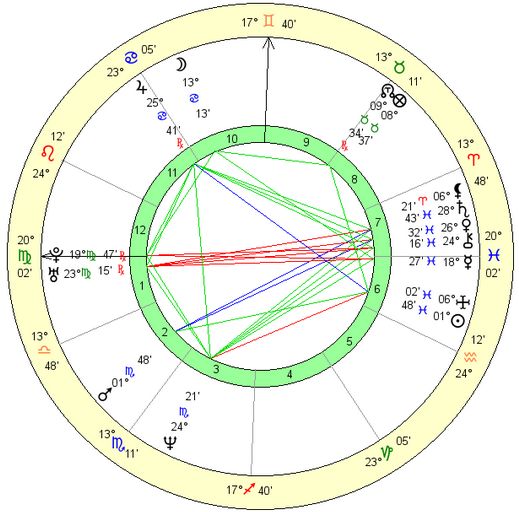
| Planet | Longitude | House | |
| Sun | 01 Pisces 48' 11" | 6 | |
| Moon | 13 Cancer 13' 13" | 10 | |
| Mercury | 18 Pisces 27' 25" | 6 | |
| Venus | 26 Pisces 32' 28" | 7 | |
| Mars | 01 Scorpio 48' 13" | 2 | |
| Jupiter | 25 Cancer 41' 38" R | 11 | |
| Saturn | 28 Pisces 43' 32" | 7 | |
| Uranus | 23 Virgo 15' 08" R | 1 | |
| Neptune | 24 Scorpio 21' 01" | 3 | |
| Pluto | 19 Virgo 47' 35" R | 12 | |
| Chiron | 24 Pisces 16' 49" | 7 | |
| Lilith | 06 Aries 21' 07" | 7 | |
| True Node | 09 Taurus 34' 51" R | 8 | |
| Part of Fortune | 08 Taurus 37' 27" | 8 | |
| Vertex | 06 Pisces 02' 29" | 6 | |
| House | Longitude | ||
| Ascendant | 20 Virgo 02' 29" | ||
| House 2 | 13 Libra 48' 18" | ||
| House 3 | 13 Scorpio 11' 06" | ||
| House 4 | 17 Sagittarius 40' 58" | ||
| House 5 | 23 Capricorn 05' 03" | ||
| House 6 | 24 Aquarius 12' 18" | ||
| House 7 | 20 Pisces 02' 29" | ||
| House 8 | 13 Aries 48' 18" | ||
| House 9 | 13 Taurus 11' 06" | ||
| MC (Midheaven) | 17 Gemini 40' 58" | ||
| House 11 | 23 Cancer 05' 03" | ||
| House 12 | 24 Leo 12' 18" |
| Planet | Aspect | Planet | Orb |
| Sun | Trine | Mars | 0.00 |
| Sun | Quincunx | Jupiter | 6.11 |
| Sun | Square | Neptune | 7.45 |
| Moon | Trine | Mercury | 5.24 |
| Moon | Sextile | Pluto | 6.57 |
| Moon | Sextile | Ascendant | 6.82 |
| Mercury | Trine | Moon | 5.24 |
| Mercury | Opposition | Uranus | 4.80 |
| Mercury | Trine | Neptune | 5.89 |
| Mercury | Opposition | Pluto | 1.34 |
| Mercury | Conjunction | Chiron | 5.82 |
| Mercury | Opposition | Ascendant | 1.58 |
| Mercury | Square | Midheaven | 0.77 |
| Venus | Quincunx | Mars | 5.26 |
| Venus | Trine | Jupiter | 0.85 |
| Venus | Conjunction | Saturn | 2.18 |
| Venus | Opposition | Uranus | 3.29 |
| Venus | Trine | Neptune | 2.19 |
| Venus | Conjunction | Chiron | 2.26 |
| Mars | Trine | Sun | 0.00 |
| Mars | Quincunx | Venus | 5.26 |
| Mars | Quincunx | Saturn | 3.08 |
| Jupiter | Quincunx | Sun | 6.11 |
| Jupiter | Trine | Venus | 0.85 |
| Jupiter | Trine | Saturn | 3.03 |
| Jupiter | Sextile | Uranus | 2.44 |
| Jupiter | Trine | Neptune | 1.34 |
| Jupiter | Sextile | Pluto | 5.90 |
| Jupiter | Trine | Chiron | 1.41 |
| Jupiter | Sextile | Ascendant | 5.65 |
| Saturn | Conjunction | Venus | 2.18 |
| Saturn | Quincunx | Mars | 3.08 |
| Saturn | Trine | Jupiter | 3.03 |
| Saturn | Opposition | Uranus | 5.47 |
| Saturn | Trine | Neptune | 4.38 |
| Saturn | Conjunction | Chiron | 4.45 |
| Uranus | Opposition | Mercury | 4.80 |
| Uranus | Opposition | Venus | 3.29 |
| Uranus | Sextile | Jupiter | 2.44 |
| Uranus | Opposition | Saturn | 5.47 |
| Uranus | Sextile | Neptune | 1.10 |
| Uranus | Conjunction | Pluto | 3.46 |
| Uranus | Opposition | Chiron | 1.03 |
| Uranus | Conjunction | Ascendant | 3.21 |
| Uranus | Square | Midheaven | 5.57 |
| Neptune | Square | Sun | 7.45 |
| Neptune | Trine | Mercury | 5.89 |
| Neptune | Trine | Venus | 2.19 |
| Neptune | Trine | Jupiter | 1.34 |
| Neptune | Trine | Saturn | 4.38 |
| Neptune | Sextile | Uranus | 1.10 |
| Neptune | Sextile | Pluto | 4.56 |
| Neptune | Trine | Chiron | 0.07 |
| Neptune | Sextile | Ascendant | 4.31 |
| Pluto | Sextile | Moon | 6.57 |
| Pluto | Opposition | Mercury | 1.34 |
| Pluto | Sextile | Jupiter | 5.90 |
| Pluto | Conjunction | Uranus | 3.46 |
| Pluto | Sextile | Neptune | 4.56 |
| Pluto | Opposition | Chiron | 4.49 |
| Pluto | Conjunction | Ascendant | 0.25 |
| Pluto | Square | Midheaven | 2.11 |
| Chiron | Conjunction | Mercury | 5.82 |
| Chiron | Conjunction | Venus | 2.26 |
| Chiron | Trine | Jupiter | 1.41 |
| Chiron | Conjunction | Saturn | 4.45 |
| Chiron | Opposition | Uranus | 1.03 |
| Chiron | Trine | Neptune | 0.07 |
| Chiron | Opposition | Pluto | 4.49 |
| Chiron | Opposition | Ascendant | 4.24 |
| True Node | Conjunction | Part of Fortune | 0.96 |
| Part of Fortune | Conjunction | True Node | 0.96 |
| Ascendant | Sextile | Moon | 6.82 |
| Ascendant | Opposition | Mercury | 1.58 |
| Ascendant | Sextile | Jupiter | 5.65 |
| Ascendant | Conjunction | Uranus | 3.21 |
| Ascendant | Sextile | Neptune | 4.31 |
| Ascendant | Conjunction | Pluto | 0.25 |
| Ascendant | Opposition | Chiron | 4.24 |
| Ascendant | Square | Midheaven | 2.36 |
| Midheaven | Square | Mercury | 0.77 |
| Midheaven | Square | Uranus | 5.57 |
| Midheaven | Square | Pluto | 2.11 |
| Midheaven | Square | Ascendant | 2.36 |
A Perspective on AstrologyWhen exploring the kurt-cobain-birth-chart, we must remember that astrology displays nothing more than tendencies. A person can master their stars if they assert their free will. If one chooses to drift with the current of life, the tendencies outlined in the natal chart will manifest their effects at certain points in their journey. One element never shown in a birth chart is the individual's free will and how it might evolve. The exercise of free will is left entirely to the individual. Astrology forewarns us, allowing us to navigate life's currents with greater wisdom. What a man sows, he must reap. The karmic law operates in perfect harmony with the planets. The incarnation of a soul into a physical body occurs at the exact auspicious moment when karmic law and planetary configurations can work in unison. Remember that the so-called auspicious or inauspicious configurations in a horoscope are not the result of chance or luck, but are the harvest of our past deeds—the birth chart reveals what we have brought from past incarnations and what we must master in this one. What we lack in our present life can be forged in the future by consciously taking up our spiritual tasks. The stars impel, they do not compel. As Goethe wisely said: *From every power that binds the world, man frees himself when he gains self-control.* The AscendantThe Ascendant is the gateway of the soul for fulfilling its karmic mission. It expresses the individual's physical appearance and personality, reveals how we were perceived by others in childhood, how we assert ourselves in our environment, our baseline level of available energy, our non-specific immunity, recovery time, the foundation of our psychophysical constitution, temperament, and the blueprint of our destiny. The Ascendant of this personality is: VIRGO The fundamental traits of an individual with this Ascendant are meticulousness, diligence, and strong logical reasoning. Such a person often projects an aura of perfection. The temperament is melancholic, yet accompanied by a very delicate will, often governed by timidity and shyness (the "timid deer" syndrome). Psychologically fragile and unstable even with positive aspects, they cannot tolerate pressure of any kind. Their most positive attribute is precision (akin to a watchmaker or technician). They are rarely capable of resolving a situation holistically, choosing instead to focus intently on details, struggling to process everything at once. An afflicted Ascendant leads to extreme sensitivity to details, overbearing pedantry, making them an excellent detective or analyst, though quite challenging to live with! Intimate life may present hurdles—they demand near-sterile cleanliness from their partner and lack sexual spontaneity. The Bach flower remedy *Crab Apple* addresses this beautifully. They constantly overanalyze, criticize, and deconstruct, spending a week resolving a single issue. Physically, they are often tall and slender, though their posture and movement may lack grace—projecting a somewhat lanky, uncoordinated, or pivoting impression. In individuals of short or medium stature, there is usually considerable physical strength. Their handwriting is often ancient, historical, and artistic. They possess an extraordinary eye for detail. Planets in SignsPlanets in signs constitute a vital part of horoscopic interpretation. The expression of each planet in a specific zodiac sign exerts a profound and highly characteristic influence on our path. Sun in Pisces This solar placement typically indicates sensitive individuals, rich in imagination and dreams, but also prone to naive and unrealistic expectations. Less harmonious aspects can trigger excessive pessimism and compensatory mechanisms in the individual, who may be impractical and inclined to flee from problems rather than facing them head-on. Conflict is deeply detrimental to Pisces, and they dislike being bound or obligated. The Sun in Pisces is certainly not an ideal placement for a high-level executive, as they dislike decision-making and avoid taking responsibility. Yet, the idealism of Pisces often turns them into passionate souls who will literally give themselves away for a good cause. They are self-sacrificing, though they often hide their true feelings behind a mask. This Sun must learn to escape less into the realms of fantasy and focus more on the practical dimensions of earthly life. Moon in Cancer Such individuals are deeply sensitive and possess an abundance of inner warmth, but they require and demand reciprocated love to feel happy and emotionally secure. Interestingly, a person with this Moon placement needs guidance—a stable, protective presence of another that allows them to live in peace, relax, and discover their soulful identity. This is a highly maternal archetype with a profound appreciation for the safety and warmth of home. Men with this placement are also nurturing and often seek deep bonds with maternal women. If their own mother was intensely maternal, it can lead to difficulties in forming romantic partnerships due to an emotional fixation on the mother. Mercury in Pisces This placement bestows poetic abilities and intuitive thinking. The perceptions of such a person possess a higher spiritual dimension; this Mercury is by no means exact or analytical, making it ill-suited for mathematicians and mechanical engineers, as well as rigorous scientific studies. Paradoxically, however, it is highly favorable for physicists. It provides a vivid imagination and can generate misunderstandings and confusion in the native's surroundings. The position of Mercury in Pisces is the most challenging for this planet, especially in our modern, technological era. Its greatest asset, however, is that it powerfully bridges waking consciousness with intuition. A person with this Mercury can express themselves in an almost intoxicating manner—one need only recall the legendary Czech actor Rudolf Hrušínský to instantly grasp the sublime style that Mercury in Pisces offers to the world. In its inharmonious form, it breeds mental chaos, unreliable judgment, an inability to process cold facts, and poor memory. Venus in Pisces This placement is not simple to interpret. It provides a unique, almost mystical allure, and especially in women, creates an impression of needing protection. It tends to be overly romantic and impractical. Naivety often harms their relationships. They escape into dreamscapes, frequently viewing relationships as a compromise between their romantic fantasies and reality. A person with Venus in Pisces is capable of deep self-sacrifice, but because they are usually consumed by their own feelings, they can lose the tangible connection to their partner. Mars in Scorpio Such a person is strongly drawn to the occult, magic, and hidden activities. They invest themselves emotionally in everything they do, constructing motivations so powerful that they can rarely be dissuaded. A potent sexual drive and a magnetic aura are typical for this Mars; however, emotions always play the leading role, with physical desire taking second place. The longing for deep emotional intimacy is characteristic, as is the intense need to express it. Love is always paramount, and sex is the natural culmination of a deepening bond. An individual with Mars in Scorpio possesses a formidable erotic charge—a classic example being the most famous politician of the last century, US President J. F. Kennedy, who was viewed as a sex symbol by millions of women worldwide, despite the fact they mostly knew him only through low-quality black-and-white television. His intimate liaisons are still depicted in highly popular films today. It must be noted, however, that the gentleman was also a Scorpio by birth! A person with Mars in Scorpio detests any form of manipulation and fiercely resists it; they refuse to be controlled or reformed by anyone. In love, they are rarely patient, and their jealousy is legendary. Women with this Mars are drawn to passionate partners, often viewing jealousy as a proof of affection—though this can become an obstacle over time. Jupiter in Cancer In water signs, this placement demands emotional depth; the soul yearns for love and emotional fulfillment. They have a sense of romance but are prone to excessive self-pity, self-sacrifice, and sentimentality. Especially in Cancer, the individual is deeply compassionate toward others and longs to help them. A drawback can be a strong attachment to a luxurious home and a tendency to spend excessively on its decoration. This Jupiter often motivates the individual to build their own sanctuary. Saturn in Pisces This planet causes the greatest difficulty in water signs due to its principle of emotional blockage, often leading to inexplicable emotional barriers. The individual is constantly confronted with their own emotions and is forced to master emotional self-control. Saturn in Pisces further heightens emotional vulnerability. Misunderstandings of situations arise—situations which could lead to spiritual growth if properly integrated. Naivety increases, and the personality forms overly idealistic views of the world, inevitably followed by disappointment when confronted with reality. Higher faculties, intuition, and insight into others may be blocked, even though these spiritual gifts are available and should be developed (depending also on Saturn's house placement and aspects). Planets in Astrological HousesEach house represents a specific area of life. The placement of a planet in a house reveals how one fares in that domain. To calculate this accurately, the precise birth time is essential. Sun in the 6th House This is a somewhat restrictive position for the Sun, as the sixth house is the domain of subordinate service and routine work. The individual often exerts immense effort, exhausting themselves without achieving significant career advancement. Fulfillment can be found in service to others and animal care. A strong Sun here almost always indicates a multitude of pets, from rabbits and cats to farm animals. Spontaneous emotional expression can be challenging here, as the sixth house develops emotions but simultaneously demands subservience. This conflicting principle manifests in childhood; if parents force a child with this Sun to suppress their emotions, the foundation for psychological distress in later life is laid. Parents should instead teach such children to express their feelings directly and healthily. Establishing proper hygiene habits—from personal care to dressing—is also vital from an early age. Moon in the 10th House While the Sun in the tenth house is intensely focused on leadership and career, the Moon's receptive, feminine energy seeks emotional satisfaction in professional life, gravitating toward nurturing professions. Women especially may channel their ambition here; if they find more emotional fulfillment at work than at home, they may neglect domestic life to the detriment of family interests. Both men and women find greater soulful satisfaction in their career than in the family circle. Women, however, are more deeply affected by this as it suppresses their maternal instinct. The Moon in the tenth house always resides in the vibrational field of Capricorn, regardless of its physical zodiac sign. Consequently, the individual may lose touch with their true feelings, much like a physical Moon in Capricorn. Paradoxically, however, the Moon in the tenth house allows a better integration of the house's primary principle: identifying with societal rules and laws. Through this alignment, the individual gains recognition and social standing. If this principle is not properly integrated, the native often becomes maladjusted, struggling to fit into social structures, frequently clashing with laws, rules, or authority figures—a trait seen even in highly educated individuals. A person with this Moon placement will readily accept financial reward for their work, especially if they can fulfill their emotional need to help others. They will evaluate others similarly—prioritizing social awareness and employee attitudes over corporate profits. The lesson of the tenth house is to learn humility, spirituality, order, and respect for authority. Through the Moon, these matters are felt deeply at the soul level, and harmonious aspects can accelerate the integration of these principles. A harder task is learning to observe life without judging. The soul, represented by the Moon, naturally seeks emotional engagement, making detachment difficult. Nonetheless, the vibrational field of Capricorn, which rules the tenth house, aids in accepting structure and order. Mercury in the 6th House A highly intriguing placement that bestows numerous talents. It primarily signifies work and intellectual professions. It produces excellent artists, teachers, scientists, merchants, and speakers. With more complex aspects, it indicates skilled technicians, watchmakers, fine mechanics, postal workers, telecommunications staff, etc. One rule applies to both groups: they perform work based on their current mood and cannot tolerate excessive physical labor. An individual with this Mercury learns to develop and express emotions. Since this planet operates intellectually and analytically, progress can be delayed by overthinking emotions, their causes, and consequences. The health aspect of this Mercury is fascinating: these individuals easily connect illnesses with their root causes, often making excellent diagnosticians, doctors, and healers. The native is highly sensitive to pain and requires modern diagnostic methods (e.g., MRI, ultrasound, CT scans) when facing health issues. As employees, they require intellectual stimulation to maintain focus and systematic organization. If they can realize their ideas, they are meticulous and methodical workers. Nervous tension from mental overload is common. Venus in the 7th House This placement usually indicates a highly popular, diplomatic, attractive, and charming individual. However, they may constantly seek external validation. In partnerships, they can harbor unrealistic emotional expectations. Relationships are formed naturally and effortlessly due to their charm; unlike the fifth house, the emphasis here is on stability and depth. Their initial contact is always captivating, and they seek the best in others. Through their partner, they learn to make primary contact with the world, validate themselves, gain friends, and discover original ideas. Their self-esteem is anchored in positive feedback, harmonious relationships, a balanced environment, and ease of communication. Mars in the 2nd House These individuals direct immense energy toward earning money, acquiring material assets, and real estate. They thrive in independent work or business, highly aware of competition. Inharmonious aspects can lead to draining battles with competitors. They are courageous, viewing business risks as a natural challenge. The zodiac sign dictates the mode of earning, self-definition, and grounding. A strong Mars asserts itself directly, while an afflicted Mars may use force. They require substantial personal space, sometimes at the expense of others, but must learn to establish boundaries firmly and clearly. The nature of Mars' aspects is crucial—positive aspects (e.g., with Jupiter) allow them to introduce innovative financial strategies, while inharmonious aspects can lead to financial ruin. A retrograde Mars suggests the misuse of material resources in past lives. Aspects with Neptune or links to Pisces point to philanthropic tendencies. Unfortunately, Mars in the second house is rarely favorable for relationships, as it causes constant self-assertion against the partner, leading to perpetual conflict if the partner is equally strong. Both partners will directly mirror each other's patterns of self-assertion. Jupiter in the 11th House Such a person forms connections easily, surrounding themselves with many acquaintances, yet rarely deep friends (unless they have a strongly tenanted seventh house). They grow and expand through group activities. Possessing high ambitions, they successfully utilize their networks to achieve them. This placement grants powerful protectors, patronage, and indicates favorable conditions for joint marital enterprises. In harmonious aspect with the Sun, Moon, or Venus, it offers excellent potential for diplomats and politicians, especially with a diurnal birth (Sun above the horizon). Generally, a well-aspected Jupiter in the eleventh house is suited for banking, leasing, and mortgages. It plays a pivotal role in the liberation from societal rules integrated during evolution. If the Capricorn field (tenth house, Saturn, Capricorn) is well-aspected, this liberation occurs harmoniously; otherwise, anarchy and rebellion against laws may trigger societal backlash. Afflicted aspects manifest as unearned, false patronage with unpredictable consequences; if afflicted by the Sun, Moon, or Venus, it indicates politicians or diplomats lacking fundamental skills, leading to catastrophic errors. Such individuals are often arrogant, worsening their plight. A retrograde Jupiter indicates an inability to achieve social standing in a past life, remaining in lower classes and wasting opportunities. Now, facing relational difficulties, they have the chance to resolve past errors. This creates a secondary inferiority complex (while Saturn in the second house governs the primary one). Saturn in the 7th House This placement brings frustrating blockages to partnerships, seemingly without external cause. The native yearns for a stable relationship, yet it proves elusive or ends abruptly due to external factors (parental interference, financial issues, a partner's changing attitude, or an unwillingness to alter one's lifestyle). The partner often blames various obstacles brought by Saturn. These individuals view relationships traditionally, approaching them with deep responsibility, and take relationship failures hard. They hold high standards for others but are capable of compromise. If Saturn is afflicted, this compromise borders on self-deprecation. They often seek older partners, who may, however, be unavailable (married). They struggle to open up. Primary trauma occurs during initial contact and forming new relationships. Meeting new people is slow and awkward; they suffer from guilt and fear of doing something wrong. Sudden obstacles (phone calls, interruptions) often disrupt the connection process. The individual always learns Saturnian lessons through their partner. In a nocturnal birth (Sun below the horizon), this threatens an oppressive marriage. In Pisces, Sagittarius, or Gemini, they may change partners frequently, worsening the primary trauma. An afflicted Saturn in Pisces in the seventh house creates a strong predisposition to severe alcoholism, as the individual often turns to drink to numb relationship frustrations. Uranus in the 1st House This placement indicates blockages or compensations regarding physical and psychological destiny, available energy, self-discovery, and self-assertion. It brings sudden reversals and unexpected, often severe crises at the most inopportune times (depending on aspects). Electric signs lead to compensation (extremes, seeking attention at all costs), while magnetic signs cause blockages. These individuals detest restrictions on their personal freedom. They are fierce individualists who stand out from the crowd, natural pioneers who prefer competition to teamwork. Neptune in the 3rd House This placement bestows poetic abilities, allowing creative work with imagination and ideas. They make excellent journalists and teachers, though their communication style is not always clear. When they focus on their rich inner imagery, they can convey profound truths (merging Neptune with Mercury's field—the third house). Communication is atypical, often intuitive (e.g., telepathy, or telekinesis when linked with Mars). Even slight afflictions to Neptune cause speech impediments, stuttering, dyslexia, and a unique memory impairment where defining precise terms is difficult. They often have indistinct, illegible handwriting and vague body language. Unresolved, afflicted Neptune energies often breed conflicts with siblings of "unclear etiology." Generally, they may travel by sea. The Neptunian principle can drive a relentless pursuit of higher education, yet failing to meet academic goals brings suffering. These issues can be remedied through the hermetic signatures of Gemini and the sign hosting Neptune. Pluto in the 12th House This aspect primarily causes an impatient expectation of acquiring higher spiritual faculties (highly important). Because these are Plutonian blockages of twelfth-house principles operating deep in the subconscious, any affliction to Pluto often leads to mental illness (schizophrenia and psychotic personality disorders). The pursuit of expanded consciousness occurs under intense psychological pressure, and the native often projects this pressure onto their environment. Severe psychotic disorders generate this intense mental strain! Modern clinical treatment poses a major dilemma here: while medication is highly effective, the individual actually needs the tension of the illness to access expanded states of consciousness. From a spiritual perspective, this constitutes counter-evolutionary treatment! The owner of this Pluto can easily fall prey to occult groups or cults. If they face a magical attack born of malice, it is not of karmic origin, making the damage extremely difficult to undo (highly important). A severely afflicted Pluto in the twelfth house typically leads to long-term institutionalization. There is a powerful threat from hidden enemies. However, if Pluto is well-aspected, the native possesses immense transformative potential in the mystical realm (highly important)! Yet this is no easy path, as the Plutonian blockages must first be transcended. The physical somatization of an afflicted Pluto-Neptune field (Pluto in the twelfth or Pisces, Neptune in Scorpio or the eighth) always leads to severe infectious diseases. There is a close link between AIDS and this configuration (the Neptunian field governs immunity, while Pluto signifies destructive cellular changes). These illnesses are often triggered by harsh transits (e.g., Mars or Saturn). The most terrifying infectious diseases linked here are pneumonic plague and anthrax. A person with Pluto in the twelfth house often realizes their visions in absolute solitude! The root of their fixation lies in the impatient craving for higher powers and expanded states. Unlike Neptunians, they do not turn to psychotropic substances to escape reality, but specifically to expand consciousness and gain spiritual power. However, substance use is equally destructive for them, as it opens spiritual doors incorrectly, with catastrophic effects on their psyche. Planetary AspectsAn aspect is the geometric relationship between planets. Based on their angles, we can discern how they influence each other, categorizing them into three groups: harmonious, inharmonious, and conjunctions. Discover how these aspects manifest in life below. Sun Harmonious with Mars Bestows the ability and desire to set goals and achieve them. Assertiveness, energy, competitiveness, impatience, and quick reflexes are typical expressions. Sun Inharmonious with Neptune Causes individuals to be overly compassionate and self-sacrificing, exposing them to exploitation and deception. They must be exceptionally cautious with drugs, alcohol, and tobacco, as they have strong tendencies to use addictive substances to cope with their problems or visions. It amplifies desire (with any planet); with the Sun, it manifests as a morbid craving for fame, power, and authority. Enormous sexual desire, confusion, and chaos are typical of false gurus and prophets who pretend to be what they are not. It also brings false inspiration and heightened sensitivity to illness. Moon Harmonious with Mercury Harmonious aspects grant an excellent memory, a poetic soul, and empathy for others. Typical careers where this aspect shines include teaching, journalism, and psychology. These individuals are deeply interested in their ancestry, roots, and environmental issues. Often accompanied by high intelligence (the soul speaks freely to the mind). Moon Harmonious with Pluto Harmonious aspects bring an intensely deep emotional life. The native strives to transform their immediate environment for the better and speaks out openly, even at the cost of conflict. These aspects offer authentic emotional experiences and powerful expression. Feelings are profound and raw, yet never theatrical. This person may use their emotions to influence others! A highly harmonious relationship with the mother is common for both sexes. Moon Harmonious with Ascendant This individual needs people around them to maintain emotional equilibrium. They are empathetic and attentive to the needs of others, openly sharing their emotions. Nurturing, sympathetic, and understanding, they genuinely love life and people. Mercury Inharmonious with Uranus Inharmonious aspects often breed extreme views and an intense need for independence. They impose their ideas—which are frequently detached from reality—on others with arrogance and a refusal to compromise. Their thinking is often ahead of its time, drawing them to groups whose views may only be accepted in the far future. They possess an inquisitive, creative, and unconventional intelligence, requiring intellectual clashes, though their creativity can be destructive, leading to rebellion and anarchy. Health manifestations: with a diurnal Mercury (third house, Gemini)—autism, concussion (*commotio cerebri*), brain contusion, nervous breakdown, hyperfunction of the thyroid and parathyroid glands (affecting appetite, calcium metabolism, and bone structure). Croupy cough, sneezing, whooping cough, and fistulas (as the body seeks an outlet for inflammation). Periodontitis. With a nocturnal Mercury (sixth house, Virgo)—diaphragmatic hernia, traveler's diarrhea, intestinal fistula, and stuttering (*balbuties*). There is a high risk of appendicitis and perforation of abdominal organs. Mercury Harmonious with Neptune Harmonious aspects bestow a vivid imagination and refined artistic taste, though they lack an eye for detail. They love photography, esotericism, and fashion, but their trusting nature can lead to exploitation. The native often possesses special spiritual gifts. These aspects represent the union of high intuition and inspiration with thought, speech, and communication. It is the aspect of poets (especially when combined with the Moon). However, practical thinking is often lacking, and material matters may remain unintegrated. Communication is unique—lacking exactness and absolute clarity. Mercury Inharmonious with Pluto Inharmonious aspects govern the mind through obsessive opinions and instincts, breeding deep prejudice. Studies are sporadic but highly intense, often resulting in exhaustion. In their search for truth, they are utterly convinced of their views, ignoring practical realities. Intelligence is utilized to manipulate others—typical of spies, secret agents, and covert researchers. They use information destructively (highly important), usually unconsciously. (For instance, at the moment the atomic bomb was dropped on Hiroshima, Mercury was in a sharp square to Pluto). Mercury Inharmonious with Ascendant Possesses restless energy and cannot sit still for long. They seek intellectual company and love mental challenges, quickly initiating debates or offering arguments to challenge the thinking of others. At times, they may struggle to express their thoughts clearly or simply speak too much. Venus Harmonious with Jupiter Bestows a gentle nature and warmth. The personality adapts easily to social trends and expectations, possessing a love for fashion. This aspect brings hospitality, generosity, and serves as a powerful aid in legal disputes. Venus in Conjunction with Saturn Brings a responsible and reserved demeanor to emotional and social activities. The native is deeply loyal, conventional, and stable, requiring a solid relationship to feel secure. They harbor a hidden fear of rejection, and their self-esteem in relationships is often fragile. An older, reliable friend provides comfort. They are meticulous with shared resources. A person with a Venus and Mars conjunction builds their relationships with greater difficulty, but these bonds then prove to be remarkably stable. However, they must consciously cultivate trust in their own feelings. Though loyal, the relationship may eventually be sustained by social conventions rather than love. Venus Inharmonious with Uranus This aspect severely complicates relationships, which are perceived almost as a loss of personal integrity. Feelings are highly unstable and volatile. They often experience numerous relationships. Unconventional, confrontational, eccentric, and original in art, their finances fluctuate, with a downward trend being more common. Emotions operate completely outside societal frameworks, leading to emotional utopias and a stormy, unstable love life. Health manifestations: with a diurnal Venus (seventh house, Libra)—fetishism, voyeurism, frotteurism (addiction to a loved one's towel!), certain forms of homosexuality, vitiligo, and renal colic not caused by stones or sand (spasms without organic cause). Ureteral spasms, sudden lumbar spine fractures, and herniated discs. With a nocturnal Venus (Taurus, second house)—dysphagia (esophageal spasm), menopausal transitions, floating kidney, and misaligned cervical vertebrae. A sharp square can cause cervical spine injuries and ruptures of atherosclerotic carotid vessels. Venus Harmonious with Neptune Grants a sense of romance, compassion, and intuition in relationships. Imagination, resourcefulness, and artistic appreciation are immense. The native possesses great taste, is highly presentable, and has a unique style. In a woman's chart, sexual arousal is triggered by the transcendent, mysticism, and magic. In a man's chart, it reflects the qualities of his inner feminine (Anima) and the nature of the women who will surround him. In artists, it signifies sublime inspiration, refined taste, and creativity. Jupiter Harmonious with Saturn Harmonious aspects are exceptionally auspicious throughout the chart—strengthening, providing a solid foundation, stability, and balance, allowing the individual to develop fully. Jupiter Harmonious with Uranus Harmonious aspects bestow independence in views, business, intellect, and expression (depending on house placements). It brings positive idealism and a philosophical mind. The native longs to assert their rights and individuality. It brings sudden luck, unexpected inheritances, a knack for medicine, and success in politics or religion. Jupiter Harmonious with Neptune Harmonious aspects bring a compassionate yet restless soul, the ideals of a reformer, artistic inclinations, and religious visions (though these may be suppressed by harsher planetary aspects). The trine and sextile are excellent aspects for lawyers and judges; higher legislative bodies should ideally be established under these aspects. These harmonious aspects can be a soul-memory of a high spiritual state in the distant past (e.g., angelic origin)—a trace of the creative forces the soul utilized during the creation of the cosmos, or rarely, a past incarnation of an archangel. Jupiter Harmonious with Pluto Harmonious aspects bestow tenacity, decisiveness, and a drive for self-realization. A trine often brings wealth and abundance in adulthood. These aspects unite Zeus with Hades (profound fortune with the subconscious)! Much depends on which planet is stronger; if Pluto dominates, destructive forces tend to prevail. Jupiter Harmonious with Ascendant The native is highly social, positive, enthusiastic, liberal, and tolerant. They love entertainment and enjoy gathering knowledge across a wide range of topics. Others naturally gravitate toward them simply because they feel good in their presence. Saturn Inharmonious with Uranus Inharmonious aspects cause unprincipled behavior that can border on anarchy, though a highly developed sense of order is also possible—albeit one that is intolerable to those around them. Actions are highly unpredictable. Hardness, rigidity, uncompromising logic, contempt for others, paranoid delusions, and degenerative neurological disorders (Alzheimer's, Parkinson's, MS). Claudication, fear of flying, and bone fractures. Compensations include flying, sudden unnatural changes, an inability to break taboos paired with a compulsive urge to do so. Saturn Harmonious with Neptune The native finds the foundation for practical endeavors in dreams and fantasies, though their views remain conservative. A harmonious and angular connection indicates systematic progress in spiritual evolution. Uranus Harmonious with Neptune Instills a yearning for a meaningful life, though these influences are subtle and require other planets to fully manifest. They also stimulate the imagination. Uranus in Conjunction with Pluto A rare aspect that accompanies major turning points in human history. The conjunction produces powerful, original personalities (especially when on sensitive points), sparking brilliant ideas that captivate crowds. This conjunction yields either a truly exceptional personality or absolute madness! While Uranus's aspects with outer planets are complex and slow to manifest, Pluto acts as a catalyst, grounding them into reality. Uranus in Conjunction with Ascendant The individual is unconventional, rebellious, and perhaps ahead of their time. They seek to reform and transform their surroundings. Highly strung and bursting with energy, they must monitor their urge to always be active and learn to rest. Their ideas are original, creative, intuitive, and artistic. They refuse to be bound to anything or anyone. Neptune Harmonious with Pluto These long-lasting harmonious aspects (with the two planets in sextile from 1945 to 1995) foster peaceful inclinations and, alongside other aspects, support global peacemaking and transformative initiatives. Neptune Harmonious with Ascendant Empathetic and compassionate. It is highly probable they cultivated strong intuitive and psychic abilities in a past life, which may surface in this incarnation. Highly creative and sensitive to the needs of others. Pluto in Conjunction with Ascendant The individual pursues their interests with immense intensity. They exert a magnetic, powerful presence, sometimes perceived as outright dangerous; others are never quite sure if this power will be used to heal or to harm. Because Pluto is a planet of supreme power, the native may face situations requiring immense inner strength and will. Here, understanding karmic law is vital: "those who live by the sword shall die by the sword." They may spend much time trying to eradicate negative traits within themselves. They possess a natural detective's ability to intuitively sense the thoughts, feelings, and motivations of others. ConclusionThis natal horoscope was cast on the assumption that the birth data provided—time, place, and time zone (including Daylight Saving Time adjustments)—is accurate. Even an hour's discrepancy will result in inaccurate house placements or an incorrect Ascendant. By no means is this astrological analysis exhaustive. Every human being is a far more complex and multidimensional entity than a single reading can ever encompass. To generate your own personal Natal Chart online completely free of charge, please visit: Free Natal Chart Source Zbyněk Slába www.oranzovestranky.cz |
