
Personal Natal Chart
Vanessa Paradis
Born Friday, December 22, 197205:20:00 (Time Zone = GMT +1 hour)
02e30, 48n48
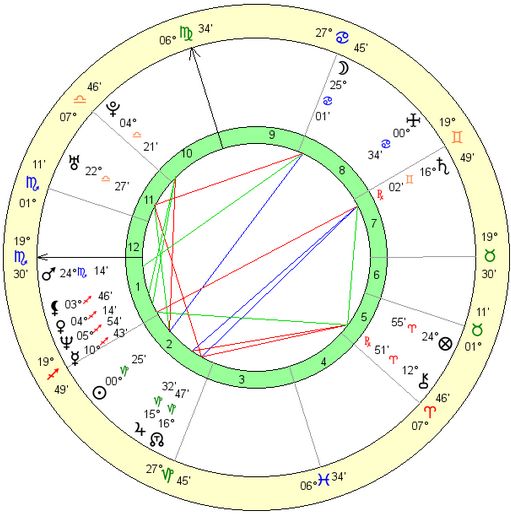
| Planet | Longitude | House | |
| Sun | 00 Capricorn 25' 46" | 2 | |
| Moon | 25 Cancer 01' 00" | 8 | |
| Mercury | 10 Sagittarius 43' 52" | 1 | |
| Venus | 04 Sagittarius 14' 39" | 1 | |
| Mars | 24 Scorpio 14' 26" | 1 | |
| Jupiter | 15 Capricorn 32' 54" | 2 | |
| Saturn | 16 Gemini 02' 06" R | 7 | |
| Uranus | 22 Libra 27' 46" | 11 | |
| Neptune | 05 Sagittarius 54' 12" | 1 | |
| Pluto | 04 Libra 21' 38" | 10 | |
| Chiron | 12 Aries 51' 26" R | 5 | |
| Lilith | 03 Sagittarius 46' 23" | 1 | |
| True Node | 16 Capricorn 47' 14" | 2 | |
| Part of Fortune | 24 Aries 55' 35" | 5 | |
| Vertex | 00 Cancer 34' 53" | 8 | |
| House | Longitude | ||
| Ascendant | 19 Scorpio 30' 49" | ||
| House 2 | 19 Sagittarius 49' 39" | ||
| House 3 | 27 Capricorn 45' 35" | ||
| House 4 | 06 Pisces 34' 39" | ||
| House 5 | 07 Aries 46' 57" | ||
| House 6 | 01 Taurus 11' 21" | ||
| House 7 | 19 Taurus 30' 49" | ||
| House 8 | 19 Gemini 49' 39" | ||
| House 9 | 27 Cancer 45' 35" | ||
| MC (Midheaven) | 06 Virgo 34' 39" | ||
| House 11 | 07 Libra 46' 57" | ||
| House 12 | 01 Scorpio 11' 21" |
| Planet | Aspect | Planet | Orb |
| Sun | Quincunx | Moon | 5.41 |
| Sun | Sextile | Uranus | 7.97 |
| Sun | Square | Pluto | 3.93 |
| Sun | Opposition | Vertex | 0.15 |
| Sun | Trine | Midheaven | 6.15 |
| Moon | Quincunx | Sun | 5.41 |
| Moon | Trine | Mars | 0.78 |
| Moon | Square | Uranus | 2.55 |
| Moon | Square | Part of Fortune | 0.09 |
| Moon | Trine | Ascendant | 5.50 |
| Mercury | Opposition | Saturn | 5.30 |
| Mercury | Conjunction | Neptune | 4.83 |
| Mercury | Trine | Chiron | 2.13 |
| Mercury | Square | Midheaven | 4.15 |
| Venus | Conjunction | Neptune | 1.66 |
| Venus | Sextile | Pluto | 0.12 |
| Venus | Conjunction | Lilith | 0.47 |
| Venus | Square | Midheaven | 2.33 |
| Mars | Trine | Moon | 0.78 |
| Mars | Quincunx | Part of Fortune | 0.69 |
| Mars | Conjunction | Ascendant | 4.73 |
| Jupiter | Quincunx | Saturn | 0.49 |
| Jupiter | Square | Chiron | 2.69 |
| Jupiter | Conjunction | True Node | 1.24 |
| Jupiter | Sextile | Ascendant | 3.97 |
| Saturn | Opposition | Mercury | 5.30 |
| Saturn | Quincunx | Jupiter | 0.49 |
| Saturn | Sextile | Chiron | 3.18 |
| Saturn | Quincunx | True Node | 0.75 |
| Saturn | Quincunx | Ascendant | 3.48 |
| Uranus | Sextile | Sun | 7.97 |
| Uranus | Square | Moon | 2.55 |
| Neptune | Conjunction | Mercury | 4.83 |
| Neptune | Conjunction | Venus | 1.66 |
| Neptune | Sextile | Pluto | 1.54 |
| Neptune | Conjunction | Lilith | 2.13 |
| Neptune | Square | Midheaven | 0.67 |
| Pluto | Square | Sun | 3.93 |
| Pluto | Sextile | Venus | 0.12 |
| Pluto | Sextile | Neptune | 1.54 |
| Pluto | Sextile | Lilith | 0.59 |
| Chiron | Trine | Mercury | 2.13 |
| Chiron | Square | Jupiter | 2.69 |
| Chiron | Sextile | Saturn | 3.18 |
| Lilith | Conjunction | Venus | 0.47 |
| Lilith | Conjunction | Neptune | 2.13 |
| Lilith | Sextile | Pluto | 0.59 |
| Lilith | Square | Midheaven | 2.80 |
| True Node | Conjunction | Jupiter | 1.24 |
| True Node | Quincunx | Saturn | 0.75 |
| True Node | Sextile | Ascendant | 2.73 |
| Part of Fortune | Square | Moon | 0.09 |
| Part of Fortune | Quincunx | Mars | 0.69 |
| Vertex | Opposition | Sun | 0.15 |
| Ascendant | Trine | Moon | 5.50 |
| Ascendant | Conjunction | Mars | 4.73 |
| Ascendant | Sextile | Jupiter | 3.97 |
| Ascendant | Quincunx | Saturn | 3.48 |
| Ascendant | Sextile | True Node | 2.73 |
| Midheaven | Trine | Sun | 6.15 |
| Midheaven | Square | Mercury | 4.15 |
| Midheaven | Square | Venus | 2.33 |
| Midheaven | Square | Neptune | 0.67 |
| Midheaven | Square | Lilith | 2.80 |
A Perspective on AstrologyAstrology reveals nothing more than tendencies. When exploring the vanessa-paradis-birth-chart, we must remember that an individual can master their stars if they exert their will. If one chooses to simply drift with the current of life, the tendencies outlined in the birth chart will, at some point, manifest their effects. Yet, there is one thing a natal chart can never display: the individual's free will and how it may evolve. The exercise of free will is left entirely to the person. Astrology serves as a forewarning, allowing us to navigate life's challenges with greater wisdom. What a person sows, they must reap. The karmic law operates in perfect harmony with the planets. The incarnation of the soul into a physical body occurs at the precise moment when karmic law and planetary configurations can align in harmony. Remember that the so-called "benefic" or "malefic" configurations within a horoscope are not the result of mere chance or luck, but are the fruits of our past deeds. The birth chart mirrors what we have brought from past incarnations and what we must master in this one. What we lack in our current existence can be acquired in the future by embracing specific tasks. The stars impel, they do not compel. As Goethe wisely wrote: "From every power that holds the world in chains, man frees himself when self-control he gains." The AscendantThe Ascendant is the gateway of the soul, through which the being fulfills its karmic mission. It governs physical appearance and personality, reflecting how we were perceived by others in childhood, how we assert ourselves in our environment, our base levels of vital energy, our non-specific immunity, recovery periods, the foundation of our psychophysical constitution, temperament, and the very blueprint of our destiny. The personality's Ascendant is: SCORPIO Often a deeply complex personality, struggling to rationally explain the overwhelming surge of their inner emotions. They project a certain mystique and possess a natural affinity for secrets. Scorpio on the Ascendant bestows the most unyielding, resilient, invisible, and all-pervading willpower of the entire zodiac. It represents a phlegmatic temperament, though not in its purest form. They can endure immense inner strain, undergo trial by fire, and will sacrifice everything to attain their ultimate goal. Positively, they possess the rare ability to confront their own shadow, acknowledge their flaws, and transcend them through this profound self-awareness. They can integrate discordant aspects into their personal evolution and find peace with them. Blessed with exceptional observational skills, they observe without judging, and this non-judgment rapidly paves the way to enlightenment. They possess the gift of initiation—both for themselves and for others. They understand the mysteries of transformation, intuitively respecting and creating rituals across all facets of life. When afflicted, the Scorpio Ascendant can manipulate others with subconscious, hidden, and dangerous genius. This manipulation is so elusive that newcomers are swiftly ensnared, remaining blind to the Scorpio’s puppet strings. Yet, the saving grace of Scorpio is its capacity for total transformation. From quantum homeopathy, the remedy *Syfilinum* is excellent for accepting one's shadow and curbing this manipulative urge. The Scorpio Ascendant is highly psychometric—possessing an extraordinary capacity to read others. It is a deeply tantric sign with intense sexuality, capable of transforming sexual energy into higher spiritual forces. Scorpio on the Ascendant manifests in two distinct archetypes. The more dangerous is the fair-skinned, almost Nordic type, with piercing light blue eyes and a cold, unyielding gaze. They excel at dissimulation and make formidable poker players due to their absolute control over facial expressions. The second archetype features an aquiline nose, darker complexion, and a distinct, swaying gait, particularly noticeable in the pelvic region. Planets in the SignsPlanets in the signs are a crucial component of natal chart interpretation. The expression of a planet within a specific sign exerts a profound and highly characteristic influence on our lives. Sun in Capricorn Such individuals are typically materially oriented, pragmatic, conservative, and practical. One of the greatest challenges of this Sun placement is a rich, intense emotional life of which the individual is often entirely unaware, usually suppressing and sidelining the needs of the soul. Capricorn essentially knows no ease, approaching everything with intense gravitas; they lean toward pessimism and harbor a love for fine, luxurious things. Spontaneity and vulnerability do not come naturally to them, yet these are the very qualities they must consciously strive to cultivate throughout their life. The primary yardstick by which the Capricorn Sun evaluates others is wealth and material assets—though not universally true, this remains the underlying tendency. Moon in Cancer These individuals are deeply sensitive, harboring immense inner warmth, but they require and demand reciprocal love to feel secure and emotionally fulfilled. Intrigued by guidance, a person with this Moon placement often seeks the steady oversight of another to live peacefully, unwind, and find their spiritual identity. They represent the archetypal maternal figure, with a profound appreciation for the safety and warmth of home. Even men with this placement exhibit maternal instincts and are often drawn to nurturing women. However, if their own mother was overly possessive, establishing romantic partnerships may prove challenging due to a deep emotional fixation on the mother. Mercury in Sagittarius This placement bestows a highly synthetic and intuitive intellect, which, unlike in Aries or Leo, always incorporates social and humanitarian elements. However, their thought process is subject to rapid fluctuations, lacking stability, and ideas can easily become scattered. Inspiration and grand visions often overshadow reality, and details are treated with lighthearted disregard. They form instinctive impressions of reality. Mercury in Sagittarius lacks tact but possesses a vibrant interest in foreign cultures and philosophy. They are fiercely free-thinking, often with a religious or philosophical undertone to their intellect. They despise restriction and tend to react disproportionately to it. When afflicted, they can become argumentative, dogmatic, and may even appear quite erratic. Venus in Sagittarius This placement instills a deep yearning for spiritual and emotional freedom, making it far from ideal for traditional, conventional relationships. In partnerships, such individuals prefer to keep an "escape hatch" open; paradoxically, if they possess this freedom and can independently decide on the relationship's fate, they are capable of achieving profound happiness and fulfillment. They loathe emotional shackles, often severing ties immediately if they feel smothered. A social or intellectual subtext often plays a role in their choice of partner. Mars in Scorpio Such a person is strongly drawn to the occult, magic, and hidden endeavors. They invest themselves emotionally in every action and form motivations so resolute that they are almost impossible to alter. A powerful sexual drive and a magnetic, enigmatic aura are highly typical of this Mars placement, though emotions always reign supreme, with physical desire taking a secondary role. The yearning for emotional intimacy is highly characteristic, alongside an intense need to express it. Love is placed above all, and physical intimacy is the natural culmination of a deepening bond. An individual with Mars in Scorpio possesses an intensely magnetic erotic charge. A classic example is the most famous politician of the last century—U.S. President J.F. Kennedy, who was a sex symbol to millions, despite being known mostly through low-resolution, black-and-white broadcasts. His intimate liaisons continue to captivate audiences in popular media to this day. It must be noted, however, that he was also a Scorpio by nature! A person with Mars in Scorpio detests any form of manipulation directed at them and resists it fiercely, refusing to be controlled or reformed. In love, they are rarely patient, and their jealousy is legendary. Women with this placement are drawn to passionate partners, often mistaking jealousy for a sign of affection—which can eventually become a strain on the relationship. Jupiter in Capricorn An individual with Jupiter in an earth sign seeks personal growth through practical endeavors, with material gain often being a primary motivator. Financial security and stability are frequently their highest aspirations. They often love mountain hiking and find a deep resonance in mountaineering. Saturn in Gemini In air signs, this planet primarily constricts communication and intellectual expansion. However (especially with strong aspects), it fosters immense mental discipline, granting the strength and motivation to overcome intellectual hurdles. With Saturn here, the individual relies heavily on concrete facts. Their communication may seem ineffective, and others may overlook them because their rhetoric lacks the magnetic power to persuade. Subconsciously, they strive for communicative success and feel deeply frustrated when they fall short. Planets in the Astrological HousesEach house represents a specific realm of life. The placement of a planet within a house reveals how one fares in that particular area. To calculate these positions accurately, the exact time of birth is indispensable. Sun in the 2nd House The individual will place great emphasis on material security, finances, and will have a pronounced need for personal boundaries and inner space. Depending on the Sun's aspects, one can determine whether they will feel threatened in their personal integrity—striving to fortify it at all costs—or if they will work constructively with space, both inner and outer (e.g., as an architect). An afflicted Sun in the second house can mirror the restrictive influence of Saturn, creating a breeding ground for inferiority complexes, financial anxiety, and an inability to enjoy life. This breeds deep-seated insecurity, a loss of self-confidence that is hard to restore, and profound uncertainties with far-reaching consequences. People with this placement prefer to manage their own finances and resist external interference. If the Sun or the ruler of the second house is afflicted, conflicts with land registries or property authorities may arise. Moon in the 8th House This placement triggers intense sexual and emotional desires, coupled with a tendency to conceal them. This can be a challenging aspect, as few parents successfully teach their children to express their intimacy spontaneously; instead, these needs are often suppressed, though modern society is increasingly open. This Moon grants profound psychological insight into others, making it an ideal aspect for tarot readers or psychics, as it heightens intuitive sensitivity. While possessing a keen business instinct, their reliance on emotional undercurrents can lead to poor, unpragmatic decisions. The Moon in the eighth house also lends an intuitive perception of death; these individuals rarely fear transition, viewing it as another evolutionary phase, though they may fear the physical process of dying itself. If the Moon is in a water sign, there may be a risk of death by drowning or asphyxiation by fluid (whereas an afflicted Mars in Aries in the eighth house might point to fire). The partner's financial status is often volatile, and the individual may receive unexpected windfalls (inheritances, windfalls). Challenges often arise in the eighth-house process of anchoring relationships; the aspects of the Moon must be weighed carefully. For instance, a conjunction with Uranus can disrupt stability, leading to premature breakups. The eighth house also governs spiritual ideals, where the Moon's sign and aspects are key. It bestows strong tantric abilities, making the individual highly sensitive and intuitive in intimacy. Mystical and occult practices require caution, as the eighth house deals with raw, elemental, and sometimes dark magic. These individuals may feel drawn to evocation or spiritism, which can be highly perilous unless the Moon is exceptionally well-dignified. Mercury in the 1st House This placement bestows wisdom, a thirst for knowledge, and a drive to articulate thoughts to others. Depending on the sign and aspects, they may be highly loquacious or, conversely, a contemplative writer. An afflicted Mercury here manifests as restlessness and nervous tics. These individuals enjoy physical self-improvement through mercurial channels: study, debate, and intellectual exchange. They love to meditate in nature, aligning their thoughts with physical practices. This channel grants them abundant information to refine the physical body, which, in Buddhist philosophy, is the temple of the soul. Venus in the 1st House This placement almost invariably bestows an attractive appearance and a charming aura. The individual cherishes friendships and partnerships, which are vital to their well-being. They are warm and amiable but harbor an intense need to be loved. Many with this Venus are drawn to art, beauty, or fashion. A harmonious relationship has a highly positive impact on their physical health and vitality. Conscious of their allure, they continuously work to enhance it. However, with discordant aspects, vanity and vanity-induced relationship troubles can emerge. In all interactions, they emphasize physical aesthetics. Self-exploration and physical expression often occur through the mirror of the partner. Their self-esteem is anchored in their appearance and romantic harmony, which fosters physical development and emotional satisfaction. Mars in the 1st House An individual with this aspect asserts themselves through sheer vitality and force. A born leader and warrior, they discover their physical limits through strength and raw action; such people often find their calling in special forces, rescue units, or athletic pursuits. They assert their desires with immense drive, resourcefully dedicating their talents to the service of others. Generally respected, an afflicted Mars here can instead seek respect through intimidation. Even when harmonious, Mars in the first house struggles with energy regulation (Mars in Aries, for instance, is practically volatile) and tends to overexert itself, ignoring physical boundaries. They view life as a battle, creating unnecessary friction. If Mars is retrograde, it suggests a past life of intense selfishness; in this life, it can manifest as a ruthless, calculating, and swift aggression (aspects must be analyzed). They often possess a muscular, athletic build with a swift, and if afflicted, somewhat erratic gait. Jupiter in the 2nd House This position is complex to analyze, depending heavily on the sign. For instance, in Capricorn, it can trigger a drive for material prosperity alongside tendencies toward miserliness. Yet, paradoxically, they can also squander money with lavish extravagance. Conversely, Jupiter in Pisces may breed a disdain for money in favor of spiritual ideals, which may sometimes be mere illusions. Generally, this planet in the second house governs material resources, wealth, generosity, and financial growth through personal effort. It is the classic signature of a philanthropist, especially in Sagittarius. This individual often invests heavily in their spiritual and intellectual growth. Self-worth and confidence are bolstered by higher education, often leading them toward law. Discordant aspects manifest as ostentatious philanthropy used for self-promotion, risking squandered fortunes through speculative ventures. An afflicted Jupiter here is the hallmark of a gambler. A retrograde Jupiter indicates financial mismanagement in past lives; the soul must now learn the true value of material wealth under more challenging conditions. Saturn in the 7th House This placement brings frustrating delays and blocks in partnerships, often without any apparent external cause. The individual deeply desires a stable union, yet it remains elusive or ends abruptly due to external forces—parental interference, financial strain, a partner's change of heart, or an unwillingness to alter one's lifestyle. The partner often presents obstacles that Saturn in the seventh house represents. These individuals approach relationships with traditional, serious responsibility, taking romantic failures very hard. While demanding of their partner, they are capable of compromise; however, if Saturn is heavily afflicted, compromise can degenerate into self-deprecation. They are often drawn to older, established, or sometimes unavailable partners. Opening up emotionally is a struggle. The primary trauma lies in initiating new connections; the process is slow, awkward, and plagued by guilt or fear of impropriety, with sudden interruptions often halting the approach. They learn Saturnian lessons of discipline and patience directly through their partners. In a nocturnal birth (Sun below the horizon), there is a risk of an oppressive marriage. In mutable signs (Gemini, Sagittarius, Pisces), they may change partners frequently, compounding the trauma of connection. An afflicted Saturn in Pisces here can predispose the individual to severe alcoholism as a coping mechanism for relationship failures. Uranus in the 11th House This is perhaps the most auspicious placement for Uranus. In the eleventh house, the individual transcends societal rules and structures—not through lawless anarchy, but through a higher understanding of their limitations. Unassimilated, this energy submits to Saturn's structure, integrating the rules, so that once the Uranian energy is mastered, the soul realizes these laws are not absolute. This realization does not lead to revolt; instead, the individual emancipates themselves, breaking taboos without violating societal boundaries destructively. When afflicted, however, it can produce anarchists or rebels who struggle to integrate, often facing societal repression. Individuals with Uranus in the eleventh house set unconventional, long-term goals, associating with eccentric groups or leading ideological circles. Their social circle is vast but constantly shifting. A integrated Uranus here is superb for scientific, inventive, and pioneering breakthroughs, especially when linked to Mercury, the Sun, or the Moon. Neptune in the 1st House Individuals with this Neptune perceive higher cosmic vibrations through the lens of their own physical vessel. Their self-assertion is subtle, almost imperceptible; if it becomes too overt, it triggers counter-pressures that halt the process. This placement is magnificent for self-realization, as physical self-knowledge can lead to spiritual salvation. They employ various esoteric techniques, often utilizing Neptunian channels: spiritual practices, mystical exercises, or occasionally substances. An afflicted Neptune in Pisces is far more prone to escapism than a harmonious Neptune in Aries, but generally, this planet in the first house is less problematic than in the twelfth, as physical awareness is sought rather than mere escapism. Nevertheless, all intoxicants should be avoided, as their bodies are far more sensitive to chemical damage. They radiate a subtle, ethereal energy, receiving atypical reactions from their environment. They must avoid over-identifying with societal beauty ideals. When unintegrated, they assert themselves through illusion, impractical ideals, and naivety. In youth, there is an elevated risk of autoimmune disorders. Neptune here weakens the body part corresponding to its sign; in Taurus, for example, it weakens the throat, causing chronic throat issues. Removing the tonsils in this case is highly perilous, as the block shifts from the throat to the heart or lungs! These highly sensitive individuals often excel in art or fashion, though they can be unreliable. They suffer from diffuse anxieties, which intensify if Neptune is conjunct the Ascendant. If unintegrated, they demand too much of themselves, leading to typical Neptunian suffering, which can be remedied through the hermetic signatures of Aries or the occupying sign. A retrograde Neptune conjunct the Ascendant often indicates a difficult birth (e.g., amniotic fluid aspiration or prolonged labor). Pluto in the 10th House The individual strives to attain tenth-house objectives through Plutonian means. Unintegrated, Pluto blocks these areas, creating high-pressure crises through which the soul discovers these principles. At a subconscious level, anyone with this aspect harbors a deep yearning for power. This is not the overt, physical power of Mars, but the silent, invisible, and far more potent power of Pluto—unspoken, hypnotic, and highly effective. They weave intricate, unseen webs of hidden relationships, drawing others in imperceptibly to manipulate and control. This operates most strongly in career and politics. A well-dignified Pluto grants political genius, whereas an afflicted one breeds corruption, fraud, and embezzlement. (In a mundane chart, Pluto in the tenth signifies state-sanctioned oppression.) Combined with Saturnian energy (the tenth house), especially if even slightly afflicted, the individual adopts societal rules as their own, enforcing them through their position, completely unaware that these are not their genuine beliefs. They merely memorize established dogmas and present them as original creations—a dangerous trait in politicians and managers alike. This negative principle manifests in two ways. In its compensated form, Plutonian-Saturnian energy manifests through state oppression and surveillance. However, individuals who lack the power to oppress others but are forced to work within the state machinery (such as civil servants) often manifest this tension through physical illness. (Generally, Pluto tied to Saturnian principles—Capricorn, Saturn in the eighth, Pluto in the tenth, Saturn in Scorpio—manifests as urogenital disorders connected to state power!) This stems from adopting external dogmas as one's own. To realize this misalignment, a crisis must occur—typically chronic, hard-to-treat urogenital ailments. These are classic Saturnian conditions: ovarian degeneration in female civil servants, uterine fibroids, tissue degeneration in urogenital organs, urinary stones, hemorrhoids, gallbladder stones, incontinence, etc. A second, far more severe somatization of Plutonian-Saturnian vibrations affects the skeletal system (Pluto in Capricorn, or in the first, sixth, eighth, or twelfth houses), potentially manifesting as bone marrow tumors or leukemia. Though rare, Pluto's ingress into Capricorn will elevate this risk for an entire generation. From a hermetic standpoint, these illnesses serve one purpose: forcing the soul to look within and find the root cause. Managers with this placement are brilliant diplomats; if afflicted, they become manipulative despots. Yet, despite these challenges, individuals with Pluto in the tenth house harbor a deep, subconscious desire to serve society. Planetary AspectsAn aspect is the geometric relationship between planets. Depending on the angle they form, we can discern their mutual influence, categorized into three groups: harmonious, challenging (disharmonious), and conjunctions. How these aspects manifest in life is detailed below. Sun in Harmonious Aspect with Uranus (Particularly affecting men) this brings unconventionality and independence. The individual eagerly champions collective causes, possessing an idealistic, progressive, intuitive, and highly original nature. Psychologically, it fuels a need to stand out, to teach, guide, and lead by example. Harmonious aspects offer creative dynamism. Health-wise, potential symptoms include cardiac arrhythmia, ataxia, AV block, non-atherosclerotic heart degeneration, pacemaker necessity, cardiac neurosis, paroxysmal tachycardia, general neuroses, grand mal epilepsy, hypermetropia (farsightedness), and retinal detachment. Psychogenic hermaphroditism, resulting homosexuality (blurring of traditional gender roles), acid reflux (esophageal spasm), hiccups, muscle spasms, and alopecia may also manifest. Sun in Challenging Aspect with Pluto This instills a tendency toward emotional outbursts, obstinacy, and a drive to intervene in the lives of others, trying to force them to change. The individual may frequently encounter death or profound transformations in their immediate environment. It grants a knack for subconscious manipulation. Self-destruction and rejection of the father figure through overt rebellion are common. At first glance, they seem gentle, but they harbor subconscious destructive mechanisms. Physical symptoms of challenging Sun-Pluto aspects include a nervous heart (cardiac neurosis during stress), pancreatic spasms, and under harsh squares, pathological changes or malignancy of the pancreas. Moon in Harmonious Aspect with Mars Harmonious aspects grant the capacity for constructive and practical action. Domestic issues are resolved with ease and a willingness to compromise. Emotional expression is open, sincere, and serious. They are excellent hosts. Moon in Challenging Aspect with Uranus Challenging aspects (mostly affecting women) breed a sense of grievance, often resolved through radical, erratic changes. They thrive in chaos and feel stifled by orderly domesticity. Drawn to alternative lifestyles, they are fiercely individualistic and ill-suited for traditional family dynamics, suffering from an alienation complex. This triggers emotional tension, mood swings, and vulnerability. A weakened or afflicted Moon amplifies these neuroses, potentially leading to bulimia, anorexia nervosa, and digestive issues during weaning. Other risks include hebephrenia (a form of schizophrenia), blood group incompatibility, retinal detachment, placental abruption, labor complications (erratic contractions), premature rupture of membranes, uterine prolapse, uterine perforation, and premature birth, alongside umbilical hernia. Moon in Harmonious Aspect with Ascendant For emotional well-being, this individual needs to be surrounded by people. Nurturing, empathetic, and attentive to others, they wear their heart on their sleeve. They love life and humanity, embodying a caring, sympathetic, and deeply understanding nature. Mercury in Challenging Aspect with Saturn This bestows serious, conservative, and pragmatic mental processes. However, a lack of self-confidence and imagination can hinder their studies due to restricted expression. Nonetheless, they are highly systematic, detail-oriented, and persistent, possessing a cold, calculating intellect that often yields unexpected success. Mercury Conjunct Neptune This conjunction bestows superb intuition, imagination, mystical abilities, and a vast perspective on life, alongside artistic talent and idealistic thoughts. However, coping with the practical world is a struggle, often resulting in escapism. Spiritual gifts are guaranteed under a harmonious conjunction, combining high inspiration with communication (the hallmark of poets, alongside the Moon). Yet, practical logic and material grounding are often lacking, leading to vague, non-committal communication. Venus Conjunct Neptune This heightens romantic sensitivity and a tendency to idealize partners, often leading to disillusionment. Fantasies easily eclipse reality. In a solid relationship, however, they are deeply devoted and self-sacrificing. They adore fashion, art, and photography. In a woman's chart, sexual arousal is linked to the transcendent, mystical, and occult. In a man's chart, it describes his inner feminine archetype and the women he attracts. For artists, it yields sublime creative inspiration and exquisite taste. When afflicted (e.g., in Taurus in the second house), it breeds an obsessive desire for possessions. Note: a single strong aspect in fixed signs acts with absolute, fateful force, overriding other aspects. An afflicted Venus-Neptune square in fixed signs and cardinal houses indicates obsessive manipulation of wealth. It also breeds sensory addictions, an enormous need for physical touch, and, with Venus in Libra, an obsessive pursuit of aesthetic perfection. Venus in Harmonious Aspect with Pluto This grants the ability to experience relationships with profound intensity and seriousness, demanding the same from partners—which can cause friction if unmet. A trine between Venus and Pluto is superb for media publication, often granting influential contacts. It ignites powerful sexual magnetism. In a woman's chart, it indicates highly intense pleasure and unvarnished sexuality, whereas challenging aspects require high-pressure crises to experience the same depth. It represents a raw, realistic approach to intimacy, free from superstition. This woman wants to know her partner's absolute truth; her sexual aura is mesmerizing, regardless of physical appearance. This is most potent with Venus conjunct Pluto in Scorpio. Mars Conjunct Ascendant The individual is fiercely independent, demanding full control over their life, detesting restrictions, and resisting authority. They thrive in leadership and responsibility. Possessing a fiery temper, they are prone to accidents, often bearing facial scars. Drawn to sports and physical action, this aspect bolsters vitality and grants extraordinary recuperative powers. Jupiter in Harmonious Aspect with Ascendant Highly gregarious, optimistic, enthusiastic, and tolerant, they love entertainment and possess a thirst for knowledge. Others are naturally drawn to their warm, comforting presence. Neptune in Harmonious Aspect with Pluto These harmonious aspects span generations (the sextile lasted from 1945 to 1995), fostering peaceful ideals and, alongside other aspects, driving global transformation and peace movements. ConclusionThis natal chart was calculated under the assumption that the birth data provided (time, place, and time zone, including daylight saving adjustments) is accurate. Even a one-hour discrepancy can alter house positions and the Ascendant. By no means is this astrological analysis exhaustive. Every human being is a far more complex soul than a single page can ever capture. To generate your own free Natal Chart online, please visit: Free Natal Chart Source Zbyněk Slába www.oranzovestranky.cz |
