
Personal Horoscope
Angela Merkel Birth Chart
Born Saturday, July 17, 195418:00:00 (Time Zone = GMT +1 hour)
9e59, 53n33
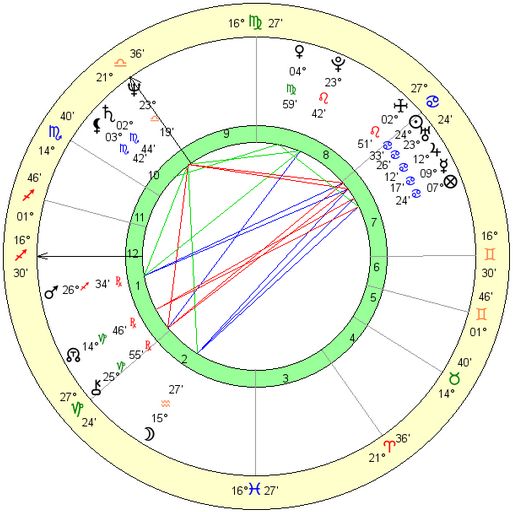
| Planet | Longitude | House | |
| Sun | 24 Cancer 33' 44" | 7 | |
| Moon | 15 Aquarius 27' 22" | 2 | |
| Mercury | 09 Cancer 17' 33" | 7 | |
| Venus | 04 Virgo 59' 16" | 8 | |
| Mars | 26 Sagittarius 34' 33" R | 1 | |
| Jupiter | 12 Cancer 12' 42" | 7 | |
| Saturn | 02 Scorpio 44' 37" | 10 | |
| Uranus | 23 Cancer 26' 07" | 7 | |
| Neptune | 23 Libra 19' 37" | 10 | |
| Pluto | 23 Leo 42' 43" | 8 | |
| Chiron | 25 Capricorn 55' 03" R | 1 | |
| Lilith | 03 Scorpio 42' 28" | 10 | |
| True Node | 14 Capricorn 46' 27" R | 1 | |
| Part of Fortune | 07 Cancer 24' 24" | 7 | |
| Vertex | 02 Leo 51' 39" | 8 | |
| House | Longitude | ||
| Ascendant | 16 Sagittarius 30' 45" | ||
| House 2 | 27 Capricorn 24' 10" | ||
| House 3 | 16 Pisces 27' 25" | ||
| House 4 | 21 Aries 36' 08" | ||
| House 5 | 14 Taurus 40' 60" | ||
| House 6 | 01 Gemini 46' 15" | ||
| House 7 | 16 Gemini 30' 45" | ||
| House 8 | 27 Cancer 24' 10" | ||
| House 9 | 16 Virgo 27' 25" | ||
| MC (Midheaven) | 21 Libra 36' 08" | ||
| House 11 | 14 Scorpio 40' 60" | ||
| House 12 | 01 Sagittarius 46' 15" |
| Planet | Aspect | Planet | Orb |
| Sun | Quincunx | Mars | 2.01 |
| Sun | Conjunction | Uranus | 1.13 |
| Sun | Square | Neptune | 1.24 |
| Sun | Opposition | Chiron | 1.36 |
| Sun | Square | Midheaven | 2.96 |
| Moon | Quincunx | Mercury | 6.16 |
| Moon | Quincunx | Jupiter | 3.24 |
| Moon | Quincunx | Uranus | 7.98 |
| Moon | Trine | Neptune | 7.87 |
| Moon | Sextile | Ascendant | 1.06 |
| Moon | Trine | Midheaven | 6.15 |
| Mercury | Quincunx | Moon | 6.16 |
| Mercury | Sextile | Venus | 4.30 |
| Mercury | Conjunction | Jupiter | 2.92 |
| Mercury | Conjunction | Part of Fortune | 1.89 |
| Venus | Sextile | Mercury | 4.30 |
| Venus | Sextile | Saturn | 2.24 |
| Venus | Sextile | Lilith | 1.28 |
| Mars | Quincunx | Sun | 2.01 |
| Mars | Quincunx | Uranus | 3.14 |
| Mars | Sextile | Neptune | 3.25 |
| Mars | Trine | Pluto | 2.86 |
| Mars | Sextile | Midheaven | 4.97 |
| Jupiter | Quincunx | Moon | 3.24 |
| Jupiter | Conjunction | Mercury | 2.92 |
| Jupiter | Opposition | True Node | 2.56 |
| Jupiter | Quincunx | Ascendant | 4.30 |
| Saturn | Sextile | Venus | 2.24 |
| Saturn | Conjunction | Lilith | 0.96 |
| Saturn | Square | Vertex | 0.12 |
| Uranus | Conjunction | Sun | 1.13 |
| Uranus | Quincunx | Moon | 7.98 |
| Uranus | Quincunx | Mars | 3.14 |
| Uranus | Square | Neptune | 0.11 |
| Uranus | Opposition | Chiron | 2.48 |
| Uranus | Square | Midheaven | 1.83 |
| Neptune | Square | Sun | 1.24 |
| Neptune | Trine | Moon | 7.87 |
| Neptune | Sextile | Mars | 3.25 |
| Neptune | Square | Uranus | 0.11 |
| Neptune | Sextile | Pluto | 0.38 |
| Neptune | Square | Chiron | 2.59 |
| Neptune | Conjunction | Midheaven | 1.72 |
| Pluto | Trine | Mars | 2.86 |
| Pluto | Sextile | Neptune | 0.38 |
| Pluto | Quincunx | Chiron | 2.21 |
| Pluto | Sextile | Midheaven | 2.11 |
| Chiron | Opposition | Sun | 1.36 |
| Chiron | Opposition | Uranus | 2.48 |
| Chiron | Square | Neptune | 2.59 |
| Chiron | Quincunx | Pluto | 2.21 |
| Chiron | Square | Midheaven | 4.32 |
| Lilith | Sextile | Venus | 1.28 |
| Lilith | Conjunction | Saturn | 0.96 |
| Lilith | Square | Vertex | 0.85 |
| True Node | Opposition | Jupiter | 2.56 |
| Part of Fortune | Conjunction | Mercury | 1.89 |
| Vertex | Square | Saturn | 0.12 |
| Vertex | Square | Lilith | 0.85 |
| Ascendant | Sextile | Moon | 1.06 |
| Ascendant | Quincunx | Jupiter | 4.30 |
| Ascendant | Sextile | Midheaven | 5.09 |
| Midheaven | Square | Sun | 2.96 |
| Midheaven | Trine | Moon | 6.15 |
| Midheaven | Sextile | Mars | 4.97 |
| Midheaven | Square | Uranus | 1.83 |
| Midheaven | Conjunction | Neptune | 1.72 |
| Midheaven | Sextile | Pluto | 2.11 |
| Midheaven | Square | Chiron | 4.32 |
| Midheaven | Sextile | Ascendant | 5.09 |
A Perspective on AstrologyAstrology, as revealed through the mystical lens of the angela-merkel-birth-chart, serves as a map of cosmic tendencies rather than absolute fate. A soul can always master its stars through the conscious application of free will. If one chooses to drift aimlessly down the river of life, the currents and planetary influences outlined in the natal chart will eventually manifest their default patterns. The birth chart does not dictate the power of human volition or how a person will choose to evolve; the exercise of free will remains entirely in the hands of the individual. Astrology acts as a sacred forewarning, allowing us to navigate life’s journey with greater wisdom and foresight. What we sow, we must inevitably reap. The Law of Karma operates in perfect harmony with the celestial bodies. The incarnation of a soul into a physical body occurs at the precise cosmic moment when karmic destiny and planetary alignments can unfold in perfect unison. Let us remember that the so-called favorable or adverse configurations in a horoscope are not the result of mere chance or luck. They are the harvest of our past actions—the birth chart reflects what we have carried over from previous incarnations and what we are destined to master in this lifetime. What we lack in our present existence can be cultivated for the future by consciously embracing our cosmic lessons. The stars impel, but they do not compel. As Goethe beautifully wrote: "From every power that binds the world, a man frees himself when he achieves self-mastery." The AscendantThe Ascendant is the gateway of the soul, the portal through which it enters to fulfill its karmic mission on Earth. It governs our outer appearance, personality, and the way we were perceived by others in early childhood. It also reveals how we assert ourselves in our environment, our baseline level of vital energy, our non-specific immunity, our recovery capabilities, the foundation of our psycho-physical constitution, our temperament, and the skeletal structure of our destiny. The Ascendant of this personality is: SAGITTARIUS Having the cusp of the First House in Sagittarius infuses its "owner" with boundless enthusiasm, courage, and optimism; indeed, it is traditionally heralded as the "best Ascendant." However, such an individual may struggle with consistent responsibility and can find it challenging to hold onto what they have acquired. The temperament is fundamentally choleric and motor-oriented. The will is remarkably powerful, yet tends to operate in short, intense bursts! This willpower is heavily influenced by emotion and Sagittarian social empathy, occasionally leading to impulsive, instinctual reactions that pose their own challenges. There is a deep-seated love for grand, dignified, and lively gatherings (receptions, outdoor pursuits, etc.). A powerful urge for independence and a love for distant travels are deeply woven into their nature. When the Ascendant is well-aspected, it yields strong prophetic intuition and synthetic, holistic thinking, though occasionally accompanied by excessive optimism. There is a genuine, inner sense of spirituality and devotion. It also brings a philanthropic, patronage-oriented spirit and a profound love for animals, especially horses. The shadow side of this placement lies in its unpredictability and sudden shifts in direction. An entrepreneur with this Ascendant may plan out tasks meticulously until evening, only to change their mind ten times throughout the day—leaving subordinates either overwhelmed or ready to resign. Impulsiveness, exaggeration, and a streak of rebellious anarchy are also common. Physically, they may resemble Gemini—tall and slender, with a longer nose, high forehead, and an open, expressive face, though with darker eyes and a sharper, more commanding gaze. A curious linguistic trait is their absolute adaptability, seamlessly transitioning from formal literary language to local jargon. Planets in the SignsThe placement of the planets within the zodiac signs is a fundamental pillar of astrological interpretation. The unique vibration of each planet in a specific sign exerts a profound and highly characteristic influence on our path. Sun in Cancer These individuals are deeply sensitive, yet they tend to shield their rich emotional lives behind an impenetrable protective shell. Especially in Cancer, analyzing the Moon's position is vital, as the Moon rules Cancer and determines the degree to which the individual will remain guarded or open. A Moon in Aries projects boldness and confidence, whereas in Scorpio it fosters mystery and secrecy. The Sun in Cancer seeks the absolute security of a safe home and a nurturing family environment; when these foundations are secure, they can fully blossom and express their strong protective instincts. This solar placement avoids unnecessary risks, preferring to keep feet firmly planted on the ground. Cancers who lack a stable home foundation can become cynical, biting, and defensive, using this sharp facade to mask their insecurities and inner emptiness. Moon in Aquarius This placement brings a profound emotional independence. This key trait naturally invites challenges in intimate relationships, as the individual resists feeling bound by their emotions or family ties. They dislike rigid responsibilities and obligations, and their domestic life is often volatile and unconventional. Moon in Aquarius is frequently found in the charts of feminists. Mercury in Cancer This placement bestows an excellent memory, where thought processes are heavily guided by feelings, moods, and emotions. The individual is compassionate and poetic; however, this position of Mercury is not ideal for objective scientific inquiry, as it tends to be more subjective and impressionable. Generally, Cancer is not the most comfortable sign for Mercury, as judgment can be unreliable and the quality of thought highly variable. Yet, the individual often possesses remarkable intuition, showing a seamless bridge between the conscious and subconscious minds. Their arguments may seem irrational, yet they carry profound truth. An afflicted Mercury is easily influenced mentally and tends to adapt its opinions to match those of its environment. Venus in Virgo This position instills a certain shyness in social settings. The individual often holds very high standards for their environment, and because they feel most people fall short of these expectations, they focus their affection on a select few "proven" friends. A lack of self-confidence can lead them to be overly critical of others, though this criticism is rarely justified. Those with Venus in Virgo must learn to honor their feelings rather than intellectualizing them into the background. Mars in Sagittarius This placement ignites a desire for lofty goals, though it often takes a long time for these grand plans to materialize. These individuals are highly ambitious and dislike dealing with tedious details or mundane tasks, which they gladly delegate to others. A passion for travel is particularly pronounced with this Mars. However, they can sometimes aim too high, overlooking essential matters. Men with this placement are often philosophically inclined, honest, and forward-looking, which inspires their partners. They are idealistic, playful, and possess a great sense of humor. They despise superficial relationships where they must pretend, choosing always to be direct. In intimacy, they are realistic and express their desires directly, sometimes even bluntly—which can drive a Libra partner to despair! Mars in Sagittarius constantly evaluates whether an intimate relationship meets a certain moral standard, eschewing sentimental romantic illusions. This trait is highly beneficial for long-term relationships, as they feel little need to seek illicit affairs. While all fire signs bring a sense of morality into relationships, this is most pronounced in Sagittarius. They are highly capable of defining their moral framework, the integrity of which depends on the aspects Mars makes to other planets. Women with Mars in Sagittarius are drawn to men who embody Sagittarian qualities, expecting them to live up to high moral standards and grand values; if these expectations are unmet, they are unlikely to welcome such men into their lives. Jupiter in Cancer In water signs, this planet craves emotional depth, love, and fulfillment. The individual possesses a romantic nature but is also prone to self-pity, self-sacrifice, and sentimentality. In Cancer, Jupiter is exceptionally compassionate and eager to aid others. A potential drawback is a strong attachment to a luxurious home and a tendency to overspend on its decoration. This placement often motivates the individual to build their own home. Saturn in Scorpio In water signs, Saturn presents its greatest challenges by blocking emotional expression. This frequently results in inexplicable emotional barriers. The individual is constantly confronted with their own deep emotions, forced to master emotional self-control. Scorpio is a highly intense, emotional sign, and Saturn filters and restricts this flow. Consequently, the individual may struggle to navigate their own feelings, appearing stiff or artificial to others. They can also be easily offended and prone to jealousy. The primary pitfall of this aspect is a lack of independent convictions and a tendency to adopt the views of others, especially authority figures. The soul's primary task here is to learn to trust its own feelings and forge independent opinions, free from the judgment of others. Planets in the Astrological HousesEach house represents a specific sphere of life. The placement of a planet in a house reveals how one fares in that particular area. To calculate this accurately, the exact birth time is essential. Sun in the 7th House This is a pivotal placement for relationships, both romantic and general. The individual can truly actualize themselves only through a partner—through the mirror of another. The second principle of the Seventh House is the discovery of one's own unique ideals, as well as spiritual and sexual identity. Here, it is crucial to analyze whether the Sun is conjunct the Descendant, along with its aspects and sign. For instance, a conjunction with the Descendant and Saturn causes severe challenges in finding this spiritual and sexual identity and original ideals; the individual will suffer from low self-esteem and will easily adopt the opinions of their partner, to whom they are deeply bound. When the Seventh House is heavily populated, a simple rule applies—the individual is always subordinate in the relationship, a dynamic colloquially known as being "under the thumb." A heavy placement refers to several planets, the Sun, or a combination of both. Note that a person with the Sun in the Seventh House almost always subconsciously alters their behavior to match the opinions of their immediate environment, including coworkers. The Seventh House governs the form of primary contact (the first subconscious reaction upon meeting). A well-aspected Sun in Leo will seek attention, while a Sun blocked by Saturn will either withdraw completely or overcompensate dramatically. Furthermore, the Seventh House indicates the quality of the social environment, the preferred type of partner (determined by the sign on the cusp), and open enemies. In the case of the Sun in the Seventh House, these enemies are often powerful, and their actions effective. In business, such an individual tends to have strong, capable partners (depending on the aspects). Moon in the 2nd House Here, the desire for security is deeply tied to money and material possessions. Paradoxically, this often leads to significant fluctuations in assets, wealth, or income. This creates inherent insecurity; much depends on the aspects and the zodiac sign of the Moon. An afflicted Moon in Aquarius or Pisces will manifest most erratically, while a harmonious Moon in Capricorn will be the most stable, even though Capricorn is generally not an ideal sign for the Moon. In some cases, the individual may completely turn away from materialism, becoming quite puritanical in both thought and lifestyle. In doing so, they find a deeper life security and their true personal identity. This path, however, is not easily predicted; it is more common with an afflicted Moon in Capricorn or Virgo than, say, in Sagittarius. For a Second House Moon, women (such as female superiors) often play a significant role in material matters. This placement also causes major fluctuations in self-esteem and self-definition. The individual may swing between extremes, from an inflated sense of self to feeling restricted and unfree, often without any external cause. Fluctuations can also affect health, particularly the throat area (tonsils, thyroid, etc.). People with this Moon, especially women, often feel a compelling urge to radically rearrange their home or apartment within a very short timeframe (typically every two or three months). Mercury in the 7th House These individuals long for a deep mental connection with their partners. They gladly share their hobbies, interests, and opinions with a close circle of friends and their partner. While they show empathy and compassion for the problems of others, their primary motivation is often sheer curiosity! A person with Mercury in the Seventh House tends to analyze relationships intellectually (depending on the sign) and requires constant communication with their partner. Whether they choose verbal or written communication depends on the sign, aspects, and circumstances (such as long-distance relationships). The need to communicate can become almost compulsive, with the individual requiring frequent reassurance that their partner is thinking of them and is ready to talk at any moment. They have an open mind regarding relationship dynamics and develop their intellect precisely through partner interaction. This is an excellent placement for psychologists, though they still require strong intuition, without which a truly great psychologist cannot function. Venus in the 8th House In relationships, the greatest emphasis is placed on sexuality, coupled with a powerful emotional bond. This is natural, as the Eighth House is tantric; a balanced intimate life, trust, and fidelity are primary catalysts for spiritual transformation through sex. However, under challenging Venus aspects, tendencies toward jealousy and greed can emerge. These individuals may subconsciously seek material gain from relationships, leading to misunderstandings and conflicts that seem to arise without any apparent cause. Venus in the Eighth House suggests that the individual must learn to manage wealth that comes to them without direct effort—such as through inheritances, gifts, winnings, or the partner's wealth. If Venus is afflicted, there may be a tendency to squander resources on superficial pleasures. Psychologically, if Venus indicates the positive influence of women, men with this placement are particularly favored, as women will significantly aid their sexual transformation and self-expression. Relationships are often initiated primarily for sex, though rarely promiscuously; intimacy is viewed as sacred, demanding depth and loyalty. Afflicted aspects can introduce greed (where the partner's financial status becomes paramount). Through their partner, these individuals learn to manage material resources, undergo deep sexual transformation, explore hidden mysteries, and understand death as a spiritual rebirth, while learning to anchor their relationships. True self-esteem will be built upon a high-quality partnership with a balanced intimate life, the cultivation of sexuality, stable finances, and potentially the development of tantric abilities. Mars in the 1st House An individual with this aspect asserts themselves dynamically through raw force and physical presence. This is the mark of a born leader, a warrior in the truest sense, who discovers their physical vehicle through strength and athletic capability. Such individuals are often found in special forces, paratrooper units, or search and rescue teams. They pursue their interests with immense energy and willpower; they are resourceful and usually eager to put their physical gifts and ingenuity at the service of others. They generally command respect, but if Mars is afflicted, they may try to force this respect from others at all costs. A challenge even for a well-aspected Mars in the First House is the difficulty in regulating their energy (Mars in Aries, for instance, is practically uncontrollable), leading to physical burnout because they do not recognize their own bodily limits. They often view life through the lens of "life is a battle," creating unnecessary conflict in relationships. If Mars is retrograde in the First House, it indicates an individual who in a past life clung too tightly to ego and selfishly pursued their own interests; they may now manifest as naturally aggressive, cunning, and swift (the nature of the aspects must always be considered). People with Mars in the First House typically possess a muscular, athletic build and a rapid, sometimes comical gait if the planet is afflicted. Jupiter in the 7th House This individual is outwardly friendly to everyone and loves taking the initiative in relationships. They are generous and seek to surround themselves with people who may benefit them in the future. They carry themselves with confidence in public, yet often battle conflicting desires for total surrender to a partner versus absolute freedom. They seek an idealized partner, which can cause friction. Generally, however, relationships are happy, friendships are loyal, and they enjoy the support of their environment due to their natural charm and radiance. They are highly welcome at social gatherings. In a daytime birth, the partner is typically faithful, extroverted, social, nurturing, devoted, and practical. A typical profession for this placement is a mediator in the judicial system. However, if Jupiter is afflicted, relationships can suffer from immoral behavior, infidelity (on either side), poor choices in friends, and legal troubles (a tendency to take the law into one's own hands, a lack of legal awareness). Such aspects are highly unfavorable, particularly for judges. A retrograde Jupiter points to past-life infidelity and betrayal of friends. Through their current relationship struggles, the individual has the opportunity to transmute these energies and understand their ancient karmic patterns. Saturn in the 10th House This is arguably the most favorable position for Saturn, especially when placed in the sign of Capricorn. The individual may take longer to find their true calling, but once they do, they work with immense responsibility, dedication, and thoroughness, steadily climbing the ladder of success. With a well-placed Saturn, career brings social security and ultimately great personal freedom in decision-making, particularly regarding employment. The primary trauma lies in achieving public success and dealing with stage fright or stiff behavior in public. Yet, career success is achieved more easily here than in any other area of the chart by adhering to traditional, established societal rules. A strong, harmonious Saturn indicates a capacity for prominent, serious, and highly responsible professions (chief physician, chancellor, general secretary, builder, industrialist, etc.). With an average Saturn, they find roles as civil servants, soldiers, or farmers. An afflicted or weak Saturn points to manual laborers, sanitation workers, lower-level clerks, or those facing poverty. These individuals often struggle to assert their rights at work and suffer from guilt and shame if they feel their actions deviate from established norms. In an active sign, an afflicted Saturn can trigger overcompensation—the classic careerist who seeks social status and public recognition through tireless involvement in public life, politics, or administration. Yet, this is rarely done out of altruism; the motives are selfish, and once the coveted success is reached, they realize it is an empty victory, leading to disappointment—a crucial process for digesting Saturnian lessons. In overcompensating forms, people often lose their hard-won positions because they demanded too much of themselves, while in blocking forms, they fail to achieve status at all, merely lamenting their bitter fate. Uranus in the 7th House This placement brings blockages, overcompensations, and projections to the realm of partnerships, close relationships, friends, and open enemies, as well as to primary contact and the discovery of original thoughts and ideas. When blocked, it restricts the ability to form initial connections and especially hinders the realization of one's sexual identity. In this form, it can manifest as homosexuality stemming from a psychological need for same-sex partnership. A harmonious Uranus can bring sudden, electric encounters with individuals who embody strong Uranian energy. In its overcompensating form, people desperately seek connection at all costs, only to face rejection or misunderstanding. Generally, those with Uranus in the Seventh House hold unconventional views on marriage, keep unusual or eccentric friends, and fear tight emotional bonds or dependency. They require a partner who grants them immense space and freedom. They often enter relationships suddenly and rapidly, only to end them just as abruptly, never to return. Neptune in the 10th House This is an intriguing position for career and social standing, as the individual often harbors unrealistic expectations of their professional life, lacking a practical overview. They can work with great devotion, but only in Neptune-ruled areas: charity, social work, fashion, and the arts. If they cannot manifest their ideals in their work, they fall into deep frustration, and their performance plummets. The Tenth House governs ambition, goal-setting, competition, social hierarchy, and the identification with a specific social class through 'psychological status symbols' (e.g., the wealthy aligning themselves with luxury cars and real estate). People with Neptune in the Tenth House may align with a social group but remain virtually unidentifiable by standard status symbols, as they do not perceive rigid class distinctions (Neptune is boundless). A harmonious Neptune brings excellent managerial and executive talents. Depending on its placement, in water signs it can grant a gift for chemistry or pharmaceuticals, but also for 'humble' tasks: water management, sewer cleaning, etc. Regarding the acceptance of societal rules and laws, Neptune can block these matters, introducing confusion. In the Tenth House, it often manifests as a desire for higher social status, which is simultaneously blocked by the individual's charitable impulses. Because these conflicting desires cannot be resolved, suffering ensues. These challenges can be resolved by working with the hermetic signatures of Saturn and the sign in which Neptune resides. Pluto in the 8th House In this position, Pluto introduces a highly unique dynamic of relationship bonding. A relationship is initiated in the Seventh House and anchored in the Eighth (fixed) house, so it may evolve in the Ninth. Pluto in the Eighth House operates on a deeply subconscious level, seeking to secure and bind the relationship at all costs. Naturally, it utilizes Plutonian methods: manipulation, pressure, and psychological control, though this dynamic is virtually invisible. In daily life, the partner of such an individual finds themselves unable to end the relationship, even if it no longer serves them. The methods of control are highly refined, diplomatic, and hidden; the partner cannot detect them directly and only begins to notice them through the feedback of their social circle. Even a harmonious Pluto causes the partner to feel an urge to flee from these subtle manipulations, though they cannot define why. An afflicted Pluto, however, creates such intense pressure that leaving becomes nearly impossible. (This aspect is heavily amplified by Pluto in Scorpio. Conversely, Pluto in Libra radiates such a beautiful, pleasant diplomacy that there seems to be no cause for suspicion, yet the result is the same). In both cases, partners may repeatedly break up and reunite, creating 'infinite' on-again, off-again relationships typical of Pluto. The partner is subconsciously convinced they will never find a better match, even as the constant underlying pressure repels them. They struggle to leave, while the partner with Pluto in the Eighth House cannot understand why, believing they are doing everything to please them (itself a sophisticated form of Plutonian control). This constellation also governs the stabilization of sexual identity, specifically the portion that can be used for personal spiritual transformation. Unless Pluto is severely afflicted, the individual has an open path to all techniques that transform the self through the cultivation of sexual energy (such as Tantric Yoga). It is important to understand the principle of cultivating sexual energy: standard sexual intercourse occurs entirely within the first and second chakras. (This is evident in 'lower' forms of art evoked in these chakras. For instance, circus performers often require frequent intercourse to keep their lower chakras active). During orgasm, sexual energy is discharged in the pelvic region of the second chakra for both sexes. This happens because attention is focused primarily on these two centers. To direct this energy into the higher chakras, one must focus their consciousness upward during intimacy. If we concentrate on the heart chakra (Anahata), the sexual energy follows our attention, traveling up the spine through the third chakra, thereby activating the core energy center (Hara). Sex then ceases to be merely physical and emotional; the qualities of the heart are profoundly amplified. In practice, Tantric exercises activate all chakras. The individual focuses on the crown, and once this pathway is anchored in the subconscious, the sexual energy naturally rises along the spinal column, activating every energy center. For Pluto in the Eighth House, the root of all fixations lies in securing the relationship, sexual transformation, and anchoring sexual identity and original ideas. Afflicted aspects can cause a subconscious terror of death and the transformative power of sex, often manifesting psychologically as an intense fear, resistance, or phobias of typical sexual and transformative symbols: spiders, bees, wasps, scorpions, frogs, and snakes. Planetary AspectsAn aspect is the geometric relationship between planets. Based on the angle they form, we can discern how their energies interact, dividing aspects into three categories: harmonious, challenging (disharmonious), and conjunctions. How these aspects manifest in an individual's life is detailed below. Sun conjunct Uranus (Particularly influential for men) This aspect bestows independence, unconventionality, and often radical views. The individual rejects established dogmas and thrives when their ideas stir debate. The conjunction is an aspect of individuality and originality taken to its absolute limit. In the case of *Cazimi*, it indicates a genius; if "combust," the conjunction is highly challenging, as negative Uranian principles (anarchy, rebellion) dominate. Between seven and fifteen degrees, it is the second most favorable position for the Sun and Uranus. Psychologically, it creates a need to stand out and showcase one's uniqueness, a desire to teach, counsel, and lead by example. Harmonious aspects bring creative dynamism and independent artistry. Challenging aspects drive the individual to extremes to prove their originality, fostering revolutionary thinking and a relentless push for the novel. This can cause a sudden rupture with the father figure and difficulty identifying with authority. Revolution and rebellion become tools for self-assertion. Health-wise, the following symptoms may arise: cardiac arrhythmia, ataxia (uncoordinated movements), atrioventricular block (AV block)—a disruption of electrical impulses to the heart muscle, septal defects without atherosclerotic etiology, non-sclerotic heart degeneration (often requiring a pacemaker), cardiac neurosis, paroxysmal tachycardia, general neuroses, epilepsy (grand mal seizures), hypermetropia (farsightedness), and retinal detachment. It can also lead to psychologically-driven hermaphroditism, resulting in homosexuality (a blurring of male and female roles in behavior), reflux esophagitis (esophageal spasms), hiccups, limb twitching (jactitation), and alopecia (hair loss). Sun afflicted by Neptune This makes individuals overly compassionate and self-sacrificing, leaving them vulnerable to exploitation and deceit. These individuals must exercise extreme caution with drugs, alcohol, and tobacco, as they have a strong tendency to escape into addictive substances to cope with their problems or visions. There is an heightened craving (with any planet); for the Sun, this manifests as a morbid craving for fame, power, and authority, enormous sexual desire, confusion, and chaos—typical of false gurus and prophets who pretend to be something they are not, false inspiration, and physical illnesses due to heightened sensitivity. Moon in harmonious aspect to Neptune Harmonious aspects evoke compassion, friendliness, and romantic idealism. While these individuals may not be paragons of orderliness, they are exceptionally hospitable and open. These aspects blend receptivity and sensitivity, granting the ability to perceive higher vibrational realms and artistic inspiration (Fire—painting, inner vision; Air—music; Earth—sculpture, graphic design; Water—poetry and writing, when paired with a strong Mercury). Moon in harmonious aspect to Ascendant For emotional well-being, this individual needs to be surrounded by people. They are empathetic and attentive to the needs of others, openly sharing their emotions. They love life and humanity, embodying a nurturing, sympathetic, sensitive, and understanding nature. Mercury in harmonious aspect to Venus Harmonious aspects bring balance, charm, and wisdom. The individual possesses ideal qualities for teaching others and communication in general. They are pleasant and sensitive in relationships. Mercury conjunct Jupiter This conjunction sparks a profound interest in the realm of ideas and a hunger for knowledge. The individual often becomes a traveler, theologian, or philosopher. They cherish freedom of expression and often rebel against formal educational systems, which may hinder them from obtaining academic degrees. Venus in harmonious aspect to Saturn This grants responsible and reserved conduct in emotional and social spheres. The individual is deeply loyal, conventional, and stable. They require a secure, lasting partnership to feel confident. They may harbor hidden fears of rejection, and their self-esteem in relationships is often fragile. An older, dependable partner or friend provides them with a sense of security. They are meticulous and responsible with shared or entrusted finances. Mars in harmonious aspect to Neptune This manifests as great imagination, creativity, artistic talent, and idealism. However, the individual can be highly impractical—the classic image of an artist celebrated by the world but entirely "useless" in private life. The union of action and ideals is harmonious, reflecting high inner spirituality, making this an ideal placement for spiritual guides. Mars in harmonious aspect to Pluto Generally, Mars is the lower octave of Pluto, and Pluto is the higher octave of Mars. This relationship amplifies both physical and psychological power, occult abilities, and stamina. These aspects magnify Martian drive, making the individual incredibly industrious and thorough. They are stubborn; once a goal is set, they are relentless in its pursuit. Harmonious aspects are typical of military commanders, granting genius strategic capabilities. They seek to master both themselves and others. It is the sole aspect that drives an individual to the ultimate realization of their goals, regardless of the obstacles. Uranus in challenging aspect to Neptune This primarily sparks a desire for chaos, upheaval, and anarchy—a signature aspect for revolutionaries. Such individuals thrive in times of systemic collapse, asserting themselves through these events. It can bring confusion, a tendency to stand out through flaws rather than merits, utopian ideals, and difficulty admitting one's own mistakes. It is associated with Hallux Valgus, and homosexuality where the individual struggles to accept their role. It relates to psychological and psychiatric matters in general. If this aspect is angular, perverse tendencies may manifest in specific areas—sexual aberrations (fetishism, complex forms of homosexuality, etc.). Neptune in harmonious aspect to Pluto These harmonious aspects endure for generations; the two planets were in sextile from 1945 to 1995. This influence fosters a global peace-oriented mindset and, when combined with other aspects, strengthens peace-keeping and transformative actions on a global scale. ConclusionThis birth chart has been calculated under the assumption that the input data—including birth time, location, and the correct time zone (accounting for daylight saving time)—is accurate. Even a one-hour discrepancy can alter the house placements of the planets or result in an incorrect Ascendant. By no means is this astrological analysis exhaustive. Every human being is a far more complex and multifaceted entity than a single page can ever capture. To generate your own personalized birth chart online, completely free of charge, please visit: Free Birth Chart Source Zbyněk Slába www.oranzovestranky.cz |
