
Personal Horoscope
Nelson Mandela Birth Chart
Born Thursday, July 18, 191814:54:00 (Time Zone = GMT +2 hours)
28e47, 31s35
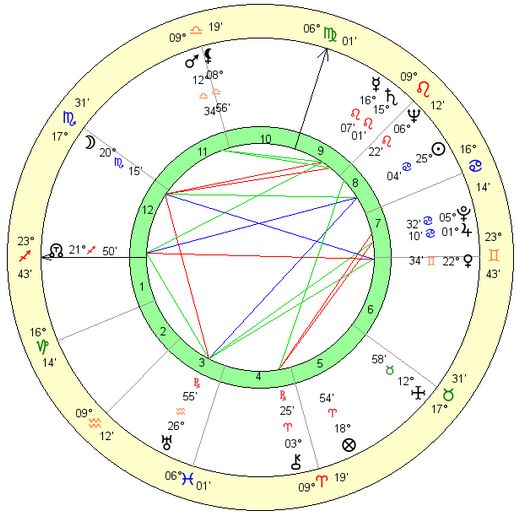
| Planet | Longitude | House | |
| Sun | 25 Cancer 04' 15" | 8 | |
| Moon | 20 Scorpio 15' 21" | 12 | |
| Mercury | 16 Leo 07' 60" | 9 | |
| Venus | 22 Gemini 34' 46" | 6 | |
| Mars | 12 Libra 34' 42" | 11 | |
| Jupiter | 01 Cancer 10' 03" | 7 | |
| Saturn | 15 Leo 01' 57" | 9 | |
| Uranus | 26 Aquarius 55' 39" R | 3 | |
| Neptune | 06 Leo 22' 37" | 8 | |
| Pluto | 05 Cancer 32' 29" | 7 | |
| Chiron | 03 Aries 25' 12" R | 4 | |
| Lilith | 08 Libra 56' 50" | 10 | |
| True Node | 21 Sagittarius 50' 18" | 12 | |
| Part of Fortune | 18 Aries 54' 16" | 5 | |
| Vertex | 12 Taurus 58' 26" | 5 | |
| House | Longitude | ||
| Ascendant | 23 Sagittarius 43' 10" | ||
| House 2 | 16 Capricorn 14' 46" | ||
| House 3 | 09 Aquarius 12' 01" | ||
| House 4 | 06 Pisces 01' 29" | ||
| House 5 | 09 Aries 19' 19" | ||
| House 6 | 17 Taurus 31' 31" | ||
| House 7 | 23 Gemini 43' 10" | ||
| House 8 | 16 Cancer 14' 46" | ||
| House 9 | 09 Leo 12' 01" | ||
| MC (Midheaven) | 06 Virgo 01' 29" | ||
| House 11 | 09 Libra 19' 19" | ||
| House 12 | 17 Scorpio 31' 31" |
| Planet | Aspect | Planet | Orb |
| Sun | Trine | Moon | 4.81 |
| Sun | Quincunx | Uranus | 1.86 |
| Sun | Quincunx | Ascendant | 1.35 |
| Moon | Trine | Sun | 4.81 |
| Moon | Square | Mercury | 4.12 |
| Moon | Quincunx | Venus | 2.32 |
| Moon | Square | Saturn | 5.22 |
| Moon | Square | Uranus | 6.67 |
| Moon | Quincunx | Part of Fortune | 1.35 |
| Mercury | Square | Moon | 4.12 |
| Mercury | Sextile | Mars | 3.56 |
| Mercury | Conjunction | Saturn | 1.10 |
| Venus | Quincunx | Moon | 2.32 |
| Venus | Trine | Uranus | 4.35 |
| Venus | Opposition | True Node | 0.74 |
| Venus | Opposition | Ascendant | 1.14 |
| Mars | Sextile | Mercury | 3.56 |
| Mars | Sextile | Saturn | 2.45 |
| Mars | Quincunx | Vertex | 0.40 |
| Jupiter | Trine | Uranus | 4.24 |
| Jupiter | Conjunction | Pluto | 4.37 |
| Jupiter | Square | Chiron | 2.25 |
| Jupiter | Sextile | Midheaven | 4.86 |
| Saturn | Square | Moon | 5.22 |
| Saturn | Conjunction | Mercury | 1.10 |
| Saturn | Sextile | Mars | 2.45 |
| Saturn | Square | Vertex | 2.06 |
| Uranus | Quincunx | Sun | 1.86 |
| Uranus | Square | Moon | 6.67 |
| Uranus | Trine | Venus | 4.35 |
| Uranus | Trine | Jupiter | 4.24 |
| Uranus | Sextile | Ascendant | 3.21 |
| Neptune | Trine | Chiron | 2.96 |
| Neptune | Sextile | Lilith | 2.57 |
| Pluto | Conjunction | Jupiter | 4.37 |
| Pluto | Square | Chiron | 2.12 |
| Pluto | Sextile | Midheaven | 0.48 |
| Chiron | Square | Jupiter | 2.25 |
| Chiron | Trine | Neptune | 2.96 |
| Chiron | Square | Pluto | 2.12 |
| Chiron | Quincunx | Midheaven | 2.60 |
| Lilith | Sextile | Neptune | 2.57 |
| True Node | Opposition | Venus | 0.74 |
| True Node | Conjunction | Ascendant | 1.88 |
| Part of Fortune | Quincunx | Moon | 1.35 |
| Vertex | Quincunx | Mars | 0.40 |
| Vertex | Square | Saturn | 2.06 |
| Ascendant | Quincunx | Sun | 1.35 |
| Ascendant | Opposition | Venus | 1.14 |
| Ascendant | Sextile | Uranus | 3.21 |
| Ascendant | Conjunction | True Node | 1.88 |
| Midheaven | Sextile | Jupiter | 4.86 |
| Midheaven | Sextile | Pluto | 0.48 |
| Midheaven | Quincunx | Chiron | 2.60 |
A Perspective on AstrologyAstrology reveals nothing more than tendencies. When examining a deep astrological blueprint like the nelson-mandela-birth-chart, we understand that man can rule his stars if he exerts his will. If a person chooses to drift with the current of life, then the tendencies indicated in the birth chart will manifest their effects at some point in their life. One thing does not appear in the Natal Horoscope, and that is the individual's free will and how it may evolve. The exercise of free will is left entirely to the individual. Astrology forewarns us, allowing us to better navigate the situations we encounter in life. What a person has sown, they must reap. The karmic law operates in perfect harmony with the planets. The birth of a soul into a physical body takes place at the auspicious moment when karmic law and planetary positions can work in unison. Remember that the so-called good or evil configurations in a horoscope are not the result of chance or luck, but are the harvest of our past deeds—the horoscope reveals what we have brought from a past life and what we must master in this one. What we lack in our present life can be acquired in the future by taking up a specific task. The stars impel, they do not compel. As Goethe said: "From every power that binds this world, man frees himself when he achieves self-control." The AscendantThe Ascendant is the gateway of the soul to fulfill the being's karmic task. It expresses a person's physical appearance and personality, and reveals how we were perceived by others in childhood, how we assert ourselves in our environment, our baseline of available energy, our non-specific immunity, recovery time, the foundation of our psychophysical constitution, temperament, and the bedrock of our destiny. The Ascendant of this personality is: SAGITTARIUS The cusp of the first house in Sagittarius endows its "owner" with enthusiasm, courage, and optimism; it is generally considered the "best Ascendant." However, such an individual is usually not very responsible and struggles to maintain what they have acquired. The temperament is choleric, motor-oriented, and the will is very strong, yet short-lived! This will is heavily dependent on the feelings and social awareness of Sagittarius, reacting instinctively, which often presents a challenge. They love entertainment, preferably grand and dignified (hunting, receptions, etc.). A powerful desire for independence and a tendency to travel to far-off lands. A well-placed Ascendant is highly prophetic and possesses synthetic thinking. Excess of optimism. They are religious, reflecting a true, inner piety. They are philanthropic! They love animals, especially horses. A negative trait is "scatterbrain" impulsiveness and unpredictability. An entrepreneur might meticulously delegate tasks for the day, only to change their mind ten times, causing subordinates to eventually break down or leave the company :-) Impulsiveness, exaggeration, rebelliousness, anarchy. Physically, they resemble Gemini—tall and slender, with a longer nose, higher forehead, and a more open face, but with darker eyes. Their gaze is faster and more piercing than Gemini's (with a hint of command). A peculiar speech pattern—ranging from formal language to slang, showing total adaptability. Planets in SignsPlanets in signs are a crucial component of horoscope interpretation. The manifestation of each planet in a specific sign exerts a profound and highly characteristic influence on our lives. Sun in Cancer These individuals are usually highly sensitive, but they tend to hide their (often rich) emotional life behind an impenetrable mask. Particularly with Cancer, evaluating the position of the Moon is essential, as the Moon rules Cancer and determines the extent to which the person will be guarded or open. The Moon in Aries acts with great courage and self-assurance, whereas in Scorpio, it appears mysterious and secretive. The Sun in Cancer requires the security of a safe home and family environment; if these foundations are present, the individual feels happy and is able to develop their nurturing maternal instincts. A Sun positioned here dislikes taking risks and prefers to keep their feet firmly on the ground. Cancers who lack a stable family background are often cynical, sarcastic, and difficult, using this mask to hide their insecurities and feelings of emptiness. Moon in Scorpio These people are usually highly guarded emotionally; their feelings possess immense depth and passion. They may carry a mysterious, magnetic, or magical aura. They desperately need an environment that provides stability and security, yet they frequently find themselves in sudden arguments and abrupt, fundamental transformations—whether in their emotions, family, or professional life. In social settings, the Moon in Scorpio behaves rather reservedly, maintaining a distance, but in close relationships, they can be deeply passionate. They do not forgive easily, they remember grievances vividly, and they often slide into jealousy. Mercury in Leo This is an intriguing and double-edged placement for this planet. In a harmonious position, it creates excellent company directors or military commanders (strategists). The intellect is grand, magnificent, and the individual has a powerful personality with great influence over others. They often hold a high opinion of their own mental capacities and possess vast mental energy. They form their own opinions regardless of the facts; the accuracy of their judgments depends primarily on the nature of their aspects. A theatrical flair and an attraction to the theater. An unharmonious Mercury in Leo tends to be arrogant, intolerant, argumentative, conceited, and incapable of admitting errors. They express themselves with gravity and pomposity. Negative aspects of Mercury in Leo are far from pleasant. Venus in Gemini This placement causes difficulties through its constant analysis of feelings, which creates an emotional detachment. The individual can speak eloquently about their emotions but is often unable to truly feel them. In emotional situations, they can appear aloof. They can initiate and end relationships without significant inner involvement and are rarely the epitome of partnership fidelity. Mars in Libra This position causes a frequent scattering of energy, which is mostly spent on maintaining harmonious relationships and peace among others. The individual tends to mediate between conflicting parties, often losing sight of the actual state of affairs. They are capable of conceiving contradictory solutions, a trait with a dual effect: on one hand, it can lead to valuable experience and the diplomatic ability to solve problems and find strategic solutions; on the other hand, it often leads to indecisiveness with ambiguous outcomes. Perhaps the greatest challenge of Mars in Libra is indecisiveness, especially when sudden, rapid action is required. The person often realizes the correct choice only after the moment has passed. Typically, their first instinct is to freeze and contemplate the most ideal course of action, reaching a resolution only when the need for action is no longer relevant. This problem is most pronounced when the individual has time to make a decision. In the face of immediate danger, however, their survival instincts usually function correctly, though this again depends on the nature of the aspects. Mars in Libra is not exceptionally passionate; its expressions are rather conventional, though it does not shy away from new experiences. They seek to dazzle their partner primarily through communication, prioritizing romantic experiences, and they react very negatively to any disharmony in the intimate sphere. Scorpios often face the greatest difficulties with this Mars placement, as their emotional expectations are usually unrealistic, making reality hard to accept. Jupiter in Cancer In water signs, such an individual requires deep emotion, yearning for love and emotional fulfillment. They have a sense of romance but are also prone to self-pity, self-sacrifice, and sentimentality. Especially in Cancer, the individual is highly compassionate towards others and longs to help them. A disadvantage is a strong attachment to a luxurious home and excessive spending on its decoration. This Jupiter placement often motivates the individual to build their own house. Saturn in Leo Saturn in a fire sign always primarily blocks energy, ambition, and the desire for self-development, significantly lowering self-confidence. Such a person constantly fears failure and worries that their plans will go awry; they avoid all risks and almost always reject the right opportunities presented to them. With good or strong aspects, however, these fears can become the motivation for sudden actions requiring strength and concentration. Saturn in Leo blocks creativity because it increases and reinforces conservatism, dampening artistic talent, musical ear, etc. It is not particularly favorable for romantic relationships either—it limits the sense of romance, and the individual's presence can feel rather cold to their surroundings. Much also depends on the sign of the Sun—in Capricorn, the fire element will be blocked even more severely by Saturn, whereas in Leo, it will attempt to break through and assert itself, often at all costs, but without a positive impact on the surroundings, which may then react to the individual with rejection. Planets in Astrological HousesEach house represents a specific area of life. The placement of a planet in a house tells us how well or poorly a person fares in that domain. To calculate the exact placement of planets in houses, the most precise birth time possible is required. Sun in the 8th House From the perspective of the eighth house, this placement is interesting in many respects. When well-aspected, the eighth house often brings a flow of material resources to the individual without their own effort (winnings, inheritance, etc.). One danger arises here—people with the Sun in the eighth house always strive for self-development, usually progressing in two ways: either they engage in helping others through alternative means and discover themselves through this work, or they amass wealth and consolidate their own power. If, for instance, they also have a negative aspect to Pluto, they may try to increase their power by manipulating others through occult methods, or by making clients dependent on them. Anyone can imagine the consequences, but the essential point is that if the Sun in the eighth house is afflicted in any way, a thorough analysis must be conducted to determine the potential outcomes. A person with this Sun is interested in the subconscious and seeks ways to work with it. They observe the cycles of life in themselves and others, study historical stages of human evolution, and enjoy working in the media, provided this work somehow offers answers to their unspoken questions. They understand death as an evolutionary stage rather than a definitive, immutable end to life. They usually encounter death in the family from an early age, or experience sudden and unexpected changes in life (supported further by any Pluto aspects—making them deep and irreversible, or Uranus aspects—creating a chain of sudden shifts, though their impact may not always be fundamental). The subconscious use of one's sexuality is also important—if the Sun is well-placed, the individual uses their sexuality creatively and is capable of self-transformation; otherwise, they may abuse it, leading to destructive results. We can easily determine here if a being possesses tantric abilities. Finally, two details deserve mention—the Sun in the eighth house always seeks a financially stable partner; this is a subconscious process. It also points to the qualities we value in others. (For example, a Sun in Cancer seeks a stable partner who can provide for the family and whose emotional side is balanced). Moon in the 12th House To correctly assess the influence of this Moon, we must understand how the principles of the tenth and eleventh houses have been integrated. There are two entirely different paths here: if these principles have been integrated, the Moon will significantly aid the process of final liberation, mystical realization, and redemption. However, if the principles of those two houses have not been integrated and the Moon is additionally in a complicated position (e.g., in Pisces and afflicted by Neptune), the individual will yearn from the depths of their soul for mystical powers but lacks a natural pathway to them, potentially turning to psychotropic or addictive substances. This path is obviously the worst possible, completely disintegrating the structure of the being, and only a very strong personality with a firm will can understand its destructive nature and transcend it. A well-placed Moon helps open the consciousness to higher energies and information, leading to mystical initiation. Such a person acquires cosmic abilities and can channel the high vibrations of spiritual realms into everyday life, gaining the gifts of clairvoyance, clairaudience, and clairsentience. All these processes unfold in due order and speed to prevent psychological damage. With an unharmonious Moon in the twelfth house, however, this may not be the case. Much again depends on the integration of the preceding houses' principles. An afflicted twelfth house causes social alienation, escapism (drugs), life on the fringes of society, and an obsessive urge to help others. Under negative Moon aspects, this urge is particularly strong, leading the person to literally "force" their help, harming their karma by making others dependent and obligating them to return the "favor." This mechanism is subconscious and therefore harder to unravel. The person strives to help while lacking any realistic basis to do so. If such a person also holds a corresponding social status, they may be an adept embezzler or fraudster seeking to finance activities they have no legal right to. Generally, people with the Moon in the twelfth house appear shy and sentimental, guarded about their inner self, putting their compassion and imagination to the service of the common good without seeking praise, preferring to remain in the background. In a harmonious position, they can be significant philanthropists, especially if other favorable aspects are present (Jupiter, Sun, etc.). Mercury in the 9th House Such an individual has excellent academic abilities, a thirst for self-education and knowledge, and therefore a strong aptitude for academic advancement. They focus their interests on philosophy, religion, law, and, in line with the energy of the ninth house, foreign cultures. A negative aspect of this Mercury placement is that these people often feel lifelong oppression, a feeling that is frequently justified. They study high hermetic arts (Kabbalah, tarot, hermetism) and have an open channel for information in this field. They develop relationships through the exchange of ideas with their partner, using this communication to stimulate their own intellect. They constantly analyze their ideals; whether they gain enough faith in them depends on the nature of Mercury's aspects. Since the ninth house governs synthetic thinking and Mercury governs analytical thinking, there is almost always a conflict between these two different modes of thought, which can manifest physically as allergies. Venus in the 6th House To be content, such a person primarily needs harmonious working conditions and environments. Good relations with coworkers are a necessity, and they constantly work to improve them. They find competitive tension or workplace conflict very difficult to tolerate. Women with this Venus placement can excel in art, real estate, and leisure management. The sixth house is somewhat contradictory, as it signifies emotional development on one hand and subordinate service on the other. Constant tension naturally exists between these elements, and any imbalances manifest in the physical health. (For instance, Venus in Capricorn causes weeping skin inflammations and joint issues, in Aries migraines, etc.). People with this Venus try to maintain the best possible health and hygiene habits. Under unharmonious aspects, we often find bulimia, anorexia, or strict vegetarianism. Romantic relationships are often initiated at work (in line with the subordinate role!) or in the health sector—such as at healing seminars, during medical studies, etc. Through their partner, these individuals can particularly develop their own emotions! This is vital, as many people have this capacity blocked. The foundation of their self-confidence will be a harmonious work environment, successful health care for themselves and others, and good professional results. This individual is constantly learning to express their emotions spontaneously, and with harmonious aspects, they succeed. Mars in the 11th House This aspect manifests as the individual surrounding themselves with a large circle of acquaintances rather than true friends—people who hold little real significance for them. Their contacts tend to be superficial. Their behavior and expressions can be curt and unfriendly, drawing the aversion of others. The eleventh house shatters established conventions and rules, and Mars intensifies this principle, breaking down old Saturnian norms, exposing taboos, and destroying rigid, obsolete principles. However, by failing to respect dying structures, they often run afoul of the law, especially under unharmonious aspects. Mars in the eleventh house usually grants powerful protectors (sponsorship/patronage). This person is a pioneer at heart. Their thinking is ahead of its time but is often rejected by their peers. A retrograde Mars indicates the abuse or exploitation of friends in past lives—a difficult karmic dynamic that manifests as meeting friends from past incarnations who now hold up a mirror, allowing the native to understand and integrate their past actions. Jupiter in the 7th House On the surface, this person is friendly to everyone and likes to take the initiative in relationships. They are generous and seek to surround themselves with people from whom they might benefit in the future. They appear confident in society but often struggle with the conflicting urges of surrendering to a partner versus the desire for freedom. They yearn for an ideal partner, which can cause issues. Usually, however, relationships are happy, friendships are faithful and reliable, and this person is supported by their environment due to their charm and charisma. They are a welcome guest at social gatherings. In a daytime birth, the partner is typically faithful, extroverted, social, caring, devoted, and thrifty. A typical profession for this Jupiter placement is a mediator in the legal system. If Jupiter is afflicted, however, relationships suffer from immoral behavior, infidelity (including on the partner's part), a tendency to choose poor friends, and potential legal troubles (a tendency to take the law into one's own hands, lack of legal consciousness). Literally law-breaking impulses can occur, making these aspects highly unfavorable, especially for judges. A retrograde Jupiter suggests infidelity in a past life and a poor attitude toward friends (whom they may have betrayed). Through current relationship challenges, the individual has the opportunity to work through these energies and understand their ancient negative behavior patterns. Saturn in the 9th House The individual is always significantly influenced by the religious conventions and moral standards of their upbringing. This principle is virtually unchangeable; diligent effort can only alter its form, not its essence. The more the individual rebels against this influence, the less power they have to change it. Long journeys are usually blocked; business trips are often more successful and productive than journeys of self-discovery. However, travel always carries some risk of dangerous situations; for instance, Saturn in Scorpio can place its "owner" in danger from terrorists. These people are seriously interested in higher philosophy and law, but an afflicted Saturn blocks these matters, causing frustration. In a compensatory form (in electrical signs), this leads to excessive striving for higher knowledge, the study of foreign religions, philosophy, etc. These efforts are logically blocking. The primary trauma lies in relationship development. The individual starts a relationship well and consolidates it properly, but cannot sustain its growth, leading to its termination for vague reasons after some time unless they follow the established rules of society. This means that until Saturn's energy is integrated, it is impossible to develop a relationship as intuition directs and the soul desires. Saturn in the ninth house is frequently found in the charts of scientists studying the interaction of matter and radiation, advanced occultists, and is an ideal aspect for understanding divine nature, materialization, or altering the structure of matter. Uranus in the 3rd House Compensatory reactions, blocks, or projections in the areas of education, communication, relations with the immediate environment, short (business) trips, trouble with siblings, or constant, unexpected car trouble :-) A blocked Uranus causes speech disorders (aphasia), irregular handwriting (both in size and angle), dyslexia (due to lack of concentration), etc. This position of Uranus always triggers an uncontrollable activation of the cerebral cortex; when poorly aspected, it threatens lack of focus, travel sickness, and ultimately even epileptic states! This is most pronounced when Uranus opposes planets in the ninth house. In compensation, it manifests as a rapid cadence of speech and fast, chaotic gesturing. A person with this Uranus always possesses unconventional thinking and suffers most in school, which is governed by strict rules and order. When integrated, however, they make excellent, engaging teachers, skilled surgeons, and generally manual adepts. They are always individuals who bring personal innovation to their profession; therefore, jobs with rigid rules (such as payroll accounting) are unsuitable for them. Excellent fields are advertising or information media, though in media, they may clash with supervisors due to their excessive independence. Neptune in the 8th House These individuals usually suffer from unrealistic expectations regarding sex and possess an overly vivid imagination in the intimate sphere. This naturally causes issues and unmet expectations in actual sexual relationships. This person is drawn to hidden matters, the process of death and rebirth, magic, and the occult, though they often encounter confusion in these subjects. It is an excellent aspect for magic, sexual magic, and tantra. Through sexual activities and excellent visualization, altered states of consciousness can be achieved. At work, this person often has great ideas and inspiration, but lacking the necessary knowledge to realize them, they face frustration. Neptune in the eighth house always provides an unharmonious link to the vibrational field of Pluto, which can lead to various non-inflammatory venereal diseases (Mars is responsible for inflammation). Even a harmonious Neptune can cause these. If this planet is afflicted or retrograde, however, there is a risk of severe diseases (such as AIDS), often stemming from an overly promiscuous approach to sex. Neptune in the eighth house, by its nature, causes the person to want more and more in the realms of sex, sexual transformation, magic, and the occult. They try to anchor relationships at all costs, but these expectations are exaggerated and unfulfilled, resulting in suffering. Problems caused by this Neptune can be solved with some difficulty using the hermetic signatures of Pluto and the sign in which Neptune resides. Pluto in the 7th House The individual forms what are known as "pivotal relationships" that usually follow an unusual course. (In a standard relationship, a partner notices their counterpart's flaw and addresses it; in a pivotal relationship, everything unfolds differently!) It usually takes the partner a very long time to recognize the flaw and admit it to their conscious mind, even though they are subconsciously aware of it. This builds tremendous tension in the relationship. The person with Pluto in the seventh house makes more and more mistakes, and because their partner fails to react meaningfully, tension accumulates further, usually leading to a breakup, even though this extreme solution is often unnecessary. This person must remain constantly aware of what bothers them about the other and address it, otherwise the relationship will collapse. This also applies to friendships and business partnerships!! People with this Pluto always experience manipulation through projection!!! (Extremely important). In practice, this means they usually have a partner who demonstrates how manipulation works in various situations. (A typical manifestation of this projection is attending a football match, where a frustrated individual experiences the success of "their" team as their own. From this mechanism, the violence of life-frustrated fans logically follows.) The root of these fixations lies in the need to establish primary contact. Pluto strives for contact but, as a super-planet, blocks it until its energies are integrated. This creates significant tension due to the unfulfilled need for connection. The energies of an afflicted Pluto are significantly harder to work through, a fact to keep in mind when assessing the chart. People with this aspect are fixated on contact at a deep subconscious level. If Pluto is afflicted or retrograde, a lack of contact can lead to depression and hopelessness. In practical life, this usually manifests as high-pressure situations, manipulation, and tense relationships. Pluto here represents the character of the partner, who always carries a strong Scorpio or Plutonian vibe. The discovery of one's sexual identity, original ideas, and spiritual identity all occur under the same pressure as the primary contact described above. Thus, if Pluto's energy is not integrated, high-pressure situations and manipulation must occur to bring these components of the being to consciousness. Generally, people with this Pluto place exaggerated emotional demands on their partner and need constant reassurance of reciprocation, which also causes issues. Planetary AspectsAn aspect is the position of one planet in relation to another. Based on the angle they form, we can determine their mutual influence and divide aspects into three groups: harmonious, unharmonious, and conjunctions. How each aspect manifests in a person's life is detailed below. Sun in harmonious aspect to Moon Contributes to balance, relaxation, and inner peace, significantly increasing the chances of finding success and contentment in life. Relationships with the opposite sex are usually balanced and harmonious. Moon in unharmonious aspect to Mercury Unharmonious aspects can cause a poorer memory. While empathy for others is also stronger here, the individual may not always interpret it correctly. Emotional difficulties and a tendency to gossip. Intelligence is high but is often employed in clever lying, which appears completely natural. The individual has a tendency to self-deception and often believes their own "truths." Moon in unharmonious aspect to Saturn Unharmonious aspects cause the individual to be virtually incapable of expressing their feelings, preferring to construct an outer mask to hide behind. They need a stable home that provides a safe haven. In family life, however, they artificially impose too many duties upon themselves. Prone to depression. Moon in unharmonious aspect to Uranus Unharmonious aspects (affecting women in particular) instill a sense of resentment and an urge to resolve it, often through radical and unexpected changes. They enjoy chaos and are bothered by an orderly family life. They love alternative lifestyles but are highly individualistic, making them rather "unusable" in collective or family environments. A feeling of alienation from society (alienation complex). Great emotional tension, instability, emotional lability, explosive feelings, emotional vulnerability. A neurotic complex (unfulfillment of one's needs)—the weaker and more afflicted the Moon, the stronger the neurosis!!!—as well as bulimia and anorexia nervosa. Dyspepsia when weaning an infant. Hebephrenia (a type of schizophrenia involving delusions), anorexia nervosa, blood group incompatibility. Retinal detachment, placental abruption, labor complications related to contractions, premature rupture of membranes, uterine prolapse, uterine perforation—with premature birth being the most common complication. Umbilical hernia. Mercury in harmonious aspect to Mars Harmonious aspects strengthen the mental faculties and grant quick action and comprehension. The individual has an analytical mind and often makes an excellent researcher or detective. Thinking is fast, practical, and precise. Mercury in conjunction with Saturn The conjunction endows the individual with serious, conservative, and practical mental processes. However, they often lack faith in their own abilities and imagination. They may have a reduced capacity for expression that hinders their studies, but they are systematic and persistent. They have an eye for detail. Venus in harmonious aspect to Uranus Causes the individual to demand constant change and initiative from their friends. They are emotionally independent and do not seek binding ties. Relationships are formed spontaneously, but they rarely last long. Harmonious aspects grant sex appeal and sudden magnetism, especially to women. Physical health manifestations: with a daytime Venus (seventh house and Libra)—fetishism, voyeurism, frotteurism (dependence on a loved one's towel), some forms of homosexuality, vitiligo (light patches on the skin), renal colic not originating from nephrolithiasis (stones and sand)—renal spasm without cause. Ureteral spasm, sudden fractures in the lumbar spine and disc herniations. With a nighttime Venus (Taurus, second house)—dysphagia (pharyngeal spasm), menopausal transitions, wandering (mobile) kidney, cervical vertebrae displacement. Venus in unharmonious aspect to Ascendant An individual under this aspect requires the approval of others. They may suffer from a lack of self-confidence and self-esteem. They attract things into their life that require virtually no effort on their part. They enjoy surrounding themselves with warm, social people. They have a charming and pleasant personality but can be insincere. There is also a tendency to take things for granted, and they can sometimes be rather lazy. Mars in harmonious aspect to Saturn Harmonious aspects are interesting because they greatly limit the individual's imagination, which is generally considered suitable for dangerous professions. The question remains, however, to what extent constructive imagination might help in a critical situation. People with these aspects can work tirelessly; they are cautious, thorough, enterprising, and do not fear scarcity. Jupiter in harmonious aspect to Uranus Harmonious aspects grant independence of opinion, enterprise, thought, and expression. Much depends on the house where these planets reside. Idealism is also present, but in a positive sense. These are often highly reflective individuals. The person longs to assert themselves as a strong individual and claim their rights; sudden luck, inheritance, a propensity for study, medicine, success in politics and religion. Jupiter in conjunction with Pluto Brings a certain conflict—the individual fights for the truth while simultaneously striving for personal power. They are interested in psychology, politics, religion, art, and love to travel. The conjunction of Jupiter and Pluto is a deeply profound aspect that unites Zeus with Hades! (Great fortune with the subconscious.) Much depends on which planet is stronger! If Pluto is stronger, destructive forces tend to prevail. Uranus in harmonious aspect to Ascendant This person has clear visions and a tendency to be highly independent. Their mind is creative, innovative, quick, and always alert to new ideas and knowledge. They likely work on multiple projects simultaneously. They have the ability to adapt to new situations and changes that are essential for life. They prefer to experience everything firsthand rather than having secondhand experiences. ConclusionThis natal horoscope was compiled on the assumption that the input data—time, place of birth, and the correct time zone, taking daylight saving time into account—are accurate. Even a one-hour discrepancy in birth time will result in inaccurate planetary positions in the houses or an incorrect Ascendant. By no means is this astrological analysis complete. It is clear that every human being is a far more complex entity than this page can ever capture. To generate your own Natal Horoscope online completely free of charge, please go to Free Natal Horoscope Source Zbyněk Slába www.oranzovestranky.cz |
