
Personal Horoscope
John Paul II
Born Tuesday, May 18, 192017:30:00 (Time Zone = GMT +2 hours)
19e30, 49n53
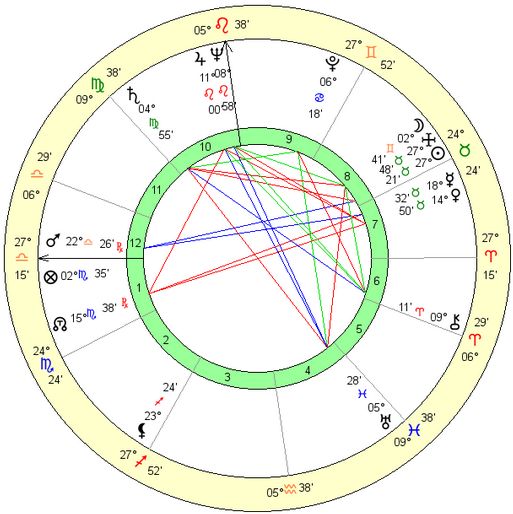
| Planet | Longitude | House | |
| Sun | 27 Taurus 21' 32" | 8 | |
| Moon | 02 Gemini 41' 06" | 8 | |
| Mercury | 18 Taurus 32' 32" | 7 | |
| Venus | 14 Taurus 50' 54" | 7 | |
| Mars | 22 Libra 26' 00" R | 12 | |
| Jupiter | 11 Leo 00' 15" | 10 | |
| Saturn | 04 Virgo 55' 57" | 10 | |
| Uranus | 05 Pisces 28' 09" | 4 | |
| Neptune | 08 Leo 58' 34" | 10 | |
| Pluto | 06 Cancer 18' 54" | 9 | |
| Chiron | 09 Aries 11' 43" | 6 | |
| Lilith | 23 Sagittarius 24' 58" | 2 | |
| True Node | 15 Scorpio 38' 16" R | 1 | |
| Part of Fortune | 02 Scorpio 35' 14" | 1 | |
| Vertex | 27 Taurus 48' 56" | 8 | |
| House | Longitude | ||
| Ascendant | 27 Libra 15' 41" | ||
| House 2 | 24 Scorpio 24' 47" | ||
| House 3 | 27 Sagittarius 52' 59" | ||
| House 4 | 05 Aquarius 38' 32" | ||
| House 5 | 09 Pisces 38' 09" | ||
| House 6 | 06 Aries 29' 55" | ||
| House 7 | 27 Aries 15' 41" | ||
| House 8 | 24 Taurus 24' 47" | ||
| House 9 | 27 Gemini 52' 59" | ||
| MC (Midheaven) | 05 Leo 38' 32" | ||
| House 11 | 09 Virgo 38' 09" | ||
| House 12 | 06 Libra 29' 55" |
| Planet | Aspect | Planet | Orb |
| Sun | Conjunction | Moon | 5.33 |
| Sun | Quincunx | Mars | 4.93 |
| Sun | Square | Saturn | 7.57 |
| Sun | Conjunction | Vertex | 0.46 |
| Sun | Quincunx | Ascendant | 0.10 |
| Moon | Conjunction | Sun | 5.33 |
| Moon | Square | Saturn | 2.25 |
| Moon | Square | Uranus | 2.78 |
| Moon | Sextile | Neptune | 6.29 |
| Moon | Sextile | Chiron | 6.51 |
| Moon | Quincunx | Part of Fortune | 0.10 |
| Moon | Quincunx | Ascendant | 5.42 |
| Moon | Sextile | Midheaven | 2.96 |
| Mercury | Conjunction | Venus | 3.69 |
| Mercury | Quincunx | Mars | 3.89 |
| Mercury | Opposition | True Node | 2.90 |
| Venus | Conjunction | Mercury | 3.69 |
| Venus | Square | Jupiter | 3.84 |
| Venus | Square | Neptune | 5.87 |
| Venus | Opposition | True Node | 0.79 |
| Mars | Quincunx | Sun | 4.93 |
| Mars | Quincunx | Mercury | 3.89 |
| Mars | Sextile | Lilith | 0.98 |
| Mars | Conjunction | Ascendant | 4.83 |
| Jupiter | Square | Venus | 3.84 |
| Jupiter | Quincunx | Uranus | 5.54 |
| Jupiter | Conjunction | Neptune | 2.03 |
| Jupiter | Trine | Chiron | 1.81 |
| Jupiter | Conjunction | Midheaven | 5.36 |
| Saturn | Square | Sun | 7.57 |
| Saturn | Square | Moon | 2.25 |
| Saturn | Opposition | Uranus | 0.54 |
| Saturn | Sextile | Pluto | 1.38 |
| Saturn | Quincunx | Chiron | 4.26 |
| Uranus | Square | Moon | 2.78 |
| Uranus | Quincunx | Jupiter | 5.54 |
| Uranus | Opposition | Saturn | 0.54 |
| Uranus | Quincunx | Neptune | 3.51 |
| Uranus | Trine | Pluto | 0.85 |
| Uranus | Quincunx | Midheaven | 0.17 |
| Neptune | Sextile | Moon | 6.29 |
| Neptune | Square | Venus | 5.87 |
| Neptune | Conjunction | Jupiter | 2.03 |
| Neptune | Quincunx | Uranus | 3.51 |
| Neptune | Trine | Chiron | 0.22 |
| Neptune | Conjunction | Midheaven | 3.33 |
| Pluto | Sextile | Saturn | 1.38 |
| Pluto | Trine | Uranus | 0.85 |
| Pluto | Square | Chiron | 2.88 |
| Chiron | Sextile | Moon | 6.51 |
| Chiron | Trine | Jupiter | 1.81 |
| Chiron | Quincunx | Saturn | 4.26 |
| Chiron | Trine | Neptune | 0.22 |
| Chiron | Square | Pluto | 2.88 |
| Chiron | Trine | Midheaven | 3.55 |
| Lilith | Sextile | Mars | 0.98 |
| True Node | Opposition | Mercury | 2.90 |
| True Node | Opposition | Venus | 0.79 |
| Part of Fortune | Quincunx | Moon | 0.10 |
| Vertex | Conjunction | Sun | 0.46 |
| Vertex | Quincunx | Ascendant | 0.55 |
| Ascendant | Quincunx | Sun | 0.10 |
| Ascendant | Quincunx | Moon | 5.42 |
| Ascendant | Conjunction | Mars | 4.83 |
| Ascendant | Quincunx | Vertex | 0.55 |
| Midheaven | Sextile | Moon | 2.96 |
| Midheaven | Conjunction | Jupiter | 5.36 |
| Midheaven | Quincunx | Uranus | 0.17 |
| Midheaven | Conjunction | Neptune | 3.33 |
| Midheaven | Trine | Chiron | 3.55 |
A Perspective on AstrologyAstrology reveals nothing more than tendencies. When exploring the pope-john-paul-ii-birth-chart, we see how a soul's potential can unfold, yet man can always rule his stars if he exerts his will. If an individual chooses to drift along the currents of life, the tendencies outlined in the birth chart will, at some point, manifest their influence. One element remains hidden within the Natal Horoscope: the individual's free will and how it may evolve. The exercise of free will is left entirely to the seeker. Astrology forewarns us, allowing us to navigate life's currents with greater wisdom. What a man sows, he must reap. The Law of Karma operates in perfect harmony with the planets. The incarnation of a soul into a physical vessel occurs at the precise moment when karmic law and planetary alignments can work in unison. Remember that the so-called beneficial or malefic configurations in a horoscope are not the result of chance or luck, but are the harvest of our past deeds—the chart illustrates what we have brought from past incarnations and what we must master in this one. What we lack in our current life can be earned in the future by embracing specific spiritual tasks. The stars impel, but they do not compel. As Goethe wisely wrote: "From every power that binds the world, man frees himself when he gains self-control." The AscendantThe Ascendant is the gateway of the soul, opening the path to fulfilling the being's karmic task. It governs the physical appearance and personality, revealing how we were perceived by others in childhood, how we assert ourselves in our environment, our baseline of available energy, our non-specific immunity, recovery periods, the foundation of our psychophysical constitution, temperament, and the very blueprint of our destiny. The Personality's Ascendant is: LIBRA The Libra Ascendant endows its native with consideration, a gentle and sensitive approach to others, and a certain innate charm. The temperament is sanguine; however, the will can be delicate and easily influenced, sometimes struggling with self-assertion due to a lack of driving energy. Such individuals often seek a partner to champion their desires, and if none is found, they assert themselves through social connections. Libra possesses an intense craving for harmony and demands it constantly—which can manifest as their greatest vulnerability: indecisiveness. Bach flower remedies such as Scleranthus and Agrimony are highly beneficial. They inherently possess a deep sense of justice. Crucial: they cannot tolerate harsh, coarse environments, which utterly drain them! An afflicted Ascendant manifests as extreme indecision, which can devolve into insolence—a typical Libra defiance that can deeply provoke others. Natives with this Ascendant are often tall, elegant, and symmetrical—resembling flight attendants or models, possessing beautiful, soft skin. They often have remarkably long legs, and sometimes arms. Their facial expression is benevolent, but when unsettled, their manner of expression shifts, escalating into a plaintive, weeping tone. Planets in the SignsPlanets in the zodiac signs are a crucial component of astrological interpretation. The expression of each planet in a particular sign exerts a profound and highly characteristic influence on our lives. Sun in Taurus Highly conservative souls who require stability and material security. They are reluctant to change their habits, preferring tangible resources and the practical side of existence. They strive to preserve everything, both the beneficial and the stagnant, clinging deeply to the past and their roots. These individuals are often creative and sensual, yet they frequently lack aggressive ambition. They are fiercely loyal, partly due to their aversion to altering their relationships. They can suffer from stubbornness, and their pragmatic approach to life rarely accommodates alternative healing methods. Moon in Gemini The emotional life of an individual with this Moon placement is often highly rationalized and moderate. Because they constantly analyze their emotions, they may lose touch with their true, deep feelings. Such a being tends to be restless and acts with great temperament. They dislike residing in one place for long. Women seek intellectual achievement, while men admire quick-witted, bright, and intellectually vibrant women. Mercury in Taurus Imparts a rather deliberate and slow thinking process, focusing concretely on practical problems. Though disadvantaged in rapid debates, they possess precise judgment because their reasoning is independent of fleeting stimuli. They view abstract intellectual exercises as a waste of time, leaning toward conservative thought. Often highly diplomatic, a harmonious Mercury in Taurus is ideal for diplomatic service, as well as any precision-oriented, solid occupation. Venus in Taurus Acts as a bridge between spiritual and physical love. It endows natives with a fidelity rooted in their very nature, alongside a profound sensuality. This dual nature can become a source of inner conflict, as pure monogamy is not always easily sustained. These individuals often possess artistic or craftsmanship talents and are highly practical in relationships. Taurus is the "maternal sign" for Venus, meaning Venus acts as Taurus’s regent (ruler). Mars in Libra Causes a frequent scattering of energies, which are primarily expended on maintaining harmonious relationships and peace among others. The native tends to play the peacemaker, sometimes losing sight of the actual state of affairs. They are capable of devising contradictory solutions—a trait with a dual outcome: it can lead to strategic wisdom and diplomatic problem-solving, yet it also frequently breeds indecision with ambiguous results. Perhaps the greatest challenge of Mars in Libra is this indecisiveness, particularly when sudden, rapid action is required. The native often realizes the correct course of action only after the critical moment has passed. Their initial instinct is to pause, doing nothing while they ponder the most righteous path, only arriving at a decision when action is no longer required. This pattern is most pronounced when time is given for deliberation. In moments of immediate danger, however, survival instincts usually function perfectly, though this ultimately depends on the nature of the aspects. Mars in Libra is rarely overtly passionate; its expressions are traditional, though it does not shy away from new experiences. They seek to dazzle their partner primarily through communication, prioritizing romance, while any disharmony in the intimate sphere is felt very negatively. Scorpios often find the greatest difficulty with this Mars placement, as their intense emotional expectations are rarely met by this air-driven energy. Jupiter in Leo This points to an individual with a significant measure of personal ambition, who will always strive to rise to prominence and gain recognition, often at any cost (depending on the aspects). They delight in demonstrating their brilliant capabilities and take great pride in them. In this sign, ambition can sometimes be driven to the point of absurdity. The native has a higher potential for significant windfalls and often desires a large family; in women, this aspect grants remarkable fertility. Saturn in Virgo Saturn in earth signs creates blockages and difficulties in the physical and practical realms. Inexplicable struggles arise regarding deadlines and schedules, though the native must ultimately bear responsibility for them. The individual is highly pragmatic, valuing firm and uncompromising stances; they keep their feet planted firmly on the earth rather than drifting in fantasy. In Virgo, Saturn further weakens self-confidence, of which this sign already has little to spare. However, it increases the capacity for arduous labor. It can deepen the desire for precision, but in a typically restrictive Saturnian way: the native becomes exceedingly meticulous, and their obsession with detail can be pushed to the point of absurdity, with obvious negative impacts on their immediate surroundings. Planets in the Astrological HousesEach house represents a specific arena of life. The placement of a planet within a house indicates how one fares or struggles in that domain. To accurately calculate planets in the houses, the most precise birth time possible is required. Sun in the 8th House In terms of the eighth house, this placement is intriguing in many ways. A well-aspected eighth house often brings a flow of material resources without personal effort (inheritances, windfalls, etc.). However, a danger arises: individuals with the Sun in the eighth house always strive for self-development, usually choosing one of two paths: they either engage in helping others through alternative means, discovering themselves through service, or they hoard wealth to amplify personal power. If, for instance, they also have a challenging aspect to Pluto, they may attempt to assert power by manipulating others through occult practices or fostering dependency in their clients. The karmic consequences of this are clear. This placement fosters a deep interest in the subconscious and methods of working with it. The native observes life cycles in themselves and others, studies historical epochs of human evolution, and may be drawn to working in media if it provides answers to their unspoken existential questions. They view death as a stage of evolution rather than a definitive end. They often encounter death within their family from an early age, or experience sudden, irreversible shifts in life (especially when triggered by Pluto, making them profound and permanent, or Uranus, resulting in a chain of sudden but perhaps less absolute changes). The subconscious expression of sexuality is also significant: if the Sun is well-placed, sexuality is used creatively for personal transformation; otherwise, it can be misused with destructive results. This placement easily reveals whether a soul possesses Tantric abilities. Lastly, the Sun in the eighth house unconsciously seeks a partner of affluent means—a subconscious mechanism—and highlights the qualities we value in others (for example, the Sun in Cancer seeks a stable partner who can secure the family and whose emotional state is grounded). Moon in the 8th House Evokes deep sexual and emotional needs, along with a tendency to conceal them. This can be a challenging aspect, as few parents can teach a child to express these needs spontaneously; instead, they are often repressed. This Moon grants profound psychological insight into others, making it an ideal aspect for intuitive practitioners and tarot readers, as it heightens sensitivity. These individuals possess a strong business acumen, yet because they place heavy emphasis on the emotional aspect of transactions, they may struggle with pragmatic decision-making. The Moon in the eighth house grants an intuitive understanding of mortality; these souls rarely fear death itself, viewing it as a transition, though they may fear the physical process of dying. In some cases, it can indicate a transition involving water or fluids, particularly if the Moon is in a water sign (by contrast, an afflicted Mars in Aries in the eighth house might suggest danger by fire). The partner's financial status is often volatile, and the native may receive unexpected inheritances or windfalls. Challenges often arise in the eighth-house process of anchoring relationships; the aspects to the Moon must be analyzed carefully. For example, a conjunction with Uranus may disrupt this anchoring, leading the native to end relationships prematurely without a solid reason. Just as it governs relationship commitments, the eighth house also signifies the acquisition of spiritual ideals. The Moon in the eighth house yields significant Tantric potential, making the native deeply sensitive and intuitive in intimacy. Magical endeavors, however, carry risk, as the eighth house governs raw, elemental, and sometimes dark occult forces. These individuals may feel drawn to evocation or spiritualist seances, which can be highly perilous unless the Moon is exceptionally well-fortified! Mercury in the 7th House These individuals primarily seek intellectual kinship with their partners. They eagerly share their hobbies, interests, and philosophies with a close circle and their significant other. They show empathy and compassion for the struggles of others, though their underlying motive is often sheer curiosity! An individual with Mercury in the seventh house tends to evaluate relationships intellectually (depending on the sign) and requires constant communication. The format—whether verbal or written—depends on the sign, aspects, and physical distance. The need to communicate can become compulsive, requiring frequent reassurance that the partner is thinking of them. They are open to learning about human dynamics and sharpen their intellect through relational dialogue. This is a common placement for psychologists, though they require intuitive aspects to truly excel. Venus in the 7th House This produces an individual who is generally highly beloved, diplomatic, attractive, and charming. To their detriment, however, they often seek external validation of their worth. In partnerships, they can harbor unrealistic emotional expectations. Thanks to their charm, they form connections with ease; yet, unlike the fifth house, they prioritize stability and depth. Their initial contact is always captivating, as they naturally seek the best in others. Through the mirror of the partner, they learn primary social engagement, self-validation, expand their social circle, and discover original ideas. Their self-esteem is deeply anchored in positive feedback, harmonious partnerships, a balanced environment, and ease of connection. Mars in the 12th House This is arguably one of the most challenging placements for Mars (as indeed it is for most planets), for the twelfth house governs isolation, mental suffering, confinement, state institutions, and hospitalization, alongside spiritual completion and enlightenment. Much depends on Mars's aspects. With harmonious aspects, the native possesses mystical inclinations in which they succeed, working tirelessly for selfless causes without needing recognition. If afflicted, however, the negative currents of Neptune's domain manifest, potentially leading to escapism, substance abuse, psychological vulnerability, or being undermined by hidden adversaries (such as an official arbitrarily denying a crucial petition). A retrograde Mars here indicates a past-life misuse of magical or mystical powers, complicating these paths in the current incarnation and often bringing periods of solitude, hospitalization, or confinement. The specific signs provide further detail: Mars in Aries may encounter direct hostility, while in Pisces, the challenge lies in escapism and addiction. Every soul with Mars in the twelfth house requires a clear spiritual purpose; without it (especially with difficult aspects), they may descend into self-sabotage, resentment, and accumulated inner tension that vents as psychological distress. Twelfth-house ailments are notoriously difficult to treat with conventional medicine but respond well to alternative and hermetic modalities, such as homeopathy. Martic conditions heal far more readily than those under the heavy vibration of Pluto. It is vital to remember that all twelfth-house trials serve spiritual growth and karmic purification, prompting the soul to recognize past-life missteps—a process in which alternative medicine is immensely supportive. Jupiter in the 10th House These individuals often face a dilemma: whether to remain true to their principles and ideals, or surrender to the lure of public acclaim and personal power. This choice primarily affects their career and status, even under harmonious aspects. With this Jupiter placement, the path to professional advancement is usually wide open, leading the native to a higher social stratum than the one into which they were born. They make exceptional managers and consummate professionals, eager for continuous education, and possess a talent for selecting and nurturing excellent subordinates. They excel at streamlining organizational structures. This placement is common among mayors, high-ranking state officials, and board chairmen. If they feel a lack of respect or recognition, their productivity suffers—a tendency most common with challenging aspects, which can also breed a sense of superiority. In such cases, the native may overreach, struggle to adapt, and exert undue pressure on subordinates out of a deep fear of failure. This fear can be effectively harmonized using Aura-Soma "The Chalice". A retrograde Jupiter suggests the misuse of authority in past professional lives, presenting current career obstacles designed to help the soul master the energies it previously mismanaged. Saturn in the 10th House This is perhaps the most auspicious placement for Saturn, particularly in the sign of Capricorn. Such an individual may take longer to find their true calling, but once found, they work with absolute dedication, overcoming obstacles to ascend the career ladder steadily. When well-aspected, it provides social security and eventual freedom of choice in professional matters. The primary wound lies in public speaking or achieving career recognition (often manifesting as reserved behavior). Yet, success is readily achieved here by adhering to traditional societal structures. A strong, harmonious Saturn points to grave and highly responsible professions (chief physician, chancellor, secretary-general, master builder, etc.). A moderately aspected Saturn leads to public service, military, or agricultural careers, while an afflicted or weakened Saturn can manifest as menial labor, or struggling at the margins of society. These individuals may find it difficult to assert their rights at work, suffering from guilt if they feel their actions deviate from established norms. In active signs, an afflicted Saturn can trigger overcompensation, creating a classic careerist who seeks social validation and power through public service or politics, not out of altruism, but from selfish motives; once successful, however, they realize this does not satisfy their soul, leading to a disillusionment that ultimately refines their Saturnian energy. In its compensating form, people often lose their hard-won positions by expecting too much of themselves, while in its blocking form, they fail to achieve their potential at all, merely lamenting their bitter fate. Uranus in the 4th House Blockages, compensations, or projections within the realm of family, home, childhood conditioning, and upbringing. In times of blockage, the native may experience sudden, unexpected relocations due to external factors. Their homes are usually highly modern and technologically equipped. Toward their own children, they often repeat the erratic parenting they experienced—alternating between sudden, unprompted praise and sudden, strict discipline. The fourth house governs the discovery of emotions; under Uranus, feelings erupt suddenly (in compensation), whereas in blockage, the native cannot access their true feelings until Uranus's energy is integrated. In projection, the environment mirrors back the exact emotions they cannot express. Such individuals are often too independent to maintain a traditional family structure, resisting domestic duties. As the house of hereditary conditions, an afflicted Uranus here can indicate chromosomal anomalies, strokes, or metabolic disorders. The ultimate task is to find an inner sense of security and heal ancestral patterns. Neptune in the 10th House An intriguing placement for career and status, as the native often holds unrealistic expectations of their professional life, lacking practical grounding. They can work with immense devotion, but only in Neptunian fields: charity, social work, fashion, or the arts. When unable to align their work with their spiritual ideals, they succumb to frustration and their output declines. The tenth house governs achievement, ambition, social standing, and alignment with specific social strata through symbolic signifiers (such as luxury cars or estates). Those with Neptune here are virtually unclassifiable by these standards, as they do not perceive social barriers (Neptune is boundless). A harmonious Neptune offers excellent managerial potential. Depending on aspects, in water signs, it can incline toward chemistry, pharmacology, or roles connected to water management and waste processing. In terms of societal rules, Neptune can introduce confusion and resistance. Its essence here drives the native toward high social standing while simultaneously blocking it through a yearning for spiritual selflessness, leading to suffering when these desires clash. These challenges can be harmonized using Saturnian correspondences and the sign in which Neptune resides. Pluto in the 9th House This constellation is highly auspicious for philosophical, mystical, and occult wisdom, yet it introduces a challenging paradox: an intense craving to acquire these spiritual powers. Pluto's very desire to possess them blocks them, for spiritual law dictates that the highest teachings (and the ninth house is the domain of higher wisdom) can only be received when one completely relinquishes all expectation. To reach this wisdom, the native must be guided through intense, pressuring situations that break down ego structures. Because Pluto in the ninth house signifies the potent archetype of the spiritual master or guru, this pressure often manifests through a teacher who pushes the native toward their true calling. If Pluto is harmonious, they encounter a genuine master or become one themselves. Under challenging aspects, however, they may attract false prophets or play the guru themselves, using manipulation that others fail to detect. In all cases, spiritual progress is hindered by the pressure of expectation. The greatest spiritual masters never reveal the future, as doing so blocks the soul's organic path. A beautiful exploration of these principles can be found in the ancient Tibetan tale *Milarepa* by the Tomášes, a text highly recommended for any serious seeker. The ninth house also governs publishing, and these natives may find themselves publishing occult, magical, or astrological works. Furthermore, Pluto here can disrupt the evolution of relationships. In its unintegrated state, it allows the native to form and anchor a connection, only to block it later without an apparent cause, prompting them to leave and repeat the cycle. They may attempt to control their partner through Plutonian manipulation to force growth, which often meets resistance. Relationship dynamics under this placement are prone to mutual control and power struggles. A common expression is trying to "reform" the partner by feeding them spiritual literature. An afflicted Pluto requires conscious integration of ninth-house principles to heal these patterns, warning the native against hasty, dogmatic judgments, especially concerning faith. Planetary AspectsAn aspect is the geometric relationship between planets. Based on their angle, we can discern how their energies interact, categorizing them into three groups: harmonious, challenging (unharmonious), and conjunctions. The interpretations below reveal how these forces manifest in the native's life. Sun conjunct Moon Brings intense individualism. Natives with this aspect are often deeply patriotic and find it difficult to separate family life from public duty. They must frequently adapt to shifting environments. Sun discordant to Saturn Creates two types of people: those who resign under the weight of hardship, and those who are catalyzed by it to reach higher, refined achievements. Self-confidence is built through diligent labor. Moon discordant to Saturn Challenging aspects make it difficult for the native to express their feelings, leading them to wear a protective mask. They require a stable home as a sanctuary, yet they often burden family life with self-imposed duties. Prone to melancholy. Moon discordant to Uranus Challenging aspects (affecting women in particular) create a sense of grievance that the native attempts to resolve through radical, unexpected upheavals. They thrive in chaos and recoil from domestic routine. Embracing alternative lifestyles, they are fiercely individualistic and struggle in domestic or collaborative environments, suffering from an alienation complex. This placement breeds immense emotional tension, instability, and explosive vulnerability. It triggers a neurotic complex of unfulfilled needs; the more afflicted the Moon, the more intense the neurosis, often manifesting as eating disorders. Physical correspondences include neurological vulnerabilities, complications during childbirth related to contractions, premature rupture of membranes, uterine prolapse, or premature birth, alongside umbilical hernias. Moon harmonious to Neptune Harmonious aspects evoke deep compassion, friendliness, and a romantic disposition. While not always orderly, these individuals are hospitable and receptive. This alignment blends sensitivity with the ability to receive higher spiritual vibrations, fueling artistic inspiration (Fire governs painting and inner vision; Air governs music; Earth governs sculpture; Water governs poetry and writing, when supported by a strong Mercury). Mercury conjunct Venus This conjunction endows the native with eloquent speech, social grace, persuasiveness, and poise. Their views are balanced, yet their intellect can be so rationalized that they rarely display their feelings openly. Venus discordant to Jupiter Generates high emotional demands. The native often struggles to maintain friendships due to competing interests, such as intense religious activities, idealism, or long stays abroad. They may harbor artistic ambitions but lack the underlying talent. A confrontational type, often self-centered, demanding, and possessed of a taste for luxury that leads to extravagant spending. Venus discordant to Neptune Creates an intense romanticism that complicates life, trapping the native in intricate situations. They frequently prefer fantasy to reality. Esoteric pursuits can overshadow practical matters, draining energy from relationships. The native requires a cooler head or a thicker skin, as they tend toward complacency. If Venus is in Taurus in the second house, this manifests as an obsessive desire for possessions. Note the cardinal rule: a single strong aspect in fixed signs is always the most powerful and fateful, serving as the benchmark for the entire chart. If Neptune is in a fixed sign and square to Venus in another fixed sign, it indicates an obsessive manipulation of material form, which is exceedingly difficult to resolve, especially in angular houses. It creates an enormous need for sensory stimuli. With Venus in Libra during the day, it breeds an obsessive pursuit of aesthetic perfection. Mars conjunct Ascendant The native is fiercely independent and demands complete control over their life, resisting limitations and rejecting orders. They crave responsibility and thrive in leadership roles. Possessing an explosive temperament, they are prone to accidents, often bearing facial scars. Drawn to physical exertion and sports, this aspect vitalizes the physical body, granting superior recuperative powers. Jupiter conjunct Neptune A deeply emotional and spiritual aspect. The native is often highly devout, idealistic, and filled with a yearning for wisdom, travel, and the arts. When placed angularly, this conjunction is a cosmic memory of a highly elevated spiritual state in the distant past (such as angelic origins)—a trace of the creative forces the soul wielded during the formation of the cosmos. In rare cases, it recalls an incarnation of an Archangel. Harmonious aspects work similarly. If the conjunction is afflicted, its manifestations are similar to challenging aspects, but amplified. Saturn discordant to Uranus Challenging aspects cause an unprincipled nature that can lean toward anarchy, or conversely, a highly rigid sense of order that others find intolerable. Behavior is often unpredictable. It breeds coldness, unyielding logic, contempt for others, paranoid delusions, and degenerative neurological conditions. Physical vulnerabilities include claudication, fear of flying, and bone fractures. In overcompensation, it leads to aviation pursuits, sudden unnatural changes, and an obsessive urge to break taboos. Saturn harmonious to Pluto (These are always complex aspects) granting focus, ambition, and a drive to fulfill the ego's desires. Saturn's structure is empowered by Pluto's force—a fusion of responsibility and intensity (the harmonious exercise of power, though this is primarily a generational aspect). Uranus harmonious to Pluto Compels the native with an inner mandate to alter the course of their life and surroundings. Depending on the chart, the soul achieves profound self-transformation, often triggered by external events. Harmonious aspects forge powerful, highly original personalities (especially on sensitive angles), sparking brilliant ideas that captivate the masses. The conjunction acts similarly but with greater intensity. While aspects between Uranus and other outer planets are complex and slow to manifest, Pluto serves as the catalyst that brings these latent potentials into physical reality. ConclusionThis natal horoscope has been calculated under the assumption that the birth data provided is accurate, including the time, place of birth, and correct time zone, accounting for daylight saving time. Even a one-hour discrepancy in the birth time will result in inaccurate house placements or an incorrect Ascendant. By no means is this astrological analysis exhaustive. Every human being is a far more complex and multidimensional soul than a single page can ever capture. To generate your own Natal Horoscope online completely free of charge, proceed to Free Natal Horoscope Source Zbyněk Slába www.oranzovestranky.cz |
