
Personal Horoscope
Václav Klaus
Born Thursday, June 19, 194103:08:00 (Time Zone = GMT +2 hours)
14e26, 50n05
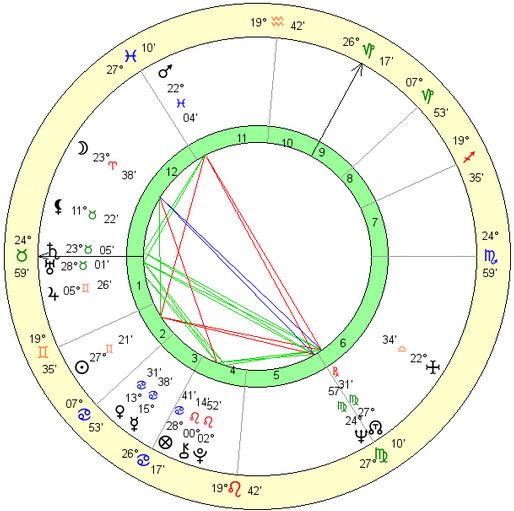
| Planet | Longitude | House | |
| Sun | 27 Gemini 21' 31" | 2 | |
| Moon | 23 Aries 38' 54" | 12 | |
| Mercury | 15 Cancer 38' 32" | 3 | |
| Venus | 13 Cancer 31' 54" | 3 | |
| Mars | 22 Pisces 04' 24" | 11 | |
| Jupiter | 05 Gemini 26' 50" | 1 | |
| Saturn | 23 Taurus 05' 54" | 12 | |
| Uranus | 28 Taurus 01' 10" | 1 | |
| Neptune | 24 Virgo 57' 16" | 5 | |
| Pluto | 02 Leo 52' 48" | 4 | |
| Chiron | 00 Leo 14' 23" | 4 | |
| Lilith | 11 Taurus 22' 34" | 12 | |
| True Node | 27 Virgo 31' 15" R | 6 | |
| Part of Fortune | 28 Cancer 41' 51" | 4 | |
| Vertex | 22 Libra 34' 29" | 6 | |
| House | Longitude | ||
| Ascendant | 24 Taurus 59' 14" | ||
| House 2 | 19 Gemini 35' 07" | ||
| House 3 | 07 Cancer 53' 06" | ||
| House 4 | 26 Cancer 17' 45" | ||
| House 5 | 19 Leo 42' 21" | ||
| House 6 | 27 Virgo 10' 51" | ||
| House 7 | 24 Scorpio 59' 14" | ||
| House 8 | 19 Sagittarius 35' 07" | ||
| House 9 | 07 Capricorn 53' 06" | ||
| MC (Midheaven) | 26 Capricorn 17' 45" | ||
| House 11 | 19 Aquarius 42' 21" | ||
| House 12 | 27 Pisces 10' 51" |
| Planet | Aspect | Planet | Orb |
| Sun | Sextile | Moon | 3.71 |
| Sun | Square | Mars | 5.29 |
| Sun | Square | Neptune | 2.40 |
| Sun | Square | True Node | 0.16 |
| Sun | Quincunx | Midheaven | 1.06 |
| Moon | Sextile | Sun | 3.71 |
| Moon | Quincunx | Neptune | 1.31 |
| Moon | Square | Chiron | 6.59 |
| Moon | Opposition | Vertex | 1.07 |
| Moon | Square | Midheaven | 2.65 |
| Mercury | Conjunction | Venus | 2.11 |
| Venus | Conjunction | Mercury | 2.11 |
| Venus | Sextile | Lilith | 2.16 |
| Mars | Square | Sun | 5.29 |
| Mars | Sextile | Saturn | 1.03 |
| Mars | Sextile | Uranus | 5.95 |
| Mars | Opposition | Neptune | 2.88 |
| Mars | Quincunx | Vertex | 0.50 |
| Mars | Sextile | Ascendant | 2.91 |
| Mars | Sextile | Midheaven | 4.22 |
| Jupiter | Sextile | Pluto | 2.57 |
| Jupiter | Sextile | Chiron | 5.21 |
| Saturn | Sextile | Mars | 1.03 |
| Saturn | Conjunction | Uranus | 4.92 |
| Saturn | Trine | Neptune | 1.86 |
| Saturn | Quincunx | Vertex | 0.52 |
| Saturn | Conjunction | Ascendant | 1.89 |
| Saturn | Trine | Midheaven | 3.20 |
| Uranus | Sextile | Mars | 5.95 |
| Uranus | Conjunction | Saturn | 4.92 |
| Uranus | Trine | Neptune | 3.07 |
| Uranus | Sextile | Pluto | 4.86 |
| Uranus | Sextile | Chiron | 2.22 |
| Uranus | Trine | True Node | 0.50 |
| Uranus | Sextile | Part of Fortune | 0.68 |
| Uranus | Conjunction | Ascendant | 3.03 |
| Uranus | Trine | Midheaven | 1.72 |
| Neptune | Square | Sun | 2.40 |
| Neptune | Quincunx | Moon | 1.31 |
| Neptune | Opposition | Mars | 2.88 |
| Neptune | Trine | Saturn | 1.86 |
| Neptune | Trine | Uranus | 3.07 |
| Neptune | Sextile | Chiron | 5.29 |
| Neptune | Conjunction | True Node | 2.57 |
| Neptune | Trine | Ascendant | 0.03 |
| Neptune | Trine | Midheaven | 1.34 |
| Pluto | Sextile | Jupiter | 2.57 |
| Pluto | Sextile | Uranus | 4.86 |
| Pluto | Conjunction | Chiron | 2.64 |
| Chiron | Square | Moon | 6.59 |
| Chiron | Sextile | Jupiter | 5.21 |
| Chiron | Sextile | Uranus | 2.22 |
| Chiron | Sextile | Neptune | 5.29 |
| Chiron | Conjunction | Pluto | 2.64 |
| Chiron | Sextile | True Node | 2.72 |
| Chiron | Conjunction | Part of Fortune | 1.54 |
| Chiron | Sextile | Ascendant | 5.25 |
| Chiron | Opposition | Midheaven | 3.94 |
| Lilith | Sextile | Venus | 2.16 |
| True Node | Square | Sun | 0.16 |
| True Node | Trine | Uranus | 0.50 |
| True Node | Conjunction | Neptune | 2.57 |
| True Node | Sextile | Chiron | 2.72 |
| True Node | Sextile | Part of Fortune | 1.18 |
| True Node | Trine | Ascendant | 2.53 |
| True Node | Trine | Midheaven | 1.23 |
| Part of Fortune | Sextile | Uranus | 0.68 |
| Part of Fortune | Conjunction | Chiron | 1.54 |
| Part of Fortune | Sextile | True Node | 1.18 |
| Vertex | Opposition | Moon | 1.07 |
| Vertex | Quincunx | Mars | 0.50 |
| Vertex | Quincunx | Saturn | 0.52 |
| Vertex | Quincunx | Ascendant | 2.41 |
| Ascendant | Sextile | Mars | 2.91 |
| Ascendant | Conjunction | Saturn | 1.89 |
| Ascendant | Conjunction | Uranus | 3.03 |
| Ascendant | Trine | Neptune | 0.03 |
| Ascendant | Sextile | Chiron | 5.25 |
| Ascendant | Trine | True Node | 2.53 |
| Ascendant | Quincunx | Vertex | 2.41 |
| Ascendant | Trine | Midheaven | 1.31 |
| Midheaven | Quincunx | Sun | 1.06 |
| Midheaven | Square | Moon | 2.65 |
| Midheaven | Sextile | Mars | 4.22 |
| Midheaven | Trine | Saturn | 3.20 |
| Midheaven | Trine | Uranus | 1.72 |
| Midheaven | Trine | Neptune | 1.34 |
| Midheaven | Opposition | Chiron | 3.94 |
| Midheaven | Trine | True Node | 1.23 |
| Midheaven | Trine | Ascendant | 1.31 |
A Perspective on AstrologyAstrology reveals nothing more than cosmic tendencies. A soul may master its stars through the exercise of free will. If one chooses to drift upon the currents of life, the alignments mapped within the vaclav-klaus-birth-chart will manifest their influence at destiny's appointed hour. Yet, one profound mystery remains hidden within the natal chart: the individual's free will and how they choose to evolve. The manifestation of free will rests solely in the hands of the seeker. Astrology serves as a celestial guide, forewarning us so we may navigate the tides of life with greater wisdom. What a person sows, so must they reap. The law of Karma operates in perfect harmony with the movements of the planets. The birth of a soul into a physical vessel occurs at the exact moment when karmic destiny and planetary alignments are in perfect alignment. Remember that so-called favorable or adverse planetary configurations are not the result of chance or luck; they are the harvest of our past actions. The horoscope mirrors what we have carried over from previous incarnations and what we are destined to master in this life. Whatever we lack in our present existence can be cultivated for the future by consciously embracing our spiritual duties. The stars impel, but they do not compel. As Goethe beautifully wrote: *'From every power that binds the world, a man frees himself when he gains self-control.'* AscendantThe Ascendant is the gateway of the soul, opening the path to fulfilling the being's karmic destiny. It shapes the physical appearance and personality, reflecting how we were perceived by others in childhood, how we project ourselves into the world, our baseline of vital energy, non-specific immunity, recovery rates, and the very foundation of our psycho-physical constitution, temperament, and ultimate fate. The Ascendant of this personality is: TAURUS It manifests as a reserved nature, stability, stubbornness, and exquisite taste. Phlegmatic in temperament, possessing an unyielding, enduring will, with deliberate and measured decision-making. The demeanor is poised and diplomatic; it is exceedingly difficult to provoke them to anger, for their reaction time is slow—yet when they finally "charge," it is truly a sight to behold! They cherish aesthetic, pleasant, and harmonious environments. If aspected by Mercury, this placement yields excellent storytellers, wits, and caricaturists, often showing an affinity for gardening, architecture, or construction (values of solidity, reliability, and precision). In a challenging aspect, it breeds extreme stubbornness and rigidity, requiring much time to realize that clinging blindly to a fixed ritual serves no purpose. Strong materialism and attachment to earthly possessions can dominate. It demands flawless physical and material security; in discordant aspects, this quest becomes the central focus of life. Physically, it often presents as a sturdy, robust build, a strong, thick neck, a broad nose, curly hair, and frequently dark eyes and hair. The gait is heavy, grounded, and pragmatic. In dance, they are precise, executing variations flawlessly. A dimple in the chin or cheek is common (a trait shared with Libra). A joyful expression while dancing is also a reliable giveaway of a Taurus Ascendant. Planets in the SignsThe placement of planets in the signs is a cornerstone of astrological interpretation. The expression of each planet within a specific zodiac sign exerts a powerful and highly characteristic influence upon our lives. Sun in Gemini These are primarily individuals of intellect and common sense who require constant mental stimulation. They thrive on acquiring and sharing knowledge, though sometimes without diving deeply into the heart of the matter—though this is not a universal rule. The Sun in Gemini loves social connections and the exchange of ideas; they delight in travel and discovery. The ideal vocation is often that of a teacher. The divine mission of this Sun is to connect people and facilitate the flow of information. Moon in Aries This individual is exceptionally self-assured and emotionally intense, with a tendency to dominate their surroundings—particularly within the family circle, but also in professional environments. They crave abundant, reciprocated love, yet remain generous in their feelings. A woman with an Aries Moon will rarely tolerate a subordinate position, while a man with this placement will seek out emotionally resilient, strong-willed women. In both cases, this can lead to inner friction. Souls with this Moon often have a deep appreciation for jewelry. Mercury in Cancer This placement bestows a powerful memory. Thought processes are heavily colored by feelings, moods, and emotions. The mind is compassionate and poetic; however, this position of Mercury is not ideal for cold, objective scientific inquiry, as it tends toward subjectivity. Generally, Cancer is a complex sign for Mercury—judgment can be unreliable, and the quality of thought fluctuates. Yet, the individual often possesses superb intuition, bridging the conscious mind and the subconscious. Their arguments may seem irrational, yet they carry profound truth. When afflicted, Mercury in Cancer is highly suggestible, easily yielding its views to the prevailing opinions of its environment. Venus in Cancer This soul deeply requires and demands emotional security, stability, and safety. Caring and compassionate in relationships, they can nevertheless exhibit the classic Cancerian trait of treating the partner as personal property. Should a relationship end, deep scars remain upon the soul, making it exceptionally difficult to reconcile with the loss. In social settings, they tend to react with reserve. Mars in Pisces This is one of the more challenging placements in the birth chart. While this constellation bestows rich intuition and imagination, enabling the individual to devise ingenious and often correct ways to solve problems, their inherent lack of practicality makes it highly difficult to apply these solutions in the physical world and see them through to completion. A classic archetype of this Mars would be an elderly humanities professor who, under a "favorable" celestial alignment, cannot even manage to boil water for tea :-) A person with Mars in Pisces is deeply considerate of others in their actions, and compassion plays a leading role in their deeds. They are drawn to unusual sensory experiences and may often feel uncertain about what truly fulfills them in intimate realms. In sexuality, they long for transcendent, extrasensory experiences, and the nature of their aspects dictates the means by which they are willing to spice up their amorous adventures. Under challenging aspects, the escape into substances cannot be ruled out. For instance, Mars in Pisces squaring Neptune is a highly treacherous aspect that might tempt the individual to "accelerate" spiritual evolution or chase timeless states through psychotropic substances. This is exceedingly dangerous, as one of the shadows of this Mars is a weakened will, leaving the soul unable to break free from its habits. For Mars in Pisces, sexuality is perceived as a sacred escape from daily monotony, prioritizing spiritual and emotional transcendence over mere physical release. They are captivated by mysterious or clandestine affairs, meaning they may not represent the classic ideal of marital fidelity; nonetheless, their deep compassion often prevents them from acting on infidelity. A similar energetic equivalent is found in Venus in Pisces or Venus in the Twelfth House, particularly in women. An individual with this Mars is always highly sensitive, especially on a psychological level. A woman with this placement will often seek a partner carrying Piscean qualities—a dreamer, a poet, wrapped in an aura of mystery. Under discordant configurations, her partners may struggle with addiction, yet she remains inexplicably drawn to them. Both genders with Mars in Pisces yearn for deep romance and frequently retreat into a realm of dreams and fantasy. Artistic talent is a very common manifestation of this cosmic placement. Jupiter in Gemini In air signs, the focus of personal expansion lies in analytical thinking and the intellect. This placement gives a strong capacity for self-analysis and self-observation, allowing the individual to examine their own motives. They enjoy contributing to collective discourse and analyzing societal trends. The collection and dissemination of facts is the primary motivation here; this is an intellectual type for whom a vast mental horizon is an absolute necessity. Saturn in Taurus In earth signs, Saturn manifests as obstacles and blockages within the physical and practical realms. Baffling delays in meeting deadlines may occur, yet the ultimate responsibility always rests with the chart holder. The individual is pragmatic, valuing firm, uncompromising stances; they do not drift in the clouds of fantasy but stand firmly on solid ground. This Saturn hardens conservative viewpoints and stubbornness. In challenging aspects, it can constrict financial flow, paradoxically heightening the urge to acquire wealth and leaving the individual frustrated by perceived scarcity. Planets in the Astrological HousesEach house represents a specific arena of life. The placement of a planet within a house reveals how one fares in that domain. To calculate these house placements accurately, the precise time of birth is paramount. Sun in the 2nd House This individual will place great emphasis on material security and wealth, alongside a profound need for personal inner space. Depending on the aspects of the Sun, the personality may either feel threatened in its personal integrity—striving to fortify it at all costs—or, conversely, master the flow of space, both inner and outer (as seen in architects). An afflicted Sun in the second house can carry effects similar to Saturn in the same placement—breeding conditions for an inferiority complex, where the individual feels financially threatened and struggles to enjoy life's pleasures. This is tied to deep-seated insecurity and a loss of self-confidence that is hard to restore, leading to profound doubts with far-reaching consequences. Individuals with this Sun prefer to manage their own finances, fiercely resisting interference in their monetary and property affairs. If the Sun or the ruler of the second house is afflicted, complications with land registries or property authorities may arise. Moon in the 12th House To correctly evaluate the influence of this Moon, we must first understand how the principles of the tenth and eleventh houses have been integrated. Indeed, two entirely divergent paths lie ahead: if these principles have been successfully integrated, the Moon acts as a powerful catalyst for ultimate liberation, mystical gnosis, and redemption. However, if the lessons of those houses remain unlearned, and the Moon is challenged (e.g., in Pisces and simultaneously afflicted by Neptune), the soul may intensely crave mystical powers without possessing a natural channel for them, potentially seeking refuge in psychotropic or addictive substances. This path is undoubtedly the most destructive, leading to the disintegration of the soul's energetic structure; only a profoundly resilient individual with an unyielding will can realize its devastating nature and transcend it. A well-aspected Moon in this house aids in opening consciousness to higher energies and celestial information, leading toward mystical initiation. The individual attains cosmic faculties, successfully anchoring the high vibrations of spiritual realms into everyday reality. This manifests as clairvoyance, clairaudience, and clairsentience, unfolding in a balanced sequence and pace to protect the psyche from overload. With a challenged Moon in the twelfth house, however, this journey may falter. Again, much depends on the integration of the preceding houses. An afflicted twelfth house can cause social alienation, escapism (addiction), existing on the fringes of society, and a compulsive urge to help others. Under negative lunar aspects, this urge becomes so overbearing that the person literally "forces help" upon others. This actually damages their karma, as it breeds dependency and obligates others to return the "favor." Because this mechanism operates unconsciously, it is incredibly difficult to dismantle. The individual strives to save others, yet lacks any practical foundation to offer real help. Should such a person occupy a high social position, they may resort to financial manipulation or fraud to fund activities they have no legal right to pursue. Generally, those with the Moon in the twelfth house appear shy and sentimental, guarding their inner world. They channel their compassion and imagination into the collective welfare, preferring to remain behind the scenes rather than seek praise. In harmonious alignments—especially with supporting aspects from Jupiter or the Sun—they can become major, quiet philanthropists. Mercury in the 3rd House This is an auspicious placement, as the planet resides within the vibrational field of its home sign, Gemini. These individuals possess highly active minds; they love to study, take short trips, share their thoughts, and continuously acquire new skills. However, they are often dissatisfied with their achievements and struggle to remain stationary. An individual with this Mercury can excel as an educational reformer, designing and implementing innovative, highly efficient teaching methods. In doing so, they actively elevate their own intellectual capacity. A child with Mercury in the third house may interact peculiarly with siblings; under challenging aspects, they might seem overly analytical or nitpicking, fixating on details that other children would naturally ignore. In adulthood, this can manifest as a relative who is unpopular due to excessive criticism and a tendency to pry. If afflicted, this placement can also trigger learning difficulties (such as dyslexia or dysgraphia) and speech disorders. Venus in the 3rd House This placement bestows a captivating charisma and exceptional storytelling abilities. It is a splendid aspect for traveling agents or highly persuasive sales professionals. This individual views close friends almost as family. In education, they lean heavily toward the arts (theatre, music, etc.), where they often excel. A typical vocation might be a television host. They often find romantic partners while traveling, studying, or through intellectual exchange. Creative self-expression is found in artistic social circles, such as dance. However, one must tread carefully with an afflicted Venus in the third house, as it carries a shadow warning regarding boundaries (including risks of boundary crossings/incest). Through relationships, they refine their communicative and intellectual gifts, pursuing higher learning and broadening their mental horizons through short travels. The core of their self-esteem rests upon their eloquence and academic achievements. Mars in the 11th House This placement manifests as a tendency to surround oneself with many acquaintances but few true friends—often people of little genuine significance to the individual. Social interactions tend to be superficial. Their demeanor can be curt and abrasive, easily drawing the ire of others. Since the eleventh house breaks established conventions, Mars intensifies this energy, shattering rigid Saturnian rules, exposing taboos, and dismantling obsolete structures. However, this disregard for established order can lead to conflicts with authority, especially under challenging aspects. In positive settings, Mars in the eleventh house attracts powerful protectors and patrons. The native is a pioneer at heart, with visionary ideas that may be too ahead of their time for general acceptance. A retrograde Mars suggests past-life exploitation of friendships; consequently, they encounter past-life connections today that act as mirrors, prompting them to resolve and balance these ancient karmic debts. Jupiter in the 1st House These are generally individuals who display a keen interest in social issues and deep reflection. Abounding in vitality, they constantly cultivate new opportunities. They seek to maintain control over themselves and their surroundings, naturally nurturing both themselves and others. However, they can fall into an "us versus them" mentality, even under harmonious aspects. This placement of Jupiter promises a favorable destiny, prosperity, honor, dignity, and a profound respect for law and order. Through self-assertion and conscious awareness of their individuality, they develop a lifelong thirst for religious and philosophical wisdom. Jupiter in the first house fosters an extroverted nature, even if other vital personal planets reside below the horizon. This is especially pronounced when Jupiter is conjunct the Ascendant—a detail where novice astrologers often err, misjudging the temperament by only looking at the inner planets. The native is warm, open, loyal, honest, and free-spirited, often becoming a patron who champions original ideas. If the Sun is below the horizon and the Moon is in its first crescent phase, they also possess remarkable organizational talents. Under discordant aspects, this expansive energy may overflow, causing friction with the environment due to overbearing behaviour. Furthermore, they may demand recognition and honors for their benevolence, which can alienate others. A retrograde Jupiter indicates that the soul did not fulfill its karmic blueprint in a past life and must now realize it under more challenging conditions. Saturn in the 12th House This is the domain of institutions, the subconscious, and the redemption of the soul from the cycle of reincarnation. Saturn here is often heavy and difficult to integrate, yet there is never cause for despair. The primary wound lies in accessing higher spiritual faculties and intuition; these natural abilities are blocked by an unintegrated Saturn, which feels deeply uncomfortable but is by no means insurmountable. If heavily afflicted, it can trigger psychological disturbances, which happily respond well to homeopathic support. These individuals possess massive organizational talent, yet suffer from low self-worth, requiring a noble purpose to unlock their gifts. They carry an irrational dread of authority and a dark future, though these fears are entirely unfounded. Consciously building self-confidence is vital. If Saturn is placed in magnetic signs, it manifests as a blocked expression, leading toward escapism (alcohol, substance abuse) or eccentric behavior. In electric signs, a compensatory reaction occurs—these individuals may play the role of a guru or lead spiritual groups, striving desperately for enlightenment at any cost. Yet, they often meet with illusion and disappointment, which ultimately serves as the catalyst to dismantle negative patterns and integrate Saturn's energy. This placement also lays the groundwork for what is known as the "syphilitic miasm"—a psychological state where one attempts to force outcomes through sheer willpower, refusing to ever back down. Uranus in the 1st House This placement brings blockages or compensations to physical and psychological destiny, vital energy, bodily self-awareness, and self-assertion. Sudden reversals and unexpected, often trying situations emerge at the most inopportune moments (governed by aspects). In electric signs, compensation dominates (manifesting as extremes and a need to stand out at all costs), while magnetic signs incline toward energetic blocks. These individuals fiercely resist limitations on their personal freedom. They are powerful individualists who delight in standing apart from the crowd—true pioneers who favor competitive battles over cooperative teamwork. Neptune in the 5th House An unintegrated or afflicted Neptune weaves illusion into all affairs of the fifth house—namely child-rearing, romance, business, and creative expression. While these individuals share a deeply tender bond with children, this relationship is often clouded by unrealistic ideals. Nevertheless, they possess innate artistic gifts that blossom fully in later years. Neptune in this house can hinder the process of individuation; if the fourth house is also heavily populated, the native will struggle to leave their family of origin, building an independent life only with great difficulty and strong parental ties. Their approach to children, intimacy, and enterprise is highly unconventional, often swayed by fantasy. Intimate blockages may occur, leading to secondary erectile difficulties in men, fertility challenges in women, or an inability to surrender to a partner. An afflicted Neptune can drive compulsive desires born of a vague yearning to merge with everyone on an intimate level. Sexual anxieties and minor functional issues can arise. The children of these individuals often exhibit a strong Neptunian or Piscean presence in their own charts. Under Neptune's influence, the soul may chase endless highs in sex, parenting, or art, suffering deeply when reality falls short of expectation. Since Neptune here resides within the vibrational field of the Sun, hermetic solar signatures and the qualities of Neptune's host sign can be utilized for healing. Pluto in the 4th House When harmoniously aspected, the upbringing is decidedly Plutonian, teaching the child diplomatic, assertive behavior and polished courtesy. (Historians may recall Dr. Kramář, the Prime Minister of the First Republic, who possessed a well-aspected Pluto in the fourth house). The exploration of emotions always unfolds through high-pressure situations, even in harmonious placements, with the mother wielding a dominant influence over development. Even with harmonious aspects, bonds of dependency form, often requiring a lifetime to untangle. This is a classic aspect of men who remain with their mother until her passing, unable to subsequently establish a meaningful partnership with another woman (discordant aspects exacerbate this outcome). While mothers must be exceedingly careful not to foster these pathological attachments, Pluto operates on such a deep subconscious level that this dynamic unfolds in most cases anyway. This aspect also heavily influences the native's home decor, which is often exotic, rare, and exceptional, yet never gaudy or offensive (as a reflection, the famous exhibition of tropical butterflies in the Prague-Troja botanical garden was a direct manifestation of Plutonian energy). Under discordant aspects, Pluto brings an overbearing, high-pressure upbringing, forging an almost unbreakable, pathological attachment to the childhood home, the mother, and ancestral roots. These ties often remain stubbornly permanent, casting a fatal shadow over the native's romantic endeavors. A challenged Pluto (particularly through severe friction with the luminaries) elevates the risk of precancerous conditions, stemming from repressed emotions and a controlling upbringing. Emotions are systematically bottled up until they erupt with uncontrollable intensity—the classic Plutonian sudden release. This emotional suppression is a prime energetic trigger for malignant growth in the physical body. Generally, an afflicted Pluto in the fourth house points to a predisposition for precancerous states linked to ancestral karma and the deep-seated, subconscious dread of inheriting family illnesses. Preventive administration of high-potency quantum homeopathic *Carcinosinum Burnett* (ideally once every two months, just prior to the full moon) can offer profound support. However, the mother of such an individual must realize that her overprotective devotion does a disservice to both her child and herself. The root of these fixations always lies in ancestral bonds and repeating the toxic behavioral models of the parents. This aspect can bring sudden, seismic shifts within the family with long-lasting consequences. Aspects of the PlanetsAn aspect is the geometric relationship between two celestial bodies. By analyzing the angle they form, we discern their mutual interaction. Aspects are divided into three groups: harmonious, discordant, and conjunctions. How each aspect manifests in a person's life is revealed in the detailed interpretation below. Sun Harmonious with Moon This aspect fosters balance, relaxation, and inner peace, greatly enhancing the likelihood of finding success and contentment. Relationships with the opposite sex are generally balanced and harmonious. Sun Discordant with Mars This placement drives a relentless work ethic, a penchant for risk-taking, and heightened physical resilience. However, it can also manifest as impulsiveness, quick temper, and self-centeredness. Sun Discordant with Neptune This breeds excessive empathy and self-sacrifice, rendering the individual vulnerable to deceit and exploitation. They must exercise extreme caution regarding drugs, alcohol, and nicotine, as they are highly prone to utilizing addictive substances to cope with challenges or escape into visions. It heightens cravings across all planetary spheres; with the Sun, this manifests as a pathological thirst for fame, power, and authority, intense sexual desires, confusion, and chaos. This is a classic signature of false gurus and prophets who present as something they are not, driven by false inspiration, alongside heightened physical sensitivities. Mercury Conjunct Venus This conjunction bestows eloquence, refined social grace, persuasiveness, and poise. Their opinions are well-balanced. However, their thinking can be so rational that they struggle to express their feelings openly. Mars Harmonious with Saturn These harmonious aspects are intriguing because they significantly rein in the imagination—a trait highly valued in high-risk professions. Yet, the question remains how much constructive imagination might aid someone in a critical situation. Individuals with this placement can work tirelessly; they are cautious, methodical, enterprising, and free from the fear of scarcity. Mars Harmonious with Uranus This infuses the native with fierce individualism and a draw toward unconventional interests. Two primary paths exist: the personality either aligns with radical activist groups and extremist movements, or channels this drive into scientific research, engineering, and cutting-edge technology. It is a superb aspect for elite athletics requiring short, explosive bursts of energy. Mars Discordant with Neptune While excellent for mysticism, this placement fuels a vivid imagination that the native often prefers over reality. These aspects are common among revolutionaries and the modern materialistic elite, severely undermining a practical approach to life. Under the opposition, kleptomania may manifest. It couples feverish self-assertion with unattainable ideals and unrealistic fantasies (tilting at windmills)—leading to completely chaotic endeavors. Medically, the body acts as its own enemy through autoimmune responses, often beginning with subtle allergies. Associated issues include anemia, claudication (limping), phantom limb pain, easy bruising, snoring, influenza, myasthenia gravis, pernicious anemia, gangrene, fluctuating immune responses, and blood-type incompatibility. Mars Harmonious with Ascendant This individual tends to be independent, brave, resolute, and assertive, showing little concern for the opinions of others. They attract dynamic, energetic allies. Guided by strong integrity and loyalty, they will fiercely defend their beliefs. This aspect strengthens the physical body, enhancing vitality and providing exceptional regenerative powers. Jupiter Harmonious with Pluto These harmonious aspects bestow tenacity, resolve, and a powerful drive for self-actualization. If aligned in a trine, the individual often amasses wealth and abundance in adulthood. These aspects bridge Zeus and Hades! (Great fortune meeting the subconscious). Much depends on which planet holds sway; if Pluto is stronger, destructive tendencies may prevail. Saturn Conjunct Uranus This brings determination, a capacity for grueling labor, originality, and the genius to find novel solutions to any problem. While harboring democratic ideals, they often behave in an overly authoritarian manner. The character of this conjunction is defined by the stronger planet. For instance, with Saturn and Uranus in Aquarius, Uranus triumphs; in Capricorn, Saturn naturally rules. In Aquarius, this breeds intense inner tension, an iron will, resistance to external influences, emotional detachment, diligence, and brilliant intelligence. Saturn Harmonious with Neptune The individual anchors their practical endeavors in their dreams and visions, though their viewpoints often remain conservative. When this harmonious link is angular, they progress systematically along their path of spiritual evolution. Saturn Conjunct Ascendant This soul tends to be serious, viewing life through a lens of duty. Responsibility and work always overshadow leisure. Relaxing can prove difficult, as there is always another task calling. Periodic waves of depression, anxiety, fear, and self-doubt may arise. Their default response to these dark moods is to work harder and longer. They must learn the art of joy and consciously carve out time for pleasure, for a life of pure labor without joy becomes unbearable. Uranus Harmonious with Neptune This placement inspires a yearning for a purposeful life, though these influences are subtle and require the support of other planets to manifest fully. They also elevate the imagination. Uranus Harmonious with Pluto This instills an inner obligation to transform the current state of things, both personally and globally. Depending on the aspect's character, the native undergoes profound personal metamorphosis, which may play out through external events. Harmonious aspects shape magnetic, highly original personalities (especially when touching sensitive points), sparking brilliant concepts that captivate the masses. The conjunction acts similarly, only with greater intensity. While Uranus's aspects to other outer planets are complex and slow to manifest, Pluto serves as the key that activates them into material reality. Uranus Conjunct Ascendant This native is unconventional, rebellious, and likely years ahead of their time. They seek to reform and revolutionize their environment and the people in it. Often high-strung and brimming with restless energy, they must monitor their drive to constantly act and rush forward, learning the sacred art of stillness. Their ideas are original, creative, intuitive, and artistic; they refuse to be bound by anyone or anything. Neptune Harmonious with Ascendant They are deeply empathetic and compassionate. It is highly probable they cultivated strong intuitive and psychic abilities in a past life, which now surge forward into active awareness. They are intensely creative and sensitive to the needs of others. ConclusionThis natal chart was calculated on the assumption that the birth data provided is precise—including the time, location, and correct time zone, accounting for daylight saving time adjustments. Even a single hour's discrepancy in birth time will yield inaccurate house placements and an incorrect Ascendant. By no means is this astrological analysis exhaustive. Every human being is a far more complex and multifaceted soul than a single document can ever capture. To generate your own personal Birth Chart online completely free, please visit Free Natal Chart Source Zbyněk Slába www.oranzovestranky.cz |
