
Personal Horoscope
Vladimir Putin
Born Tuesday, October 07, 195209:30:00 (Time Zone = GMT +3 hours)
30e15, 59n55
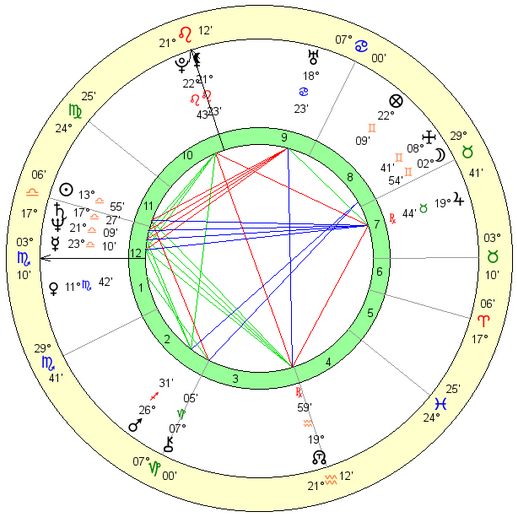
| Planet | Longitude | House | |
| Sun | 13 Libra 55' 44" | 11 | |
| Moon | 02 Gemini 54' 34" | 8 | |
| Mercury | 23 Libra 10' 28" | 12 | |
| Venus | 11 Scorpio 42' 16" | 1 | |
| Mars | 26 Sagittarius 31' 12" | 2 | |
| Jupiter | 19 Taurus 44' 58" R | 7 | |
| Saturn | 17 Libra 27' 24" | 12 | |
| Uranus | 18 Cancer 23' 50" | 9 | |
| Neptune | 21 Libra 09' 49" | 12 | |
| Pluto | 22 Leo 43' 04" | 10 | |
| Chiron | 07 Capricorn 05' 27" | 3 | |
| Lilith | 21 Leo 23' 01" | 10 | |
| True Node | 19 Aquarius 59' 37" R | 3 | |
| Part of Fortune | 22 Gemini 09' 09" | 8 | |
| Vertex | 08 Gemini 41' 35" | 8 | |
| House | Longitude | ||
| Ascendant | 03 Scorpio 10' 18" | ||
| House 2 | 29 Scorpio 41' 27" | ||
| House 3 | 07 Capricorn 00' 21" | ||
| House 4 | 21 Aquarius 12' 47" | ||
| House 5 | 24 Pisces 25' 07" | ||
| House 6 | 17 Aries 06' 40" | ||
| House 7 | 03 Taurus 10' 18" | ||
| House 8 | 29 Taurus 41' 27" | ||
| House 9 | 07 Cancer 00' 21" | ||
| MC (Midheaven) | 21 Leo 12' 47" | ||
| House 11 | 24 Virgo 25' 07" | ||
| House 12 | 17 Libra 06' 40" |
| Planet | Aspect | Planet | Orb |
| Sun | Quincunx | Jupiter | 5.82 |
| Sun | Conjunction | Saturn | 3.53 |
| Sun | Square | Uranus | 4.47 |
| Sun | Conjunction | Neptune | 7.23 |
| Sun | Square | Chiron | 6.84 |
| Sun | Sextile | Midheaven | 7.28 |
| Moon | Quincunx | Mars | 6.39 |
| Moon | Quincunx | Chiron | 4.18 |
| Moon | Quincunx | Ascendant | 0.26 |
| Mercury | Sextile | Mars | 3.35 |
| Mercury | Quincunx | Jupiter | 3.42 |
| Mercury | Conjunction | Saturn | 5.72 |
| Mercury | Square | Uranus | 4.78 |
| Mercury | Conjunction | Neptune | 2.01 |
| Mercury | Sextile | Pluto | 0.46 |
| Mercury | Sextile | Lilith | 1.79 |
| Mercury | Trine | Part of Fortune | 1.02 |
| Mercury | Sextile | Midheaven | 1.96 |
| Venus | Sextile | Chiron | 4.61 |
| Mars | Quincunx | Moon | 6.39 |
| Mars | Sextile | Mercury | 3.35 |
| Mars | Sextile | Neptune | 5.36 |
| Mars | Trine | Pluto | 3.80 |
| Mars | Trine | Midheaven | 5.31 |
| Jupiter | Quincunx | Sun | 5.82 |
| Jupiter | Quincunx | Mercury | 3.42 |
| Jupiter | Quincunx | Saturn | 2.29 |
| Jupiter | Sextile | Uranus | 1.35 |
| Jupiter | Quincunx | Neptune | 1.41 |
| Jupiter | Square | Pluto | 2.97 |
| Jupiter | Square | Lilith | 1.63 |
| Jupiter | Square | True Node | 0.24 |
| Jupiter | Square | Midheaven | 1.46 |
| Saturn | Conjunction | Sun | 3.53 |
| Saturn | Conjunction | Mercury | 5.72 |
| Saturn | Quincunx | Jupiter | 2.29 |
| Saturn | Square | Uranus | 0.94 |
| Saturn | Conjunction | Neptune | 3.71 |
| Saturn | Sextile | Pluto | 5.26 |
| Saturn | Trine | True Node | 2.54 |
| Saturn | Sextile | Midheaven | 3.76 |
| Uranus | Square | Sun | 4.47 |
| Uranus | Square | Mercury | 4.78 |
| Uranus | Sextile | Jupiter | 1.35 |
| Uranus | Square | Saturn | 0.94 |
| Uranus | Square | Neptune | 2.77 |
| Uranus | Quincunx | True Node | 1.60 |
| Neptune | Conjunction | Sun | 7.23 |
| Neptune | Conjunction | Mercury | 2.01 |
| Neptune | Sextile | Mars | 5.36 |
| Neptune | Quincunx | Jupiter | 1.41 |
| Neptune | Conjunction | Saturn | 3.71 |
| Neptune | Square | Uranus | 2.77 |
| Neptune | Sextile | Pluto | 1.55 |
| Neptune | Sextile | Lilith | 0.22 |
| Neptune | Trine | True Node | 1.17 |
| Neptune | Trine | Part of Fortune | 0.99 |
| Neptune | Sextile | Midheaven | 0.05 |
| Pluto | Sextile | Mercury | 0.46 |
| Pluto | Trine | Mars | 3.80 |
| Pluto | Square | Jupiter | 2.97 |
| Pluto | Sextile | Saturn | 5.26 |
| Pluto | Sextile | Neptune | 1.55 |
| Pluto | Conjunction | Lilith | 1.33 |
| Pluto | Opposition | True Node | 2.72 |
| Pluto | Sextile | Part of Fortune | 0.57 |
| Pluto | Conjunction | Midheaven | 1.50 |
| Chiron | Square | Sun | 6.84 |
| Chiron | Quincunx | Moon | 4.18 |
| Chiron | Sextile | Venus | 4.61 |
| Chiron | Quincunx | Vertex | 1.60 |
| Chiron | Sextile | Ascendant | 3.92 |
| Lilith | Sextile | Mercury | 1.79 |
| Lilith | Square | Jupiter | 1.63 |
| Lilith | Sextile | Neptune | 0.22 |
| Lilith | Conjunction | Pluto | 1.33 |
| Lilith | Opposition | True Node | 1.39 |
| Lilith | Sextile | Part of Fortune | 0.77 |
| Lilith | Conjunction | Midheaven | 0.17 |
| True Node | Square | Jupiter | 0.24 |
| True Node | Trine | Saturn | 2.54 |
| True Node | Quincunx | Uranus | 1.60 |
| True Node | Trine | Neptune | 1.17 |
| True Node | Opposition | Pluto | 2.72 |
| True Node | Opposition | Lilith | 1.39 |
| True Node | Opposition | Midheaven | 1.22 |
| Part of Fortune | Trine | Mercury | 1.02 |
| Part of Fortune | Trine | Neptune | 0.99 |
| Part of Fortune | Sextile | Pluto | 0.57 |
| Part of Fortune | Sextile | Lilith | 0.77 |
| Part of Fortune | Sextile | Midheaven | 0.94 |
| Vertex | Quincunx | Chiron | 1.60 |
| Ascendant | Quincunx | Moon | 0.26 |
| Ascendant | Sextile | Chiron | 3.92 |
| Midheaven | Sextile | Sun | 7.28 |
| Midheaven | Sextile | Mercury | 1.96 |
| Midheaven | Trine | Mars | 5.31 |
| Midheaven | Square | Jupiter | 1.46 |
| Midheaven | Sextile | Saturn | 3.76 |
| Midheaven | Sextile | Neptune | 0.05 |
| Midheaven | Conjunction | Pluto | 1.50 |
| Midheaven | Conjunction | Lilith | 0.17 |
| Midheaven | Opposition | True Node | 1.22 |
| Midheaven | Sextile | Part of Fortune | 0.94 |
A Perspective on AstrologyAstrology reveals nothing more than cosmic tendencies. A human being can master their stars if they exert their will. If one chooses to drift along the currents of life, the tendencies outlined in the birth chart will eventually manifest at certain moments in their life. One thing that does not appear in the Natal Chart is the individual's will and how it may evolve. The application of free will is left entirely to the individual. When analyzing the vladimir-putin-birth-chart, we see how astrology forewarns us, allowing us to better navigate life's circumstances. What a man sows, so shall he reap. The karmic law operates in perfect harmony with the planets. The incarnation of a soul into a physical vessel occurs at the opportune moment when karmic law and planetary alignments can work in unison. Remember that so-called beneficial or malevolent configurations in a horoscope are not the result of chance or mere luck, but are the fruits of our past deeds—the birth chart depicts what we have brought over from past incarnations and what we are meant to master in this one. What we lack in our present life can be acquired in the future by embracing specific spiritual tasks. The stars impel, they do not compel. As Goethe beautifully put it: "From every power that binds the world, man frees himself when he achieves self-mastery." The AscendantThe Ascendant is the gateway of the soul for fulfilling the being's karmic task. It expresses a person's physical appearance and personality, and also indicates how we were perceived by others in childhood, how we assert ourselves in our environment, our baseline level of available energy, our non-specific immunity, our recovery period, the foundation of our psychophysical constitution, temperament, and the bedrock of our destiny. The Ascendant of this personality is: SCORPIO Often a rather complex personality who cannot reliably explain the sheer abundance of their inner feelings. They project an aura of mystery and have a deep affinity for secrets. Scorpio on the Ascendant bestows the strongest will of the entire zodiac. This will is indestructible, resilient, invisible, and all-pervading. It is a phlegmatic temperament, though not in its pure form. They can endure self-inflicted hardship, allow themselves to be tormented, and will undergo absolutely anything to achieve their goal. On a positive note, they can accept their shadow, their deepest problems, and overcome them through this self-awareness. They are capable of integrating discordant aspects into their personal growth and reconciling with them. They possess exceptional powers of observation. They do not judge, and this non-judgmental attitude leads swiftly to enlightenment. They have the gift of initiation, both for themselves and others. They understand the power of transformation, and they sensitively accept and create rituals in all areas of life. An afflicted Ascendant can manipulate genially—subconsciously, covertly, and dangerously. It is difficult to detect; even a newcomer is quickly manipulated and fails to see the Scorpio's puppet strings. On the positive side is Scorpio's capacity for profound transformation. From quantum homeopathy, Syphilinum is excellent for accepting one's shadow and curbing the aforementioned manipulation. The Scorpio Ascendant is highly psychometric—it reads others excellently. It possesses an intensely powerful sexuality, as it is a tantric sign, capable of transforming sexual energy. Scorpio on the Ascendant manifests as two distinct physical types: the more dangerous is the fair-skinned (almost Nordic) type with pale blue eyes and, above all, a cold, unyielding gaze. They can feign emotions perfectly, making them formidable poker players with absolute control over their facial expressions. The second type typically possesses an aquiline nose, darker complexion, and a distinct, swaying gait, particularly visible in the pelvic region. Planets in SignsPlanets in the signs are a crucial component of horoscope interpretation. The manifestation of a particular planet in a specific sign exerts a profound and highly characteristic influence on our lives. Sun in Libra Libra possesses a highly developed sense of harmony, acutely sensing imbalance and willing to do whatever it takes to restore equilibrium. However, because they often take this ability to extremes, it breeds their characteristic and highly frustrating indecisiveness, which can drive those around them to either fits of laughter or utter despair. They detest crude or abrasive behavior, cherish beautiful surroundings and a cozy home, and find true fulfillment when in balanced relationships with others. Their conduct is often pleasant and diplomatic, though a disadvantage is their frequent dependence on the opinions, support, and approval of others. Moon in Gemini The emotional life of an individual with this Moon placement is often highly rational and temperate. Because they constantly attempt to intellectualize their feelings, they may lose connection with their true, deep emotions. Such a soul tends to be high-strung and acts with great temperament. They dislike residing in one place for too long. Women strive for intellectual achievements, while men are drawn to women of lively intellect, quick wit, and resourcefulness. Mercury in Libra This is an exceptional placement for artists, as such individuals possess refined, pleasant rhetoric and a rich way of expressing themselves. Their judgment is balanced, they can easily reconcile others, they think clearly and deliberately, possess a sharp mind, and always have several alternative solutions up their sleeve. The major drawback of Mercury in Libra (even in harmonious aspects) is its paralyzing indecisiveness. The constant search for the most optimal solution causes perpetual stress. It is not highly suited for executives or individuals who must make rapid, high-stakes decisions (e.g., an emergency room physician). In inharmonious placements, individuals can be insolent, though not necessarily vulgar, and are known for their sharp, curt retorts. It is difficult to make them explode; they tend to keep their emotions under wraps, resembling a boiling cauldron of pitch that doesn’t boil over but can occasionally sputter unpleasantly. Venus in Scorpio Always bestows an intensely powerful sexual magnetism that operates primarily on a subconscious level—meaning this being attracts others without necessarily being physically conventional-looking. This Venus is associated with the archetype of the mysterious, seductive woman who wields significant influence over her surroundings. A person with Venus in Scorpio can love passionately but often encounters baffling relationship issues, as their partner may be fickle or unreliable. Rejection can trigger deep bitterness and jealousy. However, they strive to understand the other person and can be incredibly self-sacrificing, though they may also indulge in emotional outbursts and dramatic scenes. Mars in Sagittarius Bestows a yearning for lofty goals. Consequently, it usually takes a very long time for these grand plans to come to fruition. These individuals are highly ambitious and dislike dealing with tedious details and minor tasks, which they gladly delegate to others. The desire for travel is exceptionally strong with this Mars. However, the individual sometimes aims too high, losing sight of essential details. Men with this placement are particularly philosophically inclined, honorable, and forward-looking, positively influencing their partners with these traits. They are idealistic, possess a great sense of humor, and are playful. They detest relationships where they are forced to pretend, always preferring directness. In the intimate sphere, they are mostly realistic, expressing their needs directly and sometimes rather bluntly—which, for instance, can drive their Libra partners to despair :-) Mars in Sagittarius always evaluates whether an intimate relationship meets a certain moral standard, completely eschewing sentimental, romantic fantasies. This quality is highly beneficial for long-term relationships, as such individuals feel no need to seek illicit affairs. All fire signs bring a sense of morality into relationships, but in Sagittarius, this is most pronounced. They can clearly define their moral ideals, and the righteousness of these views again depends on the nature of Mars' aspects with other planets. Women with Mars in Sagittarius are drawn to men who embody Sagittarian qualities, demanding they meet their own standards of morality and higher values; if these expectations are not met, they are usually unwilling to accept such men into their lives. Jupiter in Taurus An individual with Jupiter in an earth element always strives to develop their personality through practical endeavors, and their primary objective is often material gain. They appreciate luxurious surroundings, enjoy working with animals, and generally feel deeply at peace in nature. Saturn in Libra In air signs, this planet primarily blocks communication and mental development. However, especially in the case of strong aspects, it fosters mental discipline and provides the strength and motivation to overcome intellectual hurdles. In Libra, Saturn emphasizes high-quality, stable partnerships in a positive sense. This is certainly not a person who thrives on a succession of partners or a promiscuous lifestyle. Within relationships, they emphasize harmony and mental affinity. In the case of inharmonious aspects, the desire to achieve harmony at all costs can become incredibly exhausting for their partner. Planets in Astrological HousesEach house represents a specific area of life. The placement of a planet in a house tells us how well or poorly a person fares in that domain. To calculate the planets in houses accurately, the most precise birth time possible is required. Sun in the 11th House Primarily grants a strong community spirit and the opportunity for self-realization through collective endeavors. It does not matter whether this is a professional team, a circle of friends, or a temporary group of people on a trip. The challenge of this Sun, however, is that the chart holder may deliberately avoid close personal friendships or intimate relationships. This is simply because they feel like a fish in water within a group, often feeling that a closer bond threatens their personal integrity. Of course, this again depends on the types of aspects and the respective astrological sign. These individuals love establishing various social contacts of diverse natures, which provide them with a healthy dose of excitement. They adore clubs and associations and excel in local or community politics. The nature of the Sun's placement in this house reveals how this person will try to stand out in a crowd and the methods they will use to draw attention to themselves. A Sun in Aries will unequivocally strive for leadership, whereas in Aquarius, it will seek to stand out through an unconventional approach or even anarchy. A Sun in Capricorn will tend to block the process of breaking free from taboos and may also create blocks in managing free time, which then seemingly vanishes without cause. A well-aspected Sun grants patronage and makes it easy to manifest conscious desires. With the Sun in the eleventh house, one crucial, health-related rule applies: if the tenth house is also heavily tenanted (especially by Uranus, but also other planets), there is an acute risk of developing epilepsy. The principle of its onset lies in the activating power of the cerebral cortex by the vibrational field of Uranus (eleventh house) versus the blocking power of the vibrational field of Capricorn (tenth house). These configurations almost always begin with motion sickness (kinetosis), and if parents also treat the child insensitively, the danger of this disease manifesting becomes acute. Note—once epilepsy breaks out, it can only be managed or managed, but practically never fully cured. Therefore, we must always approach individuals with a heavily tenanted tenth and eleventh house with sensitivity and never underestimate their needs. Moon in the 8th House Triggers significant sexual and emotional needs, along with a tendency to conceal them. Because of these needs, this is a rather challenging aspect, as few parents can teach their children to express their sexual desires spontaneously; instead, these needs are usually suppressed by parents, though people today are somewhat more open than in the past. This Moon grants profound insight into others, making it an ideal aspect for tarot readers or clairvoyants, as women are generally more sensitive and intuitive—though I certainly do not wish to underestimate men in this area. People with this Moon placement have a highly developed business sense, but because they place immense emphasis on the emotional aspect of things, they often fail to make correct decisions due to a lack of pragmatism. The Moon in the eighth house also provides an intuitive view of matters concerning death; these individuals usually do not fear death, viewing it as a transition to another developmental phase, though they may fear the actual manner of their passing. In this case, death by drowning or fluid suffocation can often occur, particularly if the Moon is also in a water sign. (Conversely, an afflicted Mars in Aries in the eighth house can indicate death by fire). The financial circumstances of the partner of someone with this Moon tend to be volatile, and this person may unexpectedly acquire material wealth (winnings, etc.). A problem can arise in the typical process of the eighth house—the anchoring of a relationship; one must always carefully analyze the nature of the Moon's aspects. For example, a conjunction with Uranus practically prevents this anchoring, and the person often terminates relationships prematurely without any serious reason. Just as the eighth house signs the anchoring of relationships, it also signs the acquisition of spiritual ideals. Here too, analyzing the Moon's aspects and its astrological sign is crucial. It bestows great tantric abilities, and such a person is sensitive and intuitive in the intimate sphere. Less safe are magical abilities, as the eighth house primarily governs raw, elemental, and often black magic, granting occult faculties. These individuals may attempt to evoke various entities and host spiritualist seances. However, this is a highly dangerous activity for them unless they have an exceptionally well-placed Moon! Mercury in the 12th House This position of Mercury primarily imparts sober attitudes and a degree of restraint. The individual is drawn to psychology, mysticism, and the occult, and can analyze and discern well in these fields. They can be excellent promoters of these methods, though this Mercury tends to be more introverted, and the person has a tendency to first apply the acquired knowledge practically to themselves. With Mercury in the twelfth house, one rule is vital: the individual must learn to align their opinions and reasoning with building their self-confidence, as this placement of Mercury always somewhat undermines self-assurance. The twelfth house also rules intuition, and Mercury, by its very nature, tends to block it because it is overly analytical, depriving the person of spontaneity and trust in their own feelings, through which the subconscious tries to communicate. Because Mercury is active and analytical, it hinders and blocks the principles of the twelfth house in general. It can induce tension and nervousness, making it difficult for the person to relax, unwind, and meditate (depending also on the planet's aspects). Venus in the 1st House Practically always bestows a pleasant, attractive appearance and magnetism. This individual cherishes friendships and relationships, which are of paramount importance to them. They are amiable and friendly, but at the same time have a tremendous need to be loved. A significant number of people with this Venus placement are active in the arts or fashion. A harmonious relationship has a highly positive effect on their physical appearance and the amount of available energy. The personality is well aware of its physical attractiveness and constantly strives to enhance it. A problem arises in the case of inharmonious aspects, as such a person usually thinks more highly of themselves than they actually are, leading to a misunderstanding of their own partnership issues. In any case, they will emphasize physical appearance when forming relationships. It can be said that the exploration of one's own physical body and physical self-expression takes place precisely through the partner. The foundation of their self-confidence is satisfaction with their physical appearance, their physical attractiveness, and a balanced partnership that provides, in particular, the development of their physical capabilities and emotional satisfaction. Mars in the 2nd House These individuals direct much of their effort toward earning money, acquiring material goods, and real estate activities. They thrive in independent work or entrepreneurship, are highly aware of competition, and, especially in the case of inharmonious aspects, may tend to battle their rivals, wasting energy unnecessarily. They are courageous and accept business risks as a fact of life or even a challenge. The respective astrological sign determines the method of earning, as well as the method of self-definition and self-anchoring. A strongly asserted Mars will define itself directly, while an afflicted Mars will also do so through force or aggression. Mostly, these people require substantial personal space, even at the expense of others. However, they must learn to define themselves toward their environment in a firm and clear manner. The character of Mars' aspects is crucial—if they are positive (e.g., with Jupiter), the individual is capable of introducing innovative and effective methods into the financial sphere; in the case of inharmonious aspects, however, their activities can often culminate in financial losses. Retrograde Mars indicates the misuse of material resources in past lives. Its aspects with Neptune or links to the vibrational field of Pisces can point to a benefactor or philanthropist. Unfortunately, Mars in the second house is not a particularly fortunate aspect for relationships, as it causes constant self-assertion against the partner, and if the partner is strong, then logically, permanent arguments ensue. Both partners will mirror each other's aspects of self-assertion in a fairly direct manner. Jupiter in the 7th House This person is outwardly very friendly to everyone and loves to take the initiative in relationships. They are generous and seek to surround themselves with people from whom they might benefit in the future. They usually carry themselves with confidence in society, but often struggle with the conflicting feelings of wanting to surrender to a partner versus the desire for freedom. They yearn for an ideal partner, which can cause issues. Mostly, however, relationships are happy, friendships are excellent and reliable, and this person is supported by their environment due to their personal charm and charisma. They are welcome at social gatherings. In a daytime birth, the partner of such a person is loyal, extroverted, social, caring, dedicated, and thrifty. A typical profession for Jupiter in this placement is a mediator in the judicial system. However, if Jupiter is afflicted (inharmonious), relationships may involve amoral behavior, infidelity (including on the partner's part), seeking out bad associations, and potential legal troubles (a tendency to take the law into one's own hands, lack of legal awareness). Literally illegal impulses can occur, and these aspects are particularly unacceptable for judges. Retrograde Jupiter indicates infidelity in a past life and a poor relationship with friends (betrayal may have occurred). Through their current problems, the individual has the opportunity to work through these energies, allowing them to comprehend their ancient, negative behavioral patterns. Saturn in the 12th House This house is the domain of institutions, the psyche, and the redemption of the soul from the cycle of reincarnation. Saturn in this house is often highly burdensome and difficult to integrate, but one must never succumb to despair. The primary trauma lies in the acquisition of higher faculties and intuition; these abilities are blocked by an unintegrated Saturn, and because they are natural to the individual, their blockage is frustrating, yet not insurmountable. In cases of severe affliction of Saturn, psychotic disorders can occur, but the positive side is that these disorders are highly treatable homeopathically. These individuals possess significant organizational talent but lack self-trust; they require a meaningful task or goal to develop and utilize it. They suffer from a fear of authority and a bleak future, even though these fears are entirely unfounded in reality. A person with Saturn in the twelfth house should always consciously strive for greater self-confidence. If Saturn is in magnetic (water/earth) signs, it manifests as a blocked form of expression, resulting in alcoholism, substance abuse, or a general deviation from the norm. In electric (fire/air) signs, it manifests as a compensatory reaction; these people love playing the guru, imitating them, or becoming leaders of a sect. They have an enormous drive to change themselves at all costs, striving by all means to attain enlightenment or spiritual wisdom. Mostly, however, they achieve only an illusory goal and disillusionment, through which they comprehend their negative behavioral patterns, making the energy of Saturn easier to integrate. This position of Saturn sets the stage for the development of the so-called "syphilitic miasm"—a mental state in which the individual seeks to achieve everything through sheer force and refuses to yield. Uranus in the 9th House Blockages, compensations, or projections in the areas of religion, higher philosophy, spiritual evolution, synthetic thinking, the development of spiritual faculties, partnership growth, as well as high magic and hermeticism. These individuals often hold fairly unconventional and sometimes radical religious views (depending on the nature of the aspects), drawn to Eastern philosophies and new cults. In their quest for unusual spiritual experiences, they may travel to far-flung lands. Mostly, they are hermetic researchers, archaeologists, occult scholars, and, notably, exceptional publishers of spiritual and occult literature. In blockage, the aforementioned matters are suppressed, but these blocks are not entirely absolute even if the energy of Uranus has not yet been integrated, so the person is at least aware of the existence of the spiritual and higher faculties, enabling them to begin searching. In compensation, they may act as imitators of gurus or spiritual leaders, or espouse unusual religious or philosophical views that are not backed by higher wisdom, with the author synthesizing their beliefs through study and fantasy. In projection, they criticize others who feign spiritual realization or guidance, as they themselves are close to these matters, and their surroundings mirror this back to them. Uranus in the ninth house yields innovative and progressive (if well-aspected) views on spiritual knowledge and higher philosophy. Neptune in the 12th House While this position is relatively the most favorable for Neptune from an astrological standpoint, it is also highly sensitive to affliction. Neptune is always blocking until its energies are integrated and understood. If harmonious, it provides excellent faculties for mysticism and psychology, as well as for the ultimate liberation and redemption of the soul. These individuals can achieve expanded states of consciousness, connection to higher energetic planes, and spiritual revelation. They are aware of their healing gifts. They can attain high mystical abilities, but only in solitude. This is a classic indicator of solitary monks and hermits who distance themselves from the mundane world and society to find answers to their innermost and deepest questions, achieving expanded consciousness and liberation from the wheel of reincarnation. Most people with this Neptune are either loners or at least need to disconnect occasionally and spend long periods away from society, most frequently in nature. However, if Neptune is afflicted, various psychiatric conditions, schizophrenia, substance abuse (alcohol, drugs), or hormonal issues in the area ruled by the sign Neptune occupies can frequently occur. The severity of these issues must be assessed according to the sign Neptune is in. An afflicted Neptune in Pisces or in the water triplicity (Cancer, Scorpio) is most prone to causing highly severe psychological and substance abuse problems. People with Neptune in the twelfth house generally struggle with striving to acquire higher faculties and expanded states of consciousness, and they may also strive too hard for liberation and redemption; the non-fulfillment of these expectations then leads to suffering (on a deep, subconscious level). These issues (and mental health issues based on Neptune in the twelfth house in general) can be treated with the hermetic signatures of Pisces, Neptune, and the sign in which Neptune is placed. Pluto in the 10th House The individual attempts to achieve the principles of the tenth house through Plutonian means, whereby an unintegrated Pluto again blocks these matters and creates high-pressure situations through which the being then discovers the principles of the tenth house. Essentially, every individual with this aspect harbors a deep, subconscious desire to possess power (highly important). This is not a direct, physical power of the Martian type, but an unspoken and all the more potent Plutonian power—an invisible power, difficult to detect, and therefore far more effective. People with this aspect usually weave intricate and invisible webs of hidden relationships and connections, and others are drawn into them without even realizing it. These webs then serve to control and manipulate them. This principle is most prominent in career and politics. A strongly and well-aspected Pluto grants political genius, whereas an afflicted Pluto causes the negative manifestations of politics – corruption, fraud, embezzlement, etc. (In a nation's radix chart, Pluto in the tenth house speaks of coercive methods used for repression.) Pluto combined with a Saturnian vibrational field (tenth house), especially if even slightly afflicted, causes the individual to adopt generally accepted views, rules, and norms as their own and subsequently enforce them by virtue of their office; unfortunately, they present them as their own and, crucially, are unaware that this is not the case!! (Highly important). Thus, they memorize pre-established rules and consider them their own creation. This is highly dangerous for both a politician and a manager. There are two ways this negative principle manifests. In a compensated form, the Plutonian-Saturnian energy is processed through repressive agencies. Thus, these politicians restrict people's freedoms through state power. However, people who do not have the power to restrict the freedoms of others but are forced by the state to work for its policy (e.g., civil servants in state administration) are usually forced by principle to encounter their problem through illness. (Generally, Pluto linked to the Saturnian principle—Capricorn, Saturn in the eighth house, Pluto in the tenth, Saturn in Scorpio—causes diseases of the urogenital system linked to state power!!) (Highly important). But it always relates to adopting someone else's opinion as one's own. Yet, this person does not know that these are not their own opinions and that they bring nothing new. To find out, something must happen, e.g., something stops working. That "something" is precisely the aforementioned urogenital tract disorders, which are also highly difficult to treat. These are chronic Saturnian diseases, such as sclerotic degeneration of the ovaries in women in state administration, myomatous uteri, tissue degeneration in the genitourinary organs, sand and stones in the bladder (both sexes), obstruction of the distal part of the large intestine (hemorrhoids, poor sphincter control), reduced bile production, gallstones, incontinence, artificial urinary retention, etc. The second and far worse option for the somatization of Plutonian-Saturnian vibrations is manifestation within the skeletal system (Pluto in Capricorn, in the first, sixth, eighth, or twelfth house); here, bone marrow tumors up to leukemia can arise. Fortunately, this form of disease manifestation is far rarer, but Pluto will enter the sign of Capricorn again at the end of 2009, and its entire generation will logically be more at risk from the mentioned second form of somatization of Plutonian-Saturnian vibrations. Both described forms of disease have one single purpose from a hermetic perspective: the individual is simply forced to engage with these energies and seek the cause of their troubles. Managers with this constellation are brilliant diplomats, and when Pluto is afflicted, they become manipulators and usurpers. Unfortunately, these traits are rather sought after in a modern manager, at least in our society. Despite these elements, people with Pluto in the tenth house have a subconscious desire to serve society. Planetary AspectsAn aspect is the position of one planet in relation to another. Based on the angle they form, we can determine the mutual influence of these planets and divide aspects into three groups: harmonious, inharmonious, and conjunctions. How each aspect manifests in a person's life can be discovered in the interpretation below. Sun Conjunction Saturn Grants self-discipline, and the individual often relies on a habitual and well-established way of life, lacking the desire or courage to change. Although various problems and difficulties often arise in their life, they possess sufficient energy to overcome them and grow stronger through the experience. Sun inharmonious Uranus (Mainly affects men) bestows significant individualism, egotism, and eccentricity. They are highly independent and guard their freedom fiercely. Their actions are not always considerate, and they occasionally suffer from mental exhaustion. Psychologically, it represents a need to stand out and demonstrate uniqueness, a desire to be a teacher, counselor, and to lead by example. However, the individual is willing to go to extremes to show their originality and revolutionary thinking, championing everything new at all costs. A sudden conflict with the paternal archetype. Difficulty identifying with authority figures. Revolution and rebellion as a means to draw attention to oneself. From a health perspective, the following symptoms can arise: cardiac arrhythmia, ataxia (interrupted, uncoordinated movements), atrioventricular block (AV block)—a disruption of electrical impulses to the heart muscle, septal defects without atherosclerotic etiology, non-sclerotic degeneration of the heart, usually resulting in pacemaker implantation, cardiac neurosis, paroxysmal tachycardia, general neuroses, epilepsy (grand mal seizures), hypermetropia (farsightedness), and retinal detachment. Hermaphroditism on a psychological basis, resulting in homosexuality (blurring of male and female roles in behavior), reflux esophagitis (esophageal spasm), hiccups, limb twitching (jactitation), alopecia (hair loss). Sun Conjunction Neptune Brings intuition, sensitivity, imagination, self-sacrifice, and compassion. The individual tends to be rather impractical, occasionally leaning toward an ascetic life. It is necessary to distinguish whether Neptune is In Cazimi, combust, or in a wide conjunction. Generally, assessing the astrological strength of the conjunction is vital. A conjunction is harmonious if at least one of its elements is astrologically strong; it is even better if both are well-placed. We also distinguish between the transmitter (donor) and receiver (acceptor) of the aspect. The transmitter is the planet that initiates the aspect. This method of interpretation is also linked to applying and separating aspects. Tremendous imagination, intuition, a sense of harmony, and a spiritual path. However, order and structure are lacking in all endeavors (the person seems to "flow through" the structure of life). This individual seems to channel higher truths to others, especially if the conjunction is In Cazimi. Mercury harmonious Mars Harmonious aspects strengthen the mental faculties while bestowing quick actions and understanding. The person has an analytical mind, often making an excellent researcher or detective. Thinking is rapid, practical, and precise. Mercury Conjunction Saturn The conjunction grants the individual serious, conservative, and practical mental processes. However, they often lack faith in their own abilities and imagination. They may suffer from a diminished capacity for expression, which hinders their studies, but they are systematic and persistent. They possess an eye for detail. Mercury inharmonious Uranus Inharmonious aspects often bring extreme views and a powerful need for independence. They impose their opinions, which are frequently detached from reality, on others with arrogance and an unwillingness to compromise. In their thinking, they are often ahead of their time, gravitating toward groups whose views may eventually become widely accepted in the future. Inquisitive intelligence, creative yet unconventional ways of thinking, a need for intellectual clashes; however, creative activity is often destructive, leading to rebellion and anarchy. Manifestations in health: with a daytime Mercury (third house, Gemini)—autism, commotio cerebri (concussion), cerebral contusion, nervous breakdown, hyperfunction of the thyroid and parathyroid glands (morbid voracity, calcium metabolism, and bone structure). Whooping cough, sneezing, pertussis, all fistulas (the body seeks any outlet for inflammation to the surface of the skin). Periodontitis. With a nighttime Mercury (sixth house and Virgo)—diaphragmatic hernia, traveler's diarrhea, intestinal fistula, balbuties (stuttering). High risk of appendiceal perforation and perforation of all abdominal organs. Mercury Conjunction Neptune The conjunction often brings excellent intuition, imagination, religious sentiment, mystical abilities, sensitivity, and a broad outlook on life. An appreciation for art and idealistic thinking. However, they struggle to cope with the practical side of life, sometimes solving problems by escaping into the realm of fantasy. Special abilities are practically guaranteed in the case of a harmonious conjunction. A connection of high intuition and inspiration with thinking, speaking, and communication. This is the aspect of poets (along with the Moon). However, practical thinking is lacking, and, for instance, the material side of life is often unintegrated. A peculiar way of communicating—lacking exact expression and clarity. Mercury harmonious Pluto Harmonious aspects grant a strong will and clear opinions. The sphere of interests is quite broad—from magic and psychology to mathematics and physics. The individual needs an active exchange of ideas and experiences. These aspects have a similar effect to the conjunction, but are less intense, with a greater tendency to persuade. Mars harmonious Neptune Manifest by granting significant imagination, creativity, artistic talent, and idealism. A person with these aspects, however, is highly impractical. The classic image of this aspect is an artist known to the entire cultural world, but completely "useless" in private life. The union of activity and ideals is harmonious; a high inner spirituality, ideal for gurus. Mars harmonious Pluto In general, Mars is the higher octave of Pluto, and Pluto is the higher octave of Mars. Here, a mutual amplification of physical and psychological strength, occult abilities, etc., takes place. These aspects enhance Mars' power, making the person industrious and incredibly thorough in all their endeavors. However, they are also stubborn, and once they set a goal, they are not easily deterred. Harmonious aspects are typical for military commanders, providing a talent for brilliant strategic operations. These individuals aim to control both others and themselves. This is the only aspect that drives a person to the ultimate realization of their goals despite all possible obstacles. Jupiter harmonious Uranus Harmonious aspects grant independence in opinions, business, thinking, and expression. It also depends on the house where the planets reside. Idealism is present, but in a positive sense. These are often deeply reflective people. The individual desires to express themselves as a strong entity and assert their rights over others; sudden good fortune, inheritance, a propensity for study and medicine, success in politics and religion. Jupiter inharmonious Pluto Inharmonious aspects primarily cause stubbornness and combativeness. The individual seeks self-knowledge and loves to travel; they hold revolutionary attitudes and are often involved in religious matters. Inharmonious aspects cause fundamental conflicts between the inner and outer self, and these individuals suffer from inner torment. In the best-case scenario, they assert themselves by fighting against Plutonian mysteries; in the worst, they destroy the rules of society. (If there is a harmonious aspect between Jupiter and Pluto in a nation's horoscope, there is a truly developed legal system; state power and the judicial system are balanced with repressive forces. However, if the aspects are inharmonious, fundamental contradictions exist between legal means and repressive forces! The transit of Pluto over natal Jupiter in the national horoscope of France triggered the revolution). Saturn inharmonious Uranus Inharmonious aspects primarily cause unprincipled behavior, which can verge on anarchism; however, a highly developed sense of order is also possible, though it may not be acceptable to those close to them. Behavior is often unpredictable. Harshness, rigidity, unyielding logic, sometimes contempt for others, paranoid delusions, degenerative neurological diseases (Alzheimer's, Parkinson's, MS). Claudication (limping), fear of flying, and bone fractures. In compensation: flying, sudden and unnatural change, inability to break taboos combined with an obsessive urge to do so. Saturn Conjunction Neptune Usually has a twofold impact and must be evaluated more comprehensively. If Saturn dominates, the person can keep their imagination under control and use it constructively to realize their dreams. However, if Neptune dominates, the imagination is too wild, failing to manifest its visions practically, which breeds frustration; the person then escapes into daydreaming and is practically of little use. This, of course, also depends on other aspects. (The conjunction is practically always inharmonious): Neptune is the desire for the expansion of consciousness, yet Saturn unconsciously hinders and blocks this. In compensation, it manifests as a spiritual obsession of great caliber—the person will expand consciousness at all costs (an unconscious process) and will use all possible and impossible means to achieve this goal (spiritual fanatics). Unconscious suffering, intense inner torment. In blockage, it represents the impossibility of expansion, with problems arising whenever the person attempts to expand. The potential for paranoid delusions and obsessive behavior. In projection, the person encounters an environment that somehow prevents them from expanding consciousness, or they admire someone who pretends to have achieved this expanded consciousness, though it is always merely an illusion. Saturn harmonious Pluto (These are always complex aspects) they grant purposefulness, ambition, and a desire to fulfill the needs of the Ego. The power of Saturn is positively reinforced here by the energy of Pluto. It is the union of responsibility with power and intensity (harmonious use of power—though this aspect is generational!). Uranus inharmonious Neptune Primarily causes a desire for chaos, upheaval, and anarchy. A classic aspect for revolutionaries. Such an individual loves to participate in upheavals and asserts themselves through these events. Confusion, a tendency to stand out through flaws rather than qualities, utopias, and difficulty acknowledging one's own mistakes. Hallux valgus, homosexuality where the individual does not identify with the homosexual role. Psychological and psychiatric matters in general. If the aspect is angular, perverse tendencies occur in certain areas—sexual aberrations (fetishism, homosexuality of a "higher type" (experiential), etc.). Neptune harmonious Pluto Harmonious aspects last a very long time; both planets were in sextile from 1945 to 1995. It can be inferred that this fosters a peaceful mindset and, in conjunction with other aspects, strengthens peacemaking and transformational efforts on a global scale. ConclusionThis natal chart was calculated under the assumption that the input data—such as time, place of birth, and correct time zone (including potential daylight saving time)—is correct. Even a one-hour discrepancy in the birth time will result in inaccurate house placements or an incorrect Ascendant. By no means is this astrological analysis exhaustive. It is clear that every human being is a far more complex entity than this page can ever capture. To generate your own Natal Horoscope online and completely free of charge, please proceed to: Free Natal Horoscope Source Zbyněk Slába www.oranzovestranky.cz |
