
The Catherine Birth Chart
Catherine, Duchess of Cambridge
Born Saturday, January 09, 198212:01:00 (Time Zone = GMT +0 hours)
0w59, 51n28
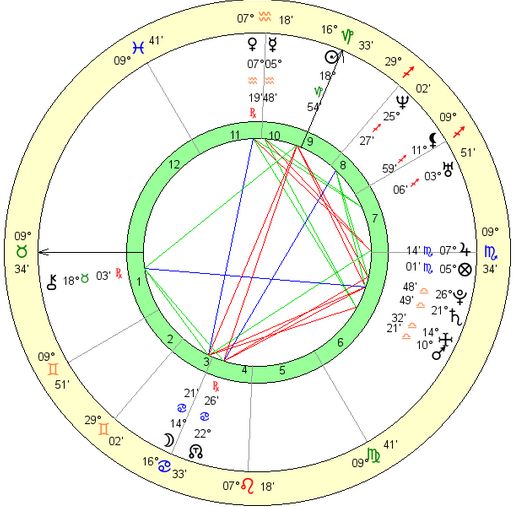
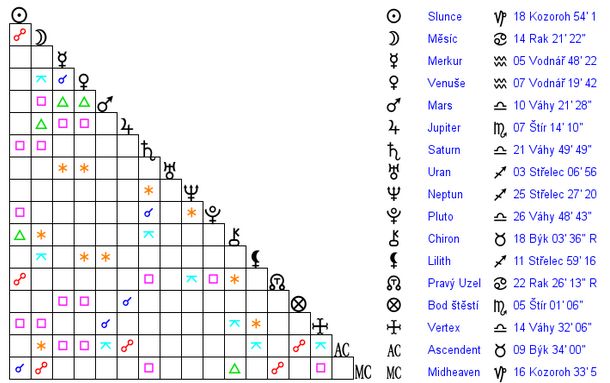
| Planet | Longitude | House | |
| Sun | 18 Capricorn 54' 16" | 10 | |
| Moon | 14 Cancer 21' 22" | 3 | |
| Mercury | 05 Aquarius 48' 22" | 10 | |
| Venus | 07 Aquarius 19' 42" R | 11 | |
| Mars | 10 Libra 21' 28" | 6 | |
| Jupiter | 07 Scorpio 14' 10" | 6 | |
| Saturn | 21 Libra 49' 49" | 6 | |
| Uranus | 03 Sagittarius 06' 56" | 7 | |
| Neptune | 25 Sagittarius 27' 20" | 8 | |
| Pluto | 26 Libra 48' 43" | 6 | |
| Chiron | 18 Taurus 03' 36" R | 1 | |
| Lilith | 11 Sagittarius 59' 16" | 8 | |
| True Node | 22 Cancer 26' 13" R | 4 | |
| Part of Fortune | 05 Scorpio 01' 06" | 6 | |
| Vertex | 14 Libra 32' 06" | 6 | |
| House | Longitude | ||
| Ascendant | 09 Taurus 34' 00" | ||
| House 2 | 09 Gemini 51' 21" | ||
| House 3 | 29 Gemini 02' 34" | ||
| House 4 | 16 Cancer 33' 56" | ||
| House 5 | 07 Leo 18' 23" | ||
| House 6 | 09 Virgo 41' 13" | ||
| House 7 | 09 Scorpio 34' 00" | ||
| House 8 | 09 Sagittarius 51' 21" | ||
| House 9 | 29 Sagittarius 02' 34" | ||
| MC (Midheaven) | 16 Capricorn 33' 56" | ||
| House 11 | 07 Aquarius 18' 23" | ||
| House 12 | 09 Pisces 41' 13" |
| Planet | Aspect | Planet | Orb |
| Sun | Opposition | Moon | 4.55 |
| Sun | Square | Saturn | 2.93 |
| Sun | Square | Pluto | 7.91 |
| Sun | Trine | Chiron | 0.84 |
| Sun | Conjunction | Midheaven | 2.34 |
| Moon | Opposition | Sun | 4.55 |
| Moon | Quincunx | Venus | 7.03 |
| Moon | Square | Mars | 4.00 |
| Moon | Trine | Jupiter | 7.12 |
| Moon | Square | Saturn | 7.47 |
| Moon | Sextile | Chiron | 3.70 |
| Moon | Quincunx | Lilith | 2.37 |
| Moon | Square | Vertex | 0.18 |
| Moon | Sextile | Ascendant | 4.79 |
| Moon | Opposition | Midheaven | 2.21 |
| Mercury | Conjunction | Venus | 1.52 |
| Mercury | Trine | Mars | 4.55 |
| Mercury | Square | Jupiter | 1.43 |
| Mercury | Sextile | Uranus | 2.69 |
| Mercury | Square | Part of Fortune | 0.79 |
| Mercury | Square | Ascendant | 3.76 |
| Venus | Quincunx | Moon | 7.03 |
| Venus | Conjunction | Mercury | 1.52 |
| Venus | Trine | Mars | 3.03 |
| Venus | Square | Jupiter | 0.09 |
| Venus | Sextile | Uranus | 4.21 |
| Venus | Square | Ascendant | 2.24 |
| Mars | Square | Moon | 4.00 |
| Mars | Trine | Mercury | 4.55 |
| Mars | Trine | Venus | 3.03 |
| Mars | Sextile | Lilith | 1.63 |
| Mars | Quincunx | Ascendant | 0.79 |
| Jupiter | Trine | Moon | 7.12 |
| Jupiter | Square | Mercury | 1.43 |
| Jupiter | Square | Venus | 0.09 |
| Jupiter | Opposition | Ascendant | 2.33 |
| Saturn | Square | Sun | 2.93 |
| Saturn | Square | Moon | 7.47 |
| Saturn | Sextile | Neptune | 3.63 |
| Saturn | Conjunction | Pluto | 4.98 |
| Saturn | Quincunx | Chiron | 3.77 |
| Saturn | Square | True Node | 0.61 |
| Saturn | Square | Midheaven | 5.26 |
| Uranus | Sextile | Mercury | 2.69 |
| Uranus | Sextile | Venus | 4.21 |
| Neptune | Sextile | Saturn | 3.63 |
| Neptune | Sextile | Pluto | 1.36 |
| Pluto | Square | Sun | 7.91 |
| Pluto | Conjunction | Saturn | 4.98 |
| Pluto | Sextile | Neptune | 1.36 |
| Chiron | Trine | Sun | 0.84 |
| Chiron | Sextile | Moon | 3.70 |
| Chiron | Quincunx | Saturn | 3.77 |
| Chiron | Trine | Midheaven | 1.49 |
| Lilith | Quincunx | Moon | 2.37 |
| Lilith | Sextile | Mars | 1.63 |
| Lilith | Sextile | Vertex | 2.55 |
| Lilith | Quincunx | Ascendant | 2.42 |
| True Node | Square | Saturn | 0.61 |
| Part of Fortune | Square | Mercury | 0.79 |
| Vertex | Square | Moon | 0.18 |
| Vertex | Sextile | Lilith | 2.55 |
| Vertex | Square | Midheaven | 2.03 |
| Ascendant | Sextile | Moon | 4.79 |
| Ascendant | Square | Mercury | 3.76 |
| Ascendant | Square | Venus | 2.24 |
| Ascendant | Quincunx | Mars | 0.79 |
| Ascendant | Opposition | Jupiter | 2.33 |
| Ascendant | Quincunx | Lilith | 2.42 |
| Midheaven | Conjunction | Sun | 2.34 |
| Midheaven | Opposition | Moon | 2.21 |
| Midheaven | Square | Saturn | 5.26 |
| Midheaven | Trine | Chiron | 1.49 |
| Midheaven | Square | Vertex | 2.03 |
A Perspective on AstrologyAstrology reflects nothing more than tendencies. An individual can master their stars through the assertion of their own will. Should one choose to merely drift along the currents of life, the inclinations mapped out in the birth chart will, in due time, manifest their influence. Yet, there is one element a natal chart can never fully capture: the human will and its infinite capacity for evolution. The exercise of free will rests entirely with the individual. Astrology serves as a divine forewarning, enabling us to navigate life's tides with greater wisdom. What a person sows, so must they reap. The law of Karma operates in perfect harmony with the movements of the cosmos. The incarnation of a soul into a physical vessel occurs at the exact, auspicious moment when karmic law and planetary alignments align in flawless resonance. Remember that the so-called favorable or adverse alignments in a horoscope are not the result of chance or mere luck; they are the harvest of our past deeds—the natal chart mirrors what we have carried over from previous lifetimes and outlines the lessons we are destined to master in this incarnation. What we lack in our present existence can be cultivated for the future by consciously embracing our current spiritual tasks. The stars impel, but they do not compel. As Goethe once wrote: "From every power that binds the world, a person frees himself when he gains self-mastery." The AscendantThe Ascendant is the gateway of the soul, through which the being steps to fulfill its karmic destiny. It governs the outer appearance and personality, revealing how we were perceived by others in childhood, how we assert ourselves in the world, our baseline of vital energy, non-specific immunity, and recovery time. It forms the foundation of our psychophysical constitution, temperament, and the blueprint of our destiny. The Ascendant of this personality is: TAURUS This placement manifests as a reserved nature, stability, stubbornness, and exquisite taste. Phlegmatic in temperament, the will is resilient and enduring. Decisions are made with deliberation and patience, and the demeanor is jovial yet diplomatic. It is highly difficult to provoke them to anger, for their reaction time is slow—but when they finally charge, it is a sight to behold! :-) They adore aesthetic, comfortable, and harmonious surroundings. If aspected by Mercury, they make excellent joke-tellers and caricaturists, sometimes possessing a natural inclination towards gardening or building (driven by solidity, reliability, and precision). Under challenging aspects, they can be fiercely obstinate, requiring considerable time to realize that clinging to a rigid ritual is futile. There can be a strong streak of materialism and attachment to earthly possessions. They demand absolute physical and material security; in disharmonious aspects, this pursuit can become their primary life purpose. Physically, this often presents as a sturdy, compact frame, a short and strong neck, a broad nose, and curly hair, often with dark eyes and hair. The gait is typically heavy and pragmatic. In dance, they are precise, performing variations flawlessly. A dimple in the chin or cheek is common (a trait also shared with Libra). A joyful gaze while dancing is another reliable indicator of a Taurus Ascendant. Planets in the SignsPlanetary placements within the zodiac signs form a crucial cornerstone of astrological interpretation. The expression of a planet in a specific sign exerts a profound and highly characteristic influence upon our lives. Sun in Capricorn An individual with this placement is typically materially oriented, pragmatic, conservative, and practical. One of the greatest challenges of this Sun is a rich and intense emotional life, of which the individual is often entirely unaware, frequently suppressing the needs of their soul and pushing them into the background. Capricorn essentially does not understand lightness; they approach everything with immense gravity. They lean toward pessimism and possess a love for fine, luxurious things. Spontaneity and openness do not come easily to them, yet these are the very qualities they must consciously strive to cultivate throughout their life. For a Capricorn Sun, the primary metric for evaluating others is often wealth and material standing—while not universally true, it is the underlying tendency. Moon in Cancer These individuals are deeply sensitive and possess a wealth of inner affection, yet they require and demand a great deal of reciprocal love to feel secure and emotionally at peace. Interestingly, those with this Moon placement require guidance—a kind of stable, protective presence that allows them to live serenely and discover their emotional identity. This is a nurturing, maternal archetype with a profound appreciation for the safety and warmth of home. Men with this placement are also deeply nurturing and often form strong bonds with maternal women. If their own mother was overwhelmingly nurturing, it can lead to difficulties in establishing romantic partnerships due to an emotional fixation on her. Mercury in Aquarius This is an excellent placement, conferring creative thinking patterns. It is highly original, innovative, and possesses the ability to apply novel, untested concepts and inventions in practice. Needless to say, this can sometimes be risky. These individuals are intellectually independent and detest being told how to think. In intelligent children, this can often present an insurmountable disciplinary challenge for parents! :-) (Naturally, much depends on the harmonious or disharmonious aspects of Mercury to other planets). A person with Mercury in Aquarius requires intellectual freedom to discover their mental pursuits. They can hold radical views and may slip into black-and-white thinking during disputes. This Mercury brings great cognitive flexibility; they are able to focus intensely and deliver work on time (unlike Mercury in Gemini). They are willing to work selflessly for the collective, being natural team players who do not overemphasize their own intellectual property. In fact, they are practically unable to work without a team. When disharmoniously aspected, Mercury can cause an erratic or inappropriate application of inventions, leading to anarchic tendencies that discard old, tried-and-tested concepts regardless of their utility, often recklessly. Venus in Aquarius In relationships, this placement seeks intellectual stimulation, variety, and engaging amusement. This individual has little regard for social conventions, dislikes being bound (highly dependent on aspects), and refuses to be forced into a predetermined societal role. They are of a rebellious nature, often ending relationships without any apparent, direct cause. There can be a certain neurological risk, such as epilepsy, particularly if Venus is located in the Tenth House. Mars in Libra This placement often causes a scattering of energy, which is primarily exerted to maintain harmonious relationships and concord among people. The individual tends to play the peacemaker between feuding parties, sometimes losing sight of the actual state of affairs. They are capable of conceiving contradictory solutions, a trait with a dual outcome: it can lead to valuable diplomatic experience and the ability to find strategic solutions, but on the other hand, it frequently results in indecisiveness and vague outcomes. Perhaps the greatest challenge for Mars in Libra is hesitation, especially when sudden, rapid action is required. Consequently, the individual often realizes the correct course of action only after the critical moment has passed. Typically, their immediate reaction is to do nothing and contemplate the most righteous path—arriving at the solution only when the need for action is no longer relevant. This issue is most pronounced when they are given time to deliberate. In moments of immediate danger, however, survival instincts usually function perfectly, though this again depends on aspects. Mars in Libra is rarely overtly passionate; its expressions are more conventional, though it does not shy away from novel experiences. They seek to dazzle their partner primarily through communication, prioritizing romanticism, and they perceive any disharmony in the intimate sphere very negatively. Scorpios often find the greatest difficulty with this Mars, as their emotional expectations are usually unrealistic, making reality hard to accept. Jupiter in Scorpio In water signs, this planet demands deep emotion; the individual yearns for love and emotional fulfillment. They have a romantic soul but are prone to self-pity, self-sacrifice, and sentimentality. Their desire to help others is often channeled through healing. A potential shadow aspect of this placement is sexual wildness and lack of restraint. They are courageous, strong-willed, and highly resourceful, with a natural affinity for esotericism. Saturn in Libra In air signs, this planet blocks communication and intellectual development. However, particularly in the presence of strong aspects, it fosters mental discipline and provides the strength and motivation to overcome intellectual hurdles. In Libra, Saturn emphasizes high-quality, stable partnerships in a positive sense. This is certainly not someone who thrives on a succession of partners or a casual sexual life. In relationships, they demand harmony and mental alignment. Under disharmonious aspects, their desperate pursuit of harmony at all costs can become incredibly exhausting for their partner. Planets in the HousesEach house represents a specific realm of life. The placement of a planet in a house reveals how one fares in that particular area. To calculate these positions accurately, the exact birth time is essential. Sun in the 10th House The keywords for this solar placement are career, self-assertion, and social recognition. The individual yearns for social prestige, status, and validation, and is willing to exert maximum effort to attain these values. If the path to these achievements is blocked, their sense of social identity is likewise obstructed, making it imperative to find a way to dissolve the block or find a suitable alternative, such as charitable work. Nevertheless, they will always strive for a social position that grants them significance. Even children with the Sun in the Tenth House contemplate their future careers and refuse to envision any obstacles. A common refrain might be, "I will build a house one day because I will earn the money for it." Individuals with a harmoniously aspected Sun in the Tenth House rarely experience career difficulties. However, the sign and aspects of this Sun hold immense significance. The Tenth House represents a fundamental phase of the vital principle of "liberation"—the ultimate goal of all mystical teachings—which requires the absolute and unconditional acceptance of societal norms, rules, and laws. If a being can integrate these rules, they eventually realize they are not universally binding, leading to liberation in the Eleventh House and the embracement of higher, universal laws. This liberation is not anarchy, but understanding and non-judgment. If the Sun is in Aquarius or negatively aspected by Uranus, it virtually blocks the integration of societal rules; the individual becomes anarchic, fights against the system, and falls into persistent trouble. Consequently, they cannot comprehend the liberating principle of universal laws in the Eleventh House, thereby blocking their ultimate enlightenment in the Twelfth. Above all, they block their own humility! This anarchic impulse can degrade into a desperate attempt to force enlightenment at any cost, often leading to the abuse of alcohol and drugs—a negative path heavily influenced by Neptune and Pisces. Significant conflict also arises if the Fourth House is heavily occupied; the individual then battles internally between career and family, facing domestic guilt for working too much. Generally, a person with the Sun in the Tenth House is highly regarded by others and knows how to evaluate people, though this is again contingent on sign and aspects. (For instance, a poorly aspected Sun in Leo will seek to dominate at all costs, and woe to anyone who does not validate their "majesty"—such a manager becomes a living nightmare for their subordinates). Moon in the 3rd House This is an excellent placement, particularly for teachers (especially of young children), provided the Moon is harmoniously or strongly aspected. The soul of such a person yearns to communicate and share knowledge. If Mercury is also well-placed, their communicative prowess is naturally amplified. Aside from teaching, they make excellent trainers, journalists, public speakers, or even preachers—though the latter requires further spiritual aspects (Ninth House). Unless the Moon is severely afflicted, the individual expresses themselves with sensitivity and imagination. They are deeply curious, and this curiosity drives their intellect. However, if the Moon is blocked by negative aspects, it can lead to cognitive decline in later years, such as Alzheimer's, because this position can foster intellectual laziness. This depends heavily on the sign and the aspecting planet. A typical constellation would be the Moon in Pisces opposing Neptune in the Ninth House, which can block faith and erode trust in one's ability to direct their own life. The person lets themselves be guided by others, abdicating personal responsibility, which can manifest as the aforementioned illness. Unless the root of this pattern is uncovered, healing is virtually impossible. The Moon in the Third House also strongly influences the intellect. A higher angular velocity of the Moon (over thirteen degrees per day) indicates a sharp, quick mind, and vice versa. Generally, the Moon governs physical movement, and its placement in the Third House amplifies this effect. A well-aspected Moon here bestows acrobatic, dancing, or physical talents, whereas negative aspects manifest as physical clumsiness. It has a similar influence on intelligence, memory, and perception. Finally, this placement indicates business travel, which the individual rarely initiates but is instead directed to take by superiors. The nature and distance of these journeys vary. Mercury in the 10th House An individual with this Mercury seeks a career that offers intellectual stimulation, allowing them to apply their ideas and communicative talents. They prioritize these conditions over financial reward, as the satisfaction derived from intellectual self-expression is paramount. They excel in education, journalism, tourism, and administrative roles. In these fields, they gather information and apply it pragmatically. They draw most of their information from existing societal structures. Through mental activity in their profession, they refine their intellect and achieve corresponding status and respect. High-level aspects produce university professors, architects, and heads of construction firms. Under harmonious aspects, they make fair judges; under disharmonious ones, they are easily swayed and may lean towards corruption. Venus in the 11th House These individuals delight in moving through high society, finding deep satisfaction there. They build broad social networks and utilize them skillfully, though they are equally generous in returning favors. They accept patronage as a matter of course, yet they appreciate it. Problems arise under challenging aspects; the individual may try to infiltrate elite social circles but is rejected, appearing foolish. Venus in the Eleventh House facilitates the integration of the house's core principle—discovering that societal laws are not absolute—though this discovery typically occurs through a partner. The partner may also significantly aid in their emancipation, liberation from taboos, and the pursuit of leisure. Their self-confidence is anchored in social connections, breaking taboos, and the rewarding use of free time. Mars in the 6th House Its influence is felt primarily in workplace relationships, subordinate service, healing, physical health, and the expression of emotion. This individual strives to outperform competitors at work, which often leads to conflict with colleagues; under disharmonious aspects, these disputes can be highly unpleasant, as the individual employs Martian force and pressure to assert themselves. On the positive side, they possess immense drive, speed, reliability, and honesty. They are capable of working incredibly hard. Their colleagues often share these traits. This is a classic placement for a dedicated civil servant, particularly one with promotion prospects. They express their emotions mainly in relation to their work, within their professional circle, and these outbursts are usually swift, sudden, and spontaneous. It is often said that before others even realize what caused the emotional explosion of a Mars-in-the-Sixth-House colleague, the individual has already forgotten why they reacted that way! :-) Aries is the archetype of this principle, whereas Scorpio will suppress emotions, directing them inward, which can damage their health—especially under disharmonious aspects where emotions are misjudged (a common issue with Scorpio placements, amplified by the Sixth House). Mars here indicates acute, sudden illnesses affecting the area ruled by its zodiac sign: Pisces rules lymphatic inflammation, Taurus rules the tonsils, Scorpio rules reproductive organs, etc. Illnesses can also arise from recklessness, restlessness, or overwork. Mars in the Sixth House naturally bestows healing gifts, closely tied to the person's interest in maintaining their own health. The application of these gifts depends on the sign. Pisces is compassionate and energetic; Scorpio possesses diagnostic insight and works with subtle energies (homeopathy, automatic drawing, Aura-Soma); fire signs work with massage, Libra with Tai Chi, etc. Retrograde Mars indicates past-life struggles with work (difficult colleagues, harsh conditions) and, if severely afflicted, the misuse of healing abilities in past incarnations (e.g., charlatanism that harmed others). Jupiter in the 6th House Jupiter in the Sixth House often causes a person to labor in an almost servile manner, especially if they believe their work serves a higher purpose. Professional satisfaction is far more important to them than material gain. However, if they find their efforts lead nowhere, they become disillusioned and their enthusiasm wanes. They are deeply proud of their work. Under challenging aspects, they can prone to overindulgence and lack of moderation. Retrograde Jupiter indicates excessive indulgence in past lives and a neglect of physical health. In this life, they are forced through health issues to practice moderation, discern what is beneficial, and would greatly benefit from a vegetarian lifestyle. Saturn in the 6th House These individuals must work diligently and hard to attain a sense of security. They demand a great deal from colleagues but often face blame, delays, and obstacles in the workplace. Their career progress is slow but steady, provided Saturn is not severely afflicted. The individual delivers work of excessive quality, which paradoxically causes them to miss deadlines and experience trauma. They tend to care for their health in obsessive or inappropriate ways. This Saturn almost always causes chronic illnesses in the second half of life that are difficult to cure (especially through allopathic means), with the affected area corresponding to the sign Saturn occupies. The severity of the illness is indicated by the aspects. Negative aspects are naturally more challenging, while harmonious ones offer a strong chance of recovery or may prevent the illness from manifesting at all. An afflicted Saturn often places the person in unhealthy working environments, leading to occupational illnesses. The primary trauma lies in objective perception, analytical processes, and the spontaneous expression of emotions. The individual can only utilize these processes if they align with societal rules; attempting a natural, personal expression results in guilt and blockages. This placement often causes ear and balance disorders, making it less than ideal for pilots or divers, especially under challenging aspects. Uranus in the 7th House This placement brings blockages, compensations, and projections in partnerships, close relationships, friends, and open enemies, as well as in initiating contact and discovering original ideas. When blocked, it restricts the ability to establish initial contact and hinders the discovery of one's sexual identity. In this form, it can manifest as homosexuality stemming from the need for a partnership with someone of the same sex. If Uranus is harmonious, it can spark sudden, lightning-fast connections with Uranian individuals. In its compensatory form, people try to force connections at all costs, facing rejection or misunderstanding. Generally, those with Uranus in the Seventh House hold unconventional views on marriage, keep eccentric friends, and fear tight emotional bonds. They require a partner who grants them ample space and freedom. They often enter relationships suddenly, only to end them just as abruptly, never to return. Neptune in the 8th House These individuals often harbor unrealistic expectations in sex and possess an overactive imagination in intimacy, leading to disillusionment in real relationships. The person is drawn to hidden mysteries, the process of death and rebirth, magic, and the occult, though they often experience confusion in these areas. This is an excellent aspect for sexual magic and tantra; through sexual activities and powerful visualization, they can achieve altered states of consciousness. At work, they have brilliant ideas but often lack the practical knowledge to execute them, resulting in frustration. Neptune in the Eighth House always forms a disharmonious connection to Pluto's vibration, which can lead to non-inflammatory venereal diseases (Mars rules inflammation). Even a harmonious Neptune can cause this. If Neptune is disharmonious or retrograde, there is a risk of serious illness (such as AIDS), often driven by a reckless approach to sexuality. Under its core principle, Neptune here makes the person crave more in sex, transformation, and occultism. They attempt to anchor partnerships at all costs, but these exaggerated expectations lead to suffering. Resolving these issues requires the hermetic signatures of Pluto and the sign Neptune occupies. Pluto in the 6th House In harmonious aspect, this is an outstanding placement for detectives, deep psychologists, and anyone who utilizes extraordinary investigative abilities. It produces healers and magnetopaths who excel with pendulums, possess telepathic or telekinetic gifts, and make excellent diagnosticians. The root of their fixation lies in an obsessive concern with health and a dark dread of disease. Pluto, especially when afflicted, can cause complex, chronic illnesses that defy conventional medical diagnosis and treatment (often leading to misdiagnosis and ineffective therapy; alternative medicine is highly recommended). Individuals with this placement (even when harmonious) often cleanse their bodies through radical means, such as drastic diets or sexual celibacy. However, these methods rarely yield positive results and can exacerbate their issues. This aspect causes highly intense emotional expression, which they may manipulate to control others (especially at work, where they face pressure from superiors and exert pressure on subordinates). Being Plutonian, these processes are hard to detect. Even with a harmonious Pluto, the individual discovers their healing gifts under pressure or through manipulation. If Pluto is disharmonious, the lessons of the Sixth House are learned solely through crisis—either workplace oppression or, more commonly, a dangerous illness (malignancy). The affected organ can be deduced from Pluto's sign, the cusp of the Sixth House, or the ruler of that cusp. Lastly, emotional overload is often vented through sudden, explosive action or illness. Aspects of the PlanetsAn aspect is the geometric relationship between two planets. Depending on their angle, we can discern how they influence each other, categorized into three groups: harmonious, disharmonious, and conjunctions. Discover how these aspects manifest below. Sun disharmonious Moon Instigates conflict, particularly between loved ones (parents and children), career and public service, and family life versus personal interests. It brings obstacles, especially in youth. Sun disharmonious Saturn Divides people into two groups: one that resigns under frequent hardships, and another that is stimulated by them to achieve greater heights. It lowers self-confidence, which must be rebuilt through honest labor. Sun disharmonious Pluto Grants a tendency toward emotional outbursts, obstinacy, decisiveness, and interfering in the lives of others to force change. The individual often encounters death or profound transformations in their environment. It brings the ability to manipulate others effectively at a subconscious level! It can manifest as self-destruction and rejection of the father archetype through rebellion (unlike the conjunction, this is visible resistance rather than innate rejection). The person appears gentle but harbors unconscious destructive patterns. Physical symptoms include a nervous heart (cardiac neurosis), pancreatic spasms, or, under hard squares, pathological pancreatic changes or cancer. Moon disharmonious Mars The individual suffers from emotional tension, acting recklessly and thoughtlessly. They thrive in domestic arguments and navigate them with ease. Domineering and stubborn, they love a wandering life and struggle to settle down. Moon harmonious Jupiter The person is exceptionally open, optimistic, and generous, often bringing success and inspiring others. They are idealistic, love a comfortable home, and excel in legal matters and studies. Moon disharmonious Saturn This aspect renders the individual virtually unable to express emotions, hiding behind a protective mask. They require a stable home as a sanctuary, yet they create excessive domestic duties. Prone to depression. Moon harmonious Ascendant This person requires people around them for emotional well-being. They are empathetic and attentive to the needs of others, openly showing their emotions. Caring, sensitive, and warm-hearted, they love life and people. Mercury in Conjunction with Venus This conjunction bestows eloquence, social grace, persuasiveness, and poise. Their views are balanced, yet their thinking can be so rational that they do not express emotions openly. Mercury harmonious Mars This aspect sharpens the mind, giving quick perception and action. Gifted in analysis, they make excellent researchers or investigators. Thinking is rapid, practical, and precise. Mercury disharmonious Jupiter Brings extremist thinking, suspended between doubt and faith, and struggles to bridge theory and practice. Restless, they often travel abroad and may engage in unsuccessful litigation. Mercury harmonious Uranus Highly inspiring, granting the ability to discover, invent, and master new technologies. The individual thrives on intellectual debates. Physical symptoms: with a diurnal Mercury (3rd House, Gemini)—autism, concussion, brain contusion, nervous breakdown, hyperthyroidism (affecting appetite, calcium metabolism, and bone structure), whooping cough, sneezing, and fistulas. Paradontosis. With a nocturnal Mercury (6th House, Virgo)—diaphragmatic hernia, traveler's diarrhea, intestinal fistula, stuttering, and a high risk of appendicitis or other abdominal perforations. Mercury disharmonious Ascendant Possesses restless energy and cannot sit still. They seek intellectual company and love mental challenges, quickly sparking debates or playing devil's advocate. At times, they may struggle to express thoughts clearly or simply talk too much. Venus harmonious Mars Attentive to their partner, kind-hearted, and practical. They have many friends, spend leisure time meaningfully, and possess abundant creative energy. It heightens sexuality and magnetism. Venus disharmonious Jupiter Causes high emotional demands. Friendships are hard to maintain due to intense interests in religion, idealism, or foreign travel. They may have artistic ambitions without the talent. Conflicting, selfish, demanding, and prone to spending excessively on luxury. Venus harmonious Uranus Demands constant stimulation and initiative from friends. Emotionally independent, they avoid tight bonds. Relationships are spontaneous but brief. In women, it bestows intense sex appeal and sudden magnetism. Physical symptoms: with a diurnal Venus (7th House, Libra)—fetishism, voyeurism, frotteurism, vitiligo, renal colic without stones, ureter spasms, and sudden lumbar fractures or herniated discs. With a nocturnal Venus (Taurus, 2nd House)—dysphagia (throat spasm), menopausal difficulties, wandering kidney, and displaced cervical vertebrae. Venus disharmonious Ascendant Requires constant approval from others and may suffer from low self-esteem. They attract ease into their lives, preferring warm, social company. Charming but sometimes insincere, with a tendency to take things for granted or fall into laziness. Jupiter disharmonious Ascendant Appears self-absorbed, egotistical, and lacking in humility. Intolerant of others' flaws, they tend to overindulge their senses, especially with food and drink, or engage in extravagant behavior. The challenge is to learn cooperation, cultivate tolerance, and accept others' ideas to unlock greater life opportunities. Saturn harmonious Neptune Finds the foundation for practical endeavors in dreams and visions, though their views remain conservative. An angular connection indicates systematic spiritual growth. Saturn in Conjunction with Pluto A highly challenging aspect, bringing intense self-control, ambition, endurance, and a deep urge for transformation. Excellent for Scorpio, fostering profound self-reflection, though psychoanalytically it indicates an absence of one's own opinion (especially in angular houses). Neptune harmonious Pluto This long-lasting sextile (1945–1995) promotes peaceful mindsets and, with other aspects, fosters global peace and transformative movements. ConclusionThis natal horoscope was calculated on the assumption that the birth data—time, place, and time zone (including daylight saving corrections)—is accurate. Even an hour's discrepancy can miscalculate house positions or the Ascendant. By no means is this analysis exhaustive. Every human being is far more complex than a single reading can capture. To generate your own Natal Chart online completely free of charge, visit: Free Natal Chart Source Zbyněk Slába www.oranzovestranky.cz |
