
Personal Horoscope
Prince Harry of Wales
Born Saturday, September 15, 198416:20:00 (Time Zone = GMT +1 hour)
0w10, 51n31
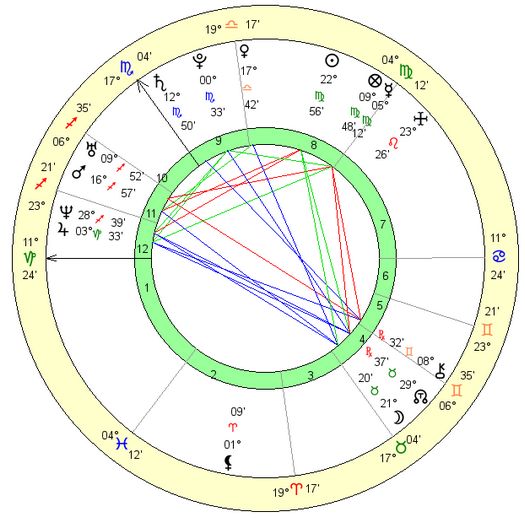
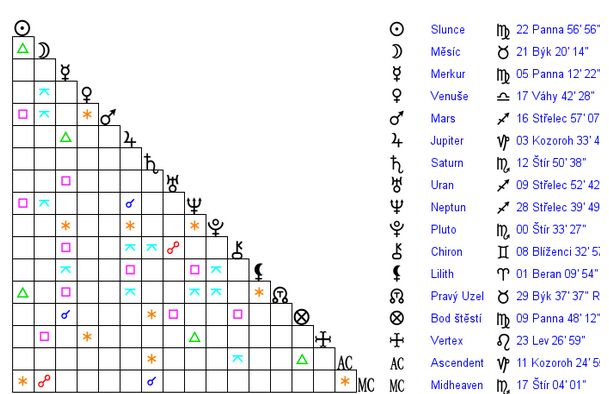
| Planet | Longitude | House | |
| Sun | 22 Virgo 56' 56" | 8 | |
| Moon | 21 Taurus 20' 14" | 4 | |
| Mercury | 05 Virgo 12' 22" | 8 | |
| Venus | 17 Libra 42' 28" | 8 | |
| Mars | 16 Sagittarius 57' 07" | 11 | |
| Jupiter | 03 Capricorn 33' 47" | 12 | |
| Saturn | 12 Scorpio 50' 38" | 9 | |
| Uranus | 09 Sagittarius 52' 42" | 11 | |
| Neptune | 28 Sagittarius 39' 49" | 12 | |
| Pluto | 00 Scorpio 33' 27" | 9 | |
| Chiron | 08 Gemini 32' 57" R | 5 | |
| Lilith | 01 Aries 09' 54" | 2 | |
| True Node | 29 Taurus 37' 37" R | 4 | |
| Part of Fortune | 09 Virgo 48' 12" | 8 | |
| Vertex | 23 Leo 26' 59" | 7 | |
| House | Longitude | ||
| Ascendant | 11 Capricorn 24' 55" | ||
| House 2 | 04 Pisces 12' 08" | ||
| House 3 | 19 Aries 17' 17" | ||
| House 4 | 17 Taurus 04' 01" | ||
| House 5 | 06 Gemini 35' 58" | ||
| House 6 | 23 Gemini 21' 11" | ||
| House 7 | 11 Cancer 24' 55" | ||
| House 8 | 04 Virgo 12' 08" | ||
| House 9 | 19 Libra 17' 17" | ||
| MC (Midheaven) | 17 Scorpio 04' 01" | ||
| House 11 | 06 Sagittarius 35' 58" | ||
| House 12 | 23 Sagittarius 21' 11" |
| Planet | Aspect | Planet | Orb |
| Sun | Trine | Moon | 1.61 |
| Sun | Square | Mars | 6.00 |
| Sun | Square | Neptune | 5.71 |
| Sun | Sextile | Midheaven | 5.88 |
| Moon | Trine | Sun | 1.61 |
| Moon | Quincunx | Venus | 3.63 |
| Moon | Quincunx | Mars | 4.39 |
| Moon | Quincunx | Neptune | 7.33 |
| Moon | Square | Vertex | 2.11 |
| Moon | Opposition | Midheaven | 4.27 |
| Mercury | Trine | Jupiter | 1.64 |
| Mercury | Square | Uranus | 4.67 |
| Mercury | Sextile | Pluto | 4.65 |
| Mercury | Square | Chiron | 3.34 |
| Venus | Quincunx | Moon | 3.63 |
| Venus | Sextile | Mars | 0.76 |
| Mars | Square | Sun | 6.00 |
| Mars | Quincunx | Moon | 4.39 |
| Mars | Sextile | Venus | 0.76 |
| Jupiter | Trine | Mercury | 1.64 |
| Jupiter | Conjunction | Neptune | 4.90 |
| Jupiter | Sextile | Pluto | 3.01 |
| Jupiter | Quincunx | Chiron | 4.99 |
| Jupiter | Square | Lilith | 2.40 |
| Saturn | Quincunx | Chiron | 4.29 |
| Saturn | Sextile | Ascendant | 1.43 |
| Saturn | Conjunction | Midheaven | 4.22 |
| Uranus | Square | Mercury | 4.67 |
| Uranus | Opposition | Chiron | 1.33 |
| Uranus | Square | Part of Fortune | 0.07 |
| Neptune | Square | Sun | 5.71 |
| Neptune | Quincunx | Moon | 7.33 |
| Neptune | Conjunction | Jupiter | 4.90 |
| Neptune | Sextile | Pluto | 1.89 |
| Neptune | Square | Lilith | 2.50 |
| Neptune | Quincunx | True Node | 0.96 |
| Pluto | Sextile | Mercury | 4.65 |
| Pluto | Sextile | Jupiter | 3.01 |
| Pluto | Sextile | Neptune | 1.89 |
| Pluto | Quincunx | Lilith | 0.61 |
| Pluto | Quincunx | True Node | 0.93 |
| Chiron | Square | Mercury | 3.34 |
| Chiron | Quincunx | Jupiter | 4.99 |
| Chiron | Quincunx | Saturn | 4.29 |
| Chiron | Opposition | Uranus | 1.33 |
| Chiron | Square | Part of Fortune | 1.25 |
| Chiron | Quincunx | Ascendant | 2.87 |
| Lilith | Square | Jupiter | 2.40 |
| Lilith | Square | Neptune | 2.50 |
| Lilith | Quincunx | Pluto | 0.61 |
| Lilith | Sextile | True Node | 1.54 |
| True Node | Quincunx | Neptune | 0.96 |
| True Node | Quincunx | Pluto | 0.93 |
| True Node | Sextile | Lilith | 1.54 |
| Part of Fortune | Square | Uranus | 0.07 |
| Part of Fortune | Square | Chiron | 1.25 |
| Part of Fortune | Trine | Ascendant | 1.61 |
| Vertex | Square | Moon | 2.11 |
| Ascendant | Sextile | Saturn | 1.43 |
| Ascendant | Quincunx | Chiron | 2.87 |
| Ascendant | Trine | Part of Fortune | 1.61 |
| Ascendant | Sextile | Midheaven | 5.65 |
| Midheaven | Sextile | Sun | 5.88 |
| Midheaven | Opposition | Moon | 4.27 |
| Midheaven | Conjunction | Saturn | 4.22 |
| Midheaven | Sextile | Ascendant | 5.65 |
A Perspective on AstrologyAstrology reveals nothing more than innate tendencies. A person can master their stars if they exert their will. If one decides to drift along the currents of life, then the cosmic forces outlined in this prince-harry-birth-chart will eventually manifest their influence at some point in their life. One crucial element never shown in a Natal Chart is the individual's free will and how it might evolve. The application of free will is left entirely to the individual. Astrology serves as a divine forewarning, enabling us to better navigate the currents of our life. What a man sows, he must reap. The Law of Karma operates in perfect harmony with the planets. The incarnation of a soul into a physical body occurs at the precise moment when karmic law and planetary configurations align. Remember that the so-called beneficial or malevolent configurations in a horoscope are not the result of chance or mere luck; they are the harvest of our past deeds—the birth chart reflects what we have brought from past lives and what we are meant to master in this lifetime. What we lack in our present life can be attained in the future by embracing our destined tasks. The stars impel, but they do not compel. As Goethe wisely said: *“From every power that binds the world, a man frees himself when he gains self-control.”* The AscendantThe Ascendant is the gateway of the soul, serving to fulfill the being's karmic quest. It governs one's physical appearance and personality, reflecting how we were perceived by others in childhood, how we assert ourselves in our environment, our baseline of vital energy, non-specific immunity, recovery time, and the foundation of our psycho-physical constitution, temperament, and destiny. The Ascendant of this personality is: CAPRICORN It manifests as a reserved nature and a dry sense of humor (individuals with this Ascendant often favor dark humor), alongside practicality and meticulousness. These individuals usually appear serious at first glance, projecting an aura of stability. A person with this Ascendant possesses a persistent, concrete, and powerful will. They are highly cautious, with a melancholic temperament. It is very difficult to anger them, but when provoked, their wrath is formidable. They can be vain and intensely driven. If they are not recognized, unlike a Leo who might laugh it off, they feel deeply offended. Their ambition is immense but kept deeply hidden, simmering beneath an exterior of "holiness" that they themselves may not fully realize. They are grave, steadfast, and fiercely protective of their inner privacy; exposing their private sphere triggers an angry reaction. Nonetheless, they are highly responsible, serious, possess a natural sense of dignity, and are exceptionally loyal—never to be bribed. An afflicted Ascendant here can make one brooding, depressive, blocked, and disdainful—and Capricorn disdains clearly and overtly. This Ascendant often indicates past incarnations within aristocratic lineages (blue blood), a trait shared with Leo and Sagittarius. Capricorn bestows unmistakable physical features: a compact, uniquely structured body, a prominent chin, a narrow chest, a longer neck, and weaker knees, which may result in a tentative gait. Their handwriting is precise and regular, as if printed. Planets in the SignsPlanets in the signs constitute a vital part of astrological interpretation. The expression of each planet within a specific sign exerts a profound and highly characteristic influence on our lives. Sun in Virgo These individuals are preeminently practical, meticulous, perfectionistic, and yet idealistic. Central to their actions is a desire for self-sacrifice for others, often subordinating their own interests and desires. They can be overly critical of their surroundings, sometimes eroding the self-confidence of others. For true satisfaction, they require tangible, clear results in their work. Ideal vocations for Virgo include accounting and economics. Much like Leos, they possess exceptional organizational talents, with the added gift of working brilliantly with minute details. Moon in Taurus The individual cherishes the practical aspects of existence, particularly fine dining, drink, and a comfortable, luxuriously appointed home. This Moon position epitomizes the maternal archetype—even in men—and is highly fertile, characterized by a potent sexuality. Women with this placement are often excellent mothers, though they may display an excess of maternal instinct that can feel suffocating. A similar protective drive manifests in men. A person with Moon in Taurus requires a peaceful, secure sanctuary and generally makes an outstanding, responsible parent. However, the exact expression always depends on the aspects the Moon forms with other planets. Mercury in Virgo This is its second-best placement (known as the nocturnal Mercury), ideal for detailed, precise, and highly responsible work. Meticulous to a fault, they may struggle to deliver projects on time because they feel it is never truly finished. They are critical, often pedantic, and have little patience for unfounded idealism, as they sometimes lack synthetic thinking. This position is excellent for fine mechanics, watchmakers, and engineers; they possess excellent judgment and a strong factual memory, though they may occasionally bypass abstract logic. They are highly reliable. If afflicted, they become nitpickers, focusing so heavily on details that they lose sight of the bigger picture. Lacking holistic thinking, they can be overly analytical and probing, which may make them less popular in groups. This is the quintessential placement for a bureaucrat who prioritizes mental order above all else. Mercury in Virgo can weaken the intestines, making sedentary work less advisable. However, since they are naturally studious, a conflict often arises. Stress or emotional strain may manifest physically as "emotional diarrhea." Venus in Libra Positioned in its second-best placement, this Venus places great emphasis on outward appearances, striving to excel through pleasant manners and elegant aesthetics. They possess a natural flair for fashion and the arts. Desiring popularity, they actively avoid arguments, conflicts, and discordant opinions. Their pursuit of modern trends often stems from emotional insecurity and indecisiveness. They place high demands on their partner, which can naturally create friction in relationships. Mars in Sagittarius This placement instills a yearning for lofty goals, though it often takes a considerable time for such grand plans to materialize. These individuals are highly ambitious and dislike dealing with tedious details, which they happily delegate to others. The desire for travel is exceptionally potent. However, they may aim too high, losing sight of immediate realities. Men with this placement are often philosophically inclined, honest, and forward-looking, qualities that positively influence their partners. They are idealistic, humorous, and playful, yet they detest pretension and always demand straightforwardness. In intimacy, they are typically realistic, expressing their desires directly and sometimes bluntly—which might drive a Libra partner to despair! Mars in Sagittarius constantly evaluates whether an intimate relationship meets a certain moral standard, rejecting sentimental or romantic illusions. This trait is highly beneficial for long-term commitment, as they feel little need for illicit affairs. While all fire signs bring a sense of morality to relationships, it is most pronounced in Sagittarius. They define their moral concepts clearly, though the integrity of these ideals depends heavily on the aspects Mars makes to other planets. Women with Mars in Sagittarius are drawn to men who embody Sagittarian traits, expecting them to live up to high moral and philosophical standards; if these expectations are unmet, they are rarely willing to welcome such men into their lives. Jupiter in Capricorn An individual with Jupiter in an earth sign strives for personal development through practical endeavors, with material gain often serving as a primary focus. Financial security and stability are paramount. They have a passion for mountain hiking and are deeply drawn to mountaineering. Saturn in Scorpio This planet presents its greatest challenges in water signs due to its tendency to constrict and block emotions, often leading to inexplicable emotional barriers. The individual is constantly confronted by their own feelings, forcing them to cultivate rigorous emotional self-control. Scorpio is an intensely emotional sign, and Saturn filters and restricts these feelings. Consequently, the individual may struggle to navigate their own emotions, appearing stiff or guarded to others. They can also be easily offended and prone to jealousy. The greatest pitfall of this aspect is a lack of independent perspective and a tendency to adopt the views of others, especially authority figures. Their primary task is to learn to trust their own feelings and forge independent opinions. Planets in the Astrological HousesEach house represents a specific area of life. The position of a planet within a house indicates how one fares in that particular domain. To calculate these house positions accurately, the precise birth time is essential. Sun in the 8th House In the context of the eighth house, this placement is fascinating in many respects. When well-aspected, the eighth house often brings material wealth without personal effort (through winnings, inheritance, etc.). However, a danger arises: individuals with the Sun in the eighth house constantly strive for self-transformation, usually taking one of two paths: they either commit themselves to helping others through alternative means, discovering themselves in the process, or they seek to accumulate wealth and consolidate power. If afflicted by Pluto, they may attempt to assert power by manipulating others through occult practices or fostering dependency. While the consequences of such actions are clear, any affliction to the Sun in the eighth house demands careful analysis to determine potential outcomes. This placement grants a deep interest in the subconscious and methods of working with it. The individual observes the life cycles of themselves and others, studies historical epochs of human development, and may thrive in media work if it helps answer their unspoken questions. They view death as a transitional stage rather than a definitive end. Often, they encounter death within their family from an early age, or experience sudden, dramatic life shifts (intensified by Pluto for deep, irreversible changes, or Uranus for a series of sudden, though not always fundamental, transformations). There is also a subconscious use of sexuality; if the Sun is well-aspected, sexuality is channeled creatively for personal transformation; if afflicted, it may be misused with destructive results. This placement is excellent for identifying tantric potential. Lastly, the Sun in the eighth house subconsciously seeks a financially secure partner, reflecting the qualities we value in others (for instance, Sun in Cancer seeks a stable partner who can provide for the family and is emotionally grounded). Moon in the 4th House Evaluating this Moon placement requires careful consideration. In modern times, which rarely favor traditional values, the fourth house plays a vital role. Unlike the egoistic drive of the Sun, the Moon represents the soul's deepest needs—in this case, a yearning for a harmonious family environment and emotional security. A well-aspected Moon can create a home radiating peace and comfort. Afflicted aspects may cause the individual to strive for this ideal, yet struggle to achieve it. One's upbringing and the parents' approach during childhood heavily influence these matters, though children with an afflicted Moon often inherit a less-than-ideal family environment, as the fourth house also signifies our origins. The individual may experience fluctuating success in their endeavors, with sudden, variable turns of fate. One day they flow easily with giving and receiving, and the next, everything changes (depending on aspects and sign). Unless heavily afflicted, the Moon in the fourth house eases the essential work of this house: discovering emotions, finding one's true nature and identity, and the capacity to accept and be accepted. Afflictions, however, can disrupt natural physical expression, leading to difficulties with movement, dance, or self-consciousness about one's physical body, which can create intimacy blocks. Finally, as the fourth house rules real estate, the Moon's placement indicates potential fluctuations in material assets. Such individuals always hold a deep, sentimental bond to ancestral property, reflecting a profound connection to their roots and heritage. Mercury in the 8th House Thinking is deeply colored by emotional impulses. Given the nature of the eighth house, an individual with this Mercury tends to keep their thoughts hidden. They possess a lively interest in the mysteries of life, transformation, and death. Drawn to psychology, they explore the higher aspects of sexuality, study the occult, and are fascinated by the evolutionary journey of humanity—especially human behavior and cognition. They have keen observational and analytical skills that they rarely display openly, using them shrewdly in business. They gather information by exploring hidden truths and the occult, and excel at explaining complex connections in these fields, making them highly capable tarot readers or diviners. Since the eighth house also rules the partner's finances, an afflicted Mercury here can incline one to choose a partner based on material wealth. They secure their relationships primarily through communication and intellectual connection (influenced by the sign on the eighth house cusp). Venus in the 8th House In relationships, paramount importance is placed on sexuality and a deep emotional bond with the partner. This is natural, as the eighth house is tantric; a balanced intimate life, trust, and fidelity are the primary catalysts for spiritual transformation through sex. However, under challenging aspects, tendencies toward jealousy and possessiveness may arise. Subconsciously, they may seek material gain from relationships, creating unspoken friction. Venus in the eighth house suggests the individual must learn to manage wealth that comes without direct effort—through winnings, gifts, inheritances, or a wealthy partner. Afflicted aspects can lead to squandering resources on fleeting pleasures. Psychologically, Venus denotes the positive influence of women; here, men benefit greatly, as women aid their sexual transformation and self-expression. Relationships are entered into primarily for intimacy—not promiscuously, but with a deep need for loyalty and emotional depth. If afflicted, a mercenary attitude toward a partner's wealth may emerge. Through their partner, they learn to manage finances, undergo sexual transformation, and comprehend death as a spiritual transition, securing the relationship's foundation. Self-esteem is deeply tied to a fulfilling, balanced intimate life, the cultivation of their sexuality, financial stability, and the development of tantric potential. Mars in the 11th House This aspect manifests as a tendency to surround oneself with numerous acquaintances rather than true friends—people of little consequence to the individual's inner life. Social contacts are often superficial. Their demeanor can be abrupt or abrasive, inadvertently alienating others. The eleventh house dismantles conventions, and Mars amplifies this, shattering old Saturnian structures, breaking taboos, and destroying obsolete principles. However, a disregard for outdated authority can lead to conflicts with rules or the law, especially under challenging aspects. Yet, Mars in the eleventh house often provides powerful patrons and protection. The individual is a pioneer at heart, possessing progressive thinking that may not be easily accepted by peers. A retrograde Mars indicates a past-life misuse of friendships, a pattern that now presents itself through encounters with past-life companions who mirror these actions, allowing the individual to resolve this karma. Jupiter in the 12th House When harmoniously aspected, this placement fosters a deep interest in mysticism (further amplified by Cancer and Pisces), astrology, religion, and yoga. Within the harmonious vibration of Capricorn and Aquarius, this Jupiter offers great potential for achieving spiritual liberation (the ultimate goal of the twelfth house). Generally, individuals with this placement find the path of self-discovery open to them through meditation and connection to higher spiritual realms, allowing them to grasp universal connections. These practices foster profound inner expansion. This configuration grants a fine perception of spiritual law, especially when supported by Neptune or Pisces. Afflicted aspects in the twelfth house are always challenging, and Jupiter is no exception. Such individuals may feel dissatisfied with mundane reality, escaping into fantasy, religion, or dogmatic mysticism. Highly idealistic, they may experience internal psychological tension. A retrograde Jupiter points to a need to balance karmic debts, suggesting that in a past life, the individual failed to utilize opportunities for spiritual evolution. Now, they face this task again under more restrictive conditions. While it can be a psychologically demanding aspect leading to solitude, specific hermetic signatures can help process these retrograde energies, accelerating spiritual growth. Saturn in the 9th House The individual is deeply shaped by the religious conventions and moral standards of their upbringing. This foundation is virtually unyielding; effort can alter its outward form, but rarely its essence. The more one rebels against this influence, the less power they have to change it. Long-distance travels may face obstacles, with business trips proving more practical than journeys of pure discovery. Travel may also carry risks; for instance, Saturn in Scorpio could expose its owner to dangerous situations. These individuals have a serious interest in higher philosophy and law, but an afflicted Saturn blocks these pursuits, causing frustration. In its compensatory form (in electrical signs), this can manifest as an overzealous drive for higher knowledge or the study of foreign religions, which paradoxically acts as a block. The primary trauma lies in relationship development; the individual can initiate and solidify a relationship but struggles to cultivate it, leading to unexplained endings unless societal conventions are observed. Until Saturn's energy is integrated, relationship growth as envisioned by the soul remains blocked. Saturn in the ninth house is common in the charts of scientists studying the interaction of matter and radiation, as well as advanced magicians, serving as an ideal aspect for understanding divine essence, materialization, and altering the structure of matter. Uranus in the 11th House This is perhaps the most favorable placement for Uranus. In the eleventh house, the process of integrating societal rules and recognizing their limits culminates not in anarchy, but in true liberation. Uranus is "at home" here. When unintegrated, its restrictive quality yields to Saturnian structure, helping the individual assimilate societal order so that, once Uranian energy is mastered, they realize these rules are not absolute. This realization avoids rebellion; the individual can emancipate themselves and break taboos without violating societal boundaries in a destructive manner. However, if afflicted, it can produce anarchists or revolutionaries who struggle to integrate, often facing societal repercussions. These individuals set unconventional, long-term goals and associate with unique groups or ideological organizations. Their circle of acquaintances is vast but ever-shifting. When integrated, Uranus in the eleventh house provides brilliant capabilities for scientific discovery and invention, particularly when linked to Mercury, the Sun, or the Moon. Neptune in the 12th House While astrologically favorable, this placement is highly sensitive to affliction. Neptune remains restrictive until its energies are integrated. When harmonious, it grants exceptional gifts for mysticism, psychology, and spiritual liberation. These individuals can attain altered states of consciousness, connecting to higher dimensions and achieving profound spiritual insights. They are often aware of their innate healing abilities. However, these high mystical gifts are usually realized in solitude. This is the hallmark of the solitary monk or hermit who retreats from society to find answers to their deepest questions and escape the cycle of reincarnation. Most individuals with this placement are natural solitaires or require periodic retreats into nature to recharge. If afflicted, however, it can manifest as psychological vulnerability, escapism, addiction, or endocrine issues in the areas ruled by the sign Neptune occupies. The severity depends on the sign; an afflicted Neptune in Pisces or water signs (Cancer, Scorpio) is particularly prone to mental distress and substance abuse. Generally, those with Neptune in the twelfth house may struggle with an intense longing for spiritual powers or liberation, and unfulfilled expectations can cause deep, subconscious suffering. These challenges can be addressed using the hermetic signatures of Pisces, Neptune, and the occupying sign. Pluto in the 9th House This constellation is highly favorable for philosophical, mystical, and magical insights, yet it creates a subtle paradox: a strong attachment to attaining these powers. Pluto's intense desire for mastery actually blocks them, for the ultimate spiritual rule dictates that sacred teachings (ruled by the ninth house) only reveal themselves when one relinquishes all expectation. To reach these heights, the individual must navigate intense, high-pressure situations that teach vital lessons. Since Pluto in the ninth house signifies the positive role of a spiritual guide or guru, this pressure often comes from a teacher who pushes the individual toward their true destiny. When Pluto is harmonious and strong, one encounters the right guide or may become a spiritual leader themselves. If afflicted, however, they may encounter false gurus or adopt the persona of a spiritual leader prematurely, manipulating others who fail to see through the illusion. In all cases, spiritual progress is hindered by the weight of expectation. The greatest spiritual guides never reveal the future, as doing so could block the individual's path and steer them off course. A beautiful text illustrating these principles is the ancient Tibetan tale of *Milarepa*, which is highly recommended for anyone serious about spiritual pursuit. As the ninth house also governs publishing, these individuals may be drawn to publishing occult, magical, or astrological literature. In relationships, an unintegrated Pluto acts as a block; the individual initiates and secures a relationship but eventually feels dissatisfied, leading to a cycle of abandonment and repetition. They may use plutonian methods (manipulation or pressure) to force relationship growth, which a partner (especially under an afflicted Pluto) will reject, leading to mutual manipulation. Often, they attempt to influence their partner by offering spiritual literature. Integrating the principles of the ninth house is essential to healing these dynamics. These individuals must also avoid hasty, dogmatic judgments, particularly regarding matters of faith. Planetary AspectsAn aspect is the geometric relationship between planets. Depending on the angle they form, we can discern their mutual influence, categorized into three groups: harmonious, challenging (disharmonious), and conjunctions. The interpretations below reveal how these aspects manifest in life. Sun in Harmonious Aspect to Moon Fosters balance, relaxation, and inner peace, significantly enhancing the chances of finding success and fulfillment. Relationships with the opposite sex are generally balanced and harmonious. Sun in Challenging Aspect to Mars Brings a drive for hard work, a penchant for risk-taking, and enhanced physical endurance. It may also manifest as impulsiveness, excitability, and egoism. Sun in Challenging Aspect to Neptune Renders individuals overly compassionate and self-sacrificing, exposing them to the risk of exploitation and deceit. They must exercise extreme caution with drugs, alcohol, and tobacco, as they are prone to using substances to escape or cope with their visions. It amplifies desires; in the case of the Sun, this can manifest as an insatiable craving for fame, power, and authority, intense sexual desires, confusion, and chaos. This is typical of false gurus who pretend to be something they are not, leading to false inspiration and physical sensitivity. Mercury in Harmonious Aspect to Jupiter Brings optimism, philosophical talent, generosity, and openness. However, the individual may pursue intellectual interests regardless of the material consequences. They love to travel and struggle to stay in one place for long. Mercury in Challenging Aspect to Uranus Brings extreme opinions and a powerful need for independence. They may dogmatically impose their views—often detached from reality—on others with arrogance and a refusal to compromise. Yet, their progressive thinking can align with concepts that society will eventually accept. It grants an inquisitive intelligence, creative but often destructive thinking, and a rebellious, anarchic streak. Health manifestations: with a diurnal Mercury (3rd House, Gemini)—autism, concussion, cerebral contusions, nervous breakdown, hyperthyroidism (affecting calcium metabolism and bone structure), whooping cough, sneezing, and fistulas (the body seeking an outlet for inflammation). Periodontitis. With a nocturnal Mercury (6th House, Virgo)—diaphragmatic hernia, traveler's diarrhea, intestinal fistulas, and stuttering, with a high risk of appendicitis or abdominal perforation. Mercury in Harmonious Aspect to Pluto Grants a powerful will and clear convictions. Interests span widely from magic and psychology to mathematics and physics. There is a need for an active exchange of ideas. While similar to the conjunction, this aspect is gentler, with a focus on persuasion rather than domination. Venus in Harmonious Aspect to Mars The individual is attentive to their partner, practical, and warm-hearted. They possess a large circle of friends, use their leisure time constructively, and channel abundant creative energy with ease. It enhances sexuality and personal magnetism. Jupiter Conjunct Neptune A deeply emotional and intuitive aspect. The individual is often highly devout, idealistic, and drawn to spiritual knowledge, travel, and the arts. When angular, this conjunction serves as a profound memory of a high state of existence in the distant past (such as angelic origins). It is a residue of the cosmic energies the soul wielded during creation. Rarely, it may recall an incarnation that channeled an archangel. Harmonious aspects work similarly, while an afflicted conjunction intensifies the challenging expressions of this pair. Jupiter in Harmonious Aspect to Pluto Instills resilience, decisiveness, and a drive for self-realization. A trine often brings wealth and abundance in adulthood. This aspect unites Zeus with Hades (linking great fortune with the subconscious). Much depends on which planet is stronger; if Pluto dominates, destructive forces may prevail. Saturn in Harmonious Aspect to Ascendant This individual is loyal, reliable, and serious. They readily accept responsibility and duties, actually finding fulfillment in their work. They will have opportunities to use their realistic, practical, and organizational skills to help themselves and others. However, they may feel uncomfortable in large groups and struggle to relax in social settings. Neptune in Harmonious Aspect to Pluto This long-lasting aspect (the sextile active from 1945 to 1995) fosters peaceful inclinations. Combined with other configurations, it strengthens global peace-building and transformative movements. ConclusionThis natal chart was calculated based on the assumption that the birth data provided (time, place, and time zone, including daylight saving adjustments) is accurate. Even a one-hour discrepancy in birth time will yield incorrect house positions and an inaccurate Ascendant. This astrological analysis is by no means exhaustive. Every human being is a far more complex entity than a single page can ever capture. To generate your own personalized Natal Chart online completely free of charge, please visit: Free Natal Chart Source Zbyněk Slába www.oranzovestranky.cz |
