
Unlock the secrets of royalty and destiny with this exclusive analysis of the queen-camilla-birth-chart, revealing the karmic path of Her Majesty, the Duchess of Cornwall.
Personal Horoscope
Camilla, Duchess of Cornwall
Born Thursday, July 17, 194707:10:00 (Time Zone = GMT +2 hours)
0w10, 51n30
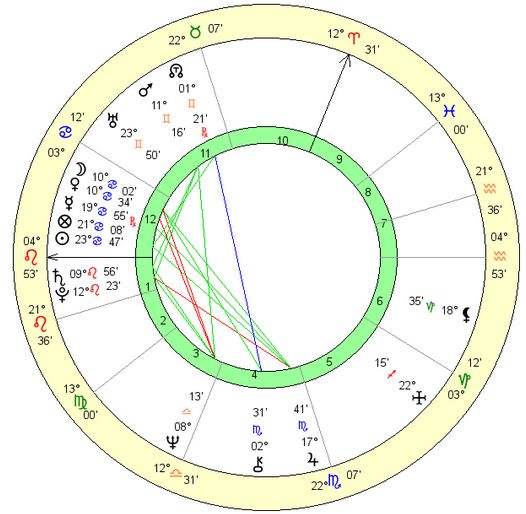
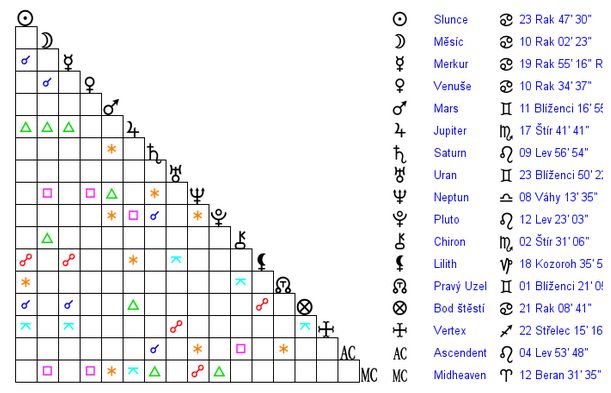
| Planet | Longitude | House | |
| Sun | 23 Can 47' 30" | 12 | |
| Moon | 10 Can 02' 23" | 12 | |
| Mercury | 19 Can 55' 16" R | 12 | |
| Venus | 10 Can 34' 37" | 12 | |
| Mars | 11 Gem 16' 55" | 11 | |
| Jupiter | 17 Sco 41' 41" | 4 | |
| Saturn | 09 Leo 56' 54" | 1 | |
| Uranus | 23 Gem 50' 22" | 11 | |
| Neptune | 08 Lib 13' 35" | 3 | |
| Pluto | 12 Leo 23' 03" | 1 | |
| Chiron | 02 Sco 31' 06" | 4 | |
| Lilith | 18 Cap 35' 51" | 6 | |
| True Node | 01 Gem 21' 05" R | 11 | |
| Part of Fortune | 21 Can 08' 41" | 12 | |
| Vertex | 22 Sag 15' 16" | 5 | |
| House | Longitude | ||
| Ascendant | 04 Leo 53' 48" | ||
| House 2 | 21 Leo 36' 34" | ||
| House 3 | 13 Vir 00' 38" | ||
| House 4 | 12 Lib 31' 35" | ||
| House 5 | 22 Sco 07' 45" | ||
| House 6 | 03 Cap 12' 51" | ||
| House 7 | 04 Aqu 53' 48" | ||
| House 8 | 21 Aqu 36' 34" | ||
| House 9 | 13 Pis 00' 38" | ||
| MC (Midheaven) | 12 Ari 31' 35" | ||
| House 11 | 22 Tau 07' 45" | ||
| House 12 | 03 Can 12' 51" |
| Planet | Aspect | Planet | Orb |
| Sun | Conjunction | Mercury | 3.87 |
| Sun | Trine | Jupiter | 6.10 |
| Sun | Quincunx | Vertex | 1.54 |
| Moon | Conjunction | Venus | 0.54 |
| Moon | Trine | Jupiter | 7.65 |
| Moon | Square | Neptune | 1.81 |
| Moon | Trine | Chiron | 7.52 |
| Moon | Square | Midheaven | 2.49 |
| Mercury | Conjunction | Sun | 3.87 |
| Mercury | Trine | Jupiter | 2.23 |
| Mercury | Opposition | Lilith | 1.32 |
| Mercury | Conjunction | Part of Fortune | 1.22 |
| Mercury | Quincunx | Vertex | 2.33 |
| Venus | Conjunction | Moon | 0.54 |
| Venus | Square | Neptune | 2.35 |
| Venus | Square | Midheaven | 1.95 |
| Mars | Sextile | Saturn | 1.33 |
| Mars | Trine | Neptune | 3.06 |
| Mars | Sextile | Pluto | 1.10 |
| Mars | Sextile | Midheaven | 1.24 |
| Jupiter | Trine | Sun | 6.10 |
| Jupiter | Trine | Moon | 7.65 |
| Jupiter | Trine | Mercury | 2.23 |
| Jupiter | Square | Pluto | 5.31 |
| Jupiter | Sextile | Lilith | 0.90 |
| Jupiter | Quincunx | Midheaven | 5.17 |
| Saturn | Sextile | Mars | 1.33 |
| Saturn | Sextile | Neptune | 1.72 |
| Saturn | Conjunction | Pluto | 2.44 |
| Saturn | Conjunction | Ascendant | 5.05 |
| Saturn | Trine | Midheaven | 2.58 |
| Uranus | Opposition | Vertex | 1.59 |
| Neptune | Square | Moon | 1.81 |
| Neptune | Square | Venus | 2.35 |
| Neptune | Trine | Mars | 3.06 |
| Neptune | Sextile | Saturn | 1.72 |
| Neptune | Sextile | Pluto | 4.16 |
| Neptune | Sextile | Ascendant | 3.33 |
| Neptune | Opposition | Midheaven | 4.30 |
| Pluto | Sextile | Mars | 1.10 |
| Pluto | Square | Jupiter | 5.31 |
| Pluto | Conjunction | Saturn | 2.44 |
| Pluto | Sextile | Neptune | 4.16 |
| Pluto | Trine | Midheaven | 0.14 |
| Chiron | Trine | Moon | 7.52 |
| Chiron | Quincunx | True Node | 1.17 |
| Chiron | Square | Ascendant | 2.38 |
| Lilith | Opposition | Mercury | 1.32 |
| Lilith | Sextile | Jupiter | 0.90 |
| True Node | Quincunx | Chiron | 1.17 |
| Part of Fortune | Conjunction | Mercury | 1.22 |
| Part of Fortune | Quincunx | Vertex | 1.11 |
| Vertex | Quincunx | Sun | 1.54 |
| Vertex | Quincunx | Mercury | 2.33 |
| Vertex | Opposition | Uranus | 1.59 |
| Vertex | Quincunx | Part of Fortune | 1.11 |
| Ascendant | Conjunction | Saturn | 5.05 |
| Ascendant | Sextile | Neptune | 3.33 |
| Ascendant | Square | Chiron | 2.38 |
| Midheaven | Square | Moon | 2.49 |
| Midheaven | Square | Venus | 1.95 |
| Midheaven | Sextile | Mars | 1.24 |
| Midheaven | Quincunx | Jupiter | 5.17 |
| Midheaven | Trine | Saturn | 2.58 |
| Midheaven | Opposition | Neptune | 4.30 |
| Midheaven | Trine | Pluto | 0.14 |
A Perspective on AstrologyAstrology reveals nothing more than tendencies. Man can master his stars if he exerts his will. If one chooses to drift along the current of life, then the tendencies indicated in the natal chart will manifest their effects at certain points in life. One thing that does not appear in a Natal Chart is the individual's will and how it may evolve. The exercise of free will is left entirely to the individual. Astrology forewarns us, allowing us to better navigate life's currents. What a man sows, he must reap. The karmic law works in perfect harmony with the planets. The birth of a soul into a physical vessel occurs at the opportune moment when the karmic law and the planets can operate in unison. Remember that so-called good or ill configurations in a horoscope are not the result of chance or luck, but the harvest of our past deeds—the chart reveals what we have carried over from past lives and what we must master in this one. What we lack in our present life can be attained in the future by undertaking specific spiritual tasks. The stars impel, they do not compel. As Goethe wisely wrote: "From every power that holds the world in chains, man frees himself when self-control he gains." The AscendantThe Ascendant is the gateway of the soul for the fulfillment of its karmic mission. It expresses a person's appearance and personality, revealing how we were perceived by others in childhood, how we assert ourselves within our environment, our baseline of vital energy, our non-specific immunity, our recovery period, the foundation of our psychophysical constitution, temperament, and the blueprint of our destiny. The Ascendant of the personality is: LEO Boastfulness and dramatic inclinations (as well as exaggeration) are the hallmark characteristics of this sign on the Ascendant. The temperament is choleric, the will powerful and instinctive—unlike Gemini, where it is calculated. There is a strong theatricality. Unlike Aries, Leo Ascendant can champion a cause not just for themselves, but for others. While they love to take center stage, they do so with consideration for others, being highly social. Their manner is open, warm-hearted, and loyal. Indeed, this is perhaps the most loyal (after Capricorn) and generous Ascendant in the entire zodiac. Their greatest vulnerability is a susceptibility to flattery—highly exploitable! They are entertaining and love to celebrate. An afflicted Ascendant, however, manifests as extremely despotic, meticulous, and inappropriate in expression when displeased. This is the specific pedantry of an afflicted Leo. Where Virgo might complain, Leo rules with a despotic hand. If we resist, things end poorly, for the Leo majesty feels wounded and reacts disproportionately. This Ascendant primarily bestows broad shoulders—disproportionately broad. The body often possesses an athletic constitution and strong bones (resilience to injury). There is a visible, majestic gait, though not precise; it is rather humanly grand. Admirable in its own way! :-) A key feature is often very light eyebrows. Planets in the SignsPlanets in the signs are a crucial component of horoscope interpretation. The expression of each individual planet in a specific sign has a significant and highly characteristic influence on our lives. Sun in Cancer These individuals are typically highly sensitive, but they tend to conceal their (often rich) emotional lives behind an impenetrable mask. For Cancer especially, analyzing the Moon's position is crucial, as the Moon rules Cancer and determines the degree to which the person will be guarded or open. A Moon in Aries acts with great courage and self-assurance, whereas in Scorpio, it behaves mysteriously and secretively. The Sun in Cancer demands the security of a safe home and family environment; when these elements are present, the individual feels secure and can fully develop their nurturing, maternal instincts. A Sun placed here dislikes risk and prefers to keep its feet firmly on the ground. Cancers who lack a solid family foundation are often cynical, sarcastic, and abrasive, using this mask to hide their insecurities and inner void. Moon in Cancer Such individuals are deeply sensitive, possessing a wealth of inner affection, yet they require and demand much reciprocal love to feel secure and emotionally safe. Interestingly, a person with this Moon placement requires guidance—a stable oversight by another person that allows them to live in peace, relax, and find their spiritual identity. This is a maternal type with a deep appreciation for the security and warmth of home; men with this placement are also nurturing and often form deep bonds with maternally inclined women. If their own mother was intensely maternal, it can lead to difficulties in establishing romantic partnerships due to an emotional fixation on the mother. Mercury in Cancer This placement bestows an excellent memory. Thinking is heavily governed by feelings, moods, and emotions. The person is compassionate and poetic; however, this position of Mercury is not highly suited for objective, scientific inquiry, as it tends to be subjective. Generally, Cancer is not the most advantageous sign for Mercury; judgment can be unreliable and the quality of thought highly variable, yet the individual often possesses superb intuition—a bridge between the conscious and subconscious minds. Arguments may be irrational, yet they carry profound truth. An afflicted Mercury is highly impressionable and tends to conform its opinions to those of its environment. Venus in Cancer Requires and demands, above all, emotional security, stability, and safety. This person is deeply caring and responds compassionately within a relationship, but a typical Cancer trait is the tendency to view the partner as a possession. If a relationship ends, deep scars remain in the soul, and they find it extremely difficult to reconcile with the loss. In social settings, they react rather reservedly. Mars in Gemini Bestows a sharp intellect through which practical problems are solved rationally. However, the person likes to take on multiple tasks simultaneously, and due to a tendency to scatter their energies, results are either delayed or fail to materialize altogether. A characteristic trait of a man with this Mars is his method of courtship—he attempts to win a woman over through ceaseless conversation, subconsciously emphasizing his intelligence, wit, and humor. If the woman's Venus is also in Gemini or another air sign, these efforts are often crowned with success. However, if the woman has Venus in an earth sign, she will likely perceive such a man as a mere chatterbox or even a fool. The mental agility of this Mars is an asset, but its weaker sexual energy and aura present a significant disadvantage, applying to both men and women. Jupiter in Scorpio In water signs, such an individual craves deep emotion, yearning for love and emotional fulfillment. They have a sense of romance but are also prone to excessive self-pity, self-sacrifice, and sentimentality. A person with this Jupiter placement directs their desire to help others primarily through healing. A potential drawback can be sexual licentiousness and wildness. They are usually courageous, strong-willed, and resourceful, with a keen interest in esotericism. Saturn in Leo Saturn in a fire sign primarily blocks energy, ambition, the desire for self-actualization, and significantly lowers self-confidence. Such an individual harbors constant fears of failure and of plans going awry, avoiding all risks and practically always passing up the right opportunities that come their way. In the presence of favorable or strong aspects, however, these fears can become the catalyst for sudden actions requiring strength and concentration. Saturn in Leo blocks creativity by reinforcing conservatism, inhibiting artistic talent, musical ear, etc. It is not particularly favorable for romantic relationships either—it restricts the sense of romance, making the person's aura seem cold to others. Much also depends on the Sun sign—in Capricorn, the fire element will be even more heavily blocked by Saturn, whereas in Leo, it will attempt to break through and assert itself, often at all costs, but without a positive effect on the environment, which may react with rejection. Planets in the Astrological HousesEach house represents a specific area of life. The position of a planet in a house tells us how well an individual fares or struggles in that domain. To calculate the exact placement of planets in the houses, the most precise birth time possible is required. Sun in the 12th House This is likely the most complex position of the Sun to interpret in a personal natal chart. Primarily, this is the vibrational field of Pisces and Neptune; regardless of the sign on the house cusp, the Sun is always influenced by this vibrational frequency. Anyone with the Sun placed here is naturally introspective, sensitive, and requires their own inner sanctuary to process the reality of the external world. They are drawn to esotericism, psychology, and mysticism. They are usually highly intuitive, and the degree to which they consciously recognize and practically utilize this intuition depends entirely on the sign and aspects of the Sun. Individuals with this Sun placement generally possess a vivid imagination, retreating into its realm to find peace and harmony. They love fairy tales and ancient legends. The twelfth house is the house of institutions—schools, hospitals, and others—and especially with children who have this placement, it is crucial to respond sensitively to school issues; if not addressed in time, school could easily be "substituted" for a hospital. The greatest challenge of the twelfth house always lies in any negative aspect of the planets residing within it, as well as the planet ruling the cusp of the house. If the Sun is afflicted, there is always a risk of seeking escape from reality in ways detrimental to health, namely through psychotropic substances or alcohol! If the Sun in the twelfth house is afflicted in any way, it is vital to understand how the individual has mastered the principles of the tenth and eleventh houses—namely, the acceptance of societal laws and rules, followed by liberation from these rules while still respecting them, knowing they are not universally absolute. If this principle is not mastered, serious issues, particularly in the psychological realm, are highly likely. The Sun in the twelfth house always induces what we might call spiritual zealotry; people may pose as false gurus, plunge into every spiritual method that catches their eye, or join various sects. This is most pronounced with an afflicted Pisces or Neptune in the twelfth house. For example, a square from the Sun in Pisces in the twelfth house to Neptune and Uranus in the tenth house will almost certainly produce a highly troubled individual who will fiercely battle all existing rules while intensely seeking escape from the harshness of this world, only to end up misunderstood, on drugs, and living as a vagrant. This is a stark comparison, but with these aspects, such an outcome is entirely possible. Another principle that can manifest when the Sun is afflicted in the twelfth house is "perpetrating good" (compulsive altruism). Such a person has an obsessive need to help, but lacks the necessary capacity to do so, subconsciously attempting to make others dependent on them. In this way, they can energetically drain others, and from the standpoint of karmic burden, the backlash on their psychological and physical health is immense. Secondarily, a craving for help from others arises, which naturally goes unfulfilled or proves ineffective, closing the vicious circle. A harmonious Sun always offers excellent prospects for ultimate enlightenment and redemption, though this naturally presupposes mastery of the tenth and eleventh house principles. The soul has an open mystical path and, through appropriate practices, can achieve the expansion of consciousness to higher, cosmic energies whose influence is otherwise unfelt in mundane life. If successful, their consciousness begins to open to these higher energies, resulting in various mystical abilities and more. This process, however, is purely individual. Through the sign in which the Sun resides, one can discern which path would be suitable, but the final choice remains the free will of the individual embarking on their own spiritual journey. Perhaps the most famous book beautifully describing a young, initially confused seeker's path to enlightenment is the ancient Tibetan spiritual classic "Milarepa" (highly recommended in the translation by the Tomášes). The aforementioned principle of the tenth, eleventh, and twelfth houses permeates the entire story, and though we live in a vastly different cultural and spiritual environment, this book will undoubtedly reveal much to us. Moon in the 12th House To properly assess the influence of this Moon, we must understand how well the principles of the tenth and eleventh houses have been integrated. There are two entirely divergent paths: if these principles have been integrated, the Moon will significantly aid the process of ultimate liberation, mystical realization, and redemption. However, if the principles of these two houses remain unintegrated and the Moon is additionally in a difficult placement (e.g., in Pisces and simultaneously afflicted by Neptune), the person will yearn from the depths of their soul for mystical abilities without having a natural path open to them, potentially resorting to psychotropic or addictive substances. This is, of course, the worst possible path, entirely disintegrative to the structure of the being, and only a highly robust personality with an iron will can comprehend its destructive nature and abandon it. A well-placed Moon helps open consciousness to higher energies and information, leading to mystical initiation. Such a person gains cosmic abilities and can channel the high vibrations of spiritual spheres into daily life. This manifests as clairvoyance, clairaudience, and clairsentience. All these processes occur in the proper order and at a safe pace so as not to damage the psyche. If the Moon in the twelfth house is afflicted, however, this may not be the case, depending heavily on the integration of the previous houses. An afflicted twelfth house causes alienation from society, escapism (drugs), life on the fringes, and an obsessive need to help others. With negative aspects to the Moon, this need is particularly strong, leading the individual to literally "inflict good," thereby damaging their karma by making others dependent on their assistance and obligating them to return the favor. This mechanism is subconscious and therefore extremely difficult to unravel. The person strives to help while completely lacking a realistic basis for doing so. If such a person also holds a corresponding social status, they are often a skilled embezzler or fraudster seeking to financially secure activities they have no legal right to. Generally, people with the Moon in the twelfth house appear shy and sentimental; they dislike exposing their inner selves, putting their compassion and imagination at the service of the common good while preferring to remain quietly in the background. In a harmonious placement, they can be great benefactors, especially if supported by other favorable aspects (Jupiter, Sun, etc.). Mercury in the 12th House This position of Mercury endows a person primarily with a sober outlook and a certain degree of reserve. They are interested in psychology, mysticism, and the occult, and can analyze and discern well within these fields. They may also make excellent proponents of these methods, although this Mercury tends to be quite introspective, with the individual preferring to apply their insights to themselves first. A key rule applies to Mercury in the twelfth house: the person must learn to always link their thoughts and opinions with building self-confidence, as this placement tends to weaken self-assurance. The twelfth house is also responsible for intuition, which Mercury inherently blocks by being overly analytical, robbing the individual of spontaneity and trust in their own feelings through which the subconscious tries to communicate. Because Mercury is active and analytical, it hinders and blocks twelfth-house principles in general. It can generate tension and anxiety, making it difficult for the person to relax, unwind, and meditate (also depending on the planet's aspects). Venus in the 12th House A Venus placed here is rather problematic for the individual, even with harmonious aspects, as shyness and reservation are inherent to their nature. They have few friends and struggle to process their emotions. Establishing relationships is far from easy, because any planet in the twelfth house tends to push its respective energy forward; with Venus, this manifests as an intense drive to form a relationship, and when this fails, it leads to even greater effort, resulting in a loop. The only way out of this pattern is absolute surrender and non-expectation. Any deliberate activity in the twelfth house blocks and delays, and Venus is no exception, even under harmonious aspects. Of course, one can imagine how difficult it is to let go and expect nothing when trying to build a relationship with someone you love and believe is "the one." People with this Venus may also tend to help their partner at all costs; this need can become compulsive, but its main subconscious goal is to bind the other person and secure their affection and love. Naturally, this cannot work. If the aspects of Venus are harmonious, there is a much greater chance that the individual will manage their relationships successfully. The partner of such a person must possess immense patience and be prepared to handle reactions that may not always be easy to manage or understand. These individuals usually form bonds with those with whom they feel a spiritual kinship and a hope that they might help them navigate the complex principles of the twelfth house. The foundation of their self-confidence will lie in successfully navigating relationship-building, processing and mastering their own emotions, and learning the principle of acceptance without judgment, which in many cases is exceptionally difficult. Mars in the 11th House This aspect manifests as the individual surrounding themselves with a large number of acquaintances rather than true friends—essentially people of little significance to them. The contacts of a person with this Mars tend to be superficial. Their behavior and expressions are often abrupt and unfriendly, thereby creating aversion in others. The eleventh house tears down established conventions and rules, and Mars amplifies this principle, breaking old Saturnian norms, shattering taboos, and destroying stagnant principles and anything obsolete. However, they do not respect the old, dying structures and thus often find themselves in conflict with the law. This principle is particularly pronounced in the case of challenging aspects. Mars in the eleventh house usually grants powerful and influential protectors (patronage). This person is a pioneer through and through. Their thinking is ahead of its time, though often rejected by their peers. A retrograde Mars points to the exploitation or abuse of friends in past lives—a troublesome pattern that manifests as meeting friends from past incarnations who now hold up a mirror, allowing the individual to understand and resolve their past actions. Jupiter in the 4th House With this configuration, the individual has a strong yearning for a grand or luxurious home. They typically enjoy a happy childhood from an early age, and since this Jupiter resides in a cardinal house, it favorably influences the entire natal chart. These individuals usually enjoy material abundance within the family and are well-provided for. They prefer high-quality things, love creating a beautiful home, and their later years are typically beautiful and content. Jupiter rules the vibrational field of Sagittarius and thus the ninth house; in the fourth house, it sometimes manifests as the individual changing their place of residence or going to live abroad. Being proud of their family or having an expansive family legacy is of immense importance to them. Sometimes they have ancestors from foreign cultures, particularly on the paternal side. A strong and unafflicted Jupiter indicates well-known and popular personalities. These individuals also tend to make successful real estate brokers, builders, industrialists, or mining magnates. Challenging aspects cause these individuals to be successful and wealthy, yet boastful, leading to envy and a lack of popularity. A retrograde Jupiter indicates domineering behavior and tyranny in managing the household in a past life, bringing difficulties and challenges through which the person can better recognize and correct past mistakes. Saturn in the 1st House This is one of the more problematic positions of Saturn in the chart, as the first house is responsible for vital energy levels, non-specific immunity, resistance to disease, the capacity for physical regeneration, and self-assertion. Saturn must always be integrated first, and the first house is no exception; thus, this planet will block and hinder all of these matters here, and every human "transgression" will be "punished" by a restriction of vital energy, almost always leading to illness or physical body issues in general. When assessing the physical vulnerability of a specific area, we must always consider three factors: the sign in which Saturn resides, the house whose cusp is in Capricorn, and any planets located in the sign of Capricorn. In principle, the organ ruled by the sign where Saturn lies is weakened, as is the organ ruled by any afflicted planets in Capricorn, while the root cause of the illness lies in the area of life represented by the astrological house whose cusp is in Capricorn. Example: Saturn is in the first house in Virgo, the cusp of the fifth house is in Capricorn (where we also find an unaspected retrograde Mercury), and the Sun and Mars are in square to Pluto in the second house. This individual will be afflicted with a weakened digestive system (intestines, digestion) and motor nerve issues (Mercury) as a consequence of improper conduct in the areas of sexuality, creativity, and children. This configuration points to someone who manipulates their partner through their sexuality (Pluto) or misuses their direct sexual energy, avoiding the opportunity to bring a child into the world (fifth house), etc. Through manipulation of the partner, they seek to expand their own inner space (Pluto in the second house) and exert greater power in the relationship. This behavior logically manifests as a health issue (Mercury—motor nerves). As a general rule, with Saturn in the first house—and especially on the Ascendant—we must also assess the position of Pluto. If Pluto is afflicted in any way, the risk of health issues is substantially higher. It is always necessary to carefully uncover the underlying principle that led to the illness; recognizing it can initiate the healing process. However, the individual is often entirely unable to admit Pluto's influence, making the treatment of illnesses and problems somewhat more complex. One must use appropriate hermetic remedies to gradually shift their thinking and approach to life. Crucially, in terms of causality, the individual must never be told where they are heading; they must determine their own future path through their own contemplation. Only then can they fully integrate Saturnian energies. The first house is responsible for self-assertion. The primary trauma thus arises in the realm of self-assertion, manifesting as the individual being able to assert themselves only through those behavioral patterns that conform to the generally accepted, appropriate norms of society. Should they attempt to assert themselves in their own unique way (as indicated by the Sun), it would inevitably lead to issues with self-confidence, guilt, remorse, and the like. If, with Saturn in the first house, the Sun is in a fire triplicity (Aries, Leo, Sagittarius), it almost always leads to aggression and self-destructive behavior, as these individuals possess vast energy that is blocked by Saturn, causing it to build up, with its release being highly difficult to achieve. As stated above, Saturnian energies must first be integrated before their influence can manifest on a positive plane. People with Saturn in the first house tend to let themselves be limited and directed by others, easily falling under the influence of authority. Lacking this guidance, they can slip into a lack of principles or disorder. They generally lack great self-confidence. If Saturn is poorly aspected, such a person can let themselves be overwhelmed by obstacles and fail to move forward. If this planet is harmonious or otherwise strong, the being systematically focuses on the problem and usually resolves it successfully through diligent work. However, they must always strive for self-discipline to progress in their evolution. Uranus in the 11th House This position of Uranus is probably the most advantageous because, in terms of the previously mentioned principle of understanding and accepting the rules of society, and subsequently recognizing in the eleventh house their limited, non-universal validity, they are transcended without leading to anarchy. This Uranus is in "its own house." Its blocking capacity in an unintegrated state allows the individual to submit to the energy of Saturn, thereby accepting and integrating social rules and order, so that once the Uranian energy is integrated, they can comprehend that these rules are not universally absolute. This realization, however, does not result in anarchy or rebellion against society if the process unfolds correctly. The individual is able to emancipate themselves and break taboos without violating laws and rules in a socially unacceptable manner. If Uranus is afflicted, however, they may become anarchists or revolutionaries who struggle to integrate into society, often requiring forms of societal repression. Individuals with Uranus in the eleventh house usually set long-term, unusual goals, move in unconventional circles, or organize groups sharing a predominantly ideological interest. Their circle of acquaintances is vast but changes frequently. An integrated Uranus in the eleventh house provides excellent prospects for science, inventions, and discoveries, especially when linked to Mercury, the Sun, or the Moon. Neptune in the 3rd House Bestows poetic abilities and allows the individual to work creatively with imagination and ideas. These people usually make excellent journalists and teachers, but their way of expressing themselves and communicating is not always entirely clear and unambiguous. Sometimes, however, they can concentrate on their rich mental imagery and convey even highly specific matters (the connection of Neptune and the vibrational field of Mercury—the third house). Their communication style is atypical, often intuitive (e.g., telepathy, and in connection with Mars, telekinesis). If Neptune is afflicted in any way, even slightly, speech difficulties such as stuttering, dyslexia, and a unique memory impairment can occur, where the person is unable to precisely define a concept. People with Neptune in the third house often have indistinct, "blurred," and hard-to-read handwriting. Similarly, their gestures are vague and unreadable. In the case of an afflicted Neptune and unintegrated energies, issues with siblings often arise, medically described as being of "obscure etiology." Generally, these individuals may take short voyages by sea. Based on the Neptunian principle, they may strive for higher and higher education without reaching their academic goals, which results in suffering. The problems caused by this Neptune can be resolved using the hermetic remedies of the Gemini vibrational field, as well as the sign in which Neptune resides. Pluto in the 1st House Direct self-assertion and first-house principles in general are blocked. The individual asserts themselves through coercion, psychological pressure, and mental power, and depending on the nature of the aspects, utilizes occult, magical forces and highly effective manipulations on their environment; the method of manipulation is determined by the energetic quality of the sign Pluto occupies. This configuration is generally favorable for black magic and astral techniques, and its greatest danger lies in the fact that most people are completely unaware of these abilities, using them unconsciously, which can make the consequences even worse. The root of their fixations lies in self-assertion and the development of their physical body. These individuals are often overly fixated on their own growth and self-assertion. Spiritually less-developed individuals may tend to use these abilities to elevate themselves above others once they realize they are somewhat exceptional. They try to assert themselves at all costs, and everything they do for their physical development is done with immense dedication, often to the detriment of other areas of life. Pluto in the first house, or in conjunction with the Ascendant, bestows highly effective powers of observation. Under favorable aspects, they can make outstanding criminologists or brilliant diplomats, but with challenging aspects, they often engage in espionage, sometimes for multiple intelligence agencies simultaneously, almost always resulting in exposure and scandal. These individuals can always pinpoint another's weakest spot with great precision and exploit it to their advantage. From a health perspective, this Pluto can cause physical spasms and often poses a pre-cancerous threat. Growth caused by these aspects is always malignant. When asserting themselves through magical means, they may resort to psychotropic substances, but unlike under Neptune's influence, they usually remain in full control of these experiments and know exactly what they wish to achieve—though these endeavors are logically far from safe. A harmonious Pluto in the first house is also found in successful natural scientists. A typical quality of such a person is the ability to see things through to the end and a drive to dissect every problem down to its core. These are excellent dispositions for mathematics and nuclear physics. The physical constitution of a person with this Pluto tends to be ectomorphic and sinewy, yet possessing superb regenerative capabilities, allowing them to restore both energy and health quickly. Conversely, when magical abilities are abused, the individual either falls ill very rapidly or begins to gain weight noticeably, with health issues arising alongside changes in body mass. In both cases, these symptoms are exceptionally difficult to treat. Aspects of the PlanetsAn aspect is the position of one planet relative to another. Based on the angle they form, we can determine how these planets interact, dividing aspects into three groups: harmonious, challenging, and conjunctions. How each aspect manifests in a person's life is explained below. Sun conjunct Mercury People with this aspect are subjective and creative, able to express their opinions, and often express themselves artistically. This is an excellent aspect for performing artists, but it limits logical thinking and attention to detail. Thinking is intensely subjective. If the Moon is waxing, this subjectivity increases, whereas a waning Moon brings greater objectivity to the thought processes. Arrogance and bias are also linked to this aspect. In any case, this is an intellectual being. However, we must always evaluate the type of conjunction. An exact cazimi is highly rare and endows the individual with truly exceptional qualities, whereas "combust" often makes a person arrogant and tactless (the nature of the resulting expression always depends heavily on the specific sign). Sun Harmonious Jupiter Creates a self-confident and optimistic personality. The "owner" of such a chart loves to travel and craves adventure. They also enjoy study and eagerly seek new experiences. Moon conjunct Venus A person with a Moon-Venus conjunction possesses a natural charm that often opens doors that would otherwise require experience and practice to enter. They love luxury and the finer things in life. They are diplomatic, devoting their abilities to fostering harmonious relationships in their environment. Moon Harmonious Jupiter The individual is exceptionally open, optimistic, and generous. Thanks to these qualities, they are often successful, radiating their positive aura onto others. They are an idealist who loves a comfortable home. They are also successful in legal matters and academic studies. Moon in Challenging Aspect to Neptune Brings a need to seek something beyond the self, which often leads to an inclination toward esoteric paths and religions. The person is highly self-sacrificing and is often taken advantage of in this regard. They are drawn to exotic art, but are rarely tidy at home. A union of receptivity and sensitivity, the ability to perceive the world of higher vibrations, and artistic inspiration. It is also a fundamental configuration for mental illness (schizophrenia, psychotic disorders). Schizophrenia is a state of split consciousness; it is essentially a natural state that is not a disease, but rather a reaction of the individual's social environment to existing reality, and the subsequent reaction of the individual to that reaction of the environment. (The person themselves usually does not understand the schizophrenia). Schizophrenia is practically a necessary state for spiritual evolution. Once the individual realizes they perceive multiple poles, clinical symptoms disappear because the being understands their state. Somnambulism, alcoholism, drug addiction, total chaos—one cannot rely on one's own emotions. A pathological need to display one's feelings (akin to hysteria). There is a tendency toward ambiguity, confusion, and unrealistic desires. The person loves art and fashion. Mercury Harmonious Jupiter Harmonious aspects bestow life optimism, philosophical talent, kindness, and openness. However, the person gladly pursues their intellectual interests despite potential material consequences. They love to travel and cannot stay in one place for long. Venus in Challenging Aspect to Neptune Causes deep romantic yearnings that complicate the individual's life and place them in intricate situations. The figments of their own imagination are often preferred over reality. Esoteric activities sometimes overshadow real life, significantly draining the energy needed for relationships. The person should maintain a cooler head or develop a "thick skin." They also tend to be very comfort-loving. For instance, if Venus is in Taurus in the second house, it manifests as a pathological desire for possessions. Note the general rule—if there is only a single strong aspect in fixed signs (from and to fixed signs) in a chart, it always exerts the most powerful, highly fateful influence and serves as a benchmark for evaluating other aspects. If Neptune is in a fixed sign and in square to Venus, also in a fixed sign, this usually indicates a pathological manipulation of matter, which is difficult to resolve, especially when located in cardinal houses. A morbid dependence on sensory stimuli, an enormous need for sensory input (the need for long embraces, etc.). With a diurnal Venus in Libra, it causes an obsessive desire for aesthetic perfection. Mars Harmonious Saturn Harmonious aspects are unique in that they greatly limit the individual's imagination, which is generally considered suitable for dangerous occupations. However, the question remains to what extent constructive imagination might aid a person in a critical situation. People with these aspects can work tirelessly; they are cautious, thorough, enterprising, and do not suffer from the fear of lack. Mars Harmonious Neptune Manifests by granting the individual vast imagination, creativity, artistic talent, and idealism. However, a person with these aspects is highly impractical. The classic image of this aspect is an artist known to the entire cultural world, yet completely "unusable" in private life. The union of action and ideals is harmonious; high inner spirituality, ideal for gurus. Mars Harmonious Pluto Generally, Mars is the higher octave of Pluto, and Pluto the higher octave of Mars. Here, mutual reinforcement of physical and psychological power, occult abilities, etc., occurs. These aspects increase Mars's power, making the person industrious and extremely thorough in all endeavors. However, they are also stubborn, and once they set a goal, they are not easily deterred. Harmonious aspects are typical of military commanders, providing talent for genius strategic operations. These individuals aim to control both others and themselves. It is the only aspect that drives a person to the ultimate realization of their goals despite all possible obstacles. Jupiter in Challenging Aspect to Pluto Challenging aspects primarily cause stubbornness and combativeness. The individual craves self-discovery and loves to travel; they hold revolutionary views and are often involved in the religious sphere. Challenging aspects cause fundamental discrepancies between the inner and outer self, and these individuals suffer from inner turmoil. In the best-case scenario, they assert themselves by fighting against Plutonian mysteries; in the worst, they destroy the rules of society. (If there is a harmonious aspect between Jupiter and Pluto in a nation's chart, a highly developed legal system exists, where state power and the legal system are balanced with law enforcement. However, if the aspects are challenging, fundamental contradictions exist between legal instruments and law enforcement! The transit of Pluto over natal Jupiter in the national chart of France triggered the revolution). Saturn Harmonious Neptune The individual finds the foundation for their practical endeavors in dreams and fantasies. Their views, however, are often conservative. A harmonious and additionally angular connection—the person systematically advances in their spiritual growth. Saturn conjunct Pluto (These are always problematic aspects) bringing the individual powerful self-control, ambition, perseverance, and a deep desire for change, transformation, and personal evolution. This aspect is excellent, especially for Scorpios. People with this aspect delight in high-level thinking, penetration, and intense self-reflection. From a psychoanalytic perspective, however, it represents an absence of one's own opinion!!! (Especially if this aspect is located in cardinal houses). Saturn conjunct Ascendant Tends to be serious with a responsible approach. Work and duties are more important to them than entertainment. It can be hard for them to relax, as there is always something that needs to be done. Periodic states of depression, anxiety, fear, and self-doubt may occur. Their response to these negative states is to work harder and longer. They should also learn to enjoy themselves, regularly setting aside time for pleasant activities, as life with nothing but work and no play is hard to bear. Neptune Harmonious Pluto Harmonious aspects last a very long time; both planets were in sextile from 1945 to 1995. It can be inferred that they promote a peaceful mindset and, in connection with other aspects, strengthen further peacekeeping and transformative actions on a global scale. Neptune Harmonious Ascendant Is empathetic and compassionate. It is highly likely they developed strong intuitive and psychic abilities in a past life, and these abilities may rise to the fore in this lifetime. They are highly creative and also sensitive to the needs of others. ConclusionThis natal chart was calculated under the assumption that the input data—such as time, place of birth, and correct time zone, including any daylight saving time adjustments—are accurate. Even a one-hour discrepancy in birth time will result in inaccurate house placements for the planets or an incorrect Ascendant. By no means is this astrological analysis complete. It is evident that every human being is a far more complex entity than can be captured on this page. To generate your own Natal Chart online, completely free of charge, please proceed to Free Natal Chart Source Zbyněk Slába www.oranzovestranky.cz |
